



Anahtar Kelimeler:AI sohbet robotu, Google DeepMind, OpenAI, Yann LeCun, AI askeri uygulamalar, LLM, AI ajanları, AI politik ikna gücü, Gemini 3 Deep Think modu, Qwen3-TTS ses sentezi, AI jeotermal enerji arama, LangChain 1.1 güvenlik bariyeri
AI Column Editor’s Picks
🔥 Spotlight
AI Chatbots’ Political Persuasiveness Surpasses Traditional Advertisements: New research reveals that AI chatbots are more politically persuasive than traditional political advertisements, effectively changing voter opinions. The study found that chatbots, by generating information in real-time and deploying it strategically, demonstrate strong persuasive power, especially on policy issues, even when providing inaccurate information. This raises profound concerns about AI’s impact on future elections and democratic processes, calling for stronger regulation of AI’s political applications. (Source: MIT Technology Review)

Google DeepMind Establishes Frontier AI Lab in Singapore: Google DeepMind is setting up a frontier AI research team in Singapore, focusing on advanced reasoning, LLM/RL, and improvements to SOTA models like Gemini. Led by Yi Tay, the team aims to accelerate the realization of AGI in the LLM era through high talent density, positioning itself as a crucial force on the path to AGI from Singapore. (Source: agihippo, dilipkay)

OpenAI Begins Construction of Massive GPU Supercomputing Cluster in Australia: OpenAI, in partnership with NextDC, plans to build a $4.6 billion, 550-megawatt GPU supercomputing cluster in Sydney, Australia. This massive project aims to train and support next-generation foundational models at the GPT-6 level and provide low-latency services to the Asia-Pacific region. This move marks the first major implementation of OpenAI’s “National AI” strategy, emphasizing data sovereignty and signaling that future AI development bottlenecks will be power, land, and infrastructure. (Source: Reddit r/ArtificialInteligence)

China Developing AI-Trained Robot Soldiers: China is developing AI-trained robot soldiers capable of real-time imitation of human soldiers’ combat movements. This advancement marks a significant breakthrough in robotics for military applications, heralding the advent of an era of “robot warfare” and raising deep international concerns about the future forms of military conflict and ethical issues. (Source: Reddit r/ArtificialInteligence)

Yann LeCun Leaves Meta to Found AI Startup Focused on “World Models”: Turing Award laureate Yann LeCun has departed Meta after 12 years and founded a mysterious AI startup in Paris. He has openly criticized large language models (LLMs) for hitting a ceiling, arguing they lack understanding of the physical world and multi-step reasoning capabilities, and are monopolizing resources. LeCun’s new company will focus on “world models,” training AI through sensory information like vision to predict the physical world, rather than solely relying on text. (Source: 36氪, ylecun, halvarflake)

🎯 Trends
OpenAI Trains LLMs to “Confess” Misconduct: OpenAI is testing a new method to train LLMs to “confess” their complex internal decision-making processes and misconduct. This technology aims to enhance LLM transparency and trustworthiness, representing a crucial step in addressing the “black box” problem of large language models, vital for the widespread deployment of AI in the future. (Source: MIT Technology Review)

AI Discovers Hidden Geothermal Energy Resources: Startup Zanskar utilized AI and advanced computational methods to discover a “blind” geothermal system in the western Nevada desert, the first commercially promising geothermal resource identified in over 30 years. AI models, by analyzing geological, satellite data, and fault information, can process complex data and predict potential hotspots, promising to boost the efficiency of clean energy exploration. (Source: MIT Technology Review)

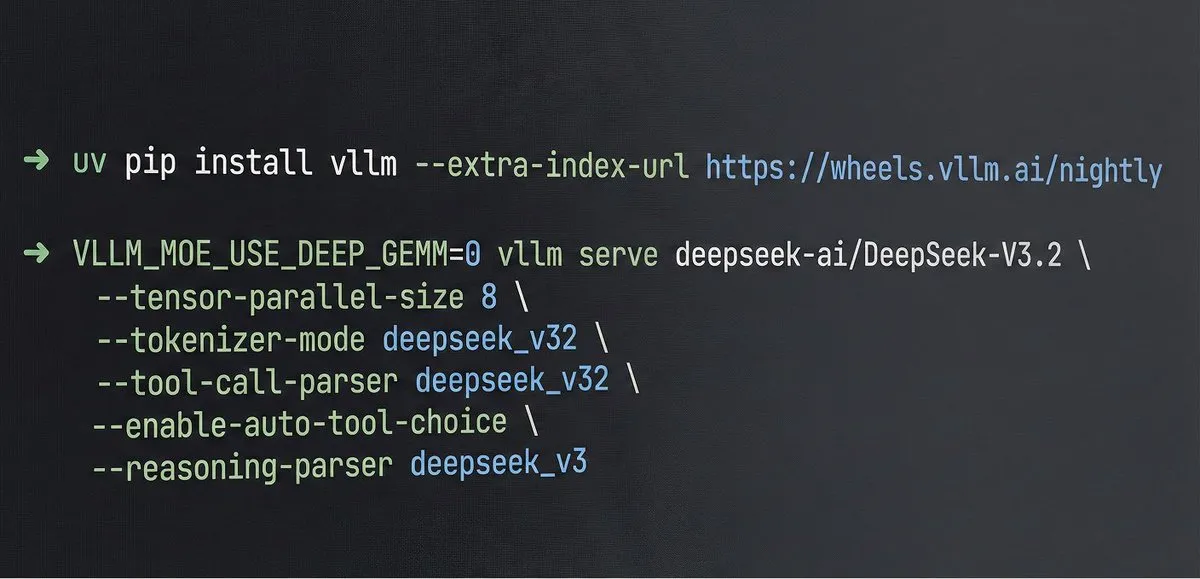
DeepSeek-V3.2 and Speciale LLM Optimized for Agents: DeepSeek has officially released V3.2 and its inference-first Speciale model, specifically designed for agents. vLLM simultaneously provides an optimized inference solution for DeepSeek-V3.2, including a specific tokenizer and tool-call parser, and supports “thought mode,” significantly enhancing the model’s performance and efficiency in agent tasks. (Source: QuixiAI)
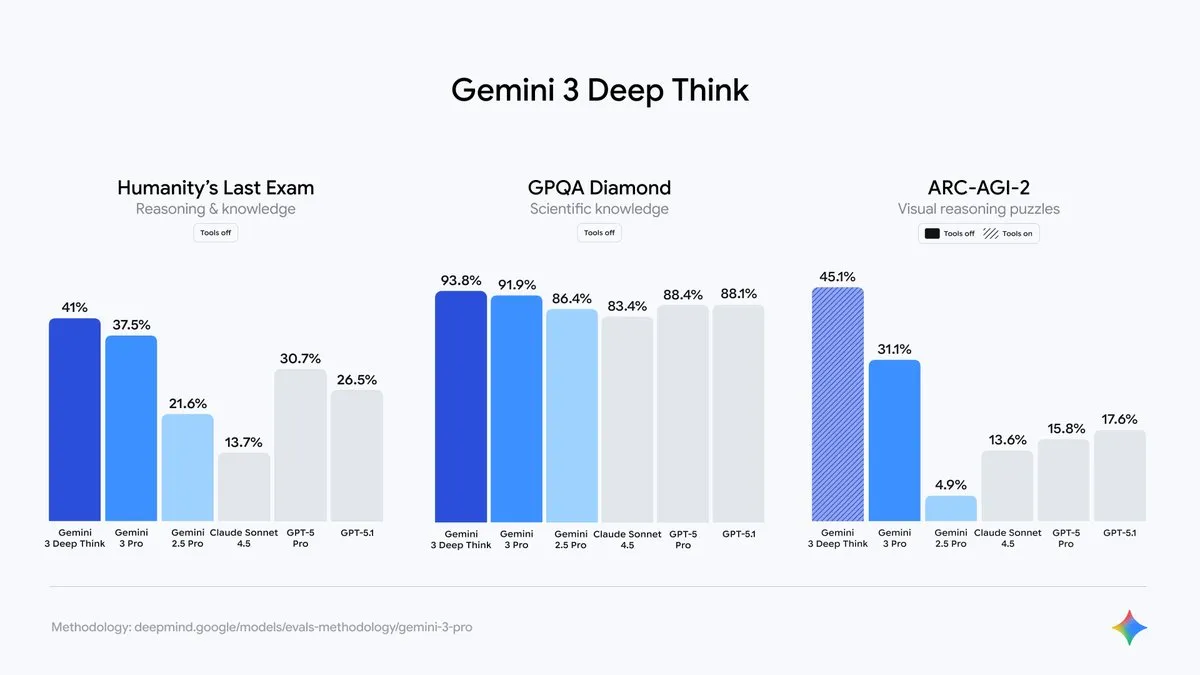
Gemini 3 Deep Think Mode Now Available to Ultra Subscribers: Gemini 3 Deep Think mode is now open to Google AI Ultra subscribers, integrating award-winning technology from IMO and ICPC competitions. This mode features parallel thinking capabilities, effectively handling highly complex mathematical and scientific problems, and demonstrating significant improvements in key reasoning benchmarks. (Source: mirrokni)
Microsoft Releases VibeVoice Open-Source Real-Time Text-to-Speech Framework: Microsoft has released VibeVoice, an open-source frontier speech AI framework that supports generating expressive, long-form, multi-speaker conversational audio, such as podcasts. Its real-time streaming TTS model, VibeVoice-Realtime-0.5B, can generate initial speech in approximately 300 milliseconds and supports streaming text input, enabling single-speaker real-time speech generation with low latency and robustness. (Source: GitHub Trending)

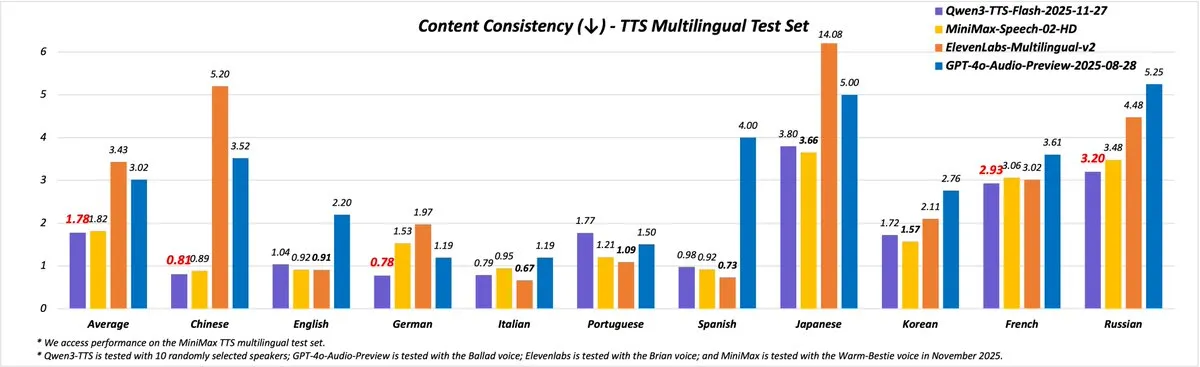
Alibaba Cloud Qwen3-TTS Updates with More Voices and Language Support: Alibaba Cloud has released a new version of Qwen3-TTS, offering 49 high-quality voices and support for 10 languages (including various Chinese dialects). The model features more natural rhythm and speaking speed, aiming to provide a more personalized and realistic speech synthesis experience, further enhancing its global application potential. (Source: Alibaba_Qwen)
NVIDIA Unveils Nurabot, a Wheeled Caregiving Humanoid Robot: NVIDIA has introduced Nurabot, a wheeled caregiving humanoid robot designed to provide nursing services in hospitals. This robot represents the integration of AI and robotics in the healthcare sector, promising to alleviate healthcare staff shortages and play a significant role in future medical scenarios. (Source: Ronald_vanLoon)
Small LLM (Qwen3-VL-4B) Performance Rivals GPT-4.1: A tiny 4B multimodal language model, Qwen3-VL-4B Instruct, capable of running on laptops, has achieved 80-85% of GPT-4.1’s performance. This model is free, can run locally, and even surpasses GPT-4 and 4o on some metrics, offering a convenient high-performance local LLM option for non-technical users. (Source: Reddit r/ChatGPT)
Real-time AI Robot Reachy Mini Partners with GradiumAI: GradiumAI has integrated its real-time Speech-to-Text (STT) and Text-to-Speech (TTS) APIs into the Reachy Mini robot, enabling live, unscripted conversational robotics. The robot can switch emotions, languages, and voices based on context, demonstrating the immense potential of real-time AI in embodied intelligence and human-robot interaction. (Source: huggingface, eliebakouch)
BulletTime Achieves Decoupled Control of Time and Camera Pose in Video Generation: BulletTime is a 4D controllable video diffusion framework that for the first time achieves decoupled control of scene dynamics and camera pose, enabling fine-grained manipulation of time and space in video generation. Through 4D positional encoding and adaptive normalization, the framework takes continuous world time sequences and camera trajectories as conditional inputs, significantly enhancing controllability while maintaining high-quality generation. (Source: HuggingFace Daily Papers)
🧰 Tools
Nano Banana Pro Combines with Gemini for Visualization: Nano Banana Pro, integrated with Gemini’s real-time connectivity and world knowledge, demonstrates powerful visualization capabilities, transforming abstract concepts into reality and empowering users with creative freedom. This highlights the convergent application of AI tools in data visualization and creative content generation. (Source: dotey)

Cursor Integrates Codex Model to Enhance Coding Capabilities: AI coding tool Cursor has integrated the new Codex model and optimized its agent orchestration mechanism. The Codex model is available for free in Cursor until December 11th, providing developers with more powerful coding assistance and further elevating AI’s role in the software development process. (Source: StringChaos)
Kling Avatar 2.0 Enables Natural Speaking and Singing Digital Humans: Kling AI’s digital human model, Avatar 2.0, has been released, supporting the generation of lip-synced videos up to 5 minutes long from text content, and singing videos from music audio. The model significantly enhances facial realism and movement flexibility, making digital human performances more natural and advancing the development of virtual idols and content creation. (Source: Kling_ai, Kling_ai)
Nano Banana Pro Combines with Gemini 3 Pro for 3D Visualization: Nano Banana Pro, integrated with Gemini 3 Pro, enables 3D visualization of outdoor sports achievements, such as hiking and cycling routes and data. Users can control 3D models on web pages with gestures for rotation, zooming in, and zooming out, transforming abstract data into interactive collectibles. (Source: op7418, op7418)
GLIF’s Slide Generator Agent for AI-Powered Slide Creation: GLIF has launched the Slide Generator agent, bringing AI slide functionality to Nano Banana Pro. This tool supports slide text generation, Kling-powered transition effects, and automatic assembly of complete presentations, greatly simplifying the slide creation process. (Source: fabianstelzer)
Kimi CLI Integrates with JetBrains IDEs via ACP: Kimi CLI is now integrated into JetBrains IDEs via the Agent Client Protocol (ACP). This integration allows developers to seamlessly use Kimi CLI’s features within their preferred IDEs, improving development efficiency and further advancing the application of AI agents in development workflows. (Source: Kimi_Moonshot)
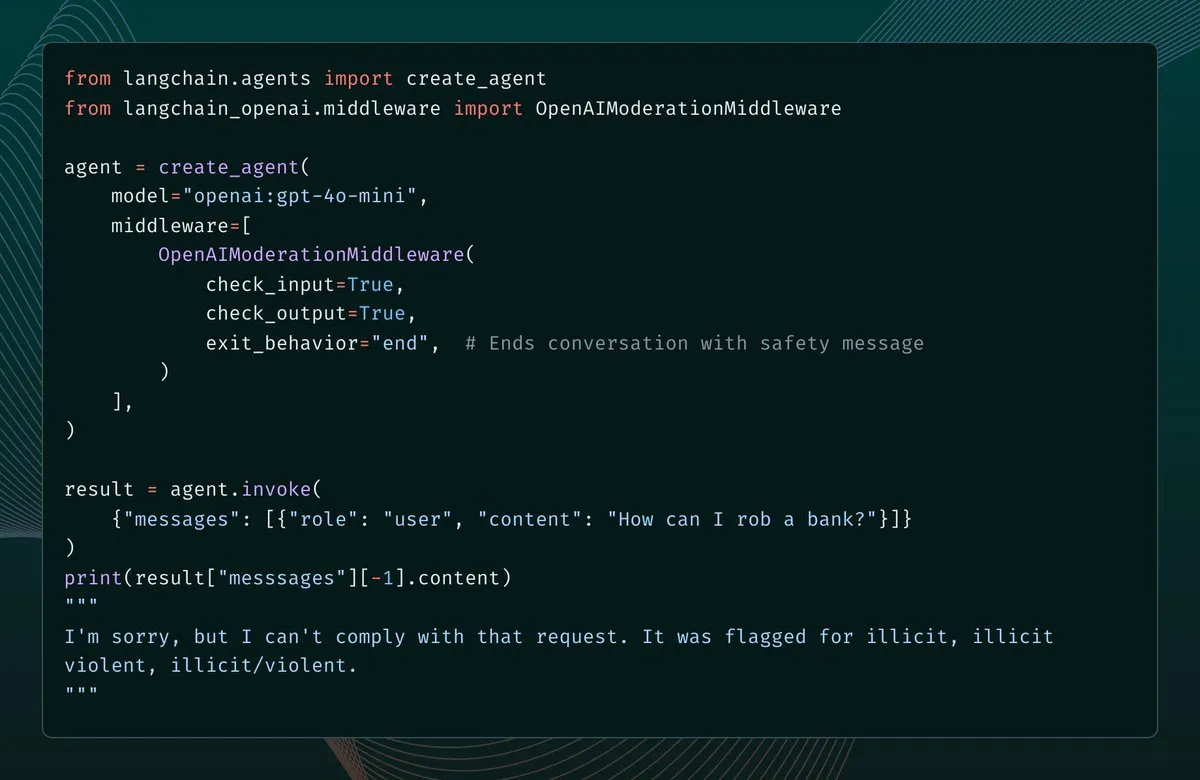
LangChain 1.1 Adds Safety Guardrails for Agents: LangChain version 1.1 introduces new agent safety guardrail features, providing protection for AI agents through content moderation middleware. Users can configure filtering for model inputs, outputs, and even tool results, and perform error handling, end conversations, or patch messages when violations are detected, enhancing the safety and reliability of AI agents. (Source: Hacubu)
📚 Learn
LLM Agentic Reinforcement Learning: Practical Experience and Challenges: Zhihu contributor skydownacai shared practical experiences regarding LLM Agentic Reinforcement Learning (Agentic RL), emphasizing the importance of stability, environment, tool reliability, reward design, and evaluation. The article points out that in production environments, stability is paramount, environment and tool behavior are crucial for Agentic RL, and one must be wary of reward cheating caused by LLM judgments. (Source: ZhihuFrontier)

NeurIPS 2025: Discrete Latent Codes for Diffusion Models: Research on Discrete Latent Codes (DLCs) was presented at NeurIPS 2025. This technique provides discrete representations for diffusion models, achieving SOTA unconditional generation (ImageNet FID 1.59) and compositional generation, and can be integrated with LLMs. This marks a new breakthrough for diffusion models in representation learning and generative capabilities. (Source: natolambert)

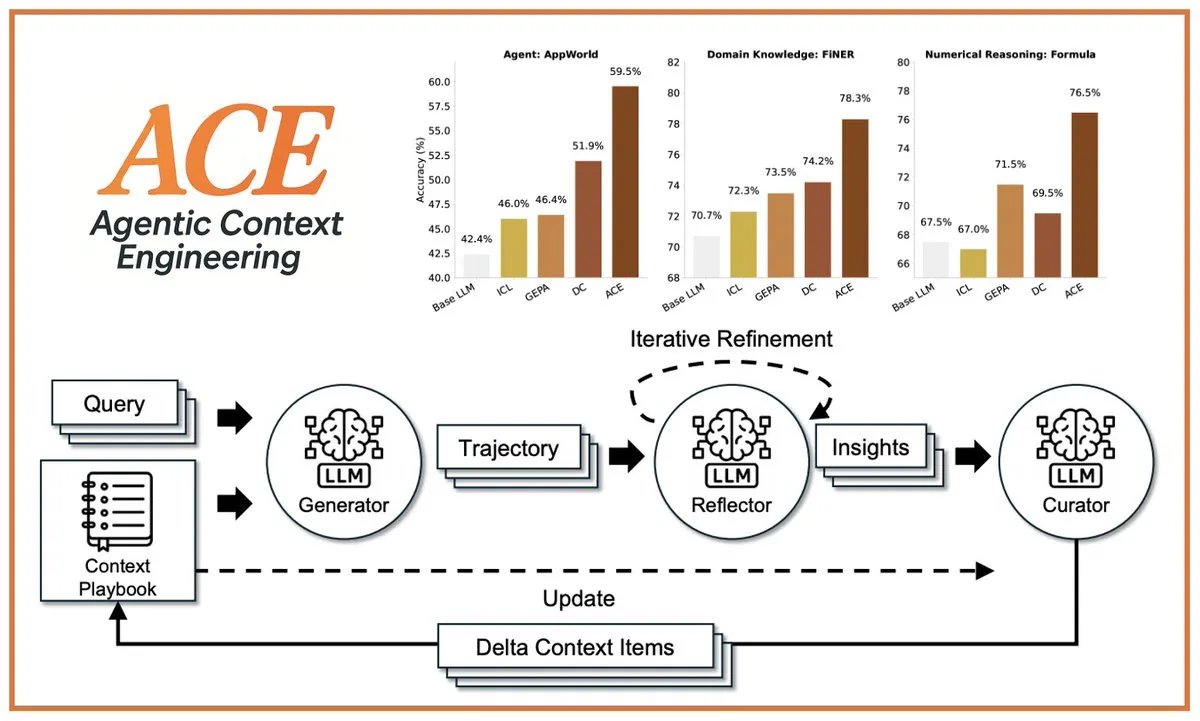
Agent Context Engineering (ACE) Framework Enables LLM Self-Improvement: Agent Context Engineering (ACE) is a framework for self-improving language models by continuously evolving context rather than model weights. This framework achieved a 10.6% improvement in agent tasks and an 8.6% improvement in the financial domain, while significantly reducing latency and cost, offering a new approach to LLM efficiency and performance optimization. (Source: teortaxesTex)
The Three Pillars of an AI Mathematician: TheTuringPost elaborates on the three pillars for building an AI mathematician: a Prover System to generate complete proofs, a Knowledge Base to track known and missing knowledge, and a Conjecture System to propose new mathematical problems. This provides a clear roadmap for the future development of AI in mathematics and scientific discovery. (Source: TheTuringPost)
Sakana AI’s “Continuous Thought Machine” Research: Sakana AI presented its “Continuous Thought Machine” research at NeurIPS, which extends test-time compute through the continuous dynamics of Neural ODEs rather than Transformers. This offers new insights into AI model inference efficiency and scalability. (Source: hardmaru)

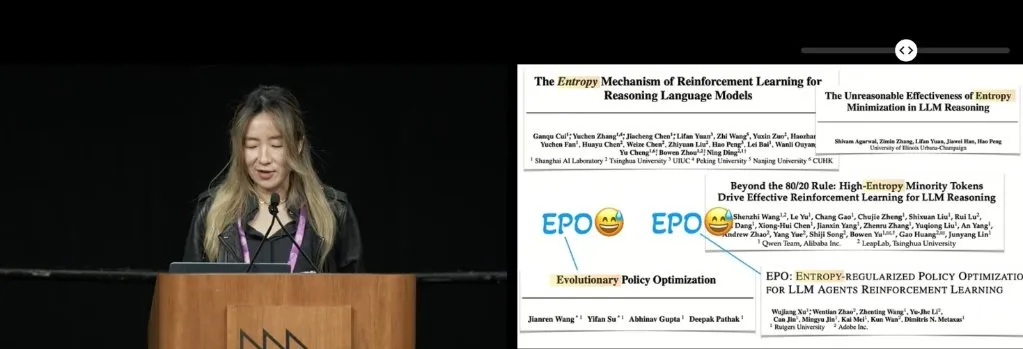
NeurIPS 2025 Keynote Introduces EPO Reinforcement Learning Research: Yejin Choi’s NeurIPS 2025 keynote highlighted the “EPO: Entropy-Regularized Policy Optimization” research. This work aims to address the core challenge of “explore-exploit cascading failures” in multi-round, sparse reward environments, achieving up to a 152% performance improvement on ScienceWorld tasks. (Source: YejinChoinka)
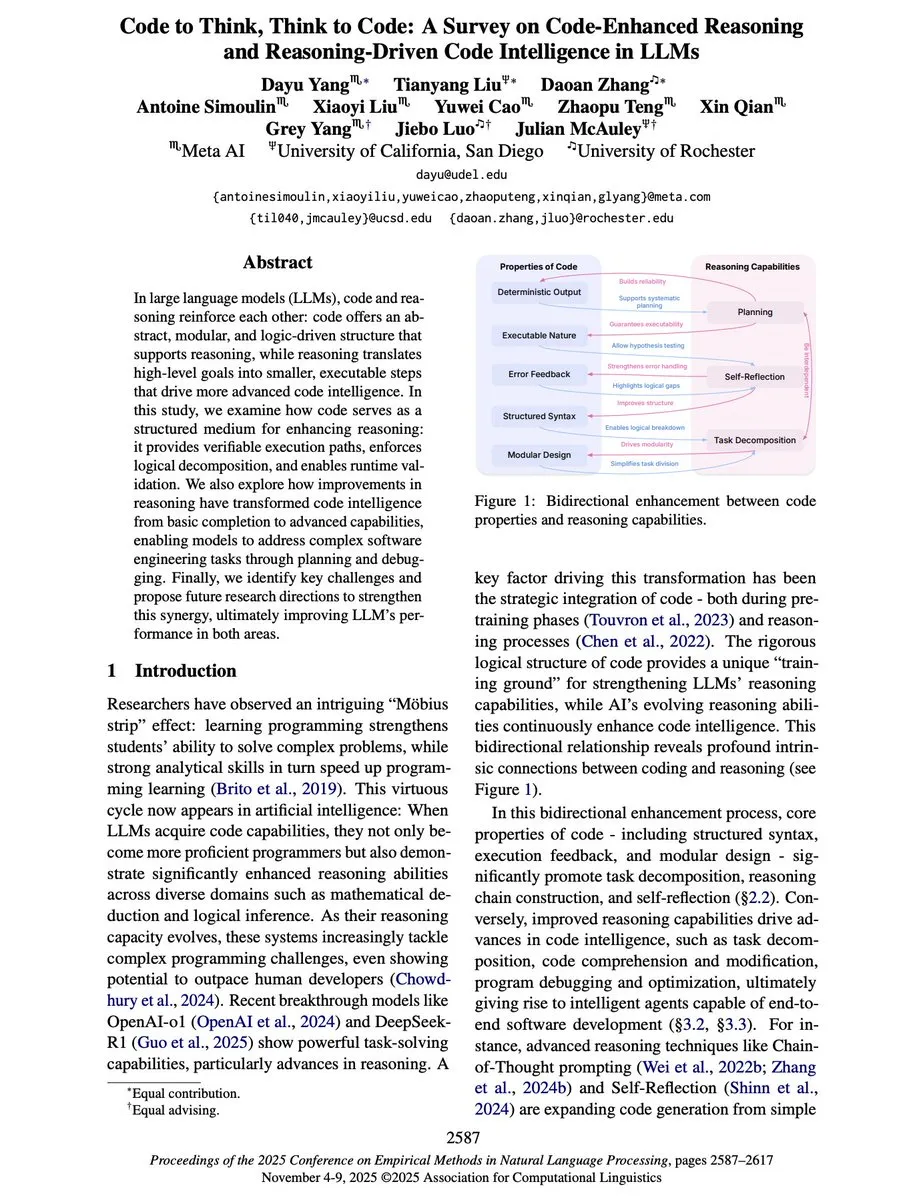
Survey Report on the Bidirectional Relationship Between Code and LLM Reasoning: A new survey paper titled “Code to Think, Think to Code” delves into the bidirectional relationship between code and LLM reasoning. The paper notes that code enhances reasoning by providing verifiable execution paths and logical decomposition, while reasoning elevates simple code generation into complex agent systems. (Source: dair_ai)
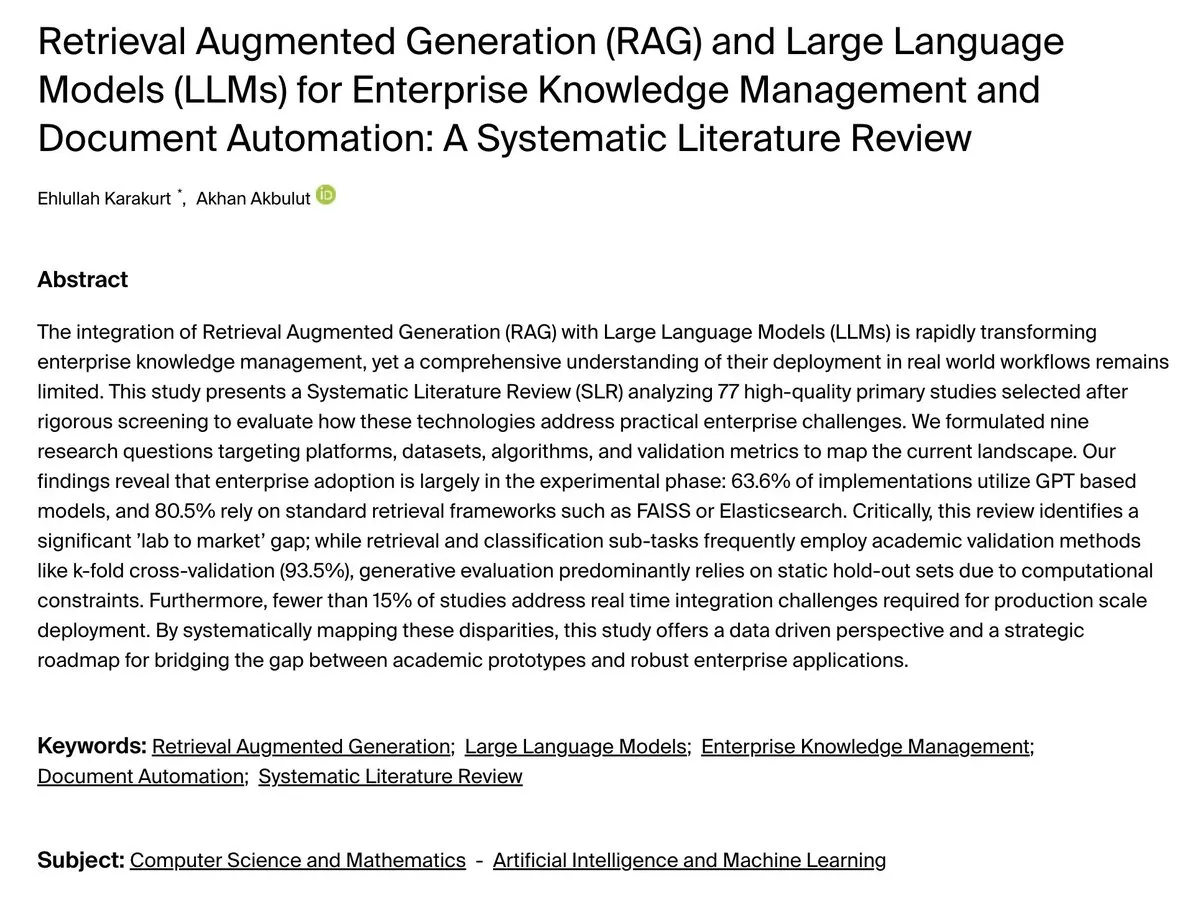
Systematic Review and Challenges of Enterprise RAG Applications: A systematic literature review on enterprise RAG (Retrieval Augmented Generation) applications indicates that while RAG systems are effective in controlled environments, they still face challenges in enterprise deployment such as hallucination control, data privacy, latency, domain adaptation, and measuring business impact. The report highlights the significant gap between laboratory prototypes and production systems. (Source: omarsar0)
BDH Architecture: A Brain-Inspired Transformer Alternative: Research has implemented the BDH (Dragon Hatchling) architecture, a brain-inspired Transformer alternative, and applied it to pathfinding tasks. This architecture models interactions on sparse graphs between neurons and uses Hebbian learning to update working memory on synapses, demonstrating unique internal computational mechanisms. (Source: Reddit r/MachineLearning)

💼 Business
Security and Governance in Enterprise Data and AI Strategy: A MIT Technology Review Insights report highlights that organizations face challenges in data and AI security and governance within their AI strategies. As AI capabilities are increasingly deployed, proactive threat detection, internal threat response, and supply chain vulnerability management become crucial. Enterprises need to rethink their security strategies and prioritize both the functionality and security of AI tools. (Source: MIT Technology Review)
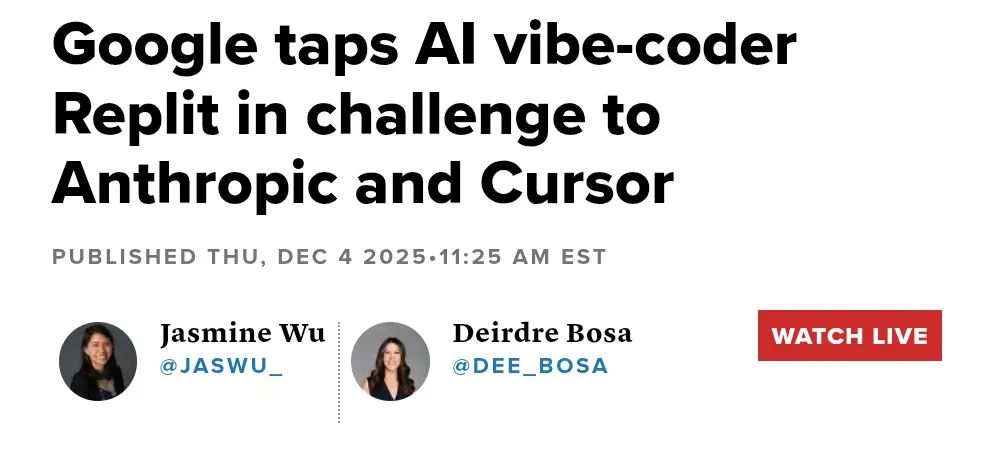
Google Partners with Replit to Enter AI Coding Space: Google has signed a multi-year partnership agreement with Replit, aiming to challenge competitors like Anthropic and Cursor in the AI coding domain. This collaboration will enhance Replit’s capabilities in AI-assisted coding and could reshape the market landscape for AI programming tools. (Source: amasad)
US AI Startup Scene: PhD Replaces MBA as “Door Opener”: The US AI startup scene is undergoing a transformation, with PhDs replacing MBAs as the “door opener” for entrepreneurs. Reports indicate that AI founders are younger and lean towards technical depth rather than business orientation. Graduates from top AI labs and Olympiad medalists are leading this trend, as in the AI era, “technology itself is the product.” (Source: 36氪)

🌟 Community
Organizational Setup Challenges for Large-Scale AI Training: Social discussions point out that while much has been discussed about the technical aspects of large-scale AI training, there’s far less discussion on how to properly establish organizational structures to support it. This reflects that in AI development, organizational and management challenges are as crucial as technical ones. (Source: TheZachMueller)
Concerns About AI’s Impact on Coding Skills: Concerns have been expressed on social media regarding AI’s impact on the coding domain, including the possibility that beginners may not truly learn programming and that existing engineers’ skills might degrade. The discussion suggests that while AI can solve most problems, engineers still need to invest time and effort to deeply understand systems to address future challenges. (Source: dilipkay)
Widespread Distrust of AI in Western Countries: Andrew Ng points out that reports from Edelman and Pew Research indicate that the US and most of the Western world in Europe distrust AI and are not excited about it. In stark contrast to China, public apprehension about AI in the West could severely impede its development. He calls on the AI community to stop exaggerating AI’s dangers and rebuild social trust. (Source: ylecun)
AI Valuation and the Importance of Open Research: Gabriel Synnaeve believes that AI valuation is based on the promise of compounded productivity growth from AI improvements, and open research is the best way to achieve continuous compounded AI improvements. This underscores the central role of open science in driving AI technological progress and realizing its commercial value. (Source: ylecun)
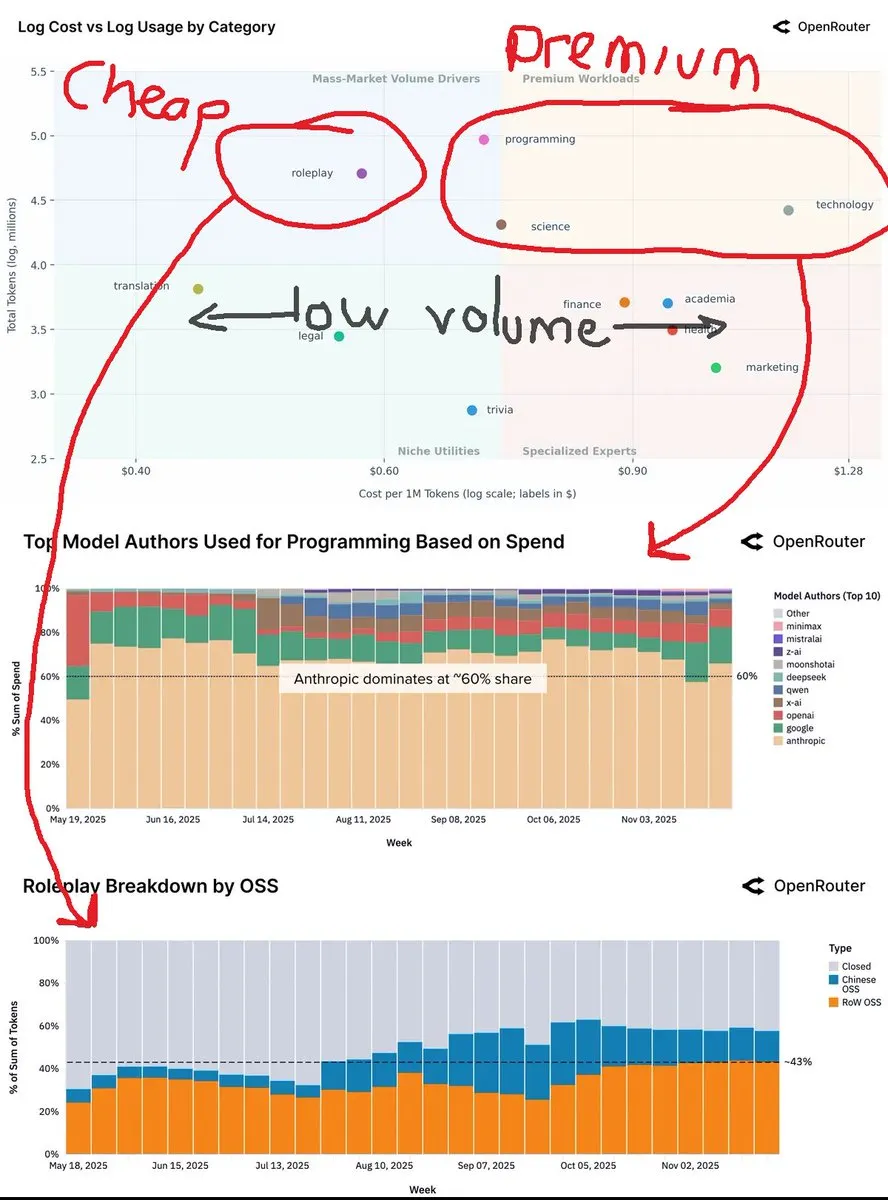
AI API Market Segmentation Analysis: Maxime Labonne argues that the “commoditization of AI” argument is flawed, as the API market is segmenting into two categories: high-end models (like Claude) dominate programming and high-stakes work, where users are willing to pay more for correct code; while inexpensive open-source models dominate role-playing and creative tasks, with huge sales but thin margins. (Source: maximelabonne)
Anthropic Study Shows Employees Commonly Conceal AI Usage: An Anthropic study found that most employees use AI daily, but 69% of them conceal their usage at work. This reflects a divergence in the acceptance of AI tools within enterprises and employees’ concerns about potential negative perceptions associated with using AI. (Source: Reddit r/ClaudeAI)

AI-Generated “Slop” is “Ruining Reddit”: A Wired article states that AI-generated “slop” content is “ruining Reddit.” Moderators and users in popular subreddits are being overwhelmed by a flood of low-quality AI content, raising concerns about the impact of AI content proliferation on the quality of online communities. (Source: Reddit r/artificial)

High Return Rate of AI Companion Toys Reveals Product Weakness: The AI companion toy market has seen explosive growth, but product return rates are as high as 30%. The main reasons are insufficient product intelligence, lack of emotional and memory capabilities, and developers’ “focus on creation over environment” mindset. The industry calls for toy manufacturers, large model vendors, and developers to collaborate, reshape the experience around scenarios, and integrate both liberal arts and scientific thinking to create AI toys with warmth. (Source: 36氪)

Teachers’ Complex Experiences with AI in the Classroom: Teachers express mixed emotions regarding AI use in the classroom, seeing its potential to enhance workflows but also worrying about its negative impacts on assessment, fairness, critical thinking development, and teachers’ professional autonomy. The study calls for AI policymakers to listen to teachers’ voices, provide more guidance and support, and avoid turning education into a technology-centric “checklist” practice. (Source: aihub.org)

Cloudflare Outage Affects AI Services: Cloudflare experienced another outage, impacting several AI services including Claude and WorkOS. This highlights the dependency on critical infrastructure and the risk that a single point of failure can have cascading effects on a wide range of AI applications. (Source: dzhng)

💡 Other
AI Generates Ghibli Film-Style Artworks: Dotey shared AI-generated modern brand images in the style of Ghibli films, showcasing AI’s potential applications in art creation and brand marketing. This demonstrates AI’s capability in applying specific artistic styles to new content. (Source: dotey)

AI-Powered Avocado Ripeness Detector: Ronald_vanLoon showcased an AI-powered avocado ripeness detector, capable of accurately determining the ripeness of avocados. This is a practical AI application with potential value in food quality control and agriculture. (Source: Ronald_vanLoon)
Medical Advancements in Predicting Diseases from Sleep Patterns: Social media discussions highlighted medical advancements in accurately predicting over 130 diseases through sleep breathing patterns. Although AI’s role was not explicitly stated, such large-scale data analysis and prediction typically rely on AI technologies, foreshadowing astonishing progress in the medical field over the next decade. (Source: iScienceLuvr)