



Anahtar Kelimeler:Yapay Zeka, Claude Kodu, OpenAI, Çoklu Ajan İşbirliği, Sonuç Odaklı Fiyatlandırma, vLLM Ticarileştirme
🔥 Spotlight
Claude Code Major Upgrade: Task Officially Replaces Todo, Ushering in Multi-Agent Collaboration Era : Anthropic’s Claude Code has received a core update introducing the “Tasks” feature designed for complex long-term engineering projects, completely replacing the old Todo tool. This transformation is supported by Opus 4.5’s powerful contextual memory and autonomous capabilities, eliminating reliance on trivial recording tools. Tasks enable real-time task status broadcasting across multiple Agents and sessions, while introducing “dependency relationship” management, with data natively stored in the local file system (~/.claude/tasks). This marks AI’s evolution from a simple coding assistant to a “digital engineer” capable of managing large-scale projects with autonomous collaboration abilities, significantly raising the automation ceiling for complex software engineering. (Sources: dotey, yoheinakajima, dejavucoder)
OpenAI Business Model Shakeup: Proposed “Outcome-Based Pricing” Sends Shockwaves Through Industry : OpenAI CFO Sarah Friar recently hinted at a shift toward “Outcome-Based Pricing,” where fees would be based on the value created by AI (e.g., drug discoveries, commercial profits) rather than simple token-based billing. This signal triggered strong community backlash against “AI royalties,” seen as “taxing factory output.” Meanwhile, Sam Altman revealed that OpenAI’s API business saw a $1 billion increase in ARR (Annual Recurring Revenue) in just one month, demonstrating enterprise markets’ heavy reliance on closed-source models. This pricing logic shift may push more companies toward localized deployments to avoid potential profit-sharing risks. (Sources: Reddit, nickaturley)
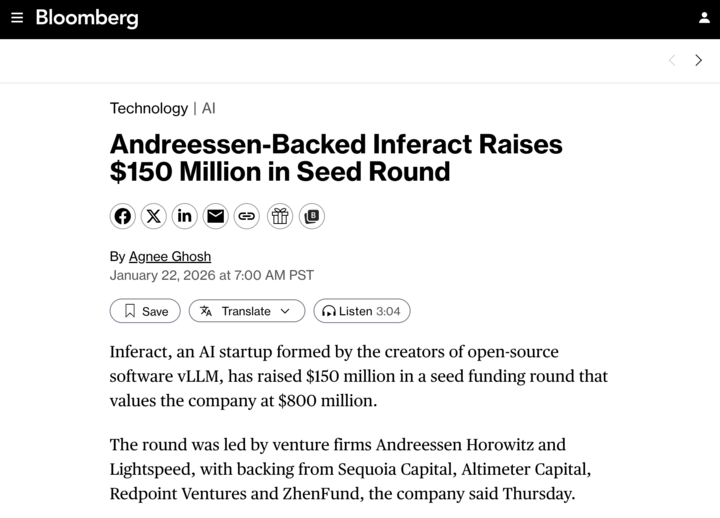
vLLM Core Team Launches Inferact: Commercial Breakthrough for Open-Source Inference Engine : The founding members of the vLLM project officially announced the startup Inferact, aiming to commercialize this globally popular open-source inference engine. Inferact’s mission is to further reduce AI usage costs by optimizing inference efficiency. While the community expresses concerns about vLLM’s “open-source dilution,” this move also signals that competition in the inference space has entered deep waters, with the core team’s involvement expected to accelerate vLLM’s performance breakthroughs and stability improvements in enterprise scenarios. (Source: QuixiAI)
AI Training Paradigm Shift: From Raw Compute Power to Refined Data Curation : Researchers from OpenAI, Thinking Machines, and Amazon are advocating for rethinking LLM training methods, focusing on improving data utilization efficiency and curation quality. Startup DatologyAI stands at the center of this wave, aiming to address core limitations in reasoning and reliability by tackling data sparsity and noise issues in current model training. This trend indicates that the second half of the AI race will no longer be just about compute arms races but about who can more efficiently extract “high-quality signals” from massive datasets. (Source: code_star)
🎯 Trends
Fei-Fei Li’s World Labs Seeks $5B Valuation in Funding Round : Spatial intelligence startup World Labs is planning to raise $500 million at a target valuation of $5 billion. The team led by Fei-Fei Li focuses on “world models,” aiming to give AI human-like understanding of 3D physical spaces. With LLMs hitting growth bottlenecks, spatial intelligence is seen as a critical path toward AGI, attracting continued investment from top-tier capital. (Source: Dorialexander)
Sakana AI Forms Strategic Partnership With Google : Japanese AI unicorn Sakana AI announced a deep collaboration with Google, receiving additional investment while combining Google’s infrastructure with Sakana’s “AI scientist” and Agent technologies to accelerate scientific breakthroughs. The partnership specifically emphasizes solutions for finance and government sectors with high data sovereignty requirements, showcasing Google’s ambitions in regional AI ecosystem development. (Source: hardmaru)
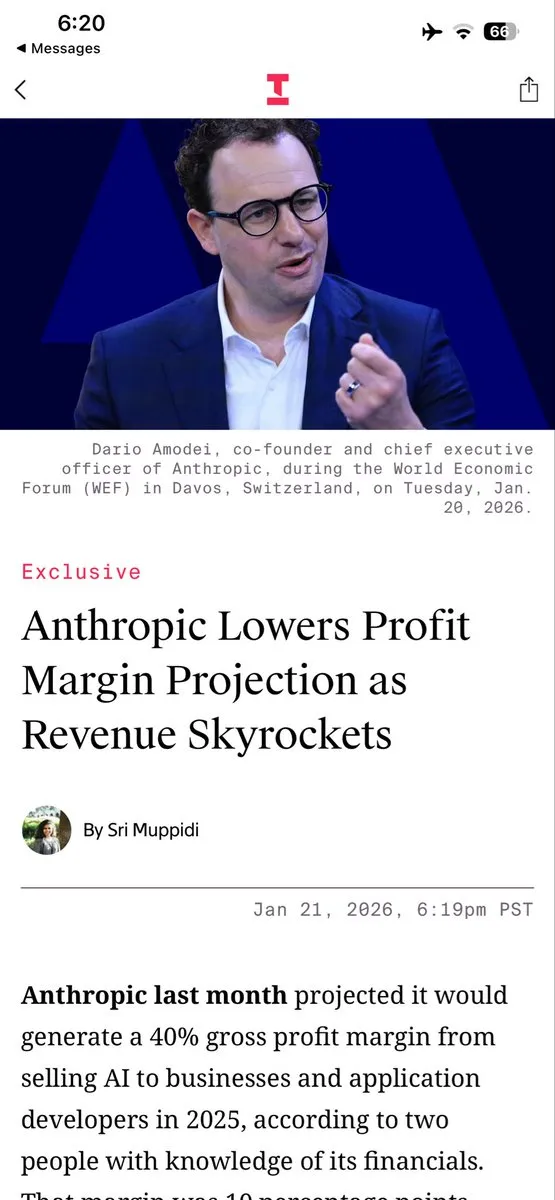
Anthropic’s Inference Costs Exceed Budget by 23%, Sparking Technical Speculation : Leaked information shows Anthropic’s inference costs on Google and Amazon servers were 23% higher than expected. Industry analysis suggests this may indicate its quantization strategy failed to achieve projected cost reductions, or that the model’s actual consumption during long-context processing far exceeds original design intentions. This reveals even top AI vendors face significant challenges balancing model performance with operational costs. (Source: code_star)
Samsung AI Researcher Exodus Highlights Cultural Challenges : Prominent researcher Alexia Jolicoeur-Martineau announced her departure from Samsung, stating that after creating substantial commercial value, her life became “hell” due to management issues. This incident sparked heated community discussions, exposing how traditional tech giants’ outdated management cultures severely clash with innovation incentive mechanisms when attracting and retaining top AI talent. (Sources: cloneofsimo, QuixiAI)
🧰 Tools
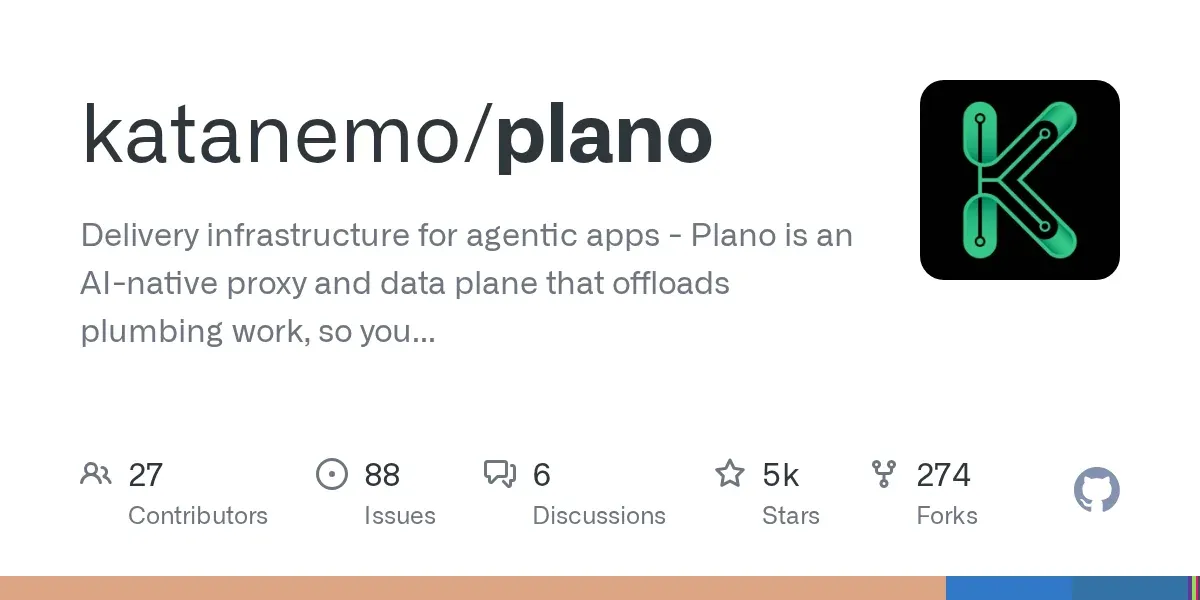
Plano 0.4.3: Introduces Filter Chains for Agent Workflow Optimization : The latest Plano release introduces “Filter Chains,” allowing developers to capture reusable workflow steps in the data plane without repeating logic in application code. This feature supports prompt inspection, request modification, or early termination upon compliance failures. Additionally, new passthrough authentication supports proxy services like OpenRouter, significantly simplifying API management in multi-tenant scenarios. (Source: Reddit)
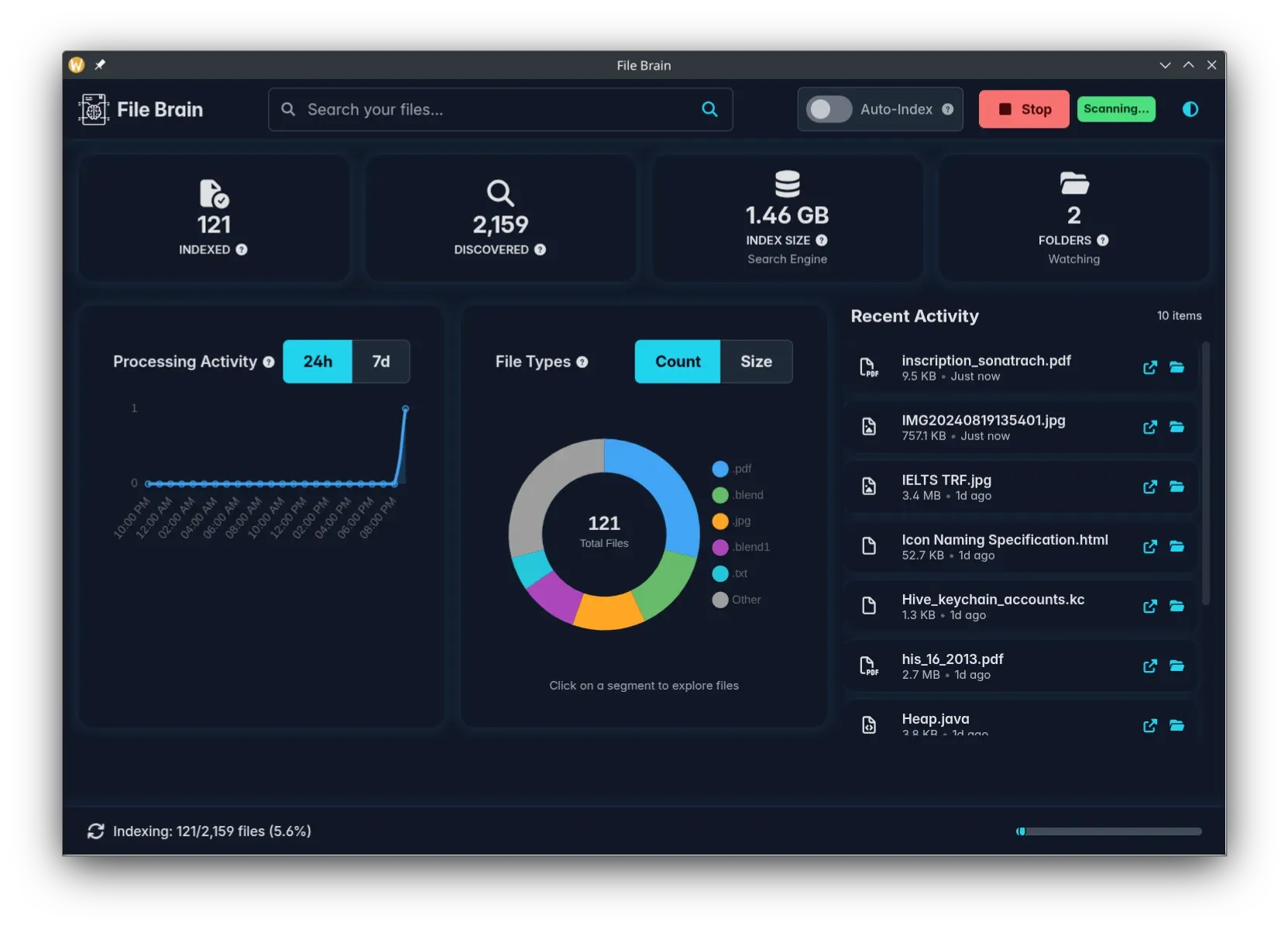
File Brain: Open-Source Local Semantic Search Engine : This 100% locally-run desktop tool combines OCR with multilingual embedding models. It automatically indexes PDFs, images, and Office documents, supporting natural language queries (e.g., “find last year’s flight tickets”) to precisely locate content even with random filenames. The tool solves traditional keyword matching’s inability to understand scanned documents or screenshots while fully protecting user privacy. (Source: Reddit)
Todoist Ramble: Voice-Driven Task Management : Todoist’s Ramble feature lets users describe tasks via voice, with AI automatically parsing and organizing them into priority lists. Community discussions note that similar workflows can be replicated using Whisper and n8n, but Todoist’s native integration and MCP server support give it significant usability advantages as a prime example of AI-optimized personal productivity. (Source: Reddit)
Step3-VL-10B: Powerful Vision Model for Geometry Problem Solving : The Step3-VL-10B vision model now supports chatllm.cpp, demonstrating exceptional performance in complex visual reasoning tasks like geometry problem solving, rivaling 200B-scale Qwen models. Its potential for edge-device operation offers new options for local vision AI applications. (Source: Reddit)

📚 Learning
SAMTok: Mask Tokenization Enables Pixel-Level Capabilities for MLLMs : The paper proposes SAMTok, a discrete mask tokenizer that converts any regional mask into two special tokens. By treating masks as language tokens, foundational multimodal models (e.g., QwenVL) can learn pixel-level capabilities without architectural modifications. Trained on 209 million diverse masks, the model achieves SOTA performance in regional description and referring segmentation tasks, providing a concise paradigm for scaling MLLM pixel-level tasks. (Source: HuggingFace)
HERMES: KV Cache as Hierarchical Memory for Video Understanding : This research presents HERMES, a training-free architecture treating KV Cache as hierarchical memory encapsulating video information at varying granularities. During inference, it reuses compact KV Cache, maintaining high accuracy while reducing video tokens by 68%, with TTFT (Time-To-First-Token) 10x faster than current SOTA, solving memory and latency pain points in streaming video understanding. (Source: HuggingFace)
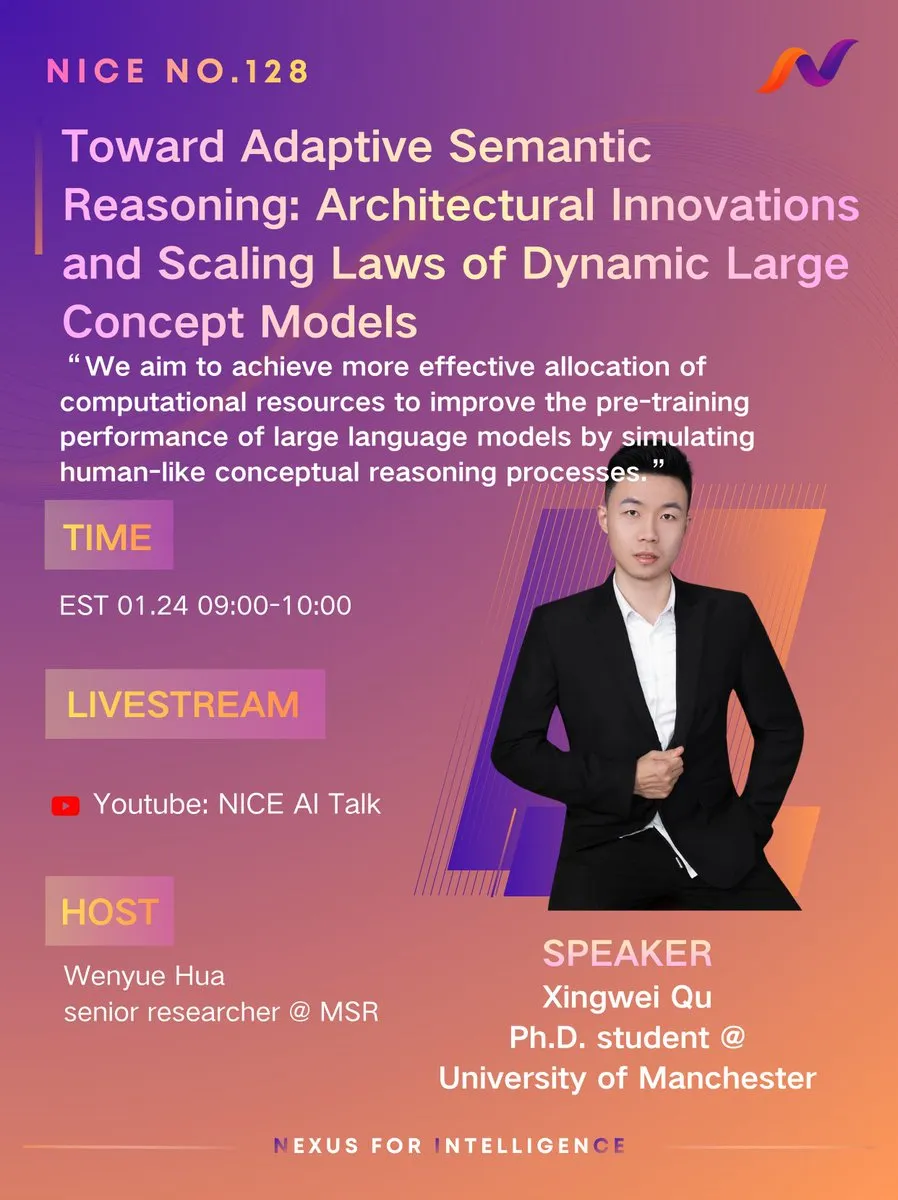
DLCM: Toward Adaptive Semantic Reasoning with Dynamic Large Concept Models : Challenging LLMs’ traditional token-level computation, this research introduces learnable “concept” granularity between tokens and sentences. The DLCM model dynamically allocates compute resources based on information density, simulating human logical concept reasoning. Experiments show significant performance gains in reasoning-intensive benchmarks at equivalent computational costs. (Source: GeZhang86038849)
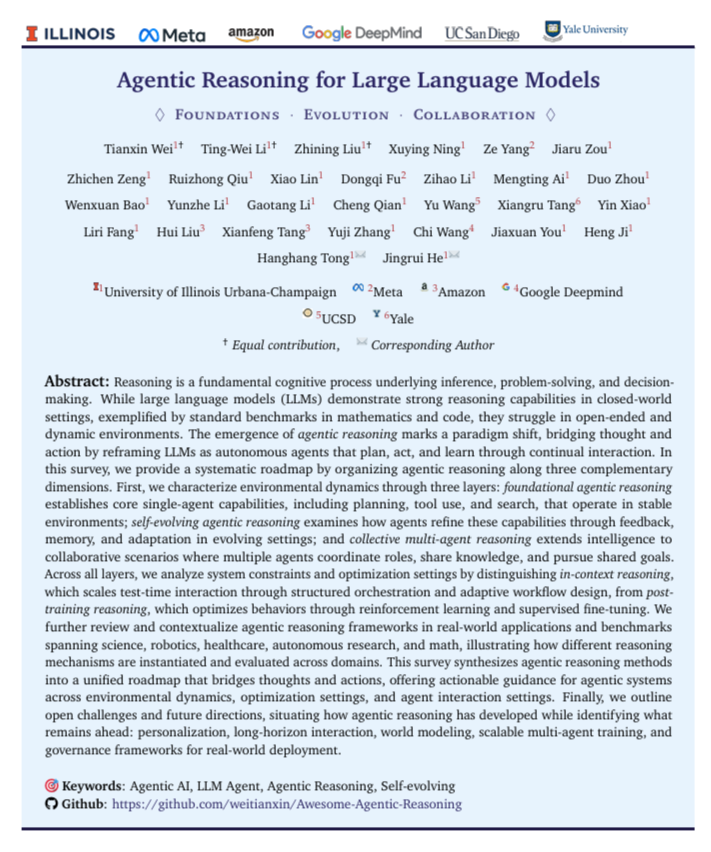
Agentic Reasoning Review: Evolution From “Thinking” to “Acting” : A joint review by Meta and Google DeepMind systematically explores how LLM reasoning is transitioning from pure Chain-of-Thought (CoT) to actions in real environments. Covering single-agent, multi-agent collaboration, environmental feedback, and long-term memory, it identifies key challenges in Agents’ long-range planning and world model construction. (Source: TheTuringPost)
💼 Business
Fei-Fei Li’s World Labs Seeks $5B Valuation in Funding Round : Spatial intelligence startup World Labs is planning to raise $500 million at a target valuation of $5 billion. The team led by Fei-Fei Li focuses on “world models,” aiming to give AI human-like understanding of 3D physical spaces. (Source: Dorialexander)
Sakana AI Forms Strategic Partnership With Google : Japanese AI unicorn Sakana AI announced a deep collaboration with Google, receiving additional investment while combining Google’s infrastructure with Sakana’s “AI scientist” and Agent technologies to accelerate scientific breakthroughs. (Source: hardmaru)
OpenAI API Business Adds $1B ARR in Single Month : Sam Altman revealed that while public attention focuses on ChatGPT, OpenAI’s API business added over $1 billion in ARR last month, demonstrating developers’ and enterprises’ strong reliance on its infrastructure. (Source: nickaturley)
🌟 Community
Great AI Bubble Debate: Valuation vs. Reality : The community hotly debates whether Thinking Machines and other startups’ high valuations signal an AI bubble. While Musk predicts 2026 as the singularity year, current AI exhibits “PhD-level math skills with intern-level common sense.” Shane Gu notes valuations have become the most reliable bubble indicator, with energy and chip supplies remaining physical bottlenecks on the path to AGI. (Sources: shaneguML, Yuchenj_UW)

Local Deployment Awakening: Countering Cloud API “Royalty” Risks : In response to OpenAI’s potential outcome-based pricing, the LocalLLaMA community has sparked a “hoard GPUs” movement. Users argue that relying on cloud APIs is like depending on the power grid—convenient but lacking control—while local deployments resemble solar panels, requiring upfront investment but ensuring project profits aren’t forcibly shared with model providers. This “sovereign AI” consciousness is rapidly spreading among developers. (Source: Reddit)
Kimi Researcher Account Hack Warning : The community exposed that Kimi researcher Crystal’s X account was compromised, sending scam DMs. This incident reminds AI professionals to strengthen personal account and sensitive data security while pursuing technological breakthroughs. (Sources: Kimi_Moonshot, iScienceLuvr)
💡 Miscellaneous
Voice as AI’s Next Frontier : Industry experts like Elad Gil identify voice interaction as AI’s next breakthrough point. With low-latency models and emotional synthesis maturing, voice will evolve from simple command input to a deeply understanding interaction interface. (Source: glennko)

Devin Review: 100% Human Oversight in AI-Leveraged Workflows : Addressing current AI code review tools’ “fighting nonsense with nonsense” phenomenon, Cognition launched Devin Review, emphasizing 100% human-AI collaboration. The tool aims to help humans truly understand code logic through AI assistance rather than superficial “vibe merging,” seeking balance between automation and rigor. (Source: russelljkaplan)