
🔥 Focus
Elon Musk Outlines Tesla’s $30 Trillion Empire Blueprint: Elon Musk predicts that if Tesla succeeds in the humanoid robot Optimus and Robotaxi fields, the company’s valuation could reach $25-30 trillion, with AI, not cars, at its core. He views Optimus as “the world’s largest product,” expecting global demand to reach tens of billions of units and annual revenue to hit $30 trillion. AI is described as a “supersonic tsunami,” the core driver of these technologies. Meanwhile, xAI is pursuing $12 billion in debt financing for chip procurement and data center construction, and Tesla’s energy business is also becoming a key growth point, demonstrating its synergistic effects in AI, energy, and advanced manufacturing. However, whether this vision can be realized remains questionable. (Source: 36氪)

AI Hallucination Becomes WAIC’s First Keyword, Hinton Sounds Alarm: At the 2025 WAIC, “hallucination” became a hot topic. Nobel laureate Hinton warned that AI might replace biological intelligence, calling for global collaboration to ensure AI safety. Academician Zheng Nanning pointed out that large model hallucination is a reliability bottleneck. Xunfei Spark X1 upgraded version focuses on hallucination governance, significantly reducing factual and faithfulness hallucinations and enhancing overall capabilities through multi-path sampling verification and fact-constrained reinforcement learning. It has made progress in education, healthcare, enterprise applications, code, and scientific research, emphasizing the importance of “trustworthy AI.” (Source: 量子位)

Large Model Privacy, Security, and Fairness ‘Seesaw Effect’ Deciphered: Latest research from Renmin University of China and Shanghai AI Lab found that strengthening large model privacy protection capabilities comes at the expense of fairness (up to a 45% decrease), stemming from a set of “coupled neurons” that simultaneously encode fairness and privacy semantics. To solve this dilemma, the team proposed the SPIN training-free solution. By precisely suppressing 0.00005% of key neurons, both the large model’s fairness awareness and privacy protection capabilities soar, without compromising general capabilities, laying the foundation for building more reliable and responsible AI. (Source: 量子位, 量子位)

🎯 Trends
2025 WAIC: AI Industry Shifts from ‘Showcasing Skills’ to ‘Practical Application’: The 2025 World Artificial Intelligence Conference (WAIC) indicates that the AI industry’s focus is shifting from technological “showcasing skills” to actual “practical application.” The conference emphasized practicality, cost-efficiency, and deep integration with application scenarios. Agent intelligence is evolving from “knowledge enhancement” to “action enhancement,” multimodal fusion has become a standard technical feature, and embodied AI is moving from labs to practical applications. Companies like Huawei Ascend, Wuwencore, and StepAhead emphasized computing efficiency and localization. Tencent and Kingsoft Office showcased Agent applications in daily work, while embodied AI companies like Galaxy Universal, Unitree, and Zhiyuan demonstrated practical operational capabilities. Capital continues to be optimistic, but the industry still faces challenges in commercialization and large-scale delivery. (Source: 36氪)

China Telecom Releases AI Flow: The Convergence of Shannon and Turing: China Telecom Artificial Intelligence Research Institute (TeleAI) released AI Flow, aiming to integrate information technology with communication technology. Through three major laws—“Information-Capacity Law” (computation for bandwidth), “Homology Law” (family-style models), and “Integration Law” (multi-model collaboration)—AI Flow can significantly reduce video communication bandwidth consumption, improve edge-cloud collaboration efficiency, and be applied in areas like anti-fraud. This technology transforms communication from “pixel transportation” to “meaning understanding and artistic reconstruction,” expected to solve signal blind spots in scenarios like ocean voyages, high-speed trains, and airplanes, ushering in a new paradigm for intelligent transmission. (Source: 量子位)

Itashi Zhihang CEO Chen Yilun: Autonomous Driving ‘Paves the Way’ for Embodied AI: Itashi Zhihang CEO Chen Yilun made his first public appearance, stating that the technological singularity for embodied AI has arrived, with full-body control fully entering the AI era, immense end-to-end potential, and multimodal large model data not yet saturated. He emphasized that autonomous driving has provided embodied AI with 4D spatio-temporal AI definitions and engineering practice experience, such as unified spatio-temporal perception, decision-making, and planning. The company has secured over 1.7 billion RMB in funding and is committed to building the “World Model AWE” and “Human-Centric Data Engine,” turning physical AI from science fiction to daily reality. (Source: 量子位)

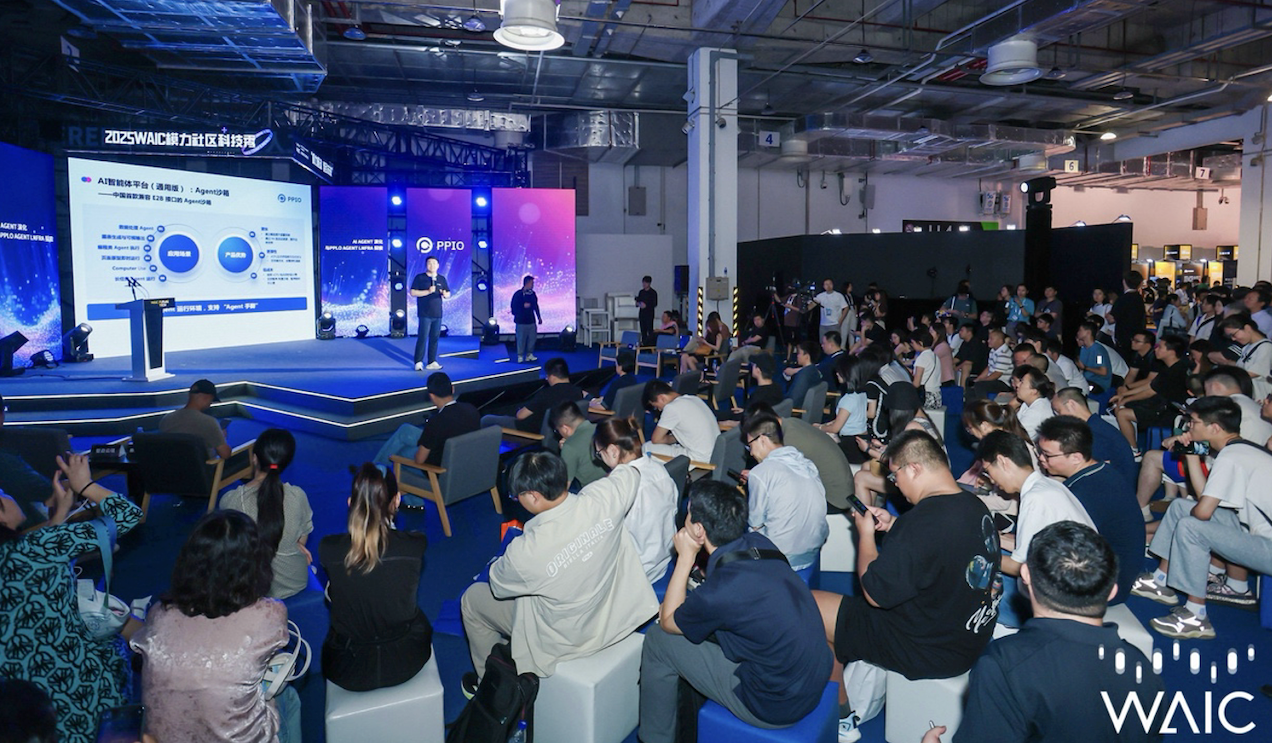
PPIO Launches China’s First Agentic AI Infrastructure Service Platform: PPIO unveiled China’s first Agentic AI infrastructure service platform at WAIC 2025, aiming to accelerate the development and large-scale deployment of Agent applications. The platform provides an E2B-compatible Agent sandbox, built on Firecracker MicroVM, featuring strong security isolation, millisecond-level startup, and high-concurrency creation capabilities, at a cost 50% lower than E2B’s official pricing. Its model service supports mainstream models like DeepSeek R1, Qwen3, and MiniMax M1, and is the first to extend DeepSeek’s context window to 160K, supporting multimodal capabilities, providing a secure, efficient, and economical cloud-based runtime environment for Agent development. (Source: 量子位)
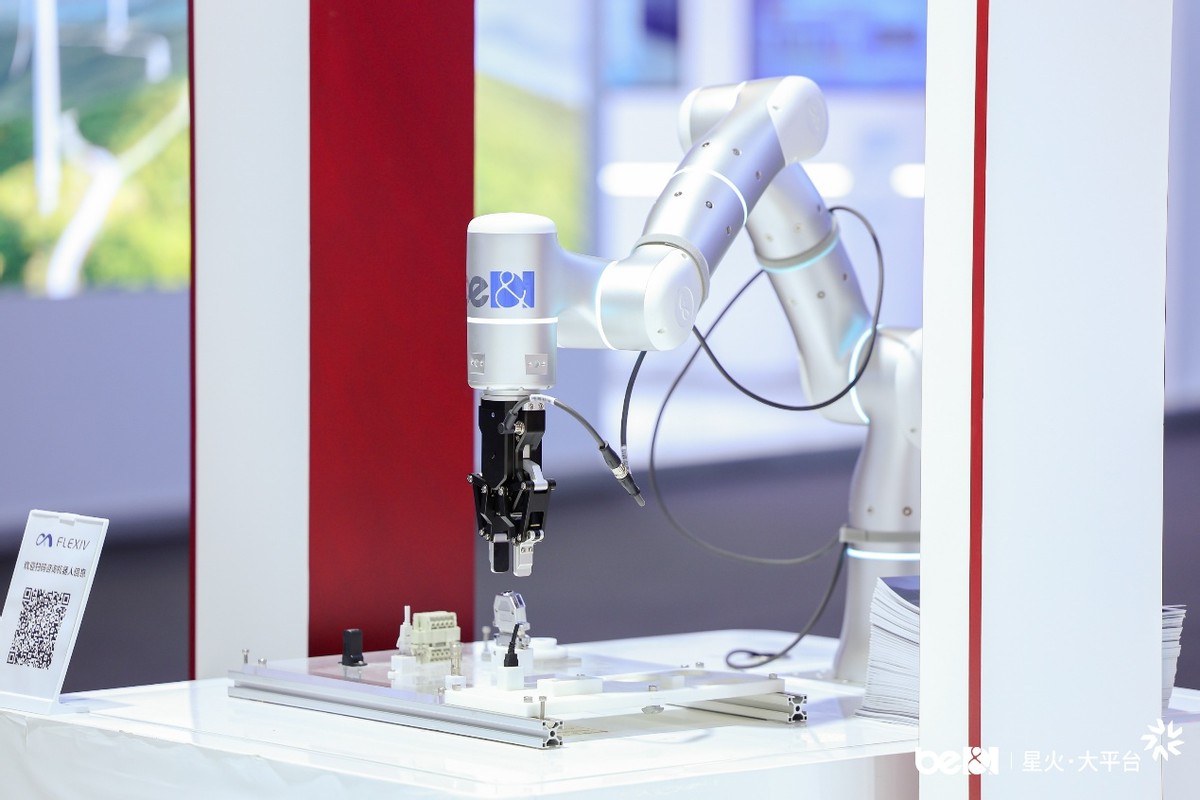
Beidian Digital Intelligence Debuts at WAIC: New Achievements in AI Empowering Industries: Beidian Digital Intelligence made its WAIC debut with the “Spark Big Platform,” showcasing AI implementation achievements across various industries such as government affairs, healthcare, AIGC, smart home, and industrial sectors, based on its “1 AI foundation + 2 major industry platforms” development path. The platform integrates computing power, algorithms, and data, offering the Forward AI Intelligent Computing Platform, Honghu Trusted Data Service, and Xintian Intelligent Agent Platform, assisting in industry digitalization and intelligent upgrading. It boasts RAG retrieval accuracy exceeding 95% and development efficiency increased by over 10 times. Case studies include a rural revitalization large model, medical auxiliary diagnosis, AIGC cultural and creative products, and smart home design, aiming to promote AI technology penetration across full processes and scenarios. (Source: 量子位)
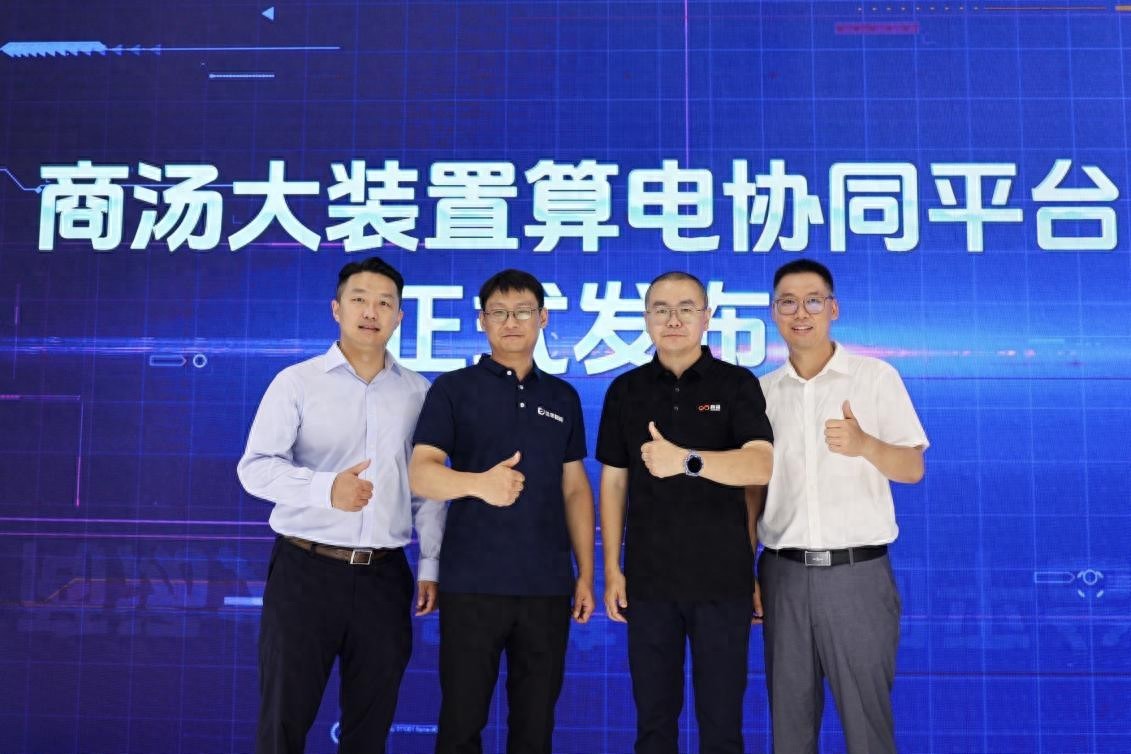
SenseTime’s SenseCore Debuts at WAIC 2025, Creating a New Paradigm for AI Infrastructure: SenseTime’s SenseCore unveiled multiple milestone achievements at WAIC 2025, continuously building a new paradigm for AI infrastructure around three directions: “technology foundation upgrade, industry practice implementation, and ecosystem co-building.” This includes the Lingang AIDC Compute-Power-Coordination Platform (with energy demand prediction accuracy over 88%), and collaborations with China Railway First Survey and Design Institute and Shanghai Municipal Bureau of Planning and Natural Resources to create large model application platforms for railway engineering design and territorial spatial planning. Simultaneously, SenseTime, in collaboration with Huawei, Hygon, and over ten other domestic partners, launched the “SenseCore Compute Mall” and signed a cooperation agreement with Huawei to deepen localization synergy and software-hardware integrated optimization, promoting AI integration into the national economy and people’s livelihoods. (Source: 量子位)
Ant Digital Technologies Releases Financial Reasoning Large Model Agentar-Fin-R1: Ant Digital Technologies launched Agentar-Fin-R1, a financial reasoning large model, at the WAIC forum, creating a “reliable, controllable, and optimizable” intelligent hub for financial AI applications. Developed based on Qwen3, this model surpasses mainstream open-source general large models and financial large models on authoritative financial large model evaluation benchmarks like FinEval1.0 and FinanceIQ, demonstrating stronger financial professionalism, reasoning capabilities, and security compliance. The model is trained on hundreds of billions of financial professional data points, supports 32B and 8B parameter versions, and MOE architecture. Ant Digital Technologies also introduced the Finova large model financial application evaluation benchmark, and has already served numerous financial institutions. (Source: 量子位)

Houmo Intelligent Releases M50 AI Chip: Highest Energy Efficiency Compute-in-Memory: Houmo Intelligent CEO Wu Qiang unveiled Houmo Manjie® M50, an industry-leading energy-efficient compute-in-memory edge AI chip for large models. The chip boasts 160TOPS@INT8 physical computing power and 100TFLOPS@bFP16 floating-point computing power, with a typical power consumption of only 10W, supporting 7B/8B model inference speeds exceeding 25 tokens/s. M50 adopts second-generation SRAM-CIM technology and Tianxuan IPU architecture, achieving parallel weight loading and matrix computation, and is the first to directly perform floating-point operations on a compute-in-memory architecture. The company also launched multiple M.2 cards and computing box products, aiming to achieve ubiquitous AI and make large model computing power readily available everywhere. (Source: 量子位)

GLM-4.5 Series Models Released, Enhancing Reasoning, Coding, and Agent Capabilities: Tsinghua University AI team Z.ai (Zhipu AI) released GLM-4.5 and GLM-4.5-Air, two flagship models designed to unify cutting-edge reasoning, coding, and Agent capabilities. GLM-4.5 has a total of 355B parameters (32B active), and GLM-4.5-Air has 106B parameters (12B active). Both adopt an MoE architecture, support “thinking mode” and “non-thinking mode,” feature a 128K context length, and native function calling. Benchmark tests show their performance is comparable to cutting-edge models like Claude 4 Opus and Gemini 2.5 Pro, excelling particularly in areas like mathematics and SWE-bench. This series of models has been open-sourced and offers API services, with training utilizing a deeper and narrower architecture, Muon optimizer, and extensive code/reasoning data. (Source: jeremyphoward, scaling01, huggingface, _akhaliq, ClementDelangue, Teknium1, Reddit r/LocalLLaMA, Reddit r/LocalLLaMA, Reddit r/LocalLLaMA, reach_vb)
Wan2.2: World’s First Open-Source MoE Video Generation Model: Alibaba released Wan2.2, the world’s first open-source MoE (Mixture-of-Experts) architecture video generation model, offering cinematic control. This model includes two specialized 14B experts (high-noise and low-noise) and boasts high inference efficiency. Simultaneously, the TI2V-5B dense model was launched, supporting 5-second 720P@24fps video generation, runnable on a single RTX 4090. Wan2.2 leads in multiple metrics on Wan-Bench 2.0, such as dynamic motion, text rendering, and object accuracy, with performance comparable to commercial models like Sora, aiming to promote the popularization and application of video AI. (Source: Alibaba_Wan, ostrisai, multimodalart, op7418, scaling01, Teknium1, Reddit r/LocalLLaMA, Reddit r/LocalLLaMA)
OpenVoice V2 Released: Instant Multilingual Voice Cloning: OpenVoice V2 has been released and is free for commercial use under the MIT license. This version improves audio quality over V1 and natively supports multiple languages, including English, Spanish, French, Chinese, Japanese, and Korean. OpenVoice can accurately clone reference voice timbre and flexibly control voice style, such as emotion and accent, while also supporting zero-shot cross-lingual voice cloning, enabling high-quality voice generation even if the target or reference language is not included in the training data. (Source: GitHub Trending)

New Paradigm for AI Video Chat: Artic Framework: The Artic framework proposes a new paradigm for AI video chat, shifting the real-time communication goal from “human watching video” to “AI understanding video.” This framework significantly reduces bitrate while maintaining MLLM accuracy through context-aware video streaming and loss-resilient adaptive frame rate technology, effectively addressing the latency bottleneck caused by excessive MLLM inference time in AI video chat, making human-AI interaction more intuitive, like face-to-face communication. (Source: HuggingFace Daily Papers)
Meta FAIR Releases DINO-world Video World Model: Meta FAIR released DINO-world, a general video world model capable of predicting the future in latent space. Trained on unfiltered videos using DINOv2, the model learns diverse temporal dynamics (e.g., driving, indoor, simulation), surpasses existing models in segmentation and depth tasks, and even grasps intuitive physics. Additionally, DINO-world can be fine-tuned for action-conditioned planning, demonstrating its potential in understanding and generating complex video content. (Source: hardmaru)

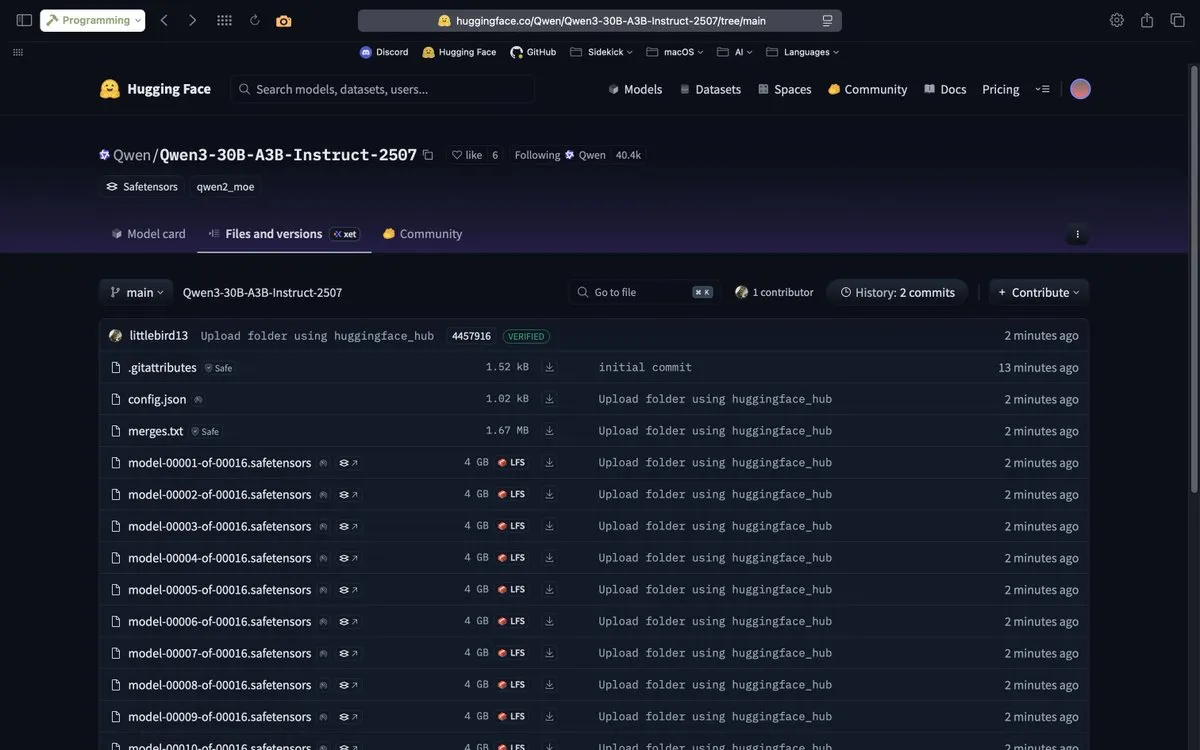
Qwen3-30B-A3B-Instruct-2507 Weights Released: The weights for the Qwen3-30B-A3B-Instruct-2507 model have been released, garnering widespread community attention. Many users stated that the previous Qwen3-30B-A3B was their preferred model for daily use and are looking forward to further improvements in the new version, especially regarding speed and daily task processing capabilities. While a detailed model card is not yet available, its release itself is considered a major advancement for the local LLM community, potentially becoming a new “daily driver.” (Source: Teknium1, Reddit r/LocalLLaMA)
Qwen3-235B-A22B-Thinking-2507 Excels in Logic and Problem Solving: The Qwen3-235B-A22B-Thinking-2507 model demonstrates significant progress in logic, problem-solving, mathematics, science, and coding. This model precisely follows instructions with minimal need for clarification and features an ultra-long context window of 256K, making it particularly effective in handling lengthy prompts and tasks requiring precise reasoning. It is considered a significant leap from previous models. (Source: yupp_ai)

OpenRouter Platform: Rapid Growth of Open-Source LLMs: OpenRouter platform data shows that 9 out of the 10 fastest-growing LLMs this week are open-source models. This trend indicates that open-source LLMs are gaining increasingly widespread adoption and attention in the community, with their performance and cost-effectiveness likely attracting a large number of users, driving their rapid growth and posing competition to proprietary models. (Source: Teknium1)

SmolLM3 Model Releases EU Public Content Summaries: The SmolLM3 model now releases EU public content summaries, becoming one of the first models to comply with AI Act requirements for providing training content summaries. Known for its powerful performance at a small size, and being fully open-source (including data), this move enhances the model’s transparency and compliance, which is particularly significant in an increasingly stringent AI regulatory environment. (Source: LoubnaBenAllal1)

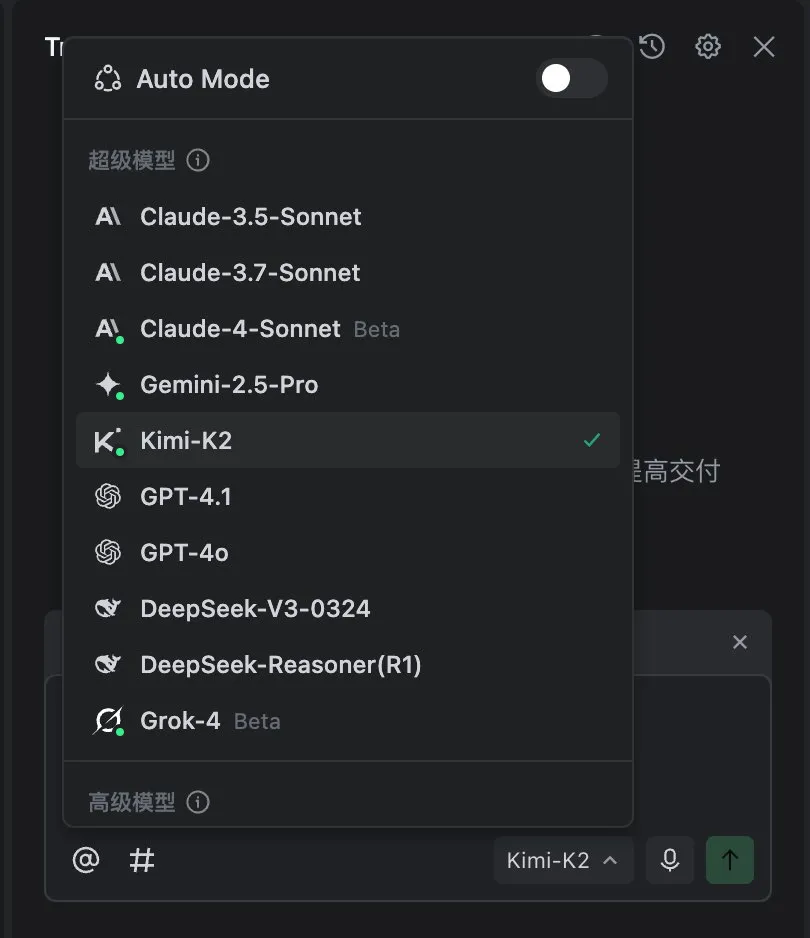
Kimi K2 Model Launched: The Kimi K2 model has been officially launched. The Kimi series models are known for their capabilities in long-context processing and high-precision reasoning. The launch of K2 is expected to further enhance its performance in complex tasks and multi-turn conversations, providing users with a more powerful AI interaction experience. (Source: bigeagle_xd)
US AI Supercomputer Nexus to Surpass 8 Billion Human Compute Power: The US AI supercomputer Nexus will possess compute power exceeding the combined total of 8 billion humans. This breakthrough development indicates that AI will reach unprecedented levels in processing complex data and executing large-scale computational tasks, potentially accelerating scientific research, technological innovation, and development across various industries, further solidifying the US’s leading position in AI. (Source: Ronald_vanLoon)

3DGS PLY Loading Performance Significantly Improved: 3D Gaussian Splatting (3DGS) PLY file loading performance has achieved a huge leap, reducing from 14.7 seconds to 0.22 seconds, with a loading speed reaching 3.1 GB/s for processing 2,902,341 Gaussian points. This improvement is attributed to memory mapping, zero-copy parsing, TBB parallelization, and SIMD technology, significantly optimizing data processing efficiency for 3D graphics and machine learning applications, enabling real-time rendering and large-scale 3D model operations. (Source: janusch_patas)
🧰 Tools
SillyTavern: Frontend for Advanced LLM Users: SillyTavern is a locally installed user interface that provides a unified interface for advanced LLM users. It supports various LLM APIs (such as KoboldAI/CPP, Horde, NovelAI, Ooba, Tabby, OpenAI, OpenRouter, Claude, Mistral, etc.), features a mobile-friendly layout, visual novel mode, image generation integration (Automatic1111 & ComfyUI), TTS, world knowledge (lorebooks), customizable UI, and automatic translation. It offers unlimited growth potential through third-party extensions and has low hardware requirements. (Source: GitHub Trending)

Langfuse: Open-Source LLM Engineering Platform: Langfuse is an open-source LLM engineering platform that helps teams collaboratively develop, monitor, evaluate, and debug AI applications. It provides core functionalities such as LLM observability, metrics, evaluations, Prompt management, Playground, and datasets. It can be quickly self-hosted and is deeply integrated with mainstream LLM tools and frameworks like OpenTelemetry, Langchain, OpenAI SDK, and LiteLLM, supporting Python and JS/TS SDKs, offering powerful support for the full lifecycle management of LLM applications. (Source: GitHub Trending)

Coze Open-Sources Core Agent Toolkit: ByteDance’s Coze has open-sourced its core Agent toolkit: Coze Studio (a low-code visual Agent development platform), Coze Loop (a Prompt development, evaluation, and operations platform), and Eino (an AI application orchestration framework), all under the permissive Apache 2.0 license. This move aims to lower the barrier to Agent development and accelerate its adoption in enterprise automation, small and medium teams, vertical industries, and education/research scenarios, allowing developers to build Agents like LEGOs and providing complete development, debugging, evaluation, and monitoring capabilities. It has quickly garnered 9K stars from the community. (Source: 量子位)

Perplexity Comet: AI Tutor for YouTube Videos: Perplexity Comet is being used as an AI tutor for YouTube videos, allowing users to pause educational videos at any time and use AI to deeply explore complex concepts they don’t understand. This functionality greatly enhances learning efficiency and depth, foreshadowing AI tutors becoming an important component of future education, helping students learn more intelligently, and potentially significantly improving children’s cognitive abilities in the coming years. (Source: rowancheung)

Kling AI Updates Elements Feature, Enhancing Video Creation Consistency: Kling AI has updated its Elements feature, allowing users to combine up to 4 images with prompt words to create video scenes with perfect consistency, significantly improving character, subject, scene consistency, dynamic quality, and artistic style preservation. This update aims to enhance video creation productivity, especially for generating sequences like aerial drops and sky falls, demonstrating its powerful control in complex video generation tasks. (Source: Kling_ai, Kling_ai)
Synthesia Releases Express-2 Full-Body AI Avatars: Synthesia has launched its new Express-2 full-body AI avatars, capable of performing natural movements, gestures, and expressions based on scripts, along with expressive voices and pixel-perfect lip-sync. These next-generation AI avatars are designed to provide more immersive and realistic video content, expected to revolutionize interaction methods in areas such as business presentations, education, and entertainment. (Source: synthesiaIO)
Hugging Face Demonstrates Multiple Innovative AI Tools: Hugging Face showcased several impressive AI tool demonstrations, including: Hunyuan-World for instant generation of explorable 3D worlds; higgs_audio_v2 for realistic speech synthesis; Qwen3-Coder-WebDev for enhanced code generation capabilities; Multi-Style Video→Anime for transforming any video into different anime styles; OmniSVG-3B for converting images to SVG code; Voxtral-WebGPU for SOTA speech-to-text within the browser; and Elastic MusicGen (a fork of Meta MusicGen Large) for faster music generation. (Source: mervenoyann, _akhaliq, ClementDelangue)

ComfyUI Natively Supports Wan2.2 Video Model: ComfyUI achieved native support for Wan2.2 on the day of its release, allowing users to run the 5B version of Wan2.2 with a minimum of 8GB VRAM using ComfyUI’s automatic unloading feature. This integration makes Wan2.2’s advanced features, such as cinematic aesthetic control, large-scale complex motion generation, and precise semantic adherence, achievable on consumer-grade GPUs, significantly lowering the barrier to entry for high-performance video AI tools. (Source: ostrisai)
Aleph Enables Instant Video Inpainting and Editing: The Aleph tool demonstrated its powerful capabilities in video editing, enabling instant inpainting and editing. Users can easily remove unwanted elements from videos with simple commands, such as “remove the cameraman’s reflection,” or add/modify video content instead of simply deleting. This makes video post-production more efficient and intuitive, turning everything in a video into an actionable “prop.” (Source: c_valenzuelab)
AI-Powered Image Cross-Creation Platform Receives Funding: An AI-powered image cross-creation platform designed to enable cultural localization of images via text prompts has received research funding. The platform can culturally adjust and optimize images based on text instructions, for example, localizing elements and styles within images to adapt to audiences from different cultural backgrounds. The project plans to use this funding to scale up the platform and bring it to a production-ready stage, with potential significant impact in content localization and global dissemination fields. (Source: gneubig)
AI-Powered Application Development: Describe to Generate: AI is revolutionizing application development models, with users in the future able to build applications simply by describing them. This trend indicates that low-code/no-code development will become even more intelligent, significantly lowering the development barrier and enabling non-professionals to quickly turn ideas into runnable applications, accelerating digital transformation and innovation across various industries. (Source: Ronald_vanLoon)
Anycoder Launched on Product Hunt: Anycoder has been launched on Product Hunt. As an AI-assisted coding tool, Anycoder aims to improve developers’ work efficiency and code quality through intelligent code generation, completion, and debugging. Its launch on Product Hunt marks the tool’s official entry into the market, seeking early user feedback and community attention. (Source: _akhaliq)
GPT-4.1 Generates P5.js Code, Demonstrating AI Coding Capability: GPT-4.1 generated 2351 lines of P5.js code without errors on the first attempt after receiving the prompt: “Create a program that can be pasted into p5.js to cleverly create a futuristic starship control panel that amazes me.” This demonstrates the powerful capability and “cleverness” of large language models in complex creative coding tasks, indicating the immense potential of AI in assisting or even leading software development. (Source: slashML)
📚 Learning
500+ AI Agent Projects/Use Cases Collection: A curated collection of over 500 AI Agent projects and use cases has been published on GitHub, covering various industries such as healthcare, finance, education, and retail. This project not only showcases practical applications of AI Agents but also provides links to open-source projects, categorized by frameworks like CrewAI, AutoGen, Agno, and Langgraph, offering a rich source of AI Agent inspiration and learning resources for developers, researchers, and business enthusiasts. (Source: GitHub Trending)
LLM Evaluation Guide: Hamel Husain Releases Evals FAQ: Hamel Husain released a comprehensive FAQ on LLM evaluations, providing detailed answers to questions across various aspects of LLM evaluation, including getting started, error analysis, data collection, evaluation design and methodology, human annotation, tools and infrastructure, production and deployment, and domain-specific applications. This FAQ aims to help developers and teams systematically and efficiently evaluate LLM performance and is available for download in PDF and Markdown formats. (Source: HamelHusain, HamelHusain)
PRIX: End-to-End Autonomous Driving Planning from Raw Pixels: PRIX (Plan from Raw Pixels) is a new, efficient end-to-end autonomous driving architecture that directly predicts safe trajectories using only raw pixel data from cameras, without LiDAR or explicit BEV representations. Its core component is the Context-aware Recalibration Transformer (CaRT), which effectively enhances multi-level visual features for more robust planning. PRIX achieves SOTA performance on NavSim and nuScenes benchmarks while being more efficient in terms of inference speed and model size, providing a practical solution for real-world deployment. (Source: HuggingFace Daily Papers)
Deep Researcher with Test-Time Diffusion: A New Framework for Deep Research Agents: TTD-DR (Test-Time Diffusion Deep Researcher) is a new deep research agent framework that conceptualizes research report generation as a diffusion process. It starts with an initial draft, then iteratively refines and “denoises” by dynamically retrieving external information, combining self-evolutionary algorithms to generate high-quality context. This design makes report writing more timely, coherent, and reduces information loss, significantly outperforming existing deep research agents in benchmarks requiring intensive search and multi-hop reasoning. (Source: HuggingFace Daily Papers)
Specification Self-Correction: Mitigating Contextual Reward Exploitation via Test-Time Refinement: SSC (Specification Self-Correction) is a novel test-time framework that enables language models to identify and correct flaws in their own guidance specifications, thereby mitigating contextual reward exploitation. The model first generates a response based on potentially flawed specifications, then critically evaluates the output, revises the specification to eliminate vulnerabilities, and finally generates a more robust response. This method reduces exploitation rates by over 90% without modifying model weights, achieving more robust model alignment. (Source: HuggingFace Daily Papers)
LLM Quantization Geometry: Equivalence of GPTQ and Babai’s Nearest Plane Algorithm: A study reveals that when quantizing linear layers from back to front, the GPTQ algorithm is mathematically equivalent to Babai’s Nearest Plane Algorithm in the classical Closest Vector Problem (CVP). This finding provides an intuitive geometric explanation for GPTQ’s error propagation and allows it to inherit the error bound of Babai’s algorithm. These theoretical results lay a solid theoretical foundation for the design of LLM quantization algorithms and could potentially introduce decades of advancements from lattice algorithms. (Source: HuggingFace Daily Papers)
CLEAR: Simplifying Error Analysis for LLM-as-a-Judge: CLEAR is an interactive open-source toolkit for LLM error analysis. It can generate textual feedback for each instance, create system-level error lists, and quantify the prevalence of each issue. The toolkit also provides an interactive dashboard with aggregated visualizations, interactive filters, and drill-down to individual instances for comprehensive error analysis. CLEAR demonstrates utility in RAG and mathematics benchmarks, helping users understand the specific reasons behind model performance. (Source: HuggingFace Daily Papers)
GEPA: Reflective Prompt Evolution Outperforms Reinforcement Learning: GEPA (Reflective Prompt Evolution) is a novel Prompt evolution method that optimizes LLM Prompts through a reflective mechanism, enabling it to outperform traditional reinforcement learning methods on certain tasks. This research indicates that systematically iterating and improving Prompts can significantly enhance model performance without changing model weights, offering a new direction for LLM optimization and application. (Source: Reddit r/MachineLearning)
Potential of Synthetic Pre-training Data Pipelines: Social media discussions highlight that results from synthetic pre-training data pipelines are highly promising. This method not only fixes issues with low-quality web data but also performs well on high-quality data, offering a new avenue for text data augmentation while avoiding issues with overly predictable data. This is significant for improving the training efficiency and ultimate performance of large language models. (Source: eliebakouch)

‘Pen & Paper Exercises in Machine Learning’ Free Practice Book: A free practice book titled “Pen & Paper Exercises in Machine Learning” has been shared, containing practice problems and detailed solutions for machine learning theory and concepts, covering topics such as optimization, model-based learning, graphical models, and Monte Carlo integration. This resource is highly valuable for learners who wish to deepen their understanding of machine learning through hands-on practice. (Source: TheTuringPost)

LLM Evaluation Benchmark RIFTS: Focusing on Human-AI Interaction: The RIFTS (Real-world Interactions for Task-based Systems) benchmark has been introduced to address challenges in human-language model (Human-LM) grounding. Based on over 60,000 real interaction data points, this benchmark reveals that users in real-world scenarios prefer models to handle context-heavy tasks like “creating presentation slides” rather than IMO (International Mathematical Olympiad) problems. This emphasizes that LLM evaluation should focus more on its performance in practical, complex, context-rich tasks. (Source: stanfordnlp, clefourrier)

ACL 2025: Multilingual Reward Model Evaluation M-RewardBench: At the ACL 2025 conference, researchers presented “M-RewardBench: Evaluating Reward Models in Multilingual Settings.” This work focuses on evaluating reward models in multilingual environments, aiming to improve LLM alignment and performance across different languages and cultural contexts, which is significant for building globalized AI applications. (Source: sarahookr)

ACL 2025: Evaluating LLMs in Multi-Session Coding Interactions: At the ACL 2025 conference, a research team presented “From Tool to Teammate: Evaluating LLMs in Multi-Session Coding Interactions.” This work explores LLM performance in continuous, multi-turn coding tasks, assessing their potential as development partners rather than mere tools, providing guidance for improving the practical utility of AI-assisted programming. (Source: sarahookr)

ACL 2025: Global MMLU Multilingual Dataset Released: At the ACL 2025 conference, the Cohere Labs team showcased Global MMLU, a multilingual dataset comprising 42 languages. This dataset aims to extend the MMLU benchmark beyond US-centric exams for more globalized LLM evaluation, offering lighter and human-curated evaluation methods to promote fairness and accuracy of LLMs in multilingual environments. (Source: sarahookr)
ACL 2025: AfroBench African Language Evaluation Suite: AfroBench, an evaluation suite for African languages, was showcased at the ACL 2025 conference. This suite aims to address the evaluation gap for LLMs in African language processing, providing specialized benchmarks to promote the development and application of LLMs in Africa’s diverse linguistic environments. AfroBench is now available on Hugging Face. (Source: sarahookr)
DSPy Few-shot Examples Significantly Improve Qwen 4 Classification Performance: The DSPy framework significantly boosted Qwen 4’s classification performance from 50% to 88% using few-shot examples. This result indicates that even a small number of high-quality examples, through DSPy’s systematic optimization, can significantly improve large language models’ performance on specific tasks, highlighting the critical role of Prompt optimization and data selection in LLM applications. (Source: stanfordnlp)

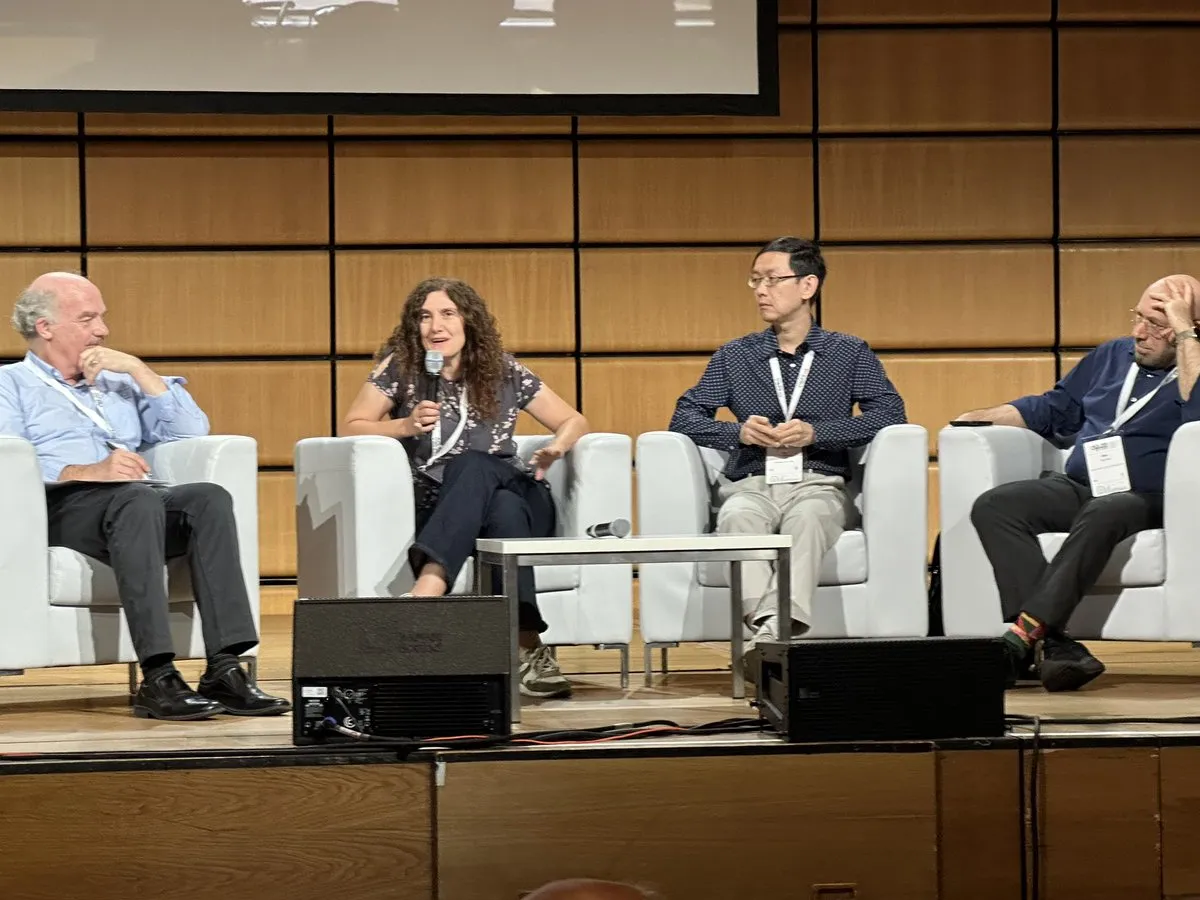
LLM Generalization: Real-time Learning and Adaptation are Key: In an ACL 2025 panel discussion on NLP model generalization, Mirella Lapata proposed that the real challenge is not generalization itself, but how to enable models to learn and adapt in real-time. This perspective emphasizes the importance of AI systems’ ability to continuously evolve and adjust in dynamic environments, considering it a key requirement for achieving true intelligence. (Source: stanfordnlp)
ArtifactsBench v1.1: Automated Visual Evaluation Benchmark for Frontend Code: ArtifactsBench v1.1 has been released, an automated visual/frontend code evaluation benchmark offering a fully transparent evaluation process. This benchmark shows 94.4% consistency with WebDev Arena and now supports more models like Qwen and Kimi. Its 100% open-source and fully reproducible nature provides a reliable tool for frontend code generation and evaluation, helping to improve the quality of AI applications in UI/UX design and development. (Source: QuixiAI)

Deep Dive into Rotational Positional Embeddings (RoPE): A blog post delves into the details of multidimensional Rotational Positional Embeddings (RoPE), providing interactive visualizations, experimental results, and code. RoPE is an important positional encoding technique in Transformer models that helps them understand the positional relationships of words in a sequence. This detailed analysis helps researchers and developers better understand and apply RoPE to optimize its performance in LLMs. (Source: sedielem)
9 New Policy Optimization Techniques: Hugging Face published an article on 9 new policy optimization techniques, including GSPO, LAPO, HBPO, SOPHIA, RePO, CISPO, PAPO, OPO, and EXPO. These techniques aim to improve policy optimization processes in reinforcement learning, enhancing model training efficiency and stability. The article provides detailed links and information, serving as a valuable resource for machine learning researchers and practitioners. (Source: TheTuringPost)

LLM Quantization: Synthetic OCR Sample Dataset Released: A dataset containing 2 million synthetically generated OCR samples has been made public under the Pleiades license. This dataset aims to address data-side deficiencies in the visual domain, providing high-quality training data for model research. Community discussions indicate that while model research is advanced, visual data aspects still need improvement, and the release of this dataset is expected to promote the development of OCR and related visual tasks. (Source: tokenbender)

LLM Training: DeepSeek Context Window Extended to 160K: PPIO’s model service is the first to extend DeepSeek’s context window to 160K and its maximum output to 160K. This breakthrough meets the long-output application needs for scenarios like multi-turn ultra-long conversations and deep Agent analysis, significantly enhancing LLM’s ability to handle complex, lengthy tasks and providing a more powerful “brain” for Agent development. (Source: 量子位)
LLM Evaluation: Design and Optimization of Agentic Workflows: Community discussions emphasize that the design and optimization of Agentic workflows present rich research problems, with immense theoretical and algorithmic workspace. MIPRO papers and the DSPy framework are mentioned as good starting points for these issues, implying that Agentic AI still faces numerous fundamental research and engineering challenges in practical applications. (Source: lateinteraction)

LLM Training: GLM-4.5 Architecture and Learning Dynamics: A review of GLM-4.5’s training shows it adopted deeper models and more attention heads to enhance reasoning capabilities, and utilized the Muon optimizer and Partial RoPE. The data stages included 15T general data and 7T code/reasoning data, with synthetic reasoning data of 32K context introduced mid-training, later expanding to 128K context Agent and long-context data. The team also open-sourced an RL framework (slime) based on Megatron-LM and sglang, demonstrating their deep optimization in model architecture and training strategies. (Source: ClementDelangue)

LLM Inference Optimization: Fast LoRA Inference for Flux Models: A blog post details how to achieve fast LoRA inference optimization for Flux models using Diffusers and PEFT. This method combines torch.compile, Flash Attention 3, and dynamic FP8 weight quantization, achieving at least a 2x speedup on H100 and RTX 4090. The article also specifically mentions hot-swapping technology, which avoids recompilation when switching LoRAs, providing an efficient inference solution for LoRA-based image generation applications. (Source: _akhaliq)

ML Learning Resource: Diffusion Models Video Tutorial: A new video tutorial delves into the details of diffusion models, aiming to explain complex mathematical and physical concepts in an easy-to-understand manner. This video is the first part of a tutorial series, helping viewers build an intuitive understanding of diffusion models through clear visualizations and explanations, which is very helpful for students and researchers looking to learn this cutting-edge AI technology. (Source: mcleavey)
ML Learning Resource: Knowledge Graph Construction Workshop: A workshop on how to build knowledge graphs will be held, led by Daniel Chalef, an expert from Zep AI. The workshop will cover the practical construction of knowledge graphs, extracting information from various data sources, and an introduction to Graphiti. This is a valuable learning opportunity for developers and researchers who wish to leverage knowledge graphs in AI applications. (Source: yoheinakajima)

ML Learning Resource: Python Package for Training Diffusion Models with ‘Bad Data’: A Python package named ambient-utils has been open-sourced, specifically designed for training diffusion generative models using “bad data.” This toolkit, through its AmbientSampler class, allows training denoisers with low-quality data only at specific diffusion times, effectively utilizing imperfect datasets. This method has been validated in multiple top-tier conference papers and is highly valuable for researchers dealing with imperfect data in scientific applications, computer vision, and robotics. (Source: Reddit r/MachineLearning)

ML Learning Resource: Generating HIDS Datasets: Community discussions revolve around how to generate datasets from normal system activity logs of Debian VPS to train a Host Intrusion Detection System (HIDS) based on an unsupervised autoencoder GRU model. The goal is to collect and train only normal behavior data and detect any deviations as potential threats. The discussion seeks automated data collection and structuring tools (e.g., CSV, JSON) to support real-time malware and rootkit activity detection. (Source: Reddit r/deeplearning)
ML Learning Resource: Single Image Super-Resolution (SISR) Techniques: Community discussions seek the latest techniques for extreme Single Image Super-Resolution (SISR), particularly for up to 100x magnification and material-specific texture synthesis in the materials domain. The discussion focuses on the feasibility of fine-tuning generative models like ESRGAN and how to utilize semantic guidance (e.g., material property labels) for conditional generation to steer output. It seeks relevant literature, model architectures, or alternative methods to improve image super-resolution applications in specialized fields. (Source: Reddit r/MachineLearning)
ML Learning Resource: Shifting from Non-Tech Startup to Machine Learning: A 22-year-old non-technical founder seeks advice on whether it’s appropriate to directly learn AI/ML without programming experience. He understands AI/ML theory and core concepts but lacks practical experience, hoping to launch a tech startup with a new co-founder within six months. He chose ML because the new product is data-driven. The community advises starting with small, classic ML models in Python/scikit-learn to build a technical foundation. (Source: Reddit r/MachineLearning)
ML Learning Resource: AI Agent Evaluation and RL Environments: Community discussions focus on porting AI Agent evaluation to Reinforcement Learning (RL) environments to create more effective benchmarks. This approach is considered superior to existing evaluation frameworks and plans to integrate reward benchmarks, arena hardcore tests, and internal refusal benchmarks, with future support for custom training sets in RL environments, to comprehensively improve Agent evaluation and training efficiency. (Source: Teknium1)
ML Learning Resource: Machine Learning Model Generalization and ‘Real Tasks’: Community discussions emphasize that machine learning systems should focus on “real tasks” rather than “proxy tasks” (e.g., classification and detection) to achieve better generalization. This perspective argues that most visual tasks are intermediate “proxy tasks,” while the system’s ultimate goal is to solve real-world problems. For example, autonomous driving should directly learn when to stop, rather than merely identifying dogs. This echoes the “bitter lesson” that end-to-end learning generalizes better than relying on intermediate proxy tasks. (Source: lateinteraction, gabriberton)

💼 Business
Synthesia Achieves $100 Million ARR by Solving Real Problems: Synthesia successfully increased its Annual Recurring Revenue (ARR) to $100 million, with a valuation of $2.1 billion, by focusing on solving real user pain points rather than merely pursuing viral spread. It took the company 8 years, through multiple business transformations and deep user conversations, to find the market’s true needs, ultimately achieving significant commercial growth by providing video generation solutions. (Source: synthesiaIO)
E2B Completes $21 Million Series A Funding to Build AI Agent Cloud Runtime: E2B announced the completion of its $21 million Series A funding round, aimed at building a cloud runtime environment for AI Agents. The company believes that current AI Agents are limited by traditional infrastructure, preventing their full potential from being realized. E2B provides fast-starting computers, file upload/download, and browser usage capabilities, as well as a securely isolated environment, all of which will be open-sourced to address infrastructure bottlenecks for Agents in practical applications. Currently, over 88% of Fortune 100 companies already use E2B’s services. (Source: yoheinakajima, swyx)
Meta Appoints VP of Generative AI to Lead Threads: Meta appointed Connor Hayes, VP of Generative AI Products, to lead Threads. This move sparked community discussion about the technical background of leadership. Some comments suggest that having “general managers” lacking AI technical domain knowledge lead generative AI products might lead to business decisions becoming disconnected from technological development. However, Meta’s recruitment strategy for its “superintelligence” project places more emphasis on technical backgrounds, indicating different internal considerations for staffing various AI projects. (Source: jeremyphoward)
🌟 Community
AI Bubble Theory: Massive Investment and Profitability Challenges: The community widely discusses the existence of a “deeply unstable” AI bubble, arguing it is built on “emotion and blind faith” and heading towards an “inevitable collapse.” Key arguments include: excessive market reliance on Nvidia, major tech giants investing massive capital in AI (over $560 billion in 2024-2025) but with meager profits, leading AI startups (e.g., OpenAI, Anthropic) suffering significant losses, and generative AI being more of a “feature” than “infrastructure,” leading to rapid commoditization. Furthermore, “AI Agent” is accused of over-marketing with limited actual capabilities, and AI tools might decrease rather than increase productivity. Comments suggest the AI industry faces sustainability challenges, and a slowdown in GPU demand or tightening capital could trigger a “significant market correction.” (Source: Reddit r/artificial, Reddit r/ArtificialInteligence)

AI’s Impact on the Job Market: Microsoft Study Reveals High-Risk and Low-Risk Professions: Microsoft released a research report, “Working with AI: Measuring the Occupational Impact of Generative AI,” listing the 40 most AI-susceptible jobs and 40 least AI-susceptible jobs. High-risk professions are mostly intellectual labor, such as advertising sales, data scientists, editors, journalists, and technical writers; low-risk professions are mostly manual labor or blue-collar jobs requiring fine motor skills, such as auto glass installers, brickmasons, dishwashers, and massage therapists. Community discussions express concern, suggesting AI might replace all “desirable” intellectual jobs, sparking discussions about social stratification and “useless people.” (Source: Reddit r/ArtificialInteligence)

Impact of AI-Generated Content on Human Communication and Social Connection: The community deeply discusses the profound impact of AI on human communication and intimate relationships. The proliferation of AI-generated content (e.g., emails, messages) is seen as making communication “lifeless” and “unnatural,” even “brain-rotting.” Many people accustomed to one-sided, friction-free interactions with AI companions may lose interest and ability in face-to-face interaction with real humans, exacerbating social isolation and atomization. Discussions point out that the emotional value provided by AI companions is “sycophantic,” lacking the inevitable conflicts, efforts, and exclusivity of real relationships, which may fundamentally shift the younger generation’s expectations for intimate relationships. (Source: 36氪, Reddit r/ArtificialInteligence)
Abuse of AI in Open-Source Communities: Proliferation of Fake Vulnerability Reports: The proliferation of AI-generated fake vulnerability reports is causing serious distress to open-source communities. Daniel Stenberg, founder of the curl project, and the Python development team both reported receiving a large number of suspected AI-generated fake vulnerability reports. While the content appears genuine, it greatly consumes maintainers’ energy and resources for review and verification. This “AI spam” is likened to DDoS attacks, forcing project owners to consider stopping vulnerability bounties to reduce abusive behavior at its root, highlighting the challenges of AI abuse to the sustainability of open-source projects. (Source: 36氪)

Sam Altman’s GPT-5 ‘Fear’ Comments Spark Controversy: OpenAI CEO Sam Altman’s comments about GPT-5 being “frightening” and “without adult supervision” sparked controversy in the community. Many criticized him for “fear-mongering” and over-hyping, arguing that GPT-5’s actual capabilities may be far from “existential threat” levels, and AI still cannot perform basic reasoning or distinguish between instructions and data. Comments suggest Altman’s remarks might aim to attract attention or lay the groundwork for potential regulation, but his continuous exaggeration has made some users weary. (Source: Reddit r/ChatGPT)

ChatGPT Chat History Privacy Raises Concerns: Sam Altman warned users that emotional communication with ChatGPT is not confidential and carries legal risks, raising user concerns about their chat history privacy. Although many users stated they would not input truly private or confidential information into ChatGPT, some still worry that chat history might be used for legal purposes or data breaches. This discussion highlights widespread concerns about user data privacy in the AI era and the challenges AI service providers face in transparency and user trust. (Source: Reddit r/ChatGPT, Reddit r/ArtificialInteligence)
Effectiveness of JSON Prompts Debated: The effectiveness of JSON prompts sparked debate in the community. Some argue that for latest models like Claude 3.7, JSON prompts are not necessarily better than Markdown or XML formats, and their current popularity might be more hype than actual performance improvement. Comments suggest that for models handling complex instructions, clear structure is more important than specific formats, over-emphasizing JSON might mislead developers, and actual experiments have not proven its superiority. (Source: imjaredz, sohamxsarkar)
Claude Code Heavy User Shares Experience: Mindset Shift and Challenges: A heavy Claude Code user shared months of experience, pointing out a mindset shift from “AI-assisted coding” to “AI as implementation partner, humans focus on architecture.” He emphasized that quality control and Prompt precision are crucial, while also warning that technical debt accumulates faster with AI assistance, and AI still has limitations with niche frameworks/languages. Although AI coding is efficient, some argue its profitability model faces challenges and it might lead to “efficiency in vain,” meaning efficiency gains exacerbate internal competition in the absence of demand growth. (Source: doodlestein, Reddit r/ClaudeAI)

LLM Training: OOM Errors and Debugging Challenges: In community discussions, ML engineers shared frustrating experiences of encountering Out-of-Memory (OOM) errors during model training, especially when they occur hours into training, leading to wasted time. This pain point highlights the stringent demands of large model training on hardware resources and optimization strategies, as well as the complexity of debugging such issues, which is a common challenge faced by ML engineers daily. (Source: francoisfleuret, TheZachMueller)

MIT’s Lack of Modern GPUs Raises Concerns: Community discussions point out that China is releasing AI models under MIT license, while the Massachusetts Institute of Technology (MIT) seemingly lacks GPUs (like H100) capable of running these modern models. This phenomenon raises concerns about insufficient computing resources at top US academic institutions for cutting-edge AI research, hinting at different strategies and development speeds between China and the US in AI infrastructure construction and open-source contributions. (Source: Dorialexander, zacharynado)
AI Agent Productivity Bottleneck: Browser Agents: Community discussions indicate that the biggest obstacle for browser Agents in boosting productivity is their efficiency and stability issues. Although AI Agents can theoretically automate complex tasks, in practical applications, browser Agents often encounter performance bottlenecks and errors when executing multi-step tasks requiring complex interactions, hindering their widespread adoption and productivity gains in real-world workflows. (Source: cto_junior)

ACL 2025 Conference: Rise of Eastern Scholars, Decline of Western Scholars: The opening slides of the ACL 2025 conference showed a significant shift in the origin of first authors: an increase in the number of Eastern scholars, while Western scholars decline. This trend indicates that the center of gravity for global Natural Language Processing (NLP) research is shifting, with Asian regions playing an increasingly important role in academic contributions and research influence. (Source: stanfordnlp)

AI’s Impact on Human Life: Alienation and Breakthroughs: Experts and scholars discuss the profound impact of AI on human life, pointing out that AI not only changes our cognitive relationship with the world but also reshapes work patterns. They explore the efficiency gains and potential internal competition brought by AI, emphasizing the importance of uniquely human creativity, intuition, and emotional connection. The discussion also touches on AI’s impact on education, occupational differentiation, and social stratification, as well as how individuals can find their place amidst uncertainty, calling for the cultivation of comprehensive abilities and humanistic and artistic literacy to address the challenges of the AI era. (Source: 36氪)
💡 Other
AI Applications in Digital Twins: AI has a wide range of applications in the digital twin domain, including urban digital twins and industrial digital twins. Urban digital twins integrate AI technology to enable smart city management, traffic optimization, and environmental monitoring; industrial digital twins utilize AI for predictive maintenance of equipment, optimization of production processes, and product quality control. AI empowers digital twins to provide real-time insights and simulation capabilities, driving various industries towards intelligent and efficient development. (Source: Ronald_vanLoon, Ronald_vanLoon)

FDA’s AI Accused of ‘Fabricating Research,’ Raising Concerns: AI used by the US Food and Drug Administration (FDA) has been exposed for “fabricating research” to accelerate drug approvals, raising serious concerns about AI’s reliability and regulation in critical areas. This incident highlights the ethical and safety issues that AI may bring in high-risk applications such as healthcare, and the urgency of ensuring transparency and accuracy in AI decision-making. (Source: Ronald_vanLoon)

2025 Tech Innovators Conference Focuses on Embodied AI: The 2025 Tech Innovators Conference will be held on September 5th in Beijing, with the theme “Embodied AI: New Engine for Industrial Intelligent Transformation.” The conference will gather top scientists, entrepreneurs, and investors to discuss technological tipping points, scenario revolutions, and supply chain restructuring in embodied AI, aiming to address the “last mile” challenge from technology to product and provide real-world scenario validation and large-scale deployment channels for cutting-edge technologies like embodied AI. This conference emphasizes industry matchmaking and resource empowerment, expected to drive the deep restructuring of China’s embodied AI industry chain. (Source: 量子位)