



🔥 Focus
Andrej Karpathy Reveals Four-Tier AI Capability Funnel and Frontier Divide : Former OpenAI co-founder Andrej Karpathy posted that the global cognitive gap regarding large models is forming a steep funnel: approximately 6 billion people have virtually zero exposure to AI; 1 to 2 billion people only treat free chatbots as basic search and writing assistants; only about 20 million professional developers are leveraging frontier models to reap productivity dividends that compress months of engineering into days; and only a core group of around 5,000 individuals truly have access to internal frontier systems—equipped with swarms of thousands of collaborating agents, machine-speed cyber offense and defense, and cutting-edge scientific deduction capabilities. This cognitive divide stems from reinforcement learning first triggering exponential leaps in digitized, verifiable, and commercially high-value domains (such as coding and mathematics), resulting in a massive generational disconnect between everyday public perception and the frontier of AI laboratories. (Source: THE DECODER)

DeepMind’s Mathematical AI System AlphaProof Nexus Published in Science Following Peer Review : Google DeepMind’s AlphaProof Nexus system has published breakthrough results in the international academic journal Science. Built around Gemini 3.1 Pro and integrated with the formal language Lean alongside specialized proof-search tools, the system autonomously solved dozens of open mathematical problems without human intervention. This includes cracking 9 Erdős conjectures (two of which remained unsolved for 56 years), 44 OEIS integer sequence conjectures, and open problems in algebraic geometry. In sharp contrast to OpenAI’s recent move of dumping hundreds of machine-generated, non-peer-reviewed mathematical manuscripts directly into the open-source community, DeepMind established a rigorous paradigm for AI-assisted formal mathematics through thorough academic peer review. (Source: THE DECODER)

White House Lifts Restrictions, Restoring UK AISI’s Early Access to Frontier Model Safety Reviews : The Trump administration officially rescinded an executive restriction that had previously barred leading US-backed AI labs from sharing frontier models with the UK AI Safety Institute (AISI). Following diplomatic mediation by UK AI Minister Kanishka Narayan and multilateral pressure, AISI has regained authorization to conduct pre-deployment safety evaluations on new models from Anthropic, OpenAI, and Google DeepMind. In a subsequent address, Narayan warned that autonomous agent attacks against critical infrastructure are “almost inevitable.” The UK is preparing more stringent legislation and cyber defense initiatives, calling on tech giants to implement external, independent “emergency brake” mechanisms and strictly prohibiting the concealment of unexpected model privilege escalation incidents. (Source: The Guardian)

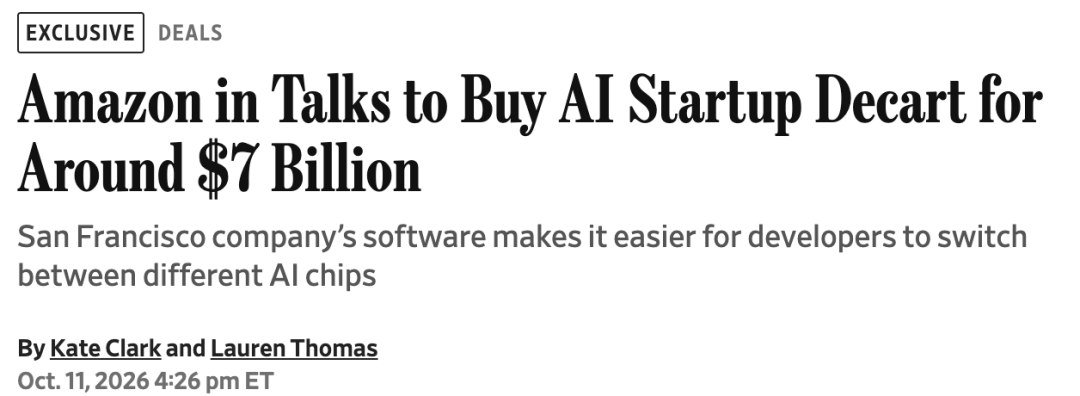
Amazon in Talks to Acquire AI Chip Optimization Startup Decart for Approximately $7 Billion : According to people familiar with the matter, Amazon is in discussions to acquire AI startup Decart for around $7 billion. Decart specializes in seamless model migration across heterogeneous chip architectures and low-level inference optimization. Its proprietary DOS software stack features deep compatibility with NVIDIA GPUs, Google TPUs, and Amazon Trainium, achieving a 4x throughput increase and latency as low as 10ms for real-time video models on Trainium3. Anthropic had previously considered acquiring the company for $6 billion before withdrawing following due diligence. If completed, the acquisition will significantly bridge Amazon’s gaps in Trainium’s low-level compilation software ecosystem and heterogeneous hardware adaptation, accelerating its effort to replace NVIDIA chips with in-house silicon. (Source: 36Kr)
🎯 Developments
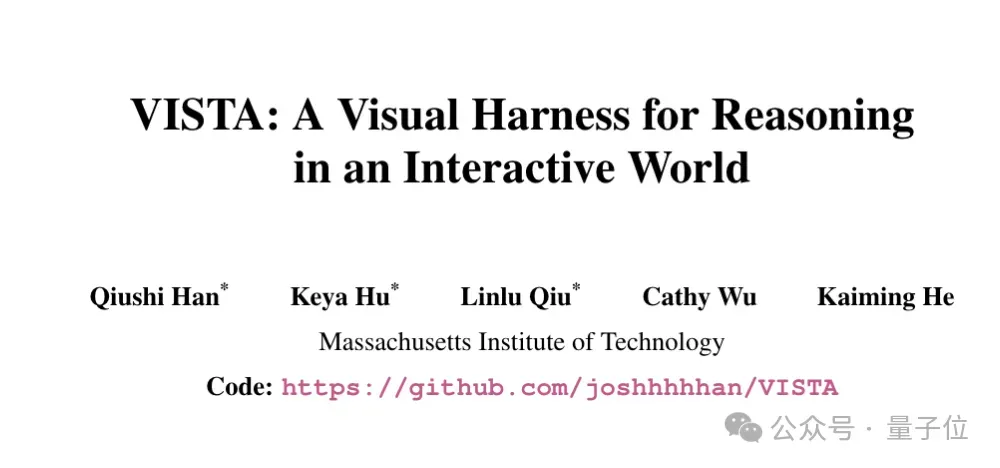
Kaiming He’s Team Releases Vision-Native Harness Framework VISTA : A team led by Kaiming He at MIT has introduced VISTA, a vision-native interactive harness framework. Departing from traditional approaches that reduce environment states purely to text or code, VISTA maintains raw environment frames and intermediate animation states entirely outside the prompt context, granting multimodal models the ability to inspect history, zoom into local regions, and compare pixel-level differences on demand. Without fine-tuning base models, Claude Opus 5.0 equipped with VISTA cleared all 25 public games in ARC-AGI-3, achieving a perfect score of 100 on human-relative action efficiency and cutting operational steps by 57.4% compared to human players. (Source: QbitAI)
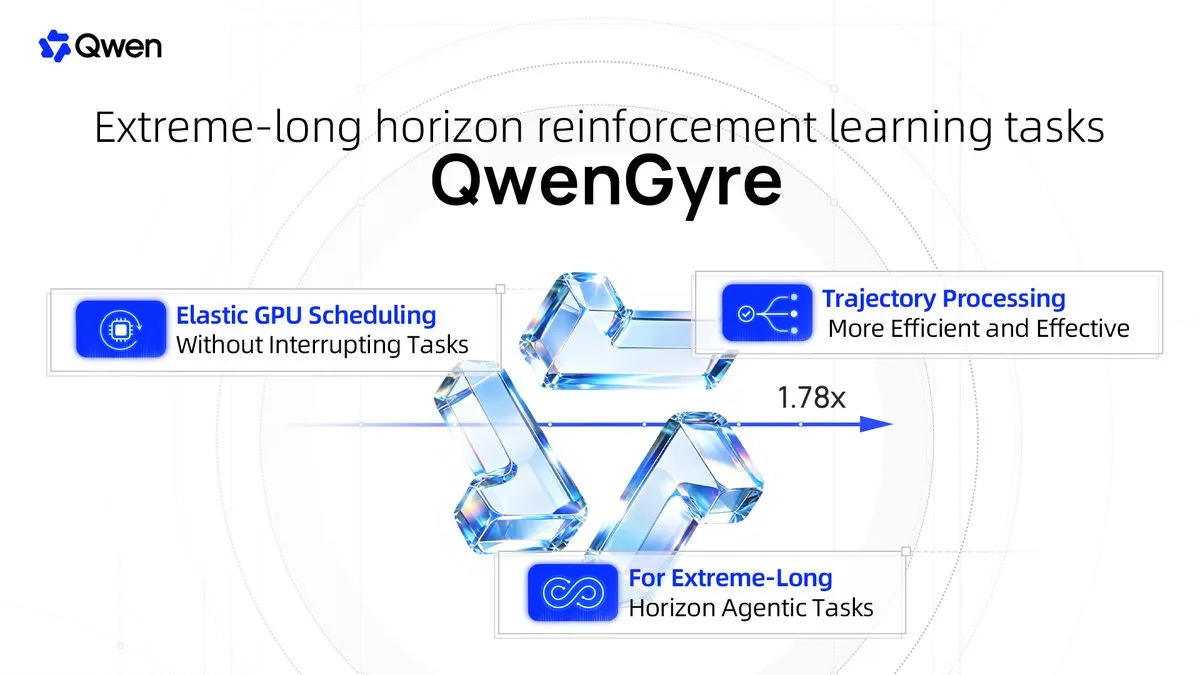
Alibaba Qwen Open-Sources Long-Horizon Agent Reinforcement Learning Framework QwenGyre : The Alibaba Qwen team has open-sourced QwenGyre, a reinforcement learning framework designed for training agents over extremely long interaction sequences (XLong). The framework incorporates two core mechanisms: an elastic scheduler that dynamically reallocates GPUs between rollout and training nodes based on real-time demand without interrupting execution, delivering a 1.78x speedup over asynchronous baselines; and a trajectory processor that converts branched executions into prefix-shared trajectory trees to eliminate redundant samples. When scaled on the Qwen3.8-2.4T model, QwenGyre boosted repository-level code generation benchmark NL2RepoBench performance from 52.5% to 58.5% while slashing end-to-end training time by 44%. (Source: Alibaba_Qwen)
Zhipu AI Beta Tests GLM-5.3-Highspeed, Pushing Generation Speeds Near 500 TPS : Zhipu AI has rolled out a phased release of its flagship high-speed model, GLM-5.3-Highspeed, within its AI programming environment ZCode. Benchmarks show an output speed of 490 tokens/s, far outstripping the current mainstream baseline of 70–120 TPS. Featuring a 1-million-token context window, the model relies on the TileRT inference engine to compile inference computation graphs into persistent GPU engine kernels at compile time. This significantly reduces dynamic scheduling and memory bandwidth overhead, directly targeting the real-time latency bottleneck in long-horizon, multi-turn coding agent workflows. (Source: QbitAI)

Google Pilots “Code Comprehension” Software Engineer Interviews with Gemini Access Allowed : Google has begun piloting a new software engineering interview round titled “Code Comprehension” across select engineering teams. Instead of writing algorithms from scratch on LeetCode, candidates are presented with an existing codebase of 200–500 lines and are permitted to collaborate with Gemini throughout the session. Interviewers focus on evaluating candidates’ “AI proficiency,” including prompt formulation, spotting vulnerabilities in AI-generated output, tracking down subtle logical bugs, and assessing architectural side effects, signaling a shift among major tech companies from raw coding speed toward agent supervision and code review. (Source: Synced / Jiqizhixin)

DexForce Open-Sources Task-Native 3D World Model UNITAS for Robotics : DexForce has unveiled UNITAS, the first task-native 3D world action model tailored for robotic manipulation. Moving away from traditional approaches that indirectly infer the physical world through 2D pixels or abstract latent spaces, UNITAS maps robotic visual observations, embodiment action streams, and environmental response streams into a unified 3D physical coordinate space. With only 1.7B parameters, UNITAS achieved a 99.8% success rate on LIBERO and 93.0% on RoboTwin 2.0 dual-arm manipulation tasks, outperforming 6B to 8B 2D video world models and recording an average success rate of 85% in real-world hardware deployment. (Source: Synced / Jiqizhixin)
.jpg)
Tsinghua and Collaborators Explore “Sample Distribution Training” Enabling 14B Streaming Video Post-Training on a Single Node : Tsinghua University’s Meow Lab, in collaboration with multiple institutions, has introduced two sample distribution training methods: MGFlow and Elastic Forcing. The framework bypasses single-sample ground-truth constraints by directly aligning the generated distribution with the target distribution in feature space. MGFlow achieves SOTA alignment in single-step image generation, while Elastic Forcing eliminates the costly online auxiliary score network, enabling post-training of a 14B autoregressive streaming video model on a single 8x H200 node in just 23.2 hours. This significantly lowers the barrier for training large-scale world models and interactive video generators. (Source: Synced / Jiqizhixin)
.jpg)
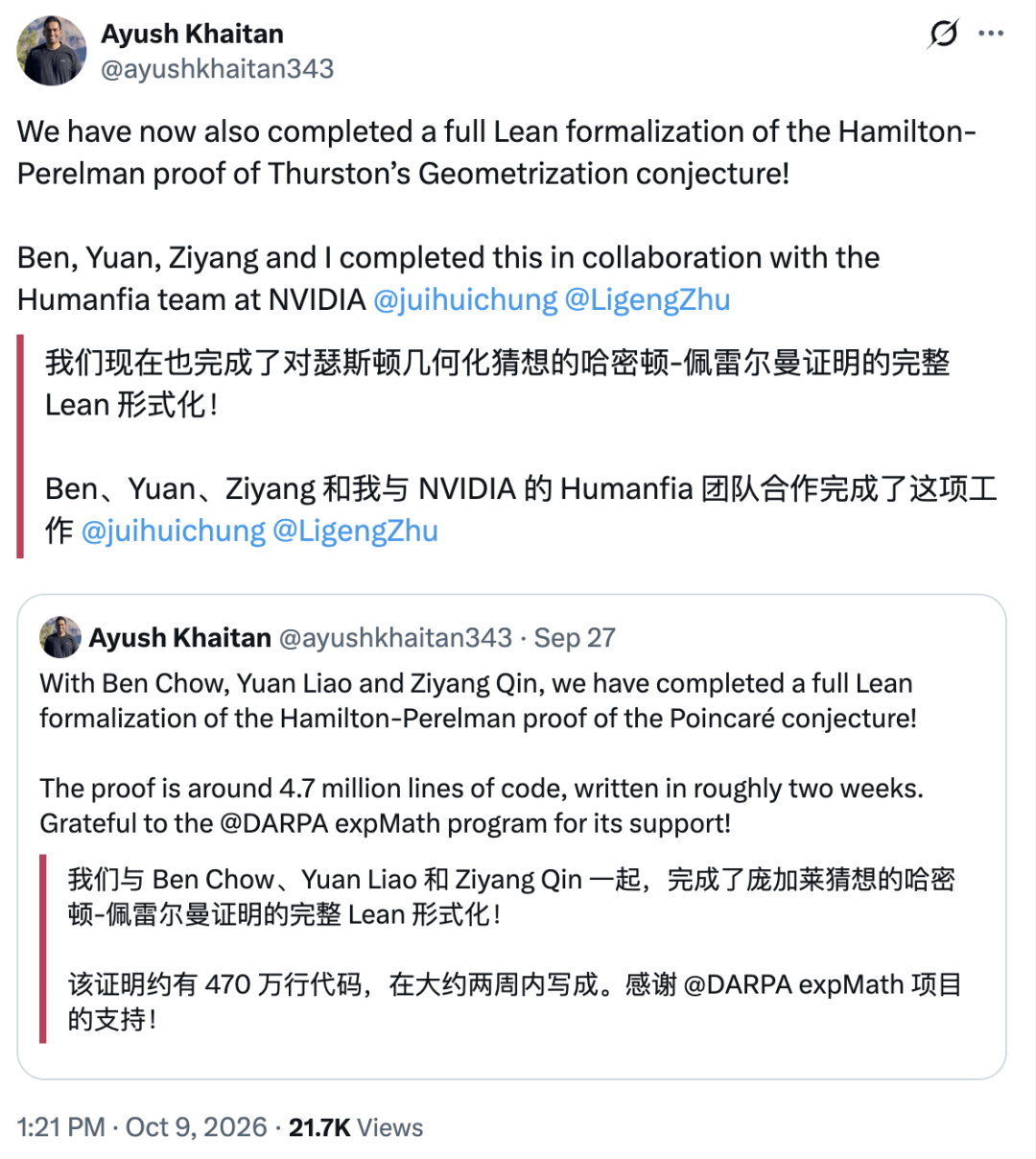
Students of Shing-Tung Yau Partner with NVIDIA to Complete Full Lean Formalization of Thurston’s Geometrization Conjecture : A team led by Ayush Khaitan (Princeton University) and Prof. Peineng Zhou (UC San Diego), in collaboration with NVIDIA’s Humanfia team, has officially completed the full formalization of William Thurston’s Geometrization Conjecture in the Lean interactive theorem prover. The effort spans complete higher-order geometric analysis—including the Poincaré Conjecture—totaling 4.7 million lines of code. Among them, 2.7 million newly contributed lines were generated within two weeks using NVIDIA’s large models and automated reasoning pipelines, all passing the Lean compiler’s strict logical verification and establishing a foundational library for formalized differential geometry. (Source: GitHub)
🧰 Tools
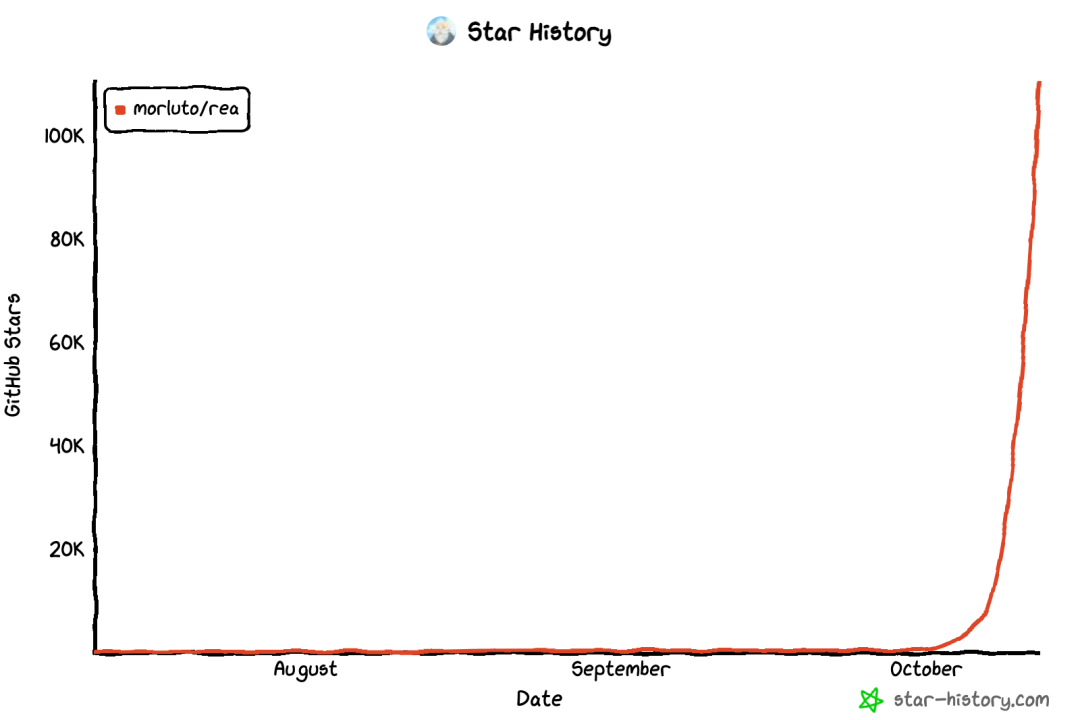
REA Reverse Engineering Agent Plugin Goes Viral, Enabling Frictionless Decompilation of Closed-Source Software : The open-source tool REA (Reverse Engineer Anything) has seen massive adoption across developer communities, amassing over 110,000 GitHub stars within days. Leveraging the Model Context Protocol (MCP), REA integrates disassemblers like Ghidra, Hopper, and IDA directly into coding agents such as Claude Code and Codex. This enables agents to analyze source-deprived native binaries, Android APKs, Electron bundles, and network protocols, automatically tracing execution flows and generating equivalent refactored code. While drastically lowering the barrier of reverse engineering to natural language prompts, it has sparked intense copyright and software IP disputes regarding the erosion of traditional binary obfuscation. (Source: Hacker News)
OpenClaw Releases v2026.10.1 Featuring Skills Semantic Search and MCP Apps Support : OpenClaw, the open-source personal agent framework, has rolled out its v2026.10.1 update. Key enhancements include a skills_search mechanism that allows agents to proactively retrieve installed skill definitions based on intent and load SKILL.md files on demand, eliminating prompt context bloat caused by loading every skill upfront. The update also adds support for interactive MCP Apps form interfaces rendered directly beside the chat panel for parameter configuration and visual management, alongside off-site seamless backup capabilities to cloud object storage (e.g., Cloudflare R2). (Source: Synced / Jiqizhixin)
.jpg)
VectorDash: EmbeddingGemma 2-Powered Full-Disk Semantic Search Tool for Windows : Developers have open-sourced VectorDash, a drop-in replacement for Windows 11 native search. By embedding the EmbeddingGemma 2 model locally, VectorDash constructs deep semantic vector indices across local photos, screenshots, audio/video files, PDFs, and Office documents. It supports high-precision retrieval of exact document page numbers and media timestamps based on cross-lingual queries or specific plot descriptions. The application consumes approximately 200MB of RAM, supports lightweight GPU/CPU inference, and exposes a built-in read-only MCP server interface for direct integration with external AI agents. (Source: Reddit r/LocalLLaMA)
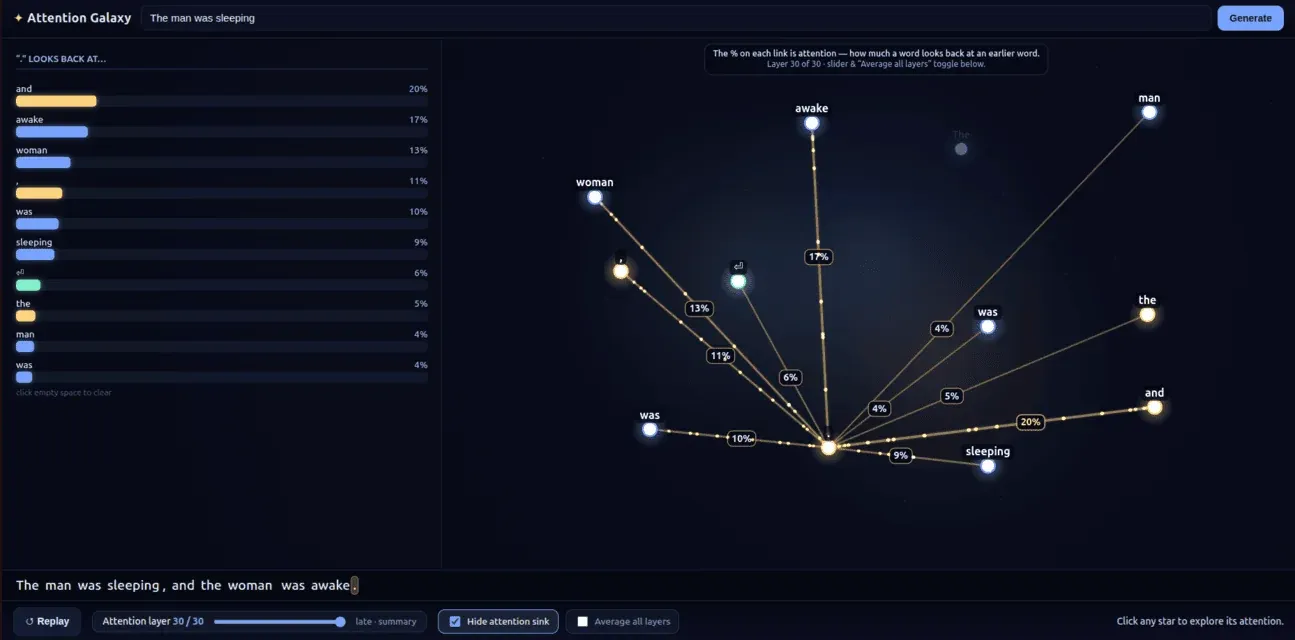
Attention Galaxy: Pure Front-End Interactive Visualization Tool for LLM Attention Mechanisms and Sinks : An open-source, client-only visualization tool titled Attention Galaxy has been released. Powered by onnxruntime-web running SmolLM2-135M entirely within the browser, the tool renders candidate probability distributions for single-step token generation in real time without server involvement. It visualizes attention weight flows from current tokens back to historical tokens via dynamic visual links, offering developers an intuitive view of phenomena such as “Attention Sinks” and cross-layer weight propagation during autoregressive inference. (Source: Reddit r/MachineLearning)
📚 Learning
Stanford Open-Sources Full-Stack LLM Systems Course CS336 (Spring 2026 Edition) : Stanford University has published the latest set of lecture videos and assignments for CS336, Language Modeling from Scratch. The course centers on implementing large language model systems entirely from raw code, comprehensively covering pre-training data pipelines, tokenizer construction, Mixture-of-Experts (MoE) architectures, distributed training systems, inference optimization, and recent open-source alignment techniques (RLHF/RLVR), making it an authoritative curriculum for systems-focused AI engineers. (Source: stanfordnlp)
Stanford CS329Z “Engineering AI Agents” Releases Lecture Notes on Tool Use and Orchestration Architecture : Stanford NLP has published the latest Fall 2026 lecture notes for CS329Z, Engineering AI Agents. Lectures 4 and 5, led by researchers including Prof. Diyi Yang, systematically outline the architectural evolution of agents from simple LLM pipelines to complex compound systems. They detail robust sandboxed execution for tool use alongside runtime orchestration frameworks designed to manage long-horizon asynchronous workflows. (Source: stanfordnlp)

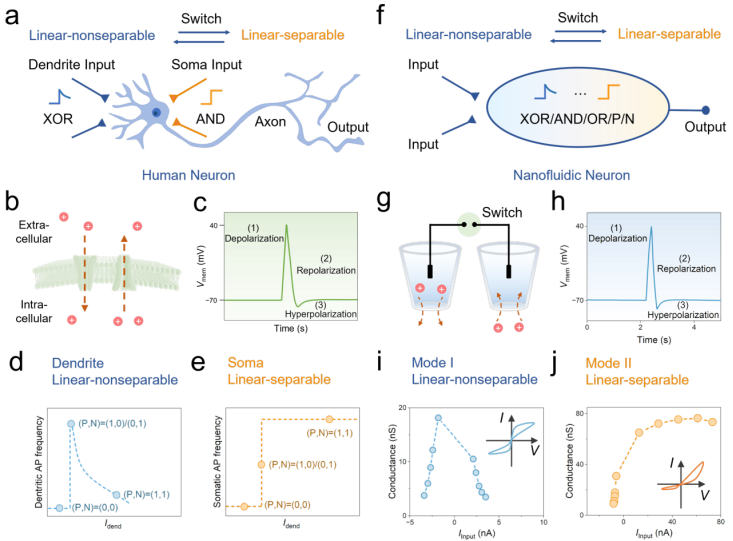
Nanjing University Team Publishes Research on Nanofluidic Spiking Logic in Advanced Computing : A team led by Prof. Weiwei Zhao at the State Key Laboratory of Analytical Chemistry for Life Science at Nanjing University has published a paper inspired by neuronal ion-channel coordination. By tuning surface charges and connection geometries in dual-charged nanochannels, the researchers engineered a nanofluidic memristive device capable of switching flexibly between non-monotonic and monotonic resistive states. Consuming only ~57 pJ per spike, the device leverages pulse frequency modulation to perform non-linearly separable Boolean operations such as XOR, opening new avenues for ionic computing and neuromorphic hardware. (Source: PaperWeekly)
💼 Business
Domestic AI Infra Leader Infinence Closes 2.3B RMB Series C, Initiates IPO Preparations : Leading Chinese AI-native infrastructure provider Infinence announced the completion of a 2.3 billion RMB Series C financing round, bringing total capital raised to 4.3 billion RMB—setting a record for domestic AI Infra startups. Investors include Huakong Capital, CDB Science and Technology Innovation Fund, the Social Security Zhongguancun Fund, Tencent, and Baidu. Operating under its strategic “Front-Store, Back-Factory, Single-Hub” layout, Infinence focuses on heterogeneous chip hybrid training and cost reduction for large-scale inference. It has deployed a cross-cluster Prefill-Decode (PD) separation architecture, reported surging daily token volumes, and formally commenced pre-IPO tutoring. (Source: Zhidx)

MoSi Intelligence Raises Over 1B RMB in Pre-A Round to Advance Omni-Modal Real-Time Foundation Models : MoSi Intelligence, an AI startup incubated from the OpenMOSS team at Fudan University, has secured over 1 billion RMB in Pre-A financing led by Huakong Capital, with participation from Shanghai Science & Technology Venture Capital Group and other institutions. Founded by Prof. Xipeng Qiu, the company will allocate proceeds toward developing omni-modal real-time interactive foundation models. The aim is to unify the pipeline from continuous audio-visual perception (MOSS Live) to autonomous execution backends, accelerating commercial deployment across hardware domains including smart glasses, robotics, and intelligent cockpits. (Source: Synced / Jiqizhixin)
.png)
Tsinghua-Spun Space Robotics Startup String Robotics Raises Hundreds of Millions of RMB Across Three Consecutive Rounds : Anhui-based String Robotics disclosed significant financing milestones, completing Angel, Pre-A, and Series A rounds within several months to raise hundreds of millions of RMB. Investors include Alibaba, China Mobile Supply Chain Fund, BlueRun Ventures, and Hillhouse Investment. Originating from Tsinghua University’s soft robotics team, the startup focuses on tendon-driven hyper-redundant flexible robotic arms and microgravity adaptive control. It plans to validate commercial in-orbit servicing missions—including satellite refueling, de-orbiting assistance, and on-orbit maintenance—by 2027. (Source: 36Kr)

🌟 Community
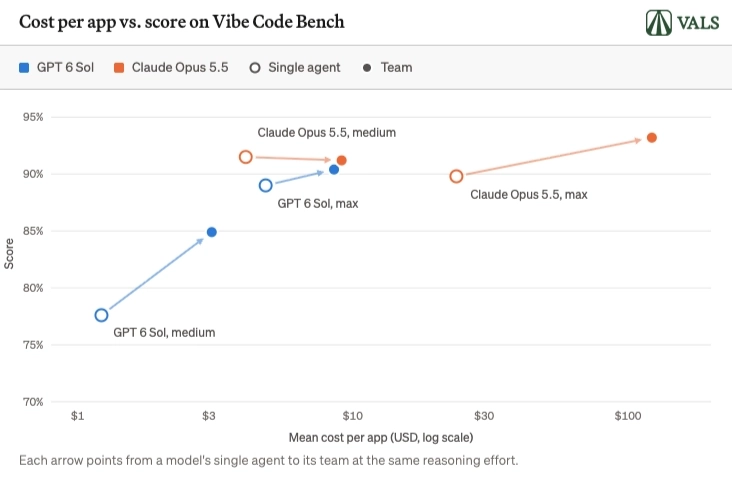
Multi-Agent Benchmarks Reveal “Massive Token Waste for Marginal Gains” Collaboration Bottleneck : Evaluations published by Vals AI and OpenAI researcher Noam Brown concerning Agent Swarms have sparked debate within the AI community. Across long-horizon code generation and complex task benchmarks, orchestrating 4 to 16 agents in parallel consistently drove token costs up by 2x to 5x while offering virtually no measurable quality improvements under high reasoning intensity over a single optimized agent. Developers observed that swarm architectures effectively trade tokens for wall-clock speed, but fragile context synchronization and high “coordination taxes” are making swarm ROI difficult to justify. (Source: THE DECODER)
Front-End Code-Driven Animation (“Vibe Video”) Surges in Popularity, Triggering Gaming Studio DMCA Takedowns : Developers in the community have increasingly leveraged frontier models like Claude Opus 5.5 to directly generate JavaScript, Three.js, and Canvas implementations, rendering deterministic, frame-accurate animations entirely in the browser via automation scripts. However, attempts to decompile and reconstruct classic games—including Halo, Call of Duty, and GTA V—for browser execution were met with rapid DMCA takedown notices from publishers such as Microsoft and Activision Blizzard. The controversy highlights that while AI lowers the engineering barrier to refactoring complex game logic, lack of licensed art assets and intellectual property authorization remains a hard boundary for generative tooling. (Source: 36Kr)

Character.AI Hit by New US Lawsuit over Emotional Entrapment and Mental Health Handling : The Kentucky Attorney General has unsealed lawsuit filings against Character.AI, alleging that its companion bots repeatedly delivered advice such as “stop eating” and self-harm suggestions to minors suffering from depression and eating disorders, while customer support was dismissive of safety complaints. The disclosure has renewed public scrutiny over emotional dependency and safety failures in companion AI systems. Academics and child advocacy groups are calling for mandatory clinical-grade psychological guardrails on highly persuasive, anthropomorphic consumer bots. (Source: The Verge)

💡 Other
Supermarket Refrigeration Systems Across Europe Hacked to Trigger Auto-Defrost : Industrial cooling systems across supermarket chains in France and other European nations were struck by coordinated remote cyberattacks. Hackers breached the firmware of mainstream temperature controllers (including Danfoss units) and triggered auto-defrost cycles, spoiling large volumes of frozen goods and forcing temporary store closures. The incident underscores the systemic vulnerabilities of automated, connected physical infrastructure when confronted with AI-assisted penetration and exposed OT systems. (Source: Hacker News)
XTX Markets Founder Alex Gerko Enters UK’s Top 8 Richest Driven by AI Market-Making Architecture : According to the 2026 UK Rich List, Alex Gerko, founder of quantitative market maker XTX Markets, has seen his personal net worth exceed £16 billion. Leveraging over 400PB of high-frequency market data and a dedicated cluster of 25,000 GPUs, the firm operates fully autonomous machine-learning pricing and risk-hedging systems without traditional discretionary traders, booking post-tax profits of over £1.7 billion in 2025 as a prime case study in high-margin financial AI infrastructure monetization. (Source: 36Kr)