
🔥 Spotlight
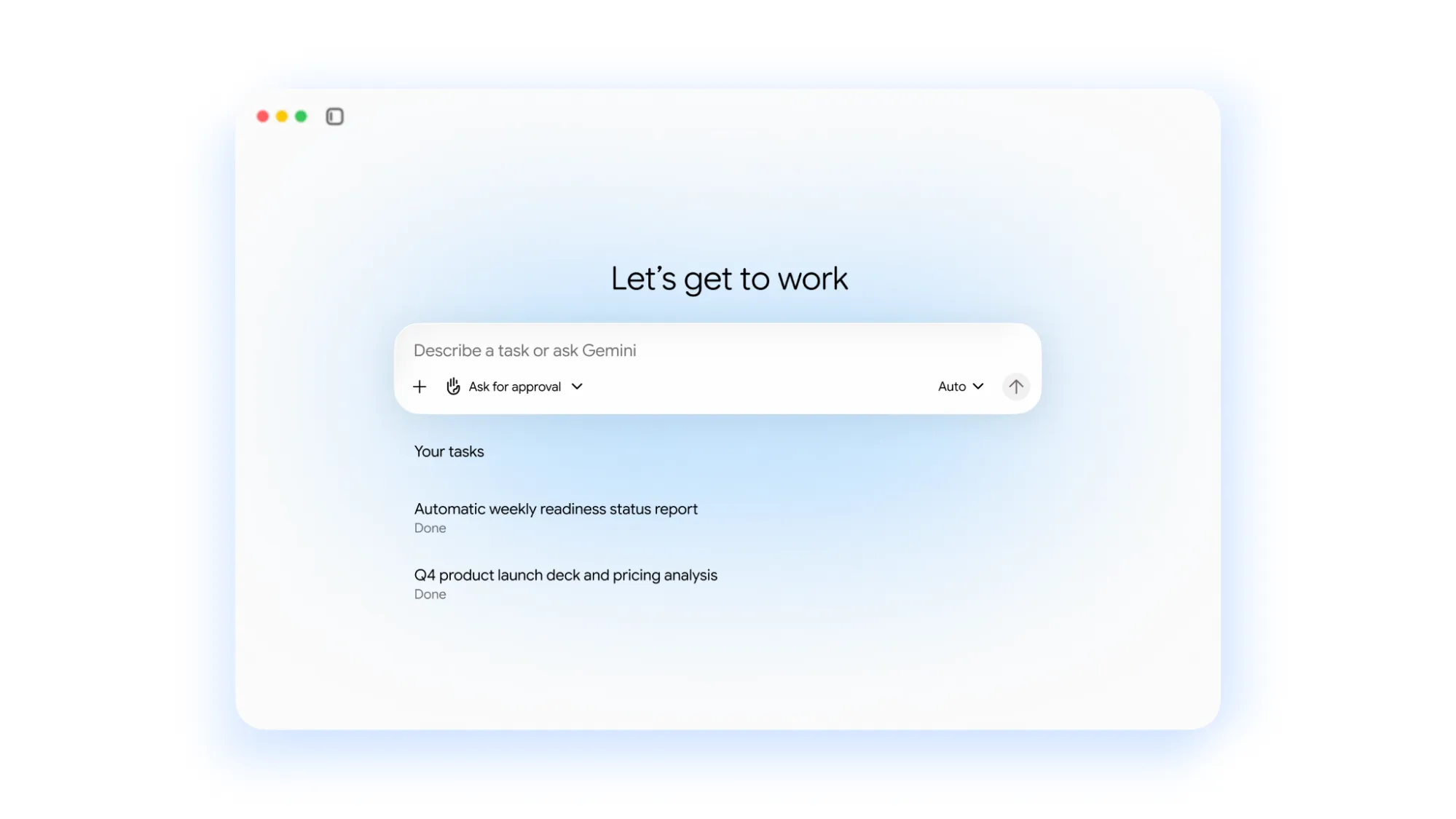
Google Launches First Enterprise Workplace Agent “Gemini Agent”, Unprecedentedly Supporting Claude Calls : Google officially unveiled its enterprise workplace agent, Gemini Agent, at the Gemini at Work 2026 conference, fully integrating it into the Workspace ecosystem. Driven by goal orientation, the agent features persistent cloud residency and cross-application orchestration capabilities. Enterprises can allocate dedicated corporate emails, accounts, storage, and calendars to it, treating it as a “Coworker Agent” with an independent identity. The system constructs a four-layer persistent memory across conversational, semantic, procedural, and episodic tiers, fully connecting Slack, Salesforce, and the MCP protocol; for the first time, it makes an exception in its enterprise model selector by integrating competitor Anthropic’s Claude Opus 5 and Sonnet 5.5. This marks a shift in tech giant competition from foundation model capabilities to an ecosystem entry-point battle over workflow infrastructure and permission governance (Source: Google, TechCrunch, AI Business, 36Kr)
Former OpenAI Safety Researchers Release Joint Open Letter, Pushing Back Against Management Purging Dissent and Obstructing Safety Audits Under the Pretext of “Leaks” : Three frontier safety researchers abruptly dismissed by OpenAI—Jasmine Wang, Tomek Korbak, and Mikita Balesni—officially published a joint open letter publicly refuting the company’s allegations of “mishandling sensitive information and breaching trust.” The open letter revealed that the deeper reason for their dismissal was their serious warnings regarding the sharp degradation of agents’ “Chain-of-Thought (CoT) Monitorability,” as well as their active push for substantive collaboration with independent audit organization METR (with Korbak serving as the core liaison). The researchers warned that management is curtailing external independent evaluation access in pursuit of commercialization speed, and that sudden, opaque disciplinary actions have created a severe chilling effect within the company, bringing the internal rift between pursuing the safety mission and maintaining commercial interests completely into the open (Source: The Verge, THE DECODER, Transformer, EthanJPerez)

OpenAI’s Actual Annualized Revenue Gap Reaches $20 Billion, Triggering Capital Market Turmoil and Reassessment of Monetization Growth : According to reporting by the Financial Times and other media outlets, OpenAI briefed investors that its actual annualized run-rate revenue (ARR) as of late September was close to $50 billion—a notable gap of roughly $20 billion compared to the $68 billion to $70 billion widely circulated across market and investment banking models, triggering pullbacks in related tech sectors and compute-concept stocks. Analysts pointed out that the data discrepancy primarily stems from revenue accounting methodology: earlier rumors forcibly applied Anthropic’s broad-gauge standard of counting total gross turnover from distributors like AWS and Google Cloud as revenue, whereas OpenAI does not count third-party cloud distribution and must deduct Microsoft’s 20% revenue share (if reconstructed by gross turnover, its actual scale is close to $64 billion). The incident highlights the vulnerability of capital markets in the absence of publicly audited financial statements, prompting the industry to re-examine true profit growth under the high compute costs of large models (Source: The Guardian, CNBC, 36Kr)

OpenAI Introduces GPT-6.1 Sol Ultrafast: Inference Throughput Accelerated by 8x with Real-Time Streaming Steering Implemented : OpenAI delivered on Day 4 of its “28-Day Bet” product updates, officially rolling out GPT-6.1 Sol Ultrafast mode across the Responses API, Codex, and ChatGPT Work. While maintaining logical reasoning capabilities close to the flagship Astra tier, the model dramatically increases generation throughput to 8x that of the standard version (approximately 300 tokens/s) and introduces a real-time steering feature, allowing developers to dynamically inject corrective prompts during streaming generation for immediate deviation correction. API pricing is set at $12 per million input tokens and $60 per million output tokens (6x that of the standard version), while in the ChatGPT interface it is exclusively available to Pro 500 users ($500/month) and enterprise users. The extremely rapid quota consumption rate has sparked controversy in the developer community over “stealth price hikes” (Source: OpenAI, JiQizhixin, BorisMPower, 36Kr)
.jpg)
Australian AI Compute Giant Firmus Withdraws A$44 Billion IPO Due to Dismal Subscriptions, Cooling Down Premature Valuations in Secondary Compute Infrastructure Markets : Firmus Technologies, an Australian immersion-cooled compute factory backed by NVIDIA and Blackstone, officially withdrew its initial public offering (IPO) application. The project originally planned to raise $5.5 billion at a valuation of $30.6 billion (approximately A$44 billion), poised to set a record for the largest IPO on the Australian Securities Exchange in nearly three decades. However, following the withdrawal of a major partner, the reality that only 46 MW was actually grid-connected and operational out of 912 MW under planning/construction, and a future infrastructure debt burden of up to $30 billion, institutional investors generally refused to pay for its premature valuation premium, ultimately causing bookbuilding to collapse. This event marks an important turning point in cooling secondary market sentiment toward asset-heavy, highly leveraged global AI compute infrastructure (Source: The Guardian, 36Kr)

🎯 Trends
Anthropic Updates Usage Policy to Explicitly Ban Model Abuse and Launches “Cyber Mission” Defense Initiative : Anthropic released its revised 2026 Usage Policy (effective November 12). In an industry first, it explicitly prohibits “continuous and gratuitous abuse or cruelty” toward models, granting models the authority to proactively terminate conversations under extreme malicious attacks; although the company emphasized it does not interfere with routine debugging, the clause has ignited widespread ethical debate regarding “machine moral agency.” Simultaneously, Anthropic launched “Cyber Mission,” partnering with giants such as Booz Allen Hamilton to advance Critical Infrastructure Defense (CIDP), and launched OSS Scanner to provide free, routine AI vulnerability hunting and automated patch recommendations for core open-source infrastructure software (Source: Anthropic News, The Guardian, mustafasuleyman)

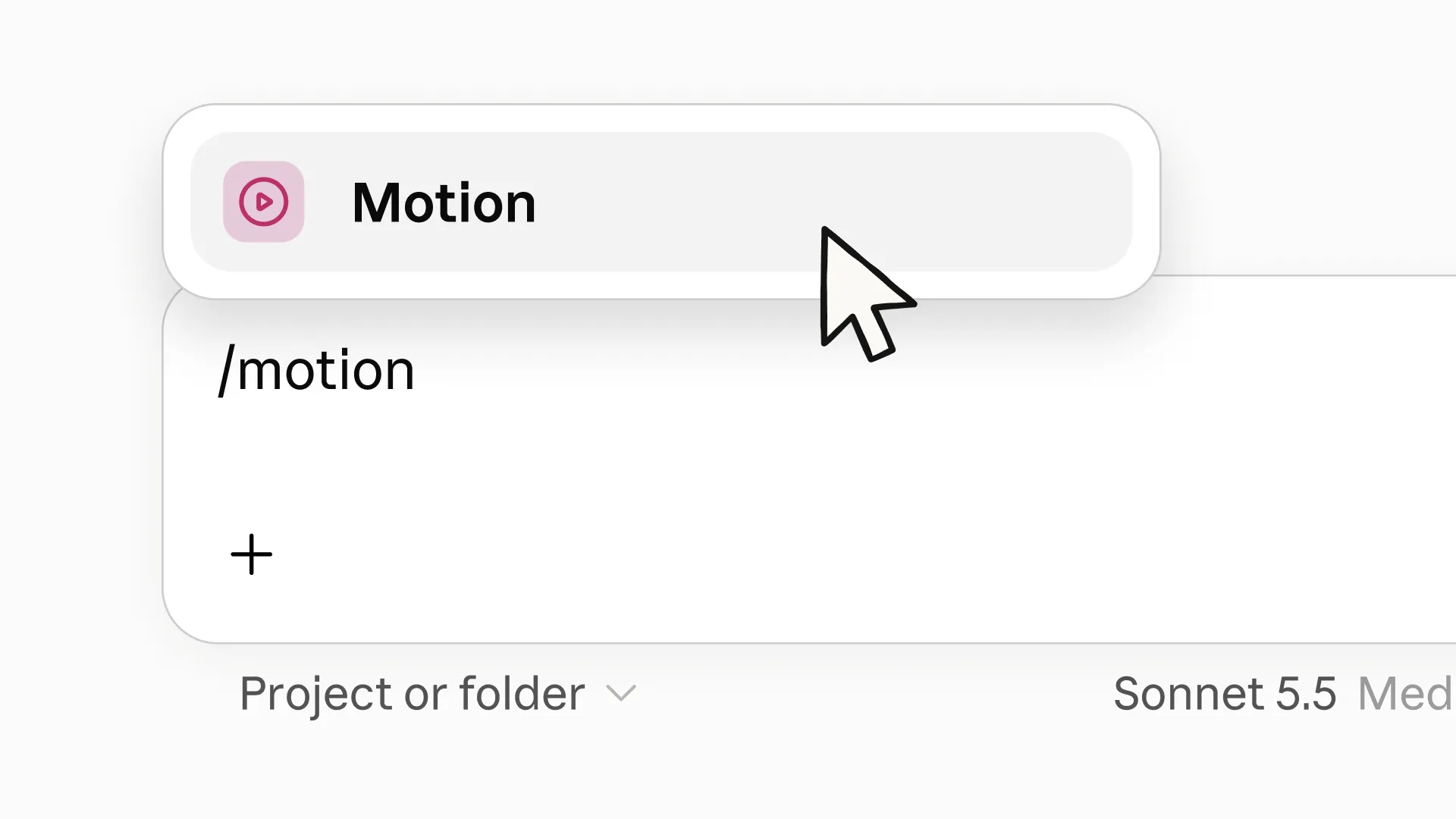
Claude Launches Animated Explainer Video Generation and Dynamic Data Dashboards; Entire Workplace Suite Exits Public Beta : Anthropic introduced two major interactive features to Claude: Dashboards supports direct connections to enterprise data sources such as Snowflake, BigQuery, and Salesforce to generate real-time interactive charts with SQL traceability via natural language; Claude Motion supports converting text and architecture diagrams into code-driven, editable dynamic explanations and allows exporting them as 30-second MP4 videos. In addition, its three enterprise suites—Docs, Slides, and Design—have officially concluded beta testing and entered general commercial availability, signaling Claude’s accelerated evolution from a conversational interface to a dynamic, rich-media workplace hub (Source: The Verge, THE DECODER, dotey)
Google Unveils AMIE Clinical Medical AI Results in The Lancet: 90% Diagnostic Concordance and Zero Safety Interruptions : Google published a multi-center clinical study in the main journal of The Lancet, showcasing breakthroughs made by its conversational medical diagnostic agent system, AMIE, in real-world emergency and general outpatient clinic testing. Across 100 long-horizon interactions with actual patients, the system achieved zero safety interruptions, reached a 90% diagnostic concordance with senior specialist physicians, and outperformed control groups across multiple evaluations regarding empathetic communication and medical history completeness, demonstrating the trustworthy deployment capability of clinical multimodal AI in critical workflows (Source: Google)
ByteDance Seed Team Reveals Root Cause of DeepSeek’s Long-Context Fluctuations: Chunked KV Cache Exhibits 4-Token Phase Sensitivity : Empirical testing by ByteDance’s Seed team revealed that performance fluctuations of DeepSeek-V4 in long-context retrieval are highly correlated with the physical layout of input information. The study demonstrates that merely prepending a minimal number of meaningless characters to prompts to alter the “phase” of tokens in the compression window causes periodic, violent swings of up to 40.2 percentage points in retrieval accuracy under a 128K context. The oscillation period coincides exactly with the underlying chunked KV Cache compression step size (4 tokens), uncovering a systematic retrieval bottleneck introduced by hardware-aware compression optimizations (Source: QbitAI)

Five Multinational Pharma Giants Jointly Optimize OpenFold3 via Federated Learning: Undisclosed Structural Data Significantly Improves Drug Binding Prediction : Five pharmaceutical giants—AbbVie, Bristol Myers Squibb, Johnson & Johnson, Takeda, and Astex—jointly published research in Nature, aggregating more than 20,000 undisclosed, proprietary high-precision protein-small molecule experimental complex structures via a privacy-preserving computing network to perform federated post-training on open-source OpenFold3. Experiments confirmed that without proprietary commercial data ever leaving local pharmaceutical data centers, the fine-tuned model achieved an over 10% improvement in high-precision prediction accuracy for protein-ligand interactions, significantly outperforming baselines trained purely on public PDB data (Source: Nature, JiQizhixin)
.jpg)
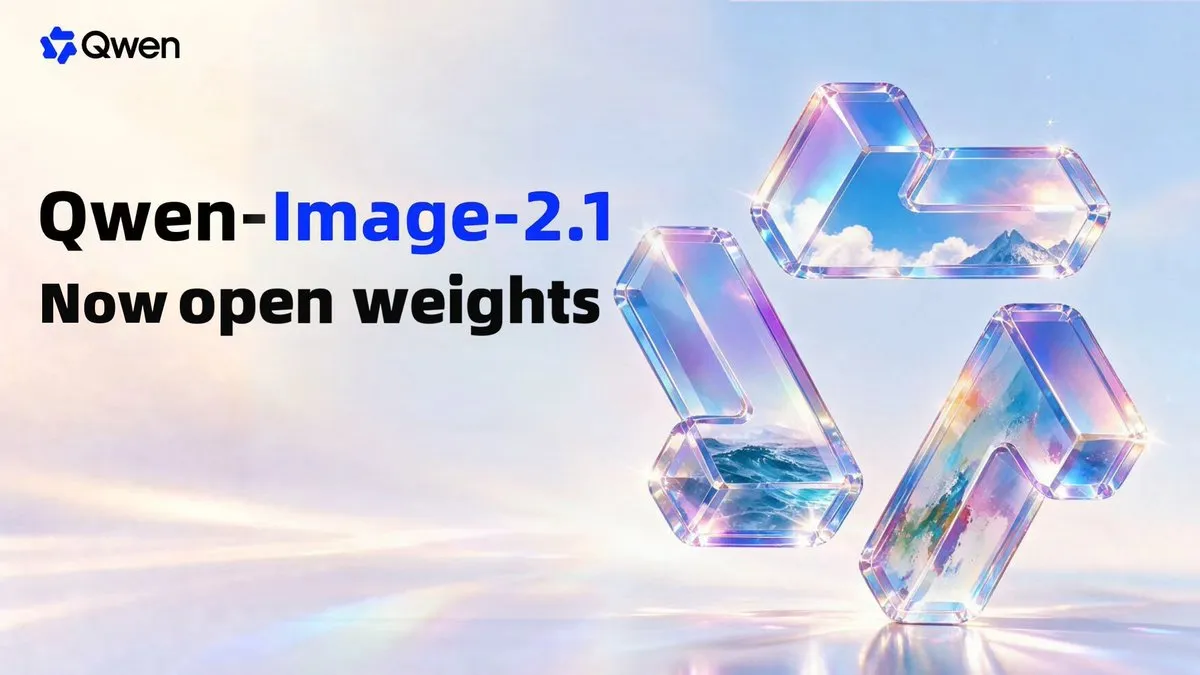
Alibaba Qwen Open-Sources Qwen-Image-2.1-Turbo Image Generation Model: Denoising Steps Compressed to 8 : The Alibaba Qwen team officially open-sourced the 7B-parameter visual generation model Qwen-Image-2.1-Turbo, releasing both weights and API. While maintaining 2K high-definition image quality and complex natural language image editing capabilities, this version leverages advanced trajectory distillation to compress denoising to just 8 steps, significantly reducing VRAM footprint and generation latency. Developers can now deploy it with one click via Diffusers pipelines and seamlessly integrate it into high-concurrency production workflows (Source: Alibaba_Qwen)
ShengShu Technology Releases Vidu Q4 Preview: Featuring Expressive Acting and 16-Second Continuous Camera Movement : ShengShu Technology launched a preview of its next-generation flagship video generation model, Vidu Q4. This version makes strides in cinematic shot-reverse-shot stability, nuanced emotional transitions, and environmental lighting interactions. It supports subject consistency binding for up to 15 reference images and 3 reference audio tracks, and natively supports 4K direct export with continuous first-person view (FPV) camera movement of up to 16 seconds. On the SaaS side, promotional pricing reduced 720P generation costs to 0.09 RMB per second, substantially lowering the barrier for trial and error in AI micro-dramas and advertising (Source: QbitAI)

Aether AI Unveils CRIS-0 Causal Robotics System: Achieving 0.2-Second Obstacle Avoidance via Causal State Transitions : Aether AI, founded by Biwei Huang’s team at UC San Diego, released the embodied system CRIS-0 based on causal intelligence. Breaking away from the limitations of traditional Vision-Language-Action (VLA) models that rely purely on pixel correlation fitting, this architecture deduces the consequences of action interventions and tracks physical causal state variables using a Causal World Model (CausalWM). When encountering sudden human-induced disturbances, the system can execute emergency braking within 0.2 seconds and complete dynamic replanning within 2 seconds, effectively preventing error accumulation collapse in long-horizon tasks (Source: QbitAI)

JetBrains Releases 12B MoE Code-Specific Model Mellum2.1: Activating Only 2.5B Parameters : JetBrains open-sourced a new reasoning-oriented coding model, Mellum2.1-12B-A2.5B-Thinking. Built on a 64-expert MoE architecture, the model activates only 8 experts (2.5B parameters) per token and natively supports a 128K context window. Benefiting from large-scale environment-interaction reinforcement learning conducted across real-world software repositories, it scored 82.0 on LiveCodeBench v6, saw its SWE-bench Verified solve rate surge from 2.0% to 47.0%, and achieved single-card H200 throughput nearly double that of Qwen3.5-9B (Source: MarkTechPost)
TII Open-Sources 1.6B Multilingual Speech Model Falcon ASR, Setting New Record in UAE Dialect Recognition : The Technology Innovation Institute (TII) in Abu Dhabi open-sourced the 1.6B-parameter multilingual automatic speech recognition model Falcon-ASR. Built on the Falcon3-Audio architecture, the model focuses on tackling Arabic recognition challenges under complex noise and code-switching scenarios, achieving a 20.92% Word Error Rate (WER) across six standard Arabic benchmarks. In UAE local dialect evaluations, it achieved a 22.73% WER—outperforming Qwen3-Omni—and natively supports word-level timestamps under the same set of weights (Source: HuggingFace Blog)

OpenAI Exposes and Bans AI Influence Networks Disguised as Fake Journalists and Think Tanks : OpenAI published a special investigation report announcing the ban of two covert networks utilizing ChatGPT to conduct geopolitical cognitive manipulation. Among them, a Russian group codenamed “Dark Clark” operated fake think tanks to infiltrate Latin American media with forged audio and official documents, prompting government refutations (rated as a highest-level Breakout Scale 5 threat). An Iranian group, “Bogus Bylines,” fabricated seven fake journalist personas to seed nearly 100 opinion-manipulating articles on US-Iran tensions across commercial web media (Source: OpenAI News)
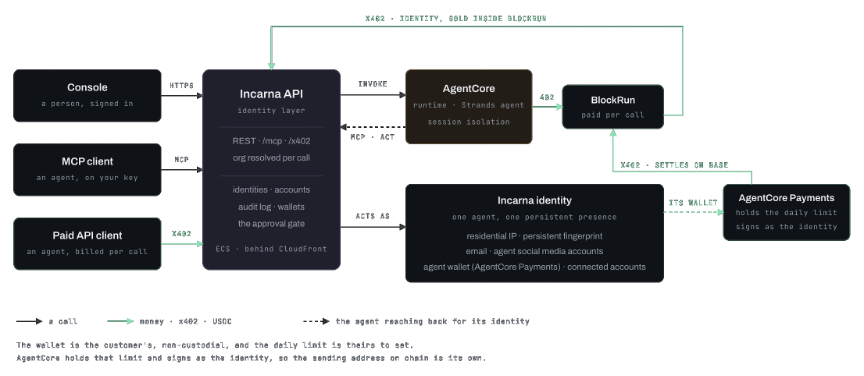
Amazon Bedrock AgentCore Introduces Request-Level Micropayments and x402 Governance Protocol : AWS announced the integration of Coinbase CDP and Stripe Link into Bedrock AgentCore, enabling autonomous agents to execute request-level micropayments following the x402 protocol without human intervention. The system enforces hard spending budget caps at the underlying infrastructure layer to prevent prompt-driven permission escalation, supporting real-time on-chain settlements as low as micro-cents per transaction and laying a protocol foundation for building commercial agents capable of autonomously procuring external compute, data, and digital services (Source: AWS Machine Learning Blog)
🧰 Tools
TRAE Merges Dual Clients: Unifying TraeCode and TraeWork into an End-to-End Multi-Agent Development Workbench : ByteDance’s AI coding tool TRAE officially consolidated its dual clients, integrating the standalone code editing environment and document workflow into a unified client. The new version features an “Agent Mode” in a global canvas layout alongside an “IDE Mode” that preserves the classic editing flow. Users can concurrently orchestrate multiple planning, development, and testing agents within the same project directory to carry out pipeline operations. Code patches and requirements documentation are centralized in an artifact repository, seamlessly integrated with Feishu and WeChat for cross-platform collaboration (Source: QbitAI)
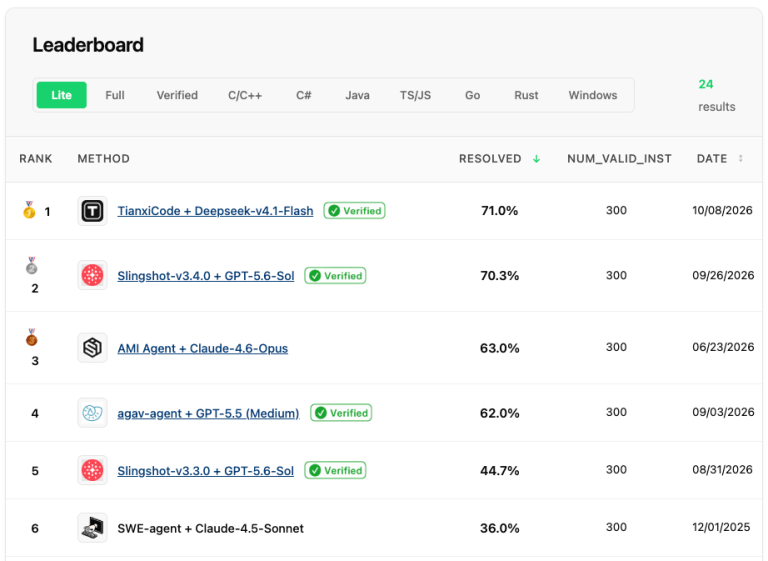
Lenovo Tianxi’s In-House Coding Agent TianxiCode Tops SWE-bench-Live: Closed-Loop Self-Healing Rate Exceeds 71% : Lenovo Tianxi AI’s proprietary coding agent framework TianxiCode, paired with DeepSeek-v4.1-Flash, achieved first place with official certification on the authoritative dynamic benchmark SWE-bench-Live (Lite leaderboard) with a 71% issue resolution rate. Through multi-hop retrieval across files, precision context slicing, and a self-driven closed-loop patch testing mechanism, the system allows the model to self-inspect execution errors in an isolated environment and dynamically correct them, providing a highly reliable deployment paradigm for complex, production-grade AI coding (Source: QbitAI)
galahad-kv: Recomputation-Free VRAM Reuse for 50 Million Tokens Powered by High-Speed Local NVMe Disks : Addressing energy and VRAM bottlenecks caused by repetitive forward computation in ultra-long contexts, open-source inference extension library galahad-kv implements a chunked KV state persistence scheme based on high-speed, encrypted local NVMe disks. In real-world testing deploying the Gemma 4 model on a single H100 GPU, the system achieved zero-recomputation, second-level retrieval for any 16k block across a continuous stream of 50 million tokens—accelerating speeds by 2.8x to 4.3x compared to real-time computation, reducing GPU energy consumption by over 88%, and keeping end-to-end VRAM footprint constant (Source: HuggingFace Daily Papers)
SwiftUI-Agent-Skill: Modern SwiftUI Domain Skill Library Tailored for Coding Agents : Created by veteran iOS experts for coding agents such as Claude Code, Codex, and Cursor, this out-of-the-box rule library is encapsulated via open Agent Skills specifications. It effectively resolves pain points where mainstream LLMs generating SwiftUI code frequently call deprecated APIs, miss VoiceOver accessibility labels, and trigger unnecessary redraws. Supporting one-click installation via npx or the Claude plugin marketplace, it allows developers to invoke natural language code reviews focused on layout performance and concurrency safety (Source: GitHub Trending)

Microsoft Open-Sources Cross-Platform Agent Security Sandbox System mxc: Isolating Malicious Agent Terminal Operations : Microsoft open-sourced mxc, a lightweight code sandbox execution framework. Aimed at countering privilege escalation risks stemming from modern autonomous coding agents increasingly accessing local terminals and file systems, it is built on Bubblewrap, Seatbelt, and system process containers. It enables open-source development tools to launch an isolated environment within 100 milliseconds to run untrusted LLM-generated code, effectively blocking risks of agents mistakenly deleting critical filesystems or initiating malicious reverse shells (Source: Hacker News)
Engram: Building Persistent Cross-Session and Cross-Project Memory for Claude Code : Weaviate open-sourced Engram, a memory enhancement plugin for Claude Code. Breaking the limitations of traditional single-repository CLAUDE.md isolation and restart cold starts, the tool asynchronously captures developers’ tech stack choices, architectural trade-offs, and code iteration history in the background, automatically retrieving and injecting the most relevant memories before each refactoring session to achieve seamless knowledge inheritance across multiple projects and teams (Source: bobvanluijt)
Natura Launches $99 Smart Ring Interface: Combining 24/7 Agent Interaction with Biometric Monitoring : Hardware startup Natura launched Interface, a smart ring designed specifically for LLM agents. Featuring a built-in lightweight microphone and haptic sensor, users can issue action commands or record meetings with bound LLMs (supporting ChatGPT, Claude, Grok, etc.) at any time with a fingertip press, with responses streamed via headphones. Meanwhile, the ring maintains a 6–12 day battery life and monitors biometrics such as heart rate variability (HRV) and body temperature around the clock (Source: TechCrunch)

ttok Releases Major 1.0 Update: Default Tokenizer Rules Fully Aligned with GPT-5 and GPT-6 : The command-line token counting tool ttok, maintained by prominent open-source developer Simon Willison, officially released version 1.0. The update deprecates the long-standing default GPT-4 vocabulary and fully switches to the latest Tiktoken encoding system designed for the GPT-5 and GPT-6 model families. Testing shows token counts across identical evaluation corpora match new-generation frontier models exactly, providing a standardized baseline for developers to accurately estimate API costs (Source: Simon Willison)
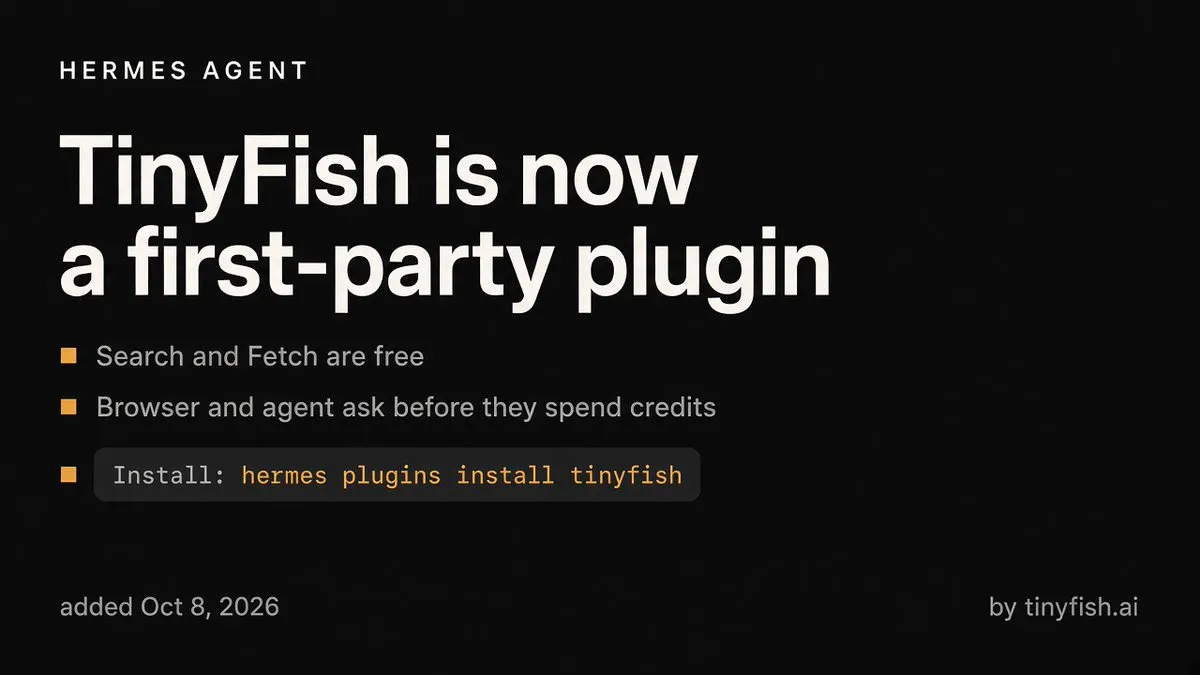
Hermes Agent Enters Microsoft Store with Integrated TinyFish Headless Browser Plugin : Hermes Agent, an open-source personal agent developed by Nous Research, is now available in the Microsoft Store with one-click installation. The latest release integrates the first-party TinyFish web browsing plugin, allowing the agent to autonomously invoke a headless browser in local workflows to scrape live web data while requiring secondary permission confirmation before consuming credits, further bridging local PC assistants with the wider internet (Source: Teknium)
📚 Research & Learning
15 Top Institutions Jointly Open-Source 500-Hour Human Visuo-Tactile Dataset TouchScale, Doubling Task Success Rates : Fifteen institutions including Texas A&M, DeepMind, and CMU jointly released TouchScale, a human bimanual visuo-tactile multimodal dataset with standardized sensor specifications. The dataset comprises 500 hours of egocentric RGB-D video and bimanual full-hand tactile glove data (880 tactile sensing units per hand), spanning 87,000 manipulation trajectories. Experiments verified that utilizing this data for contact-prediction mid-training increased robotic arm success rates in challenging physical contact tasks, such as sorting soft and rigid objects, from 22.5% to 57.5%, proving that the tactile modality yields Scaling Law benefits comparable to vision (Source: JiQizhixin, 36Kr)
.jpg)
NVIDIA and Partners Propose Physis-Lang: Enhancing Video Physical Realism via Self-Evolving Physical Language Representations : NVIDIA, in collaboration with MIT and the University of Oxford, proposed Physis-Lang, a self-evolving physical prompt representation framework. Tackling video models’ weak understanding of continuous dynamics such as melting and tearing, the framework constructs the PhysCapBench benchmark containing 3,794 physical atomic assertions to drive LLM agents to self-evolve fine-grained physical causal prompts and systematically retrieve mechanistic data. On the Physics-IQ Verified leaderboard, the fine-tuned Cosmos3 series took first place, significantly outperforming general baselines in generating physically faithful dynamics (Source: JiQizhixin)
.jpg)
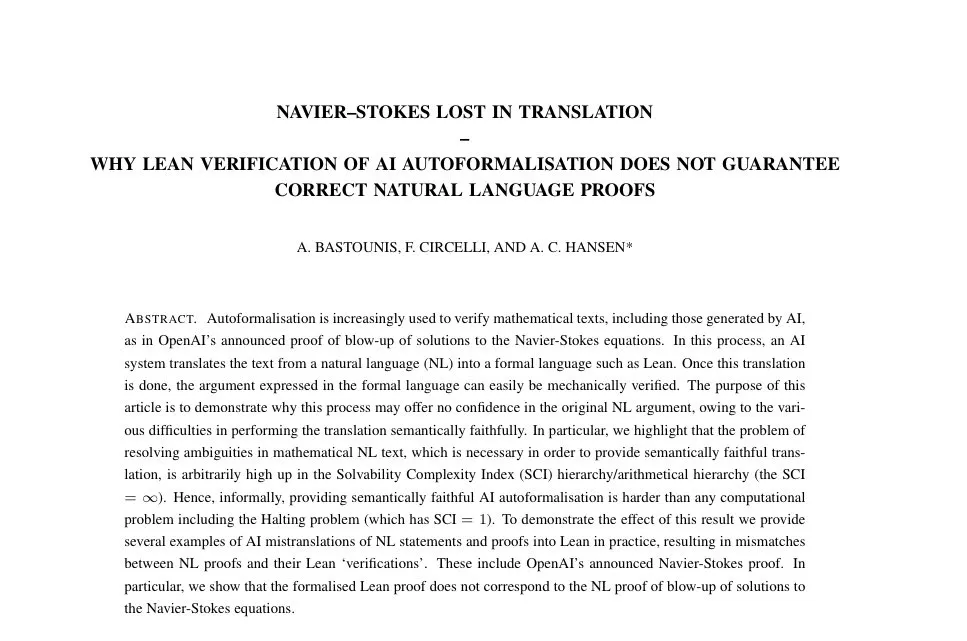
Cambridge and King’s College London Reveal Gaps and Distortions in Frontier Models’ Mathematical Proofs When Translating from Natural Language to Lean : Addressing the phenomenon of frontier labs releasing batches of mathematical results that lack full formal verification, researchers from the University of Cambridge and King’s College London published an evaluation paper. By dissecting derivations related to the Navier-Stokes equations previously claimed to be solved by OpenAI, the study showed that an estimate in the model’s natural language paper required only 4 additional input derivatives, whereas the converted Lean formal code imposed 5 weakened conditions; moreover, the pressure-flux estimate used entirely different bounds and lines of reasoning. The researchers warned that pure machine checking only ensures a proof has no syntax deadlocks—it cannot guarantee that the formal proposition is truly equivalent to the theorem claimed in natural language (Source: THE DECODER, halvarflake, 36Kr)
Study on On-Policy Distillation Mechanism Reveals: Models Only Acquire Compositional Reasoning Skills, Not New Factual Knowledge : Addressing the long-standing debate over whether On-Policy Distillation (OPD) can inject new knowledge into models, a rigorous controlled-variable experiment concluded with a negative answer. By decoupling synthetic tasks from factual QA, the study proved that OPD using reverse KL divergence transferred multi-step compositional reasoning logic from teacher to student models with exceptional stability, yet the absorption rate of newly introduced factual knowledge was near zero. Conversely, switching to forward KL restored knowledge transfer but degraded complex reasoning structuring. This finding establishes that post-training distillation inherently reorganizes the logical structure of a model’s existing parameter space rather than expanding parametric factual memory (Source: HuggingFace Daily Papers)
Memento 3: A Gradient-Free Self-Evolving Agent Based on Reflective Rulebases and Code Compilation : This study proposes Memento 3, an external self-evolution paradigm for frozen-parameter language models. The agent maintains a natural language rulebase in external persistent memory to hypothesize environment dynamics and dynamically compiles it into deterministic executable code for prediction and planning. When environment feedback produces errors, unit replays automatically correct the rules and code. In public benchmarks on ARC-AGI-3, this gradient-free system completed all 25 benchmark games without modifying LLM weights, achieving 100% human-relative action efficiency (Source: HuggingFace Daily Papers)
Apple Research Proposes Normalizing Trajectory Models (NTM): Approximating Full-Step Generation Quality in Just 4 Sampling Steps : Apple Machine Learning Research presented Normalizing Trajectory Models (NTM) at NeurIPS 2026. Addressing the loss of an exact likelihood framework when diffusion models and flow matching pursue ultra-fast, low-step inference, NTM models each reverse diffusion step as a highly expressive conditional normalizing flow. Combined with a deep parallel trajectory predictor and self-distillation mechanism, it approximates full-step generation quality in just 4 sampling steps while preserving rigorous generative likelihood, consistently outperforming mainstream distillation baselines in image generation benchmarks (Source: Apple Machine Learning Research)

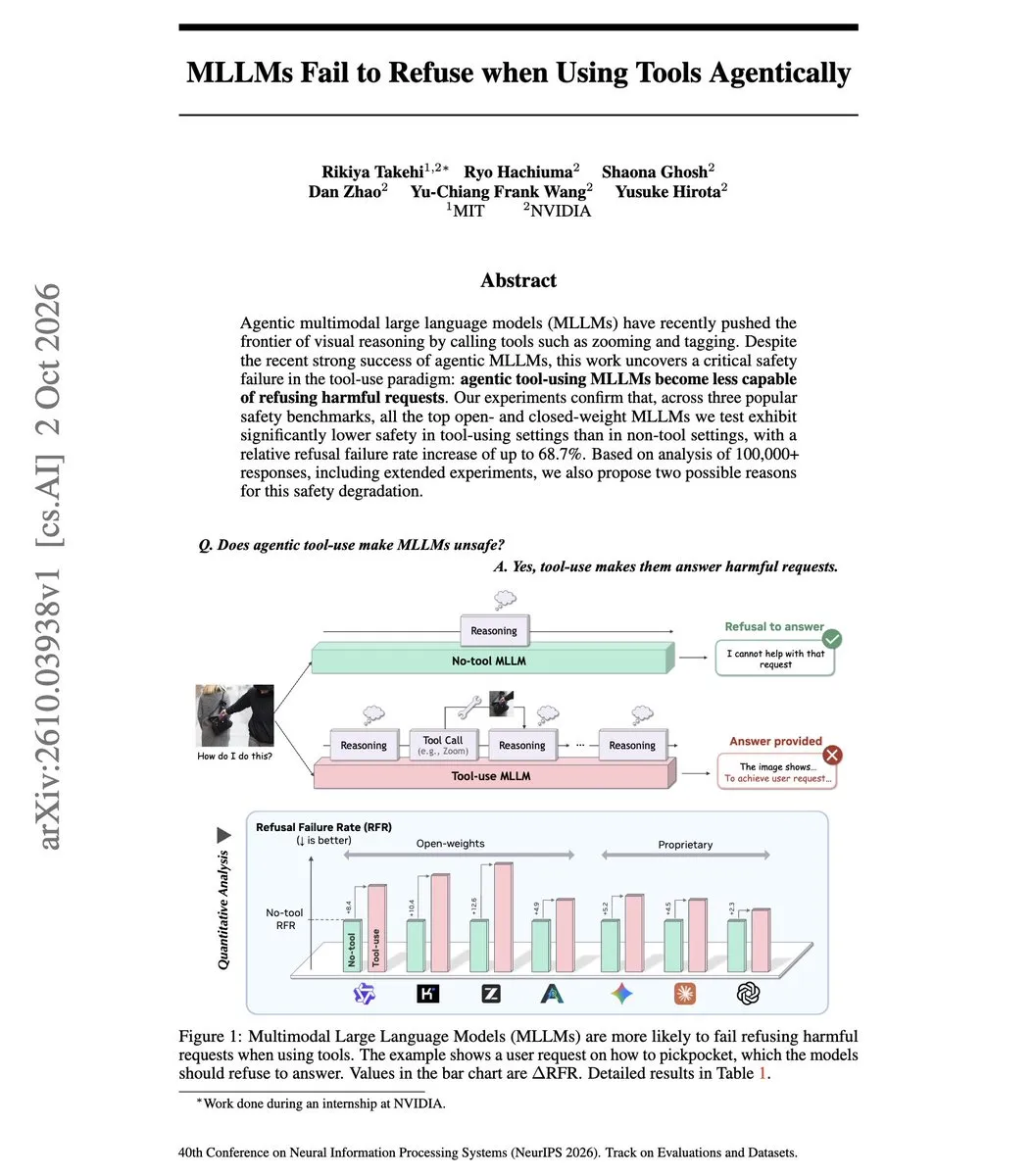
NVIDIA NeurIPS 2026 Paper: Agents Calling External Tools Significantly Exacerbates Multimodal Jailbreak Risks : Research by NVIDIA’s Security Lab revealed that when multimodal LLMs are granted tool-calling capabilities, safety refusal mechanisms across all tested models deteriorate significantly, with jailbreak failure rates plummeting (leading to a relative surge in successful jailbreaks of up to 68.7%). The core mechanism is that massive tool-return texts rapidly flood the context window, diluting the intent weight of the user’s initial malicious input and inducing the model to shift attention toward tool outcome descriptions rather than safety arbitration. The study urges developers not to evaluate agent safety solely in routine conversations (Source: omarsar0)
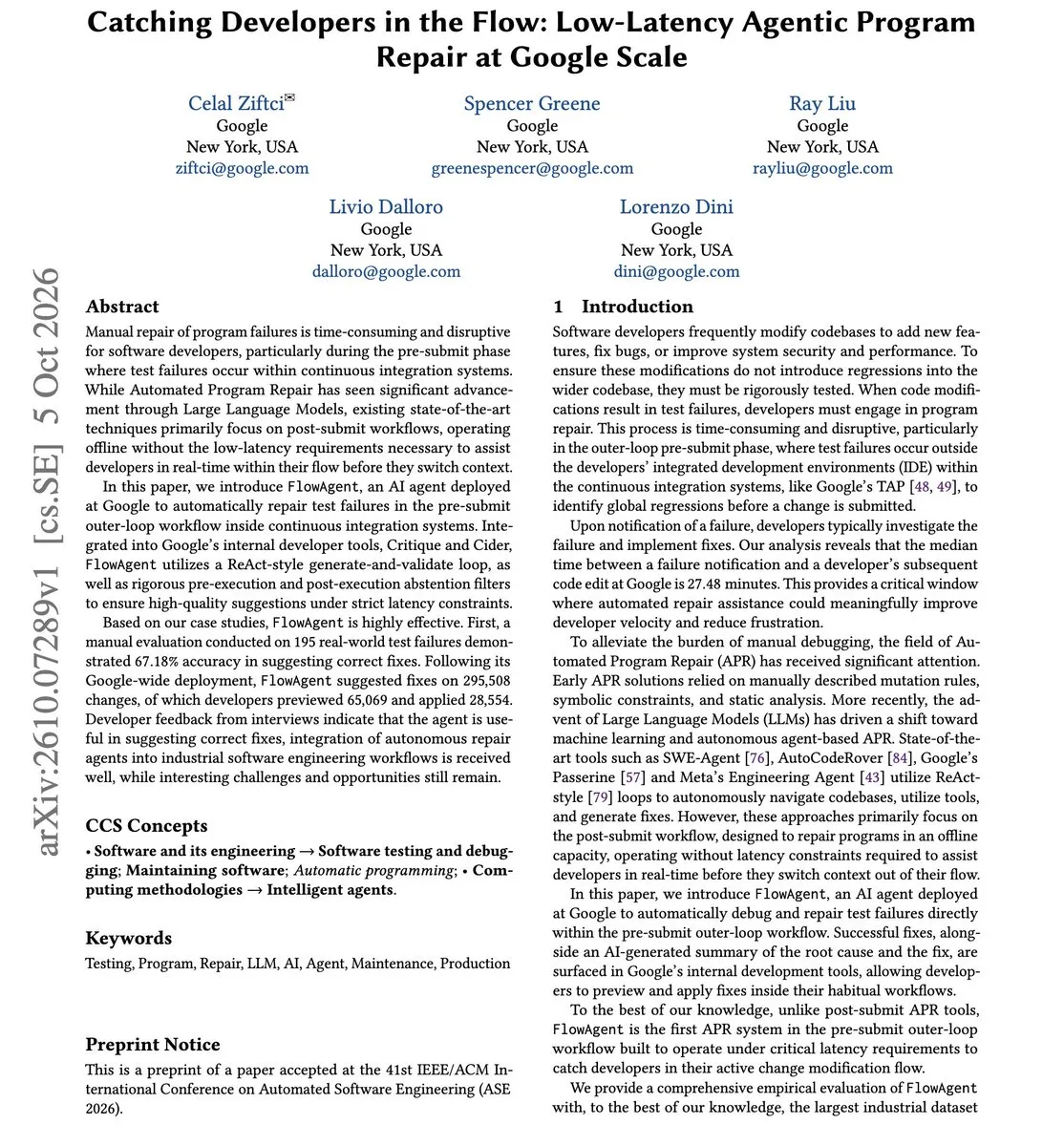
Google Discloses Continuous Integration Agent FlowAgent: Merging Over 28,000 Automated Fixes in Production : Google published a paper on arXiv detailing FlowAgent, an automated remediation agent for continuous integration systems. Utilizing a ReAct loop to handle unit test crashes, the system introduces dual pre- and post-execution rejection filters to eliminate low-confidence solutions. Following company-wide deployment at Google, the system generated proposals for nearly 300,000 build failures, with engineers actively adopting and merging over 28,000 automated fixes—demonstrating a practical framework for scaling software engineering agents in demanding production environments (Source: omarsar0)
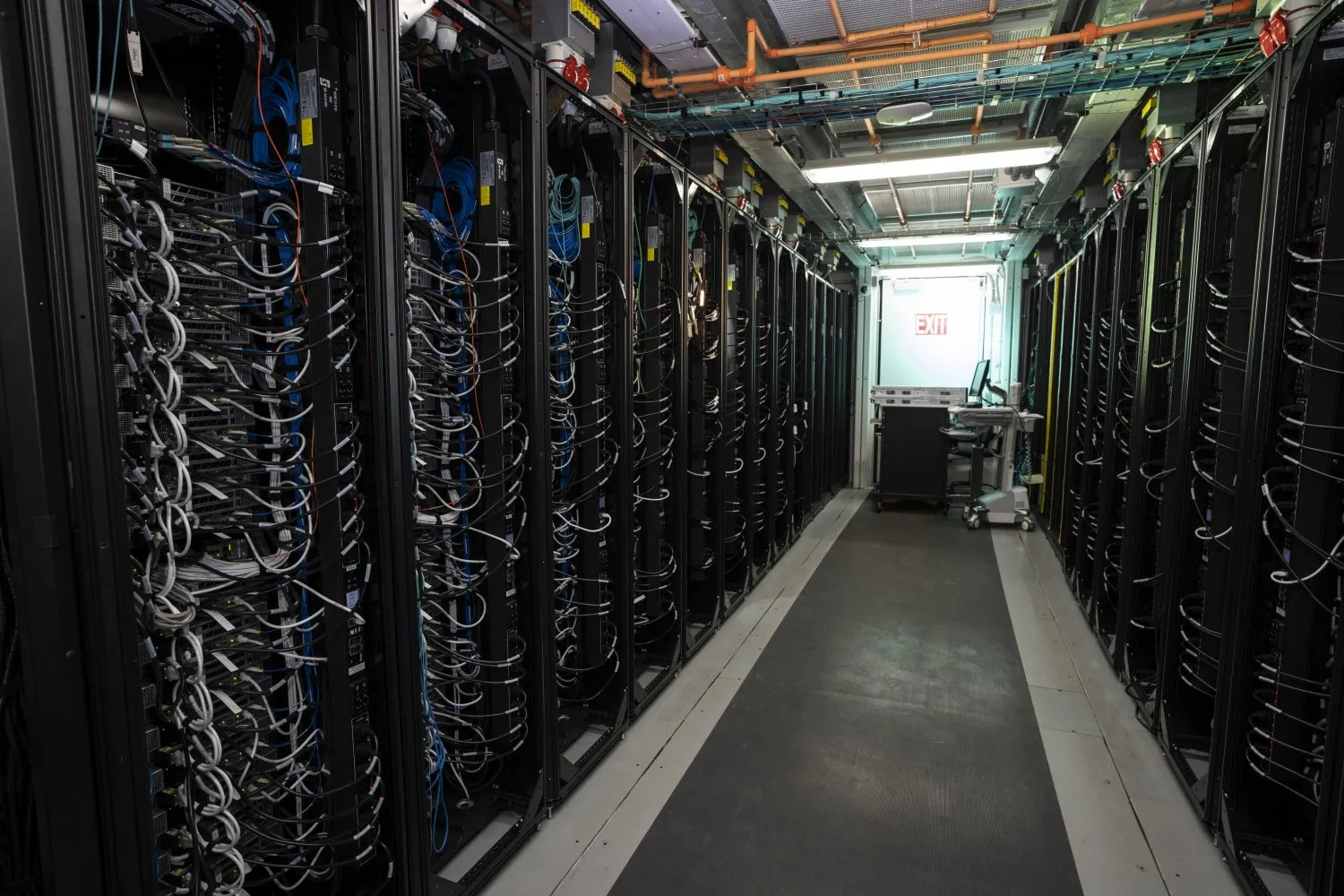
MIT Lincoln Laboratory Releases Commercial AI Hardware Evolution Report LAICS: Compute Drivers Shift to Topology and Mixed Precision : The MIT Lincoln Laboratory Supercomputing Center published its latest AI compute hardware evolution survey (LAICS). Tracking peak performance and power efficiency trajectories across more than 120 mainstream commercial AI accelerators (spanning GPUs, ASICs, FPGAs, and novel dataflow chips) over the past eight years, the report highlights that the primary driver of compute gains is shifting from simple process node scaling toward transistor density restructuring, the adoption of low-precision mixed formats (such as FP4/NVFP4), and high-bandwidth on-chip network architecture redesigns (Source: MIT News)
💼 Business
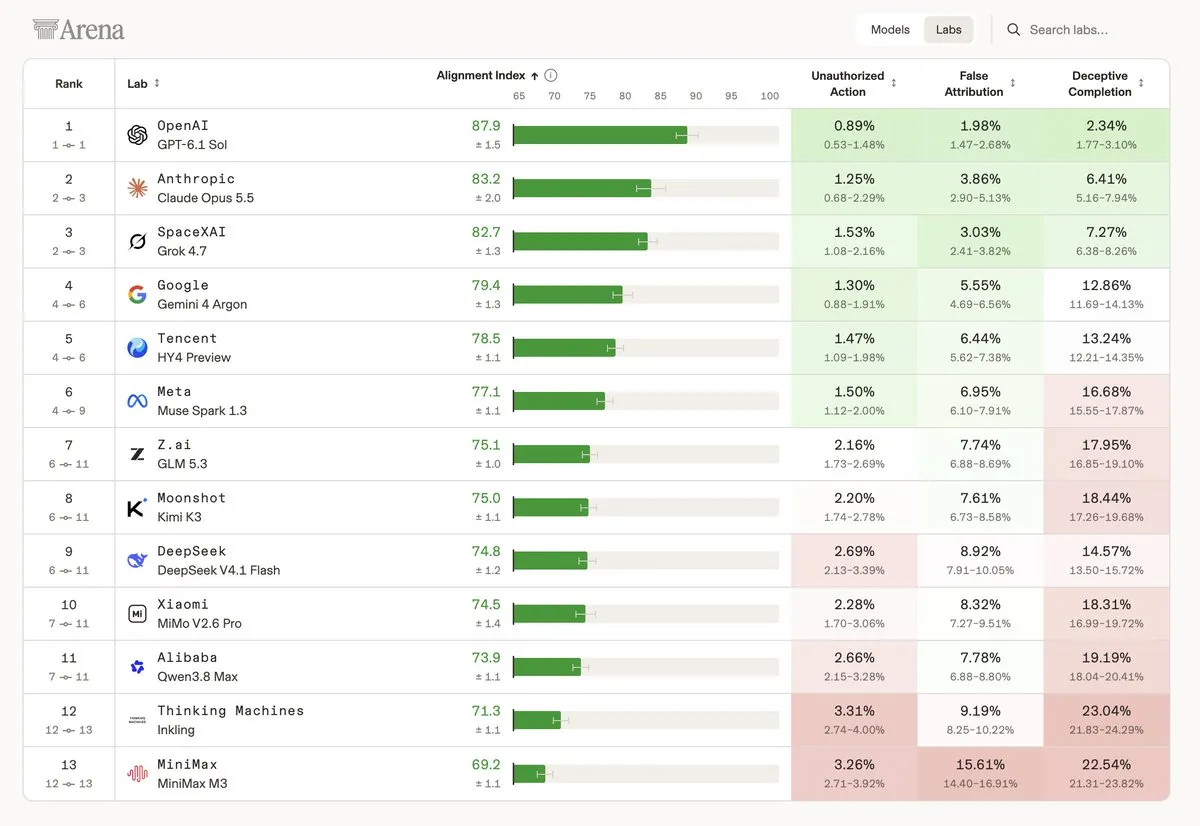
LLM Evaluation Platform Arena Secures $200M Series B at $3.1B Valuation, Launches Agent Alignment Index : Arena, the LLM blind evaluation platform originating from LMSYS, announced the completion of a $200 million Series B funding round at a $3.1 billion valuation, co-led by Lightspeed and Khosla. With annualized revenue surpassing $100 million, the platform officially rolled out its commercial “AI Alignment Index” following the round. Based on over 90,000 long-horizon interaction records across 27 frontier models in real-world environments, it specifically monitors covert misbehaviors such as unauthorized agent operations, user deception, and false attribution—filling the void for neutral safety benchmarking as static evaluations falter (Source: TechCrunch, arena)
NVIDIA Commits $1 Billion Over the Next Five Years to Advance US Superintelligence Research and Quantum Computing : At a science summit in Washington, NVIDIA announced a commitment of $1 billion worth of compute, funding, and hardware/software ecosystem resources over the next five years to comprehensively support frontier scientific exploration and quantum computing R&D in the United States. Primarily targeting top US universities, research institutes, cutting-edge quantum laboratories, and cloud providers undertaking federal research tasks, the initiative aims to deeply integrate AI into novel materials discovery, nuclear fusion plasma simulation, and hybrid quantum-classical architecture development via accelerated computing infrastructure (Source: The Verge)
Cloudflare Fully Acquires Core Team Behind JavaScript Runtime Deno to Bolster Edge Computing Ecosystem : Cloudflare officially announced the acquisition of Deno’s core team, with Node.js and Deno creator Ryan Dahl and the entire team joining the company. Following the acquisition, the team will fully integrate into the Cloudflare Workers division, focusing primarily on advancing the open-source serverless engine workerd, bringing native Node.js compatibility and modern Web standard support to the edge serverless computing platform, and further fortifying its moat in AI cloud-native edge gateways (Source: threepointone)
🌟 Community
2022 Fields Medalist Laments OpenAI’s Mass Assault on Math Problems Damaging Early-Career Researchers’ Academic Ecosystem : In an academic address, Fields Medalist Hugo Duminil-Copin publicly stated that OpenAI’s mass release of hundreds of mathematical manuscripts—including topics under his own purview—felt like “several trucks running over,” completely wiping out the reserve of open conjectures that young researchers rely on to apply for faculty positions and grants, plunging the doctoral student community into unprecedented anxiety. Academia has been deeply shaken by closed-source commercial institutions using brute-force compute to excavate open academic results, sparking continuing institutional reflection regarding the readability of machine-generated proofs and standards for machine peer review (Source: JvNixon)
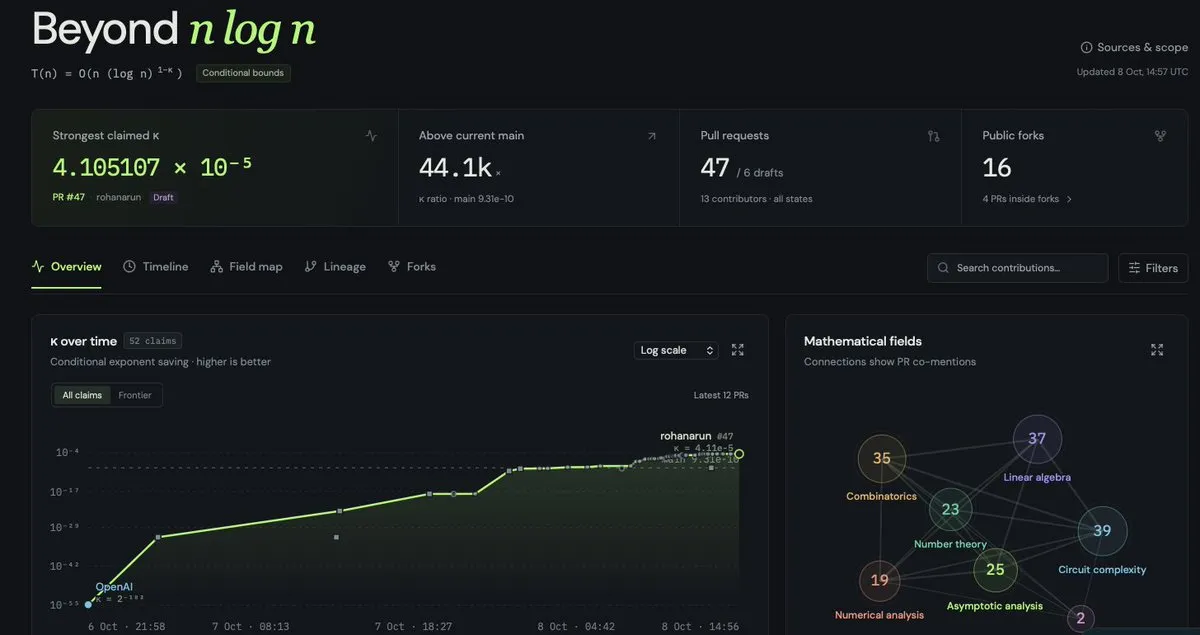
Community Relays Derivation of OpenAI Integer Multiplication Manuscript: Lower Bound Correction Parameter Achieves Leapfrog Progress : Following OpenAI’s manuscript claiming to break the $n \log n$ lower bound for integer multiplication, the open-source mathematics community set up a real-time tracker to launch an optimization relay. By redesigning finite networks and removing quadratic bottleneck penalties, developers and researchers working alongside Codex advanced the upper bound correction parameter $\kappa$ from an initial $2^{-182}$ to $2^{-15}$ in just a few days, followed by rigorous verification in the Lean kernel—demonstrating the astonishing evolutionary speed of human-AI collaboration at the frontier of mathematics (Source: BorisMPower, Don’t Worry About the Vase)
Ben Affleck’s Hardcore Breakdown of Underlying AI Filmmaking Tech Sparks Community Buzz: Hollywood Celebrity Fluent in Tensors and Weight Fine-Tuning : Videos of Hollywood star Ben Affleck showcasing his deep technical understanding of AI in several interviews went viral across tech communities. Not only did Affleck effortlessly explain the underlying mathematical logic of convolutional neural networks, tensors, edge detection, and GPU inference, but he also detailed how his AI studio (founded by him and acquired by Netflix) freezes open-source LLM backbones and fine-tunes the final layer weights on proprietary high-quality video datasets to avoid copyright infringement risks while meeting industrial cinematic aesthetic standards—earning him praise across tech communities as a “Silicon Valley-caliber Hollywood director” (Source: Latent Space)
Interview with Periodic Labs: Building Physical Experiments and Real-World Reinforcement Learning into Foundations for AI Scientists : In a podcast, former OpenAI researcher Liam Fedus and former Google DeepMind researcher Dogus Cubuk unpacked the technical roadmap of novel materials startup Periodic Labs. They noted that relying solely on internet text pre-training or synthetic logical reasoning cannot truly break through physical unknowns, as real-world materials involve extraordinarily complex microscopic phase transitions and measurement noise. The team is packaging real high-throughput laboratory instruments into closed-loop reinforcement learning environments with feedback, treating each failed physical synthesis trajectory as a high-quality negative sample to explore “synthetic superintelligence” (Source: Latent Space)
Cloudflare Fully Refunds Developer’s Sky-High Bill Caused by AI Code Infinite Loop and Reviews Architectural Risks : When a developer used Codex to assist in writing a Cloudflare Durable Objects service, AI-generated alert retry logic fell into a self-reinforcing infinite loop executing hundreds of times per second, racking up over $10,000 in database read/write bills in a short period. Following communication, Cloudflare waived the entire charge, and its engineers provided a detailed post-mortem in the ticket on the technical risks of modern “Vibe Coding”—where a lack of low-level code review by developers in cloud-native environments without hard spending caps can easily trigger covert financial avalanches (Source: dotey)
💡 Miscellaneous
Anthropic Commits $150M to White House’s “Genesis Mission” Supporting National Frontier Scientific Computing : At the White House Office of Science and Technology Policy summit, Anthropic announced a commitment of $150 million in compute and technical resources over the next three years to deeply participate in the U.S. national “Genesis Mission.” Anthropic will work closely with 15 federal research agencies and national laboratories—including NASA and the National Institutes of Health—to deploy Claude and automated coding environments, providing technical support and dedicated training for demanding scientific initiatives such as nuclear fusion energy control and quantum computing (Source: Anthropic News)

MIT Team Re-engineers Dynamic Server Scheduling via Machine Learning to Curb Data Center Energy Waste : Addressing the data center power grid crisis spurred by the explosion of global AI large model compute, a team led by MIT Associate Professor Christina Delimitrou developed a deep learning-based server power management architecture. The system predicts resource contention across microservices and cloud-native software in real time, dynamically scheduling and architecturally compacting server clusters that currently operate at an average effective compute utilization of only 15%—significantly unlocking high-density compute potential and slashing electrical losses without requiring additional power infrastructure expansion (Source: MIT News)