
🔥 Spotlight
Trump Appoints Director of National Intelligence Jay Clayton as White House AI Czar : Donald Trump has officially announced the appointment of U.S. Director of National Intelligence Jay Clayton to concurrently serve as the White House AI Czar, leading the newly established “Super Intelligence Force” (SIF). Clayton, who previously served as SEC Chairman and has overseen all 18 U.S. intelligence agencies, has publicly stated that AI represents both a historic opportunity and a national security threat. The SIF will coordinate federal government interactions with general consumers, public interest groups, religious organizations, critical infrastructure, and frontier superintelligence R&D institutions. This appointment marks the transition of U.S. regulation and safety governance of frontier AI into a combat-readiness, inter-agency coordination phase. (Source: The Guardian)

Europe’s Aleph Alpha Open-Sources 78B Bilingual MoE Model Kolibri : German AI startup Aleph Alpha has officially open-sourced its sovereign large model, Kolibri-1. Featuring 78.1B total parameters, the model adopts a hybrid sliding-window and global attention architecture, activating only 3.46B parameters per token (4.4%), and supports a 1M token context window. Completely trained on local European infrastructure in compliance with the EU AI Act and GDPR standards, Kolibri achieved high scores of 96.9% on the AIME 2025 math test and 84.3% on GPQA Diamond. Its FP8 weights are open-sourced under the Apache 2.0 license and optimized for deployment on a single B200 or dual H100 GPUs. (Source: MarkTechPost)
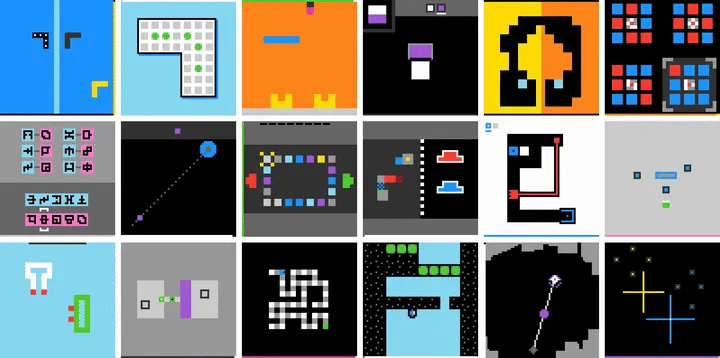
Kaiming He’s Team Cracks ARC-AGI-3 Benchmark with VISTA Vision-Augmented Architecture : Kaiming He’s team has released VISTA, subverting the traditional practice of converting interactive games into abstract digital symbols by using pure native image inputs coupled with an external “lossless visual album” mechanism (explicit attention). During exploration, the model can browse and compare historical frames side-by-side on demand, enabling Claude Opus 5 with zero extra training to achieve a perfect 100 score across all 25 games using only 0.43x the steps of human first-time clears, while GPT-5.6 Sol also reached 99 points. This breakthrough dispels the belief that abstract reasoning must rely on long chain-of-thought or code simulators, proving that visual perception and working memory are crucial keys to overcoming abstract generalization in AGI. (Source: 36Kr)
NASA and IBM Jointly Release Open-Source Lunar Science Foundation Model : NASA and IBM Research have jointly unveiled a lunar foundation model based on the TerraMind multimodal architecture, integrating nearly 2 million high- and low-resolution remote sensing tiles accumulated over 17 years from missions like the Lunar Reconnaissance Orbiter (LRO). By incorporating illumination angles and solar spatial geometry as explicit prior inputs, the model reduces error by up to 22% in predicting water ice deposition probabilities in permanently shadowed polar craters, while demonstrating exceptional performance in crater detection. Model weights, code, and benchmark datasets have been fully open-sourced on Hugging Face and GitHub. (Source: The Decoder)

🎯 Developments
Google Restructures Gemini Personal Subscription Tiers: Free Tier Downgraded to Flash-Lite with New Paywalls Introduced : Google announced a tightening of Gemini access for personal accounts. Free users will now be restricted to the smallest Flash-Lite model, losing access to Flash and Pro; $5/month AI Plus subscribers have also been stripped of Pro access, retaining only Flash-Lite and Flash. Access to the full suite of complete models now requires purchasing Pro or Ultra tiers ranging from $20 to $100 per month. Industry observers believe this move aims to curb high-frequency LLM inference deficits while paving the way for the commercial rollout of the more expensive next-generation flagship, Gemini 4 Argon. (Source: The Decoder)
DeepSeek Harness Releases v0.2.1, Introducing Experimental Compatibility Layer for Claude Code Mods : DeepSeek has updated its open-source Agent scaffolding to v0.2.1-alpha.1. Beyond packaging an official desktop application, the core highlight is the introduction of an experimental compatibility layer for the Claude Code Mods API, enabling mods like Token Weather and Blast Radius to run within DSH’s plugin system via bridging. Team lead Tianyi Cui stated that DSH adheres to the philosophy of “everything is a plugin,” and this move aims to validate that competitor mod mechanisms can be reused across ecosystems as a subset of the DSH plugin architecture. (Source: Synced)

OpenAI Teases Astra 6.1 Enhancing Code Reduction and Refactoring Capabilities : OpenAI Product Lead Tibo Sottiaux and Post-Training Researcher Rajan Agarwal revealed that their next-generation model is heavily prioritizing “code reduction and simplification” to tackle the technical debt of agents generating bloated spaghetti code. The R&D team is refining post-training strategies targeting developer pain points to equip the model with high-taste refactoring and self-pruning capabilities, while hinting that Astra 6.1—previously delayed over safety concerns—is nearing public release. (Source: Synced)

Google Develops TEE-Based Verifiable Differentially Private Federated Learning : Google Research released a next-generation Federated Learning (FL) architecture based on Trusted Execution Environments (TEEs), already deployed to the Gboard English-Japanese bilingual predictive model. The architecture shifts on-device gradient computation to remotely attested hardware TEEs in the cloud, leveraging Sigstore’s public, tamper-proof code access policy logs. This allows external auditors to verify central differential privacy noise injection without needing to trust Google, resolving the privacy-trust gap in large-scale collaborative training. (Source: MarkTechPost)
Bilibili Open-Sources Index-Translate Multilingual Translation Model Family : Bilibili fine-tuned and open-sourced the Index-Translate series based on Qwen3.5, supporting high-precision translation across 150 languages with special emphasis on terminology constraints and formatting preservation. The series further expands into Index-Echo (voice-cloned simultaneous interpretation), Index-Homura (target syllable count-aligned translation), and Index-NativeLong (cross-paragraph context-consistent long document translation), surpassing multiple commercial baselines in community tests for English-Japanese translation. (Source: Reddit r/LocalLLaMA)
🧰 Tools
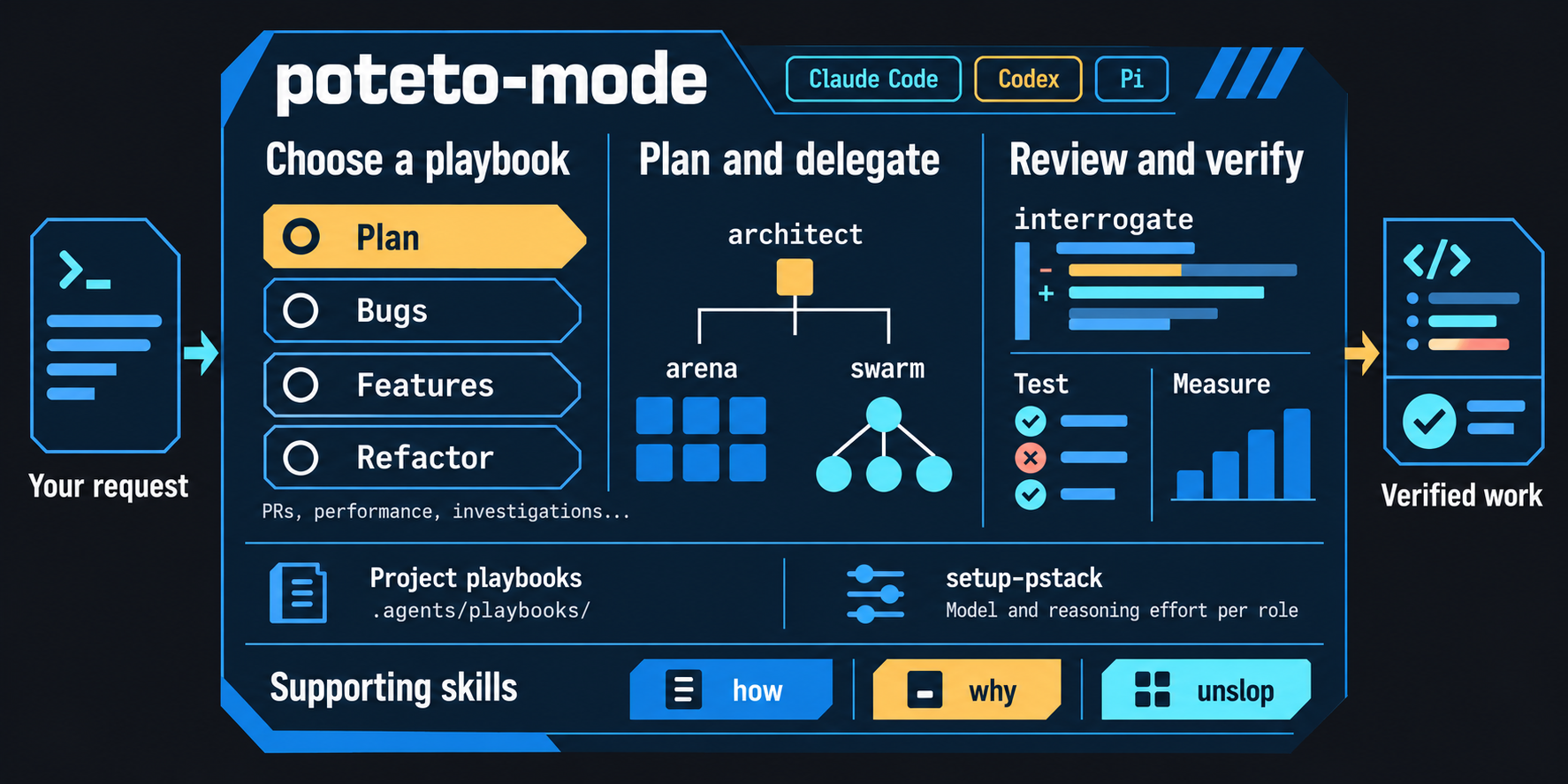
pstack-claude: A Rigorous Agent Engineering Skill Library Ported Across Multiple Harnesses : Community developers have built a multi-environment port of pstack targeting Claude Code, Codex, and Pi, inspired by practices from the Cursor team. Integrating the poteto-mode automated execution flow, the plugin enforces a strict validation lifecycle of “reproduce – bidirectional inquiry – targeted fix – retest” during bug resolution, and mandates an architectural review when crossing function boundaries, assisting developers in building high-quality automated commit pipelines. (Source: GitHub Trending)
e2e: Natural Language-Driven End-to-End AI Testing Framework for Applications : The open-source testing framework e2e supports driving web and mobile testing directly with natural language descriptions. Its core mechanism automatically solidifies UI operation sequences into model-free execution scripts once an agent explores and achieves test goals based on prompts during the initial run. Subsequent regression tests replay directly and accurately without consuming tokens, guaranteeing agile assertions while entirely eliminating token waste during extended test runs. (Source: GitHub Trending)
local-codex-proxy: Open-Source Middleware to Connect Local LLMs to Codex and ChatGPT Interfaces Without API Keys : Developers have open-sourced a lightweight Codex proxy middleware that allows users to bridge locally deployed open-source models (such as Gemma and Qwen via vLLM or Ollama) directly into the ChatGPT desktop client and Codex execution environments. By emulating OpenAI endpoints locally alongside state synchronization, developers can enjoy a polished desktop GUI experience without exposing internal codebases to the cloud. (Source: TheZachMueller)

Texting Bubbles: Anthropomorphic Segmented Chat Bubble Plugin for Open WebUI : The community introduced the Texting Bubbles suite for Open WebUI, restructuring traditional monolithic streaming Markdown answers into consecutive message bubbles reminiscent of human texting. An accompanying filter guides the model via system prompts to output concise snippets, paired with delay scheduling featuring dynamic typing pauses to bring a more natural, immersive feel to chats and role-playing. (Source: Reddit r/OpenWebUI)
NInfer-4080: Extreme Throughput Inference Engine Tailored for 16GB GPUs : Developers released NInfer-4080, an inference engine deeply customized for the RTX 4080 (16GB VRAM). By pairing ISTA-DASLab’s GSQ high-compression quantization with DFlash2 speculative decoding, it achieves up to 2,720 tok/s prefill and 262 tok/s generation speeds under a 100K context window, demonstrating the overwhelming advantage of hardware-specialized vertical inference engines over general-purpose frameworks. (Source: Reddit r/LocalLLaMA)
📚 Learning
NTU Team Led by Bo An Uncovers Interaction Mechanisms Between Models and Harnesses : A team from Nanyang Technological University (NTU) published an evaluation report on the agent ecosystem, comparing 66 combinations across OpenHands, DSH, PI, openJiuwen, and official native harnesses. Experiments confirmed that “native pairings are optimal” is a misconception: for instance, GPT-6 Astra on PI comprehensively outperformed Codex. Furthermore, nuanced harness mechanisms (such as timeout feedback, splitting file write vs. edit operations, and context KV cache hit rates) play a decisive role in model self-healing and final task costs. (Source: Synced)

Key AlphaGo Author Analyzes Why LLMs Lack Genuine System 2 Reasoning : Former DeepMind senior researcher Thore Graepel published an article in MIT Technology Review pointing out that current LLM chain-of-thought is merely extended System 1 associative generation, lacking AlphaGo-style auditable search mechanisms and explicit, mutable cognitive state trees. Genuine machine reasoning must completely decouple “knowledge representation” from “execution and deduction,” relying on independent arbitration architectures capable of evidence evaluation and hypothesis testing rather than purely scaling up parameter sizes. (Source: Synced)

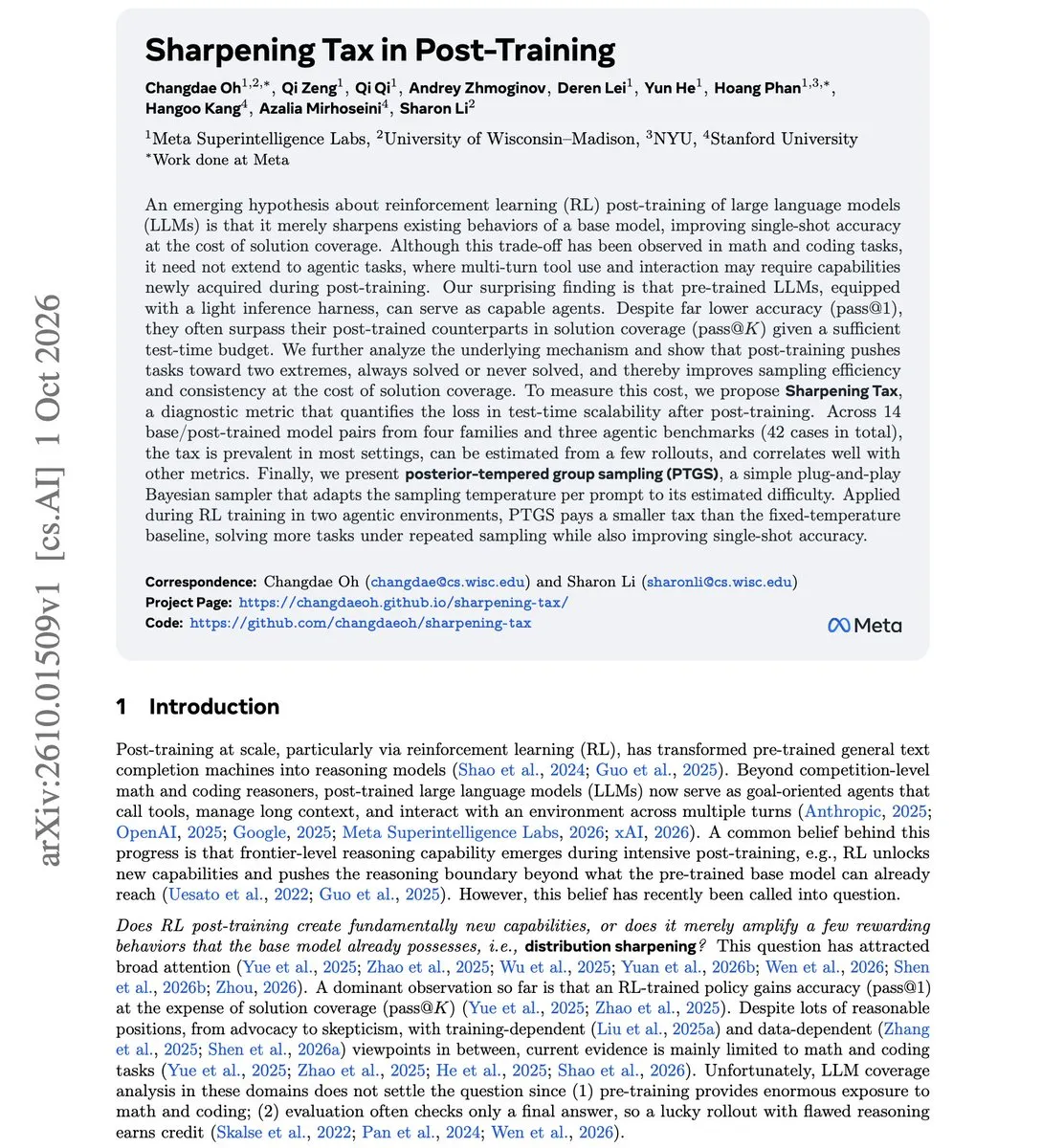
Meta Superintelligence Lab Unveils the “Sharpening Tax” in RL Post-Training : Analyzing 42 pairs of base and RL post-trained models, a Meta research team discovered that while RL significantly boosts pass@1 success rates, it does so at the expense of output space diversity, driving tasks toward extreme consistency (either always right or always wrong). Given an ample sampling test budget (Large K), base models without heavy post-training paired with lightweight harnesses can instead conquer long-tail, complex challenges that RL models fail to solve entirely. (Source: dair_ai)
Stanford Releases CS336: An Open Course on Systems-Level Large Language Model Training : Stanford University’s NLP Group launched course materials for CS336: Language Model Systems Engineering in Practice. The course focuses on hardcore engineering practices for building LLMs from scratch, covering tokenizer implementations, distributed Transformer training optimizations, scaling past GPU memory walls, scaling law verification, data cleaning pipelines, and reinforcement learning for reasoning. Assignments are designed to balance theoretical rigor with production-grade engineering requirements. (Source: stanfordnlp)
Meta Proposes RankEvolve: A Multi-Agent Scientific Research Error-Correction Pipeline : Addressing subtle flaws like data leakage and silent gradient detachments when AI autonomously conducts machine learning experiments, a Meta team proposed RankEvolve, a multi-agent scientific harness. By configuring Claude Code and Codex as mutually redundant reviewer nodes that cross-audit and fix code changes via compilation protocols, the system significantly boosted the accuracy of fully automated scientific experiments from 45.8% to 62.5%. (Source: dair_ai)
💼 Business
3D Generative AI Unicorn Meshy Surpasses $100M ARR, Highlighting Moats in Specialized Modalities : Business analysis revealed that 3D generation startup Meshy saw its Annual Recurring Revenue (ARR) surge from $1 million to $100 million in less than two years. Although general-purpose models have gained basic geometry scripting abilities, vertical 3D generation has formed a robust commercial moat through major gaming studio API integrations and 3D printing hardware ecosystems, excelling in high-detail topologies, texture alignment, and industrial pipeline compatibility. (Source: QbitAI)

Elon Musk Confirms Talks with TSMC for Terafab Foundry Partnership : Elon Musk publicly confirmed in-depth discussions with TSMC regarding the Terafab ultra-scale vertically integrated chip manufacturing initiative. Terafab is planned to produce 1 TW of computing power annually to fulfill demand across Tesla, SpaceX, and xAI. Facing timeline pressure on Intel’s 14A process node mass production, Musk aims to hedge supply chain risks and secure absolute control over the custom chip supply chain by tapping into TSMC’s factory operations and mature yield expertise. (Source: QbitAI)

Queensland, Australia Faces Local Backlash Over A$31B Anthropic Compute Hub : A proposed A$31 billion Western Downs data center project intended to power Anthropic models has triggered intense pushback from local residents. The facility’s peak power consumption is projected at 2.16 GW (equivalent to a quarter of Queensland’s total power consumption), sparking a petition signed by over 20,000 residents. To protect the energy transition and economic benefits, the Queensland state government announced it is revoking local council approval authority to centrally coordinate the process, underscoring the fierce tension between compute expansion and local public sentiment. (Source: The Guardian)

🌟 Community
Altman Takes Hard Stance Against Deifying AI as Silicon Valley Ideological Divide Deepens : In response to media reports that Anthropic executives held frequent meetings with religious leaders to discuss AI consciousness and the moral status of machines, OpenAI CEO Sam Altman stated publicly that granting AI models religious authority or encouraging humans to surrender their judgment is a severe safety hazard. Turing Award laureate Yann LeCun and multiple scholars echoed this sentiment, pointing out that framing LLMs as sentient conscious entities is not only philosophical pseudoscience, but could also be exploited by tech giants in legal defenses to evade strict product liability for model infringements or illegal behaviors. (Source: sama)
Industry Reflection Behind the Surge of Forward Deployed Engineers (FDE) : With Forward Deployed Engineer (FDE) roles surging in popularity, practitioners note that the role’s core focus has shifted completely from traditional “code-and-turnkey delivery” to “business ontology structuring and organizational remodeling.” As AI dramatically slashes the marginal cost of software development, cross-departmental data silos, permission barriers, and employee pushback have become the true bottlenecks for AI deployment, effectively evolving the FDE role into deep, tech-savvy business consulting. (Source: QbitAI)
Alibaba AI Leadership Passes to Post-90s Generation as Grassroots Deployment Steals the Spotlight at Apsara Conference : The 2026 Apsara Conference sent clear generational and strategic signals: the Tongyi Qianwen large model is now fully helmed by two post-90s leaders—Liu Dayiheng, who spearheaded pre-training, and Chen Yusen, who drives Qianwen Workspace commercialization—completing the loop between model R&D and product monetization. The venue drew crowds of next-generation manufacturing executives seeking AI transformations for their factories, with attention shifting entirely toward rigid financial returns: “how many hours to complete the process, and how long to recoup the investment.” (Source: 36Kr)
Terminal CLI vs. Desktop GUI: Developers Debate Next-Gen Agent Interfaces : Discussions surrounding the form factor of AI coding tools are heating up across the community. Many developers point out that multi-tab terminal CLIs are becoming obsolete, with high cognitive context loads pushing tooling toward dedicated agent interfaces exemplified by Codex desktop clients or standalone canvas workspaces. Instead of micromanaging files directly, users are shifting toward macroscopic coordination and asynchronous auditing across multiple agents through persistent workspaces. (Source: Yuchenj_UW)
Developers Urge Cloud Providers and Model Gateways to Enforce Default Hard Budget Caps : In response to bill shock horror stories caused by multi-agent autonomous execution loops, Simon Willison and community engineers strongly called on API gateways and cloud platforms to make “hard circuit-breaker errors upon exceeding budget limits” the default policy. Soft email alerts are entirely ineffective when autonomous agents run amok overnight, making granular cost controls and rigid circuit breakers essential baselines for deploying agent engineering into production. (Source: Simon Willison)
💡 Miscellaneous
NVIDIA Shield TV Price Jumps $100 as AI Drives Up Memory Costs : Seven years after its release, the NVIDIA Shield TV Pro streaming box suddenly saw its price hiked by $100 to $299.99. NVIDIA confirmed that industry-wide expansion of AI compute infrastructure has triggered a dramatic surge in procurement costs for memory and components, forcing price increases even on older consumer hardware using mature architectures to sustain production lines. (Source: WIRED)

Survey Shows Female Representation and Leadership Roles Decline Amid AI Boom : Fresh survey data indicates that despite record-breaking global hiring volumes and salary premiums in AI, women account for only a quarter of new AI roles and hold just 13% of executive positions, with the majority being pushed into low-wage data annotation jobs. Aggressive overtime culture and network-heavy recruitment pipelines are increasingly relegating women to high-risk margins vulnerable to AI displacement. (Source: The Guardian)

U.S. Rural Data Center Tax Breaks Face Tech Giant Distancing and Public Scrutiny : Multibillion-dollar federal tax break policies targeting data centers in rural “Opportunity Zones” are slated to take effect next year. However, tech giants including Microsoft, Meta, and Amazon have publicly distanced themselves from the initiative. Critics argue that relying solely on capital expenditure thresholds fails to create meaningful long-term employment in rural communities, while exacerbating competition for power and water resources alongside escalating community backlash. (Source: WIRED)