



🔥 In Focus
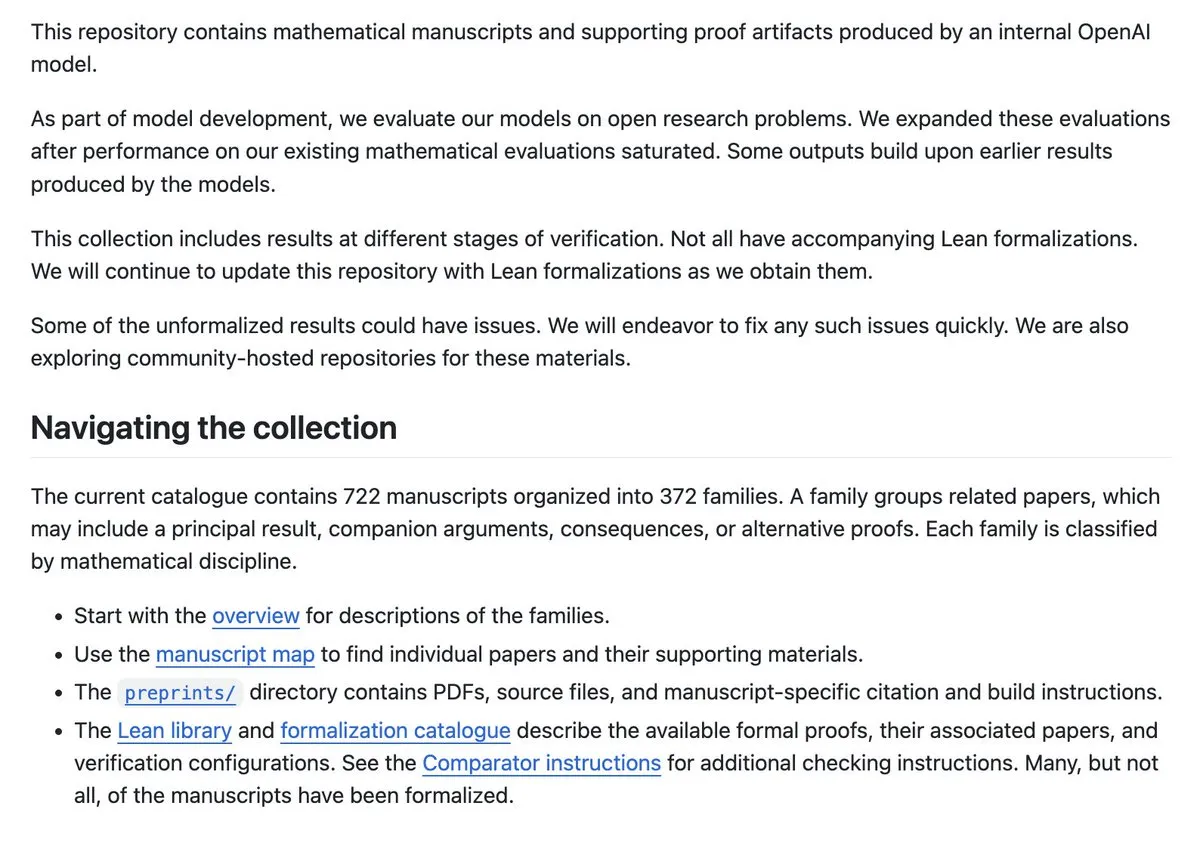
OpenAI Releases 722 Math Manuscripts from Unreleased Frontier Model, Pushing Boundaries on Century-Old Problems Including the Quasi-Riemann Hypothesis : OpenAI officially released 372 sets of results totaling 722 mathematical paper manuscripts generated by an unreleased internal frontier model in the open-source GitHub repository openai/math. Core achievements encompass the Quasi-Riemann Hypothesis (claiming to prove that all Dirichlet L-functions have no zeros in the region with real part greater than 7/8 and eliminating Siegel zeros), a proof of the Hodge Conjecture for Abelian varieties, the 4D Kakeya Conjecture, Hilbert’s Tenth Problem over the rationals, and establishing an NP-hardness threshold for Basic-SDP independent of the Unique Games Conjecture; approximately 160 of these include formal Lean proofs. OpenAI revealed that each individual result required an average of about 3 hours of ChatGPT Pro reasoning compute. While hailed as a milestone in autonomous machine scientific discovery, an advisory panel from the Institute for Advanced Study (IAS) in Princeton, including three Fields Medalists, issued a statement emphasizing that publication does not equate to peer validation and warning that machine-scale proof generation poses severe challenges to human researchers’ capacity to digest and verify the work (Sources: 机器之心, The Verge, Latent Space, Abhishek Saha, openai)
U.S. Department of Energy and NIH Partner with DeepMind and Other Tech Giants to Launch “Virtual Biology Initiative” : The U.S. Department of Energy (DOE) and the National Institutes of Health (NIH) announced a national strategic partnership with Google DeepMind, Meta, Isomorphic Labs, NVIDIA, and other institutions to establish the “Virtual Biology Initiative.” The project aims to systematically map full-scale cell biology and generate standardized benchmark data, leveraging multimodal AI to construct the world’s first general digital model capable of end-to-end prediction of cellular life processes, reshaping drug discovery and disease mechanism exploration from first principles (Source: Alex Rives)
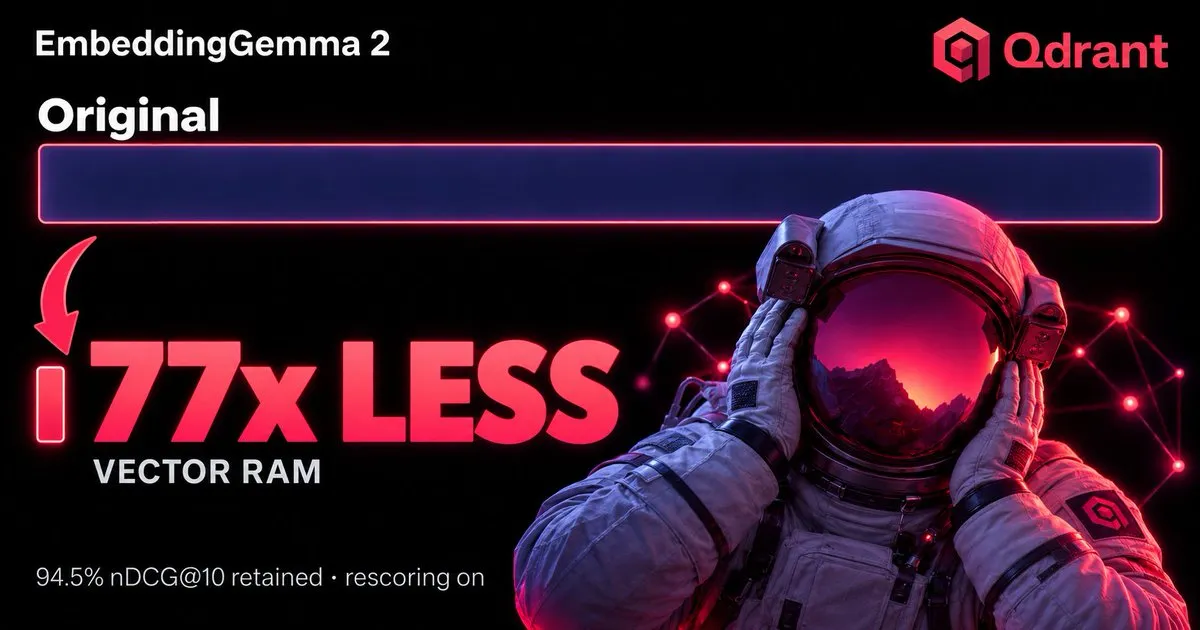
Google DeepMind Open-Sources On-Device Omnimodal Embedding Model EmbeddingGemma 2 : Google DeepMind officially open-sourced its first multimodal embedding model based on the Gemma 4 architecture, EmbeddingGemma 2, under the Apache 2.0 license. With 740M parameters, the model natively unifies the vector representation spaces of text, code, images, audio, and video, supporting an 8K context window. Its modular design allows the text-only unimodal configuration to run with 270M parameters, consuming only ~191MB of RAM on mobile devices after quantization. Leveraging Matryoshka representation learning, it supports dynamic dimension truncation down to 768 dimensions. Benchmarks by Qdrant show that combined with 1-bit quantization, memory usage drops by 77x while maintaining 94.5% retrieval accuracy, filling an infrastructure gap in lightweight on-device omnimodal RAG and offline semantic search (Sources: Google DeepMind Blog, THE DECODER, GoogleDeepMind)
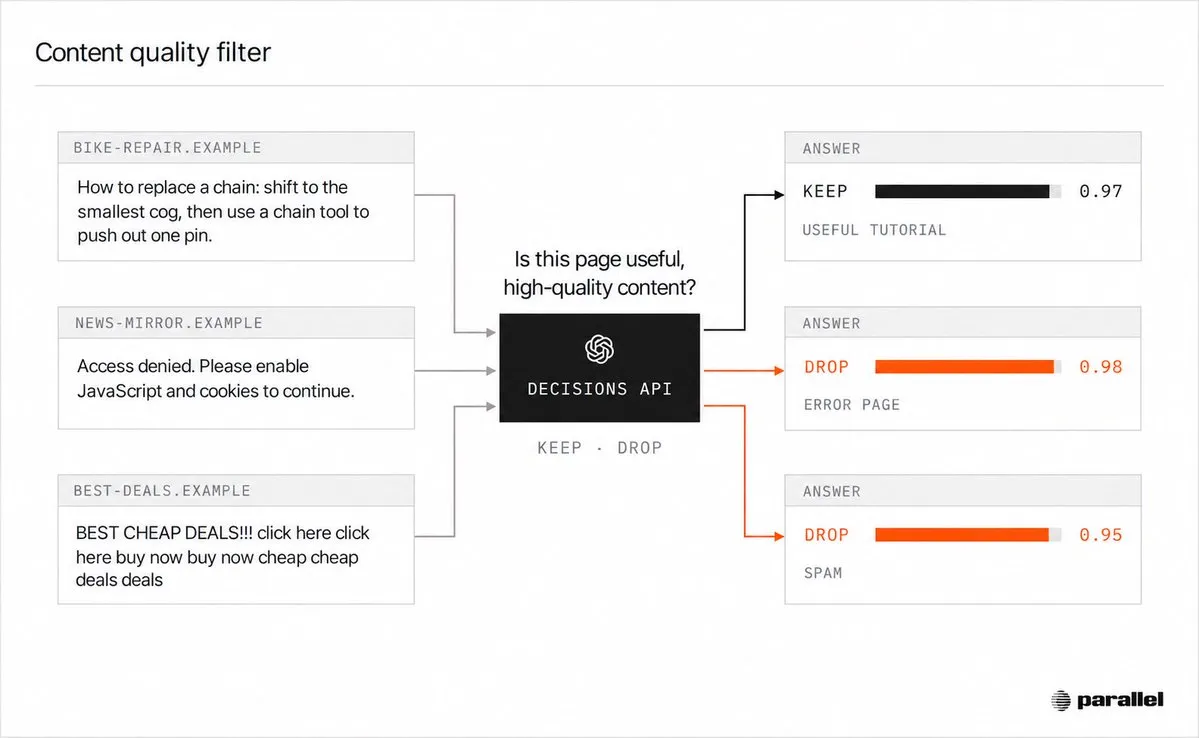
OpenAI Delivers Day 2 Update of “28-Day Challenge”: Auto-review Made Free for All, Public Beta for Decisions API : On Day 2 of its “28 Days of Shipping Practical Improvements” challenge, OpenAI launched several core updates targeting agent deployment friction: the automated risk audit feature for long-running tasks, Auto-review, is now free for all logged-in ChatGPT users and exempt from rate limits; API pricing tiers have been streamlined from five to three—Build, Launch, and Grow—with the highest tier threshold lowered to $500; the Decisions API, designed for discrete routing and tool dispatching, entered public beta, powered by GPT-6 Luna with sub-100ms server response times, priced at just $0.10 per million input tokens with zero output and cache fees; additionally, the Meetings workspace plugin for macOS began a phased rollout (Sources: 机器之心, OpenAI Developers, )
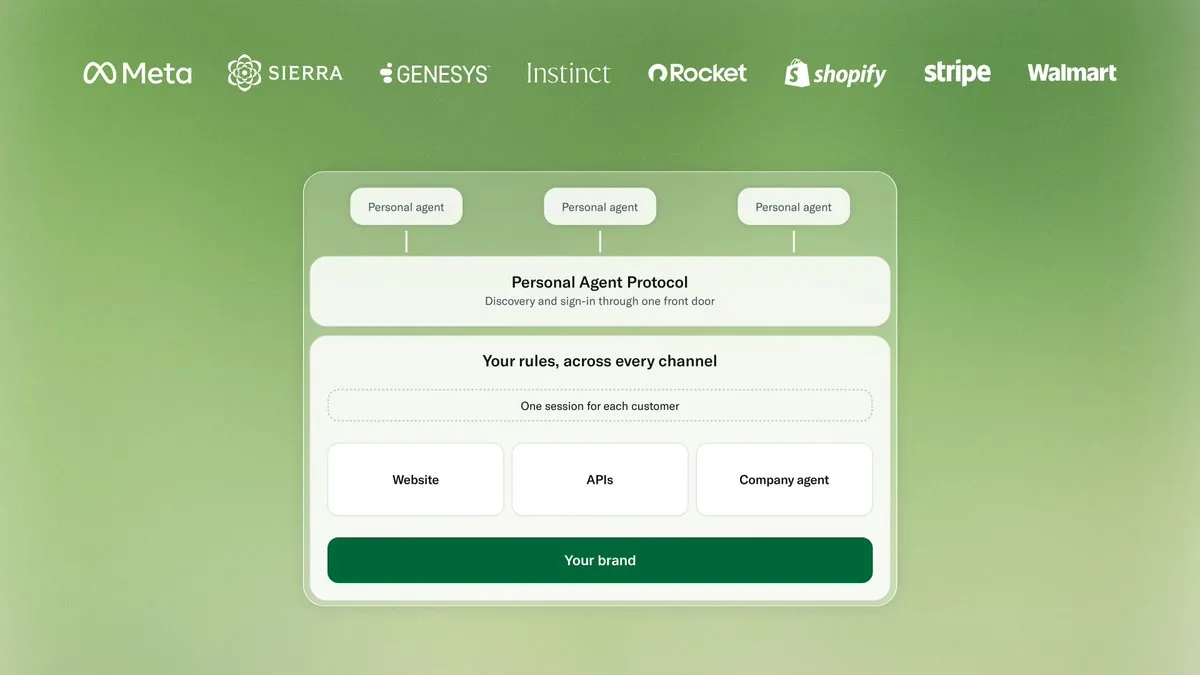
Meta and Sierra Partner with Industry Leaders to Launch Personal Agent Protocol (PAP), Establishing Standards for Consumer-Enterprise Agent Interaction : Addressing the hurdle where consumer AI agents frequently face anti-bot blocks on commercial websites, Meta and AI customer support platform Sierra, along with Stripe, Shopify, Walmart, and others, jointly introduced an open industry standard: the Personal Agent Protocol (PAP). Built on A2A and OAuth architectures, the protocol establishes clear authorization and risk-control boundaries for personal AI assistants interacting with enterprise systems when performing checkout, ticket inquiries, and form filling on behalf of users. Decagon concurrently open-sourced the accompanying PACT trust protocol to accelerate the reduction of trust friction during cross-boundary agent invocations (Sources: The Verge, TechCrunch, saranormous)
🎯 Trends
Google DeepMind Releases Image Generation and Editing Model Nano Banana 2.1 : Google launched Nano Banana 2.1 (API identifier: gemini-nano-banana-2.1), a generative image model based on Gemini 3.6 Flash, rolling it out across the Gemini API, AI Studio, and Google Ads. The new model natively supports complex typography design, precise masked local inpainting, and character consistency fusion across up to 14 reference images, rendering up to 4K resolution. The generation cost per image has dropped to $0.034 (an approximate 50% reduction), directly addressing multi-turn consistency challenges in commercial visual design (Sources: 机器之心, GoogleAIStudio, THE DECODER)

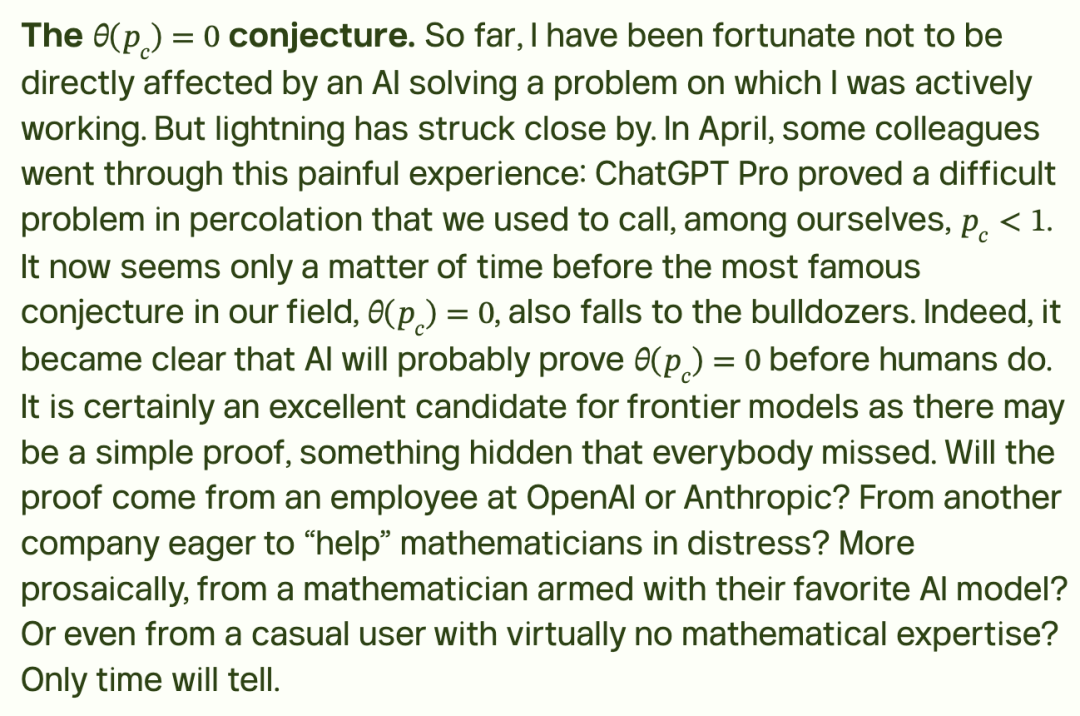
Claude Cracks Decades-Old Probability Problem, Formally Proving the Continuity of Percolation Phase Transitions in Lean : Anthropic’s unreleased internal frontier Claude model has successfully resolved the conjecture on the continuity of percolation phase transitions (infinite cluster probability is 0 at the critical probability $p_c$), an open question for nearly 70 years. Building upon the inequality framework established in 2024, the model completed thousands of lines of formal deductions using the Lean proof assistant, breaking a long-standing deadlock in critical physical dimensions 3 through 10. The milestone of an AI formally verifying a Fields-Medal-caliber conjecture has sent shockwaves through the mathematical community (Source: 36氪)
Anthropic Expands Cyber Verification Program with Three-Tier Access Framework : Anthropic announced the expansion of its Cyber Verification Program (CVP) into a permanent three-tier access architecture (Defensive, Red Team, and Specialized), granting verified organizations and white-hat experts access to Claude Opus 5.5, Sonnet 5.5, and Mythos 5.1 with relaxed safety filters. This system marks the first compliant, authorized offensive access for penetration testing and red-teaming exercises, aiming to resolve the tension where defenders needing powerful tools to remediate vulnerabilities are blocked by generic safety policies (Sources: Anthropic News, AnthropicAI, THE DECODER)

DeepMind Introduces AlphaGenome Atlas to Decode Genome-Wide Variant Effects : Google DeepMind unveiled its genomic deep learning model AlphaGenome alongside its precomputed database, AlphaGenome Atlas. Featuring single-base pair resolution and a 1-million-base-pair context window, the Atlas precomputes the molecular phenotypic effects of all 9 billion possible single nucleotide variants in the human genome—30 times the data scale of the AlphaFold database—aiming to systematically decode the mechanisms behind rare mutations and complex disease susceptibility (Source: )
vLLM v0.31.0 Introduces CRIU Snapshot Mechanism, Turning Cold Starts into Millisecond Process Restorations : vLLM released version 0.31.0, introducing the vllm snapshot and vllm preload resident daemons. Leveraging Linux CRIU technology, this mechanism enables rapid checkpoint saving and image restoration of the inference engine runtime, skipping the time-consuming model weight loading and initialization stages during instance failovers or scaling, significantly cutting cold-start latency for elastic scheduling in large-scale inference clusters (Source: vLLM)
HIT and NUS Open-Source QuantWM: A 2-Bit KV Cache Compression Method for Video World Models : To address excessive GPU memory consumption in autoregressive video world models and the severe flickering caused by traditional quantization, a joint team from HIT Shenzhen and NUS proposed QuantWM, a training-free quantization framework. The study reveals that spatio-temporal attention misalignment caused by Key quantization is the root cause of temporal jitter. Through sensitivity-aware clustering and principal subspace error compensation, QuantWM achieves up to a 6.2x KV cache memory compression while maintaining temporal stability in generated video frames (Source: 机器之心)
.jpg)
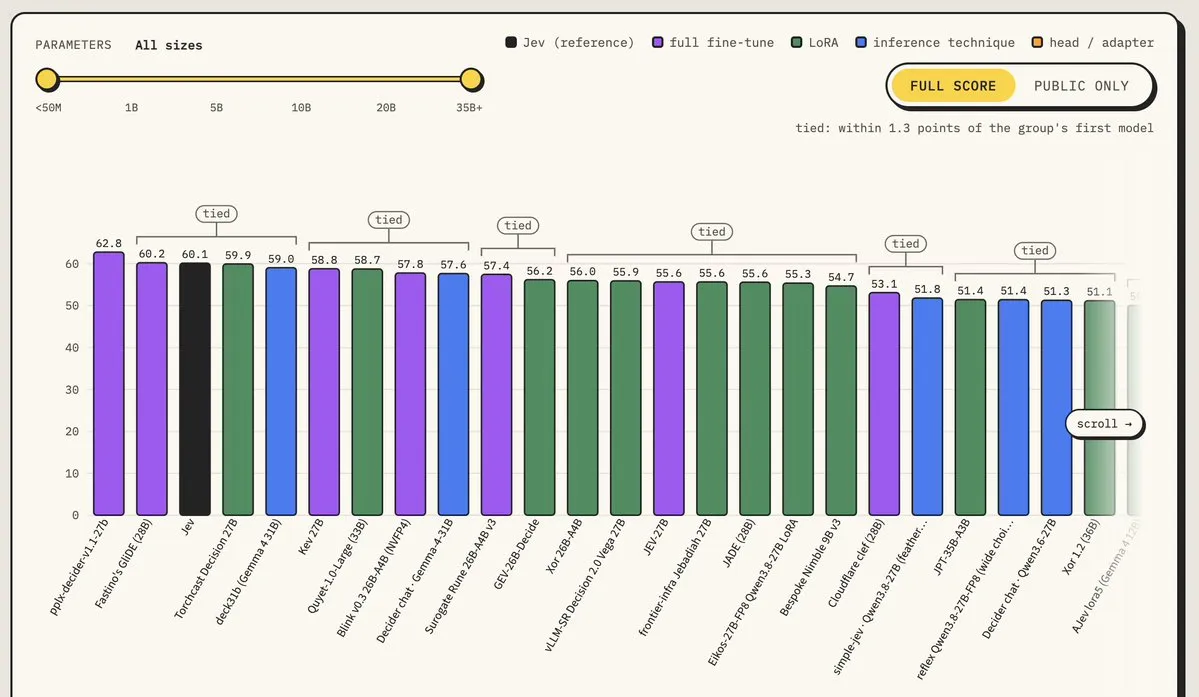
Perplexity Releases Upgraded Open-Source Decision Model pplx-decider-v1.1-27b : Perplexity open-sourced an upgraded multimodal decision model, pplx-decider-v1.1-27b. The weights topped the latest Hugging Face Decision Index 0.3 benchmark, significantly optimizing inference efficiency while preserving visual and logical decision accuracy. Concurrently, the price of the associated Decision API was reduced to $0.02 per million input tokens (Source: AravSrinivas)
Meta Open-Sources Production-Grade Assignment Solver Rebalancer : Meta officially open-sourced Rebalancer, its internal C++ core solver that has operated for over 9 years, processing around 40 million resource scheduling tasks daily (offering a Python interface under the Apache 2.0 license). The tool abstracts NP-hard problems like shard placement and traffic balancing into unified directed acyclic graphs (DAGs), providing highly efficient local search and mixed-integer programming solvers for massive-scale entities in the millions (Source: MarkTechPost)
TII Releases Falcon-Emirati-7B Tailored for Emirati Arabic : The Technology Innovation Institute (TII) of the UAE introduced Falcon-Emirati-7B, a model specialized in Emirati Arabic. The team developed a data pipeline encompassing colloquial web data, local cultural context, and controlled synthetic corpora. It achieved an 84.83% multiple-choice accuracy on the local Alyah benchmark, significantly improving cultural metaphor comprehension and etiquette alignment in free-form conversation (Source: HuggingFace Blog)

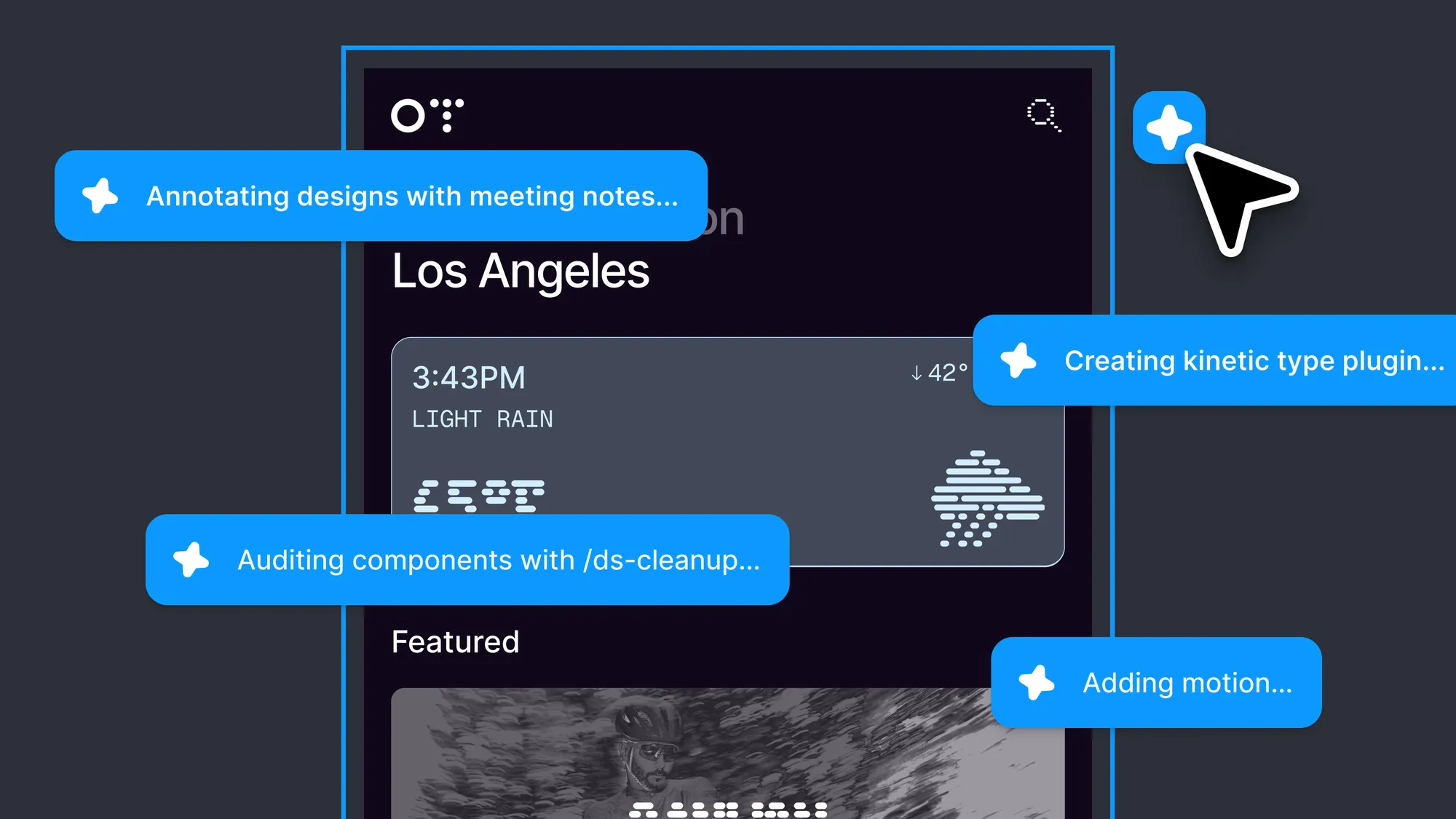
Figma’s AI Agent for Product Design Enters General Availability : Figma announced that its native AI agent for UI/UX product design is now generally available to all users. The update adds binding mechanisms for team design guideline references and visualized cross-team agent action coordination in multiplayer mode, allowing agents to automatically generate high-fidelity interfaces and multi-state interactive prototypes directly from component libraries (Source: The Verge)
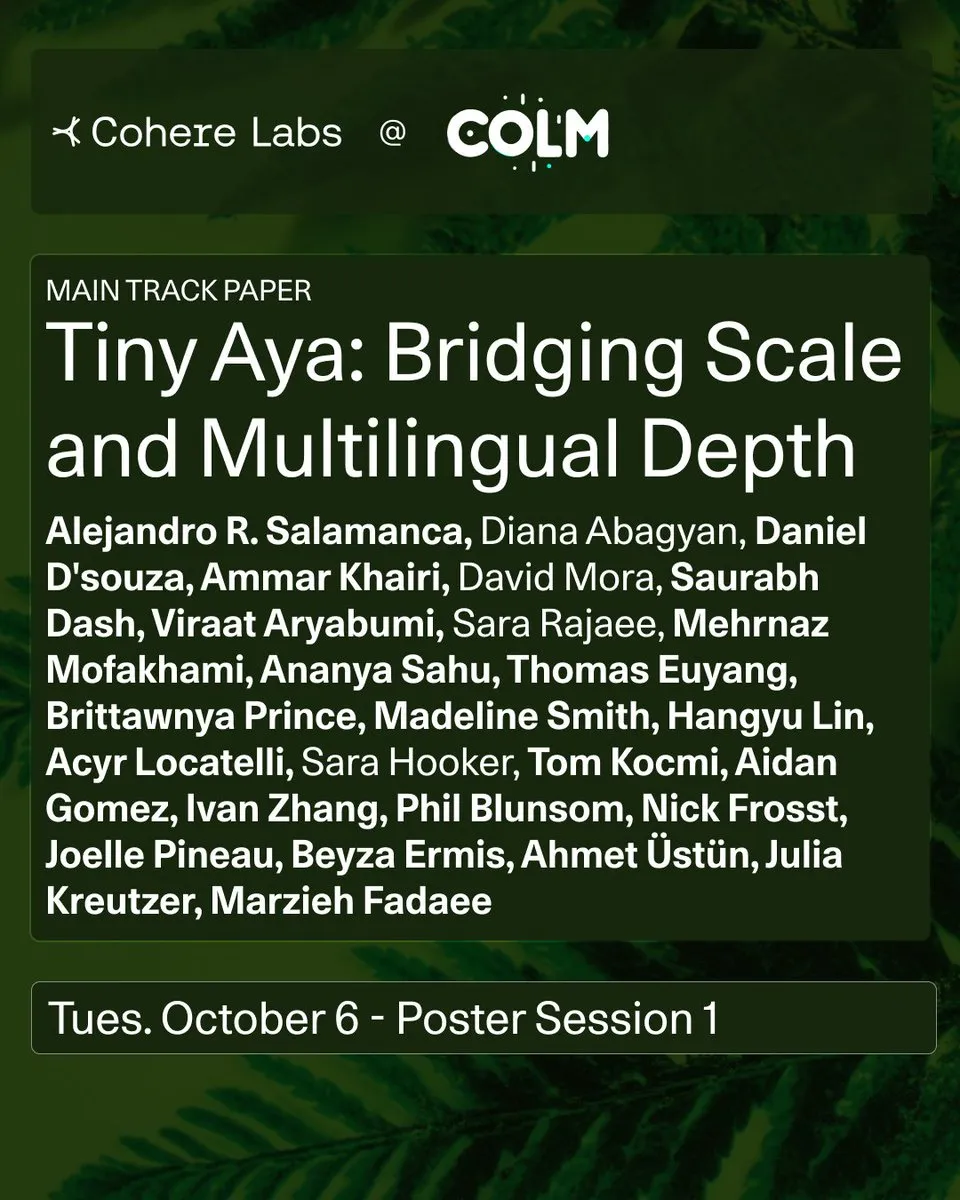
Cohere Open-Sources Tiny Aya Family of Small Multilingual Models Covering 70+ Low-Resource Languages : Cohere Labs open-sourced the Tiny Aya lightweight multilingual model family at COLM 2026. The series pairs a general multilingual base with regionally specialized variants, covering over 70 languages globally (including many low-resource tongues), aimed at lowering the barrier for on-device multilingual deployment and improving cross-cultural semantic generation in small models (Source: sarahookr)
NeurIPS 2026 | SAGE Framework Uses Topological Structural Signals to Correct Drift in LLM Long-Horizon Reasoning : A team from Virginia Tech and collaborating institutions proposed SAGE (Structure-Admissibility Guided Exploration) to tackle the chronic issue where LLMs drift mid-chain during long-horizon reasoning and fail to recover due to delayed terminal rewards. By compressing exploration bias via algebraic sparsification and providing step-by-step feedback through hyperbolic distance, SAGE significantly improves accuracy across multiple symbolic and formal math benchmarks, multiplying Lean verification pass rates several-fold (Source: 机器之心)
.jpg)
Google Launches Experimental No-Code Game Creation Platform Playground : Google launched an experimental AI gaming platform, playground.google. Users can design lightweight games featuring custom physics rules, character interactions, and visual styles in their browser entirely through natural language dialogue. The platform supports cross-device play and community sharing, with plans to integrate Unity Spark for advanced 3D engine support (Source: Google AI Blog)
Replit Launches Cross-Project Global Context and Background Asynchronous Coding Agent : Replit rolled out a major update to its development environment, introducing cross-project workspace global context. Agents can index all past projects and design systems under a user’s account, extracting color palettes and component logic from reference projects into new ones, while supporting background asynchronous generation and one-click review and merge (Source: amasad)
🧰 Tools
Hark Pro: On-Device Privacy Personal Agent Powered by an Isolated Sandboxed Browser : The team led by Figure AI founder Brett Adcock launched desktop and mobile application Hark Pro. Equipped with the Handoff computer-use agent and an interface designed by former Apple designers, the system securely manages user credentials within an isolated sandbox to autonomously browse the web and execute tasks such as visa applications, ticket purchases, and cross-system form submissions. Actions remain fully transparent to the user, striking a balance between autonomous agency and on-device privacy (Sources: TechCrunch, TheRundownAI)
Monid.ai Raises $7.7M to Build Dynamic Tool Settlement Gateway for Agents : Agent infrastructure provider Monid.ai secured $7.7 million in funding to launch an aggregated API gateway dubbed the “OpenRouter for Agents.” Through a single unified interface, agents can dynamically discover and pay-per-call across 2,500 commercial APIs spanning marketing, SEO, search, e-commerce, and multimodal generation, replacing traditional monthly enterprise SaaS subscription lock-ins (Source: yoheinakajima)
AgentID Launches: Independent Identity Credential Solution Built for AI Agents : AgentMail launched the AgentID service. The solution assigns each autonomously running agent an independent authenticated email and identity credential bound to a human owner, enabling third-party SaaS platforms to safely allow external agent logins and cross-platform authorizations while preserving auditability and avoiding account security flags (Source: omarsar0)
Spotify Portal AI Plugins: Bringing Enterprise Developer Platforms to Mainstream Coding Agents : Spotify released an official open-source plugin suite connecting its internal developer platform, Spotify Portal, directly to Claude Code, Codex, and Cursor. Agents can query microservice catalogs, run diagnostics, and check health statuses via CLI, while supporting the “shunt” plugin to offload I/O-heavy tasks to lightweight models to reduce token expenditures (Source: GitHub Trending)
T3 Code Introduces In-Thread Real-Time UI Rendering and Interactive Previews : Coding tool T3 Code launched in-app UI visualization capabilities. When agents execute frontend refactoring or PR code reviews, they can render interactive HTML/React components and visual prototypes directly inside the conversation thread, reducing the context-switching penalty of jumping out to an IDE for hot-reloading (Source: theo)
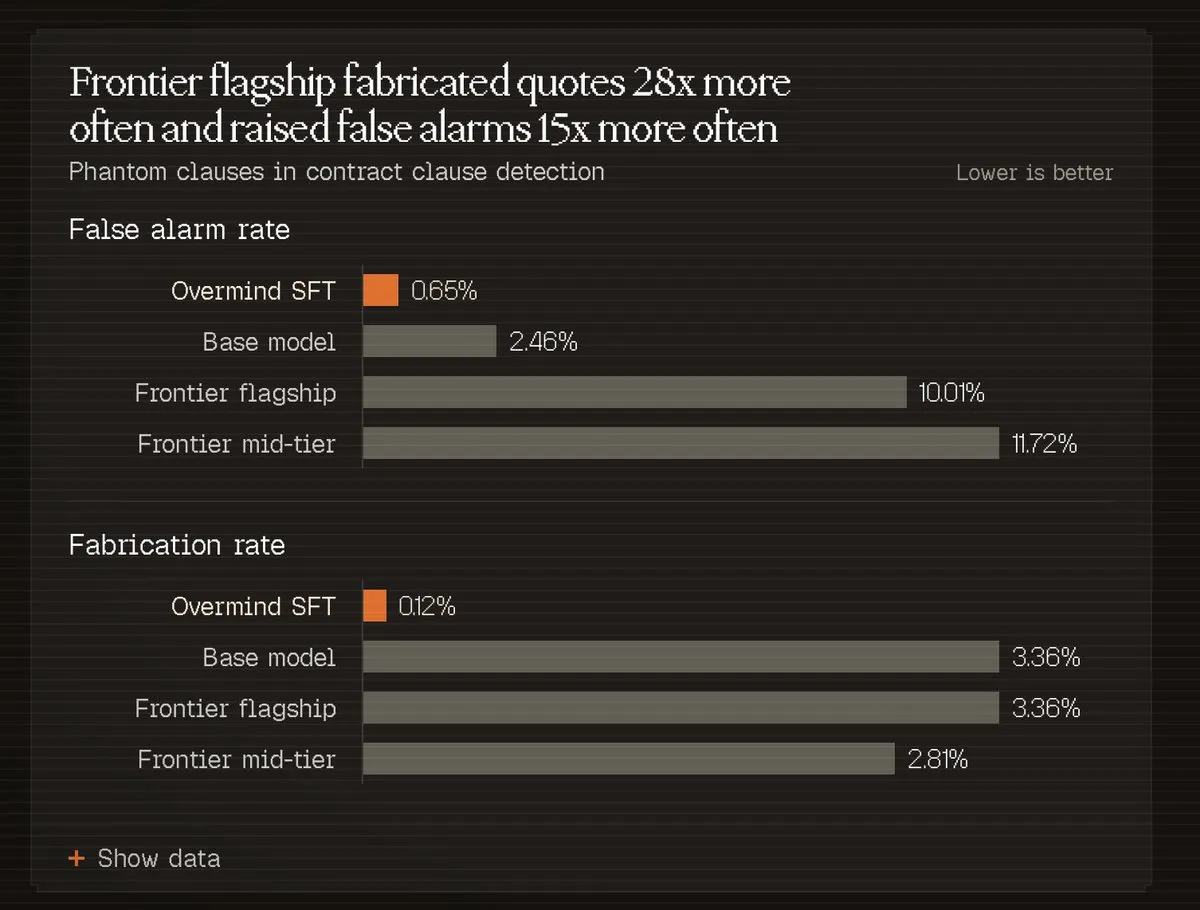
Overmind Open-Sourced: Automated Distillation of Domain-Specific Small Models from Agent Execution Traces : Open-source tool Overmind was released, enabling automated extraction of high-value fine-tuning datasets and evaluation suites from the tool invocation logs and execution traces of everyday coding and business agents. Tests show that fine-tuned domain-specific small models reduced citation hallucination rates from 3.36% (in LLMs) to 0.12% in long-contract clause extraction scenarios (Source: kimmonismus)
Mitchell Hashimoto Releases OSC 7501 Universal Terminal Program State Specification : Renowned developer Mitchell Hashimoto published the new OSC 7501 terminal control specification, allowing command-line programs to report fine-grained states (such as idle, running, blocked/waiting, completed, and failed) directly to the terminal. The specification aims to replace heuristic regex parsing relied upon by hundreds of agent orchestrators and establish a standard protocol for multi-agent status communication (Source: mitchellh)
Scale AI Open-Sources High-Fidelity Agent Reinforcement Learning Environment Framework AgentEnv : Scale AI, in collaboration with Modal, open-sourced the AgentEnv environment building suite. Designed for RL post-training of complex long-horizon agents, the framework provides dynamic triggers, virtual clocks, and multi-sandbox scheduling, seamlessly interfacing with mainstream cloud sandbox clusters to support massive concurrent rollouts and adversarial environment training (Source: Scale AI)
DAIR.AI Launches MCP Suite for Agent-Driven Top-Tier Paper Discovery : Open-source AI research community DAIR.AI introduced a dedicated Model Context Protocol (MCP) plugin offering one-click integration with Claude Code, Codex, Grok Bot, and other agents. Agents can autonomously query curated AI research paper databases to synthesize literature trends, generate automated literature reviews, and visually compare methodological architectures (Source: DAIR.AI)
ruNNtime Runs EmbeddingGemma 2 Completely In-Browser via WebGPU : WebGPU inference library ruNNtime successfully ported both the text and vision towers of EmbeddingGemma 2 directly into a pure frontend environment. Users can perform multimodal semantic search over photo galleries locally without backend server involvement, validating the promise of lightweight on-device multimodal retrieval for privacy-preserving and offline applications (Source: Reddit r/LocalLLaMA)

Anthropic Launches Public Beta of Claude for Google Workspace Add-on : Anthropic launched an official Google Workspace sidebar add-on for paid subscribers, enabling users to invoke Claude directly within Google Docs, Slides, and Sheets for multi-turn editing, structural refinement, and automated formatting, with support for cross-document context reading (Source: The Verge)
📚 Research & Learning
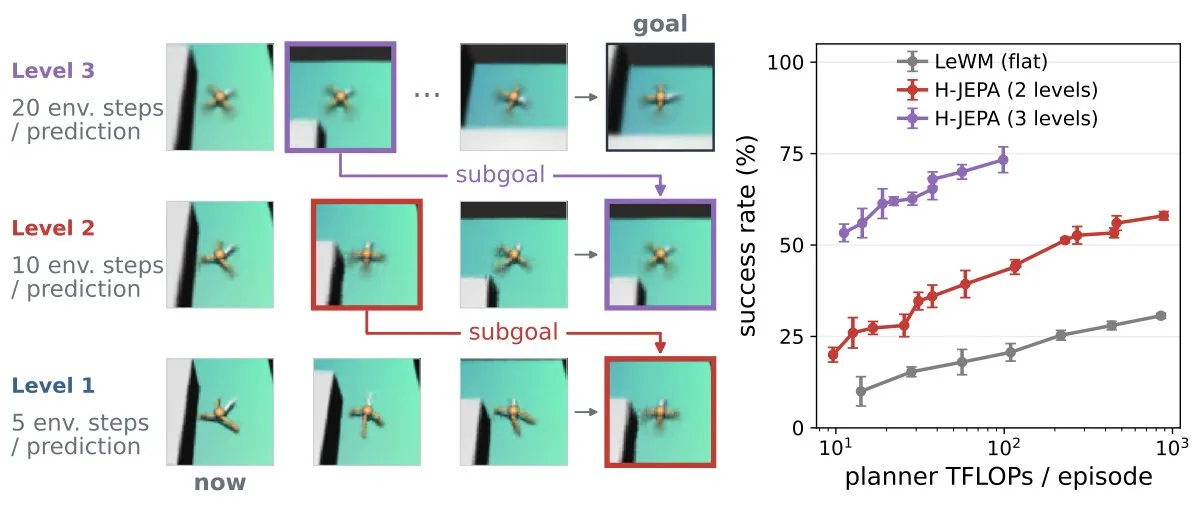
Yann LeCun’s Team Introduces Hierarchical World Model H-JEPA, Quadrupling Long-Horizon Visual Planning Success Rate : To address the issue of end-to-end visual planning losing local details, Yann LeCun’s team proposed H-JEPA, a top-down hierarchical representation architecture. Each layer possesses independent latent space representations and semantic abstraction scales. In the challenging Visual AntMaze long-horizon planning benchmark, the three-layer stacked architecture boosted the task success rate from 18% to 73% (Source: ylecun)
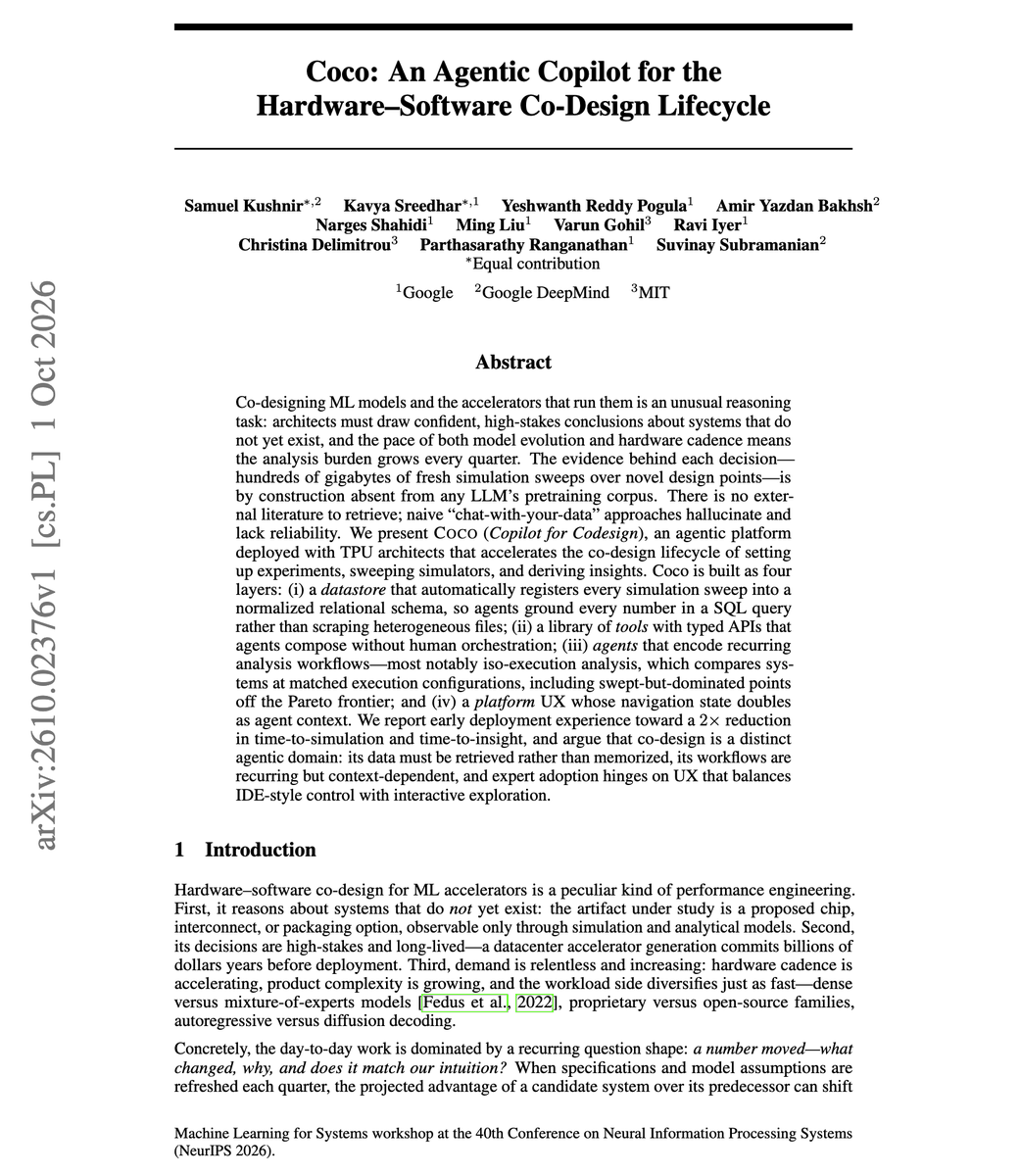
Meta and MIT Introduce Coco: A Multi-Agent Platform for Hardware and Deep Learning Co-Design : Meta and MIT introduced Coco, a multi-agent system for hardware design. Facing hundreds of gigabytes of unseen simulation scan data, agents autonomously write SQL queries against relational databases, orchestrate analysis tools, and inspect UI navigation states, cutting in half the time TPU architects spend setting up simulation configurations and attributing performance bottlenecks (Source: dair_ai)
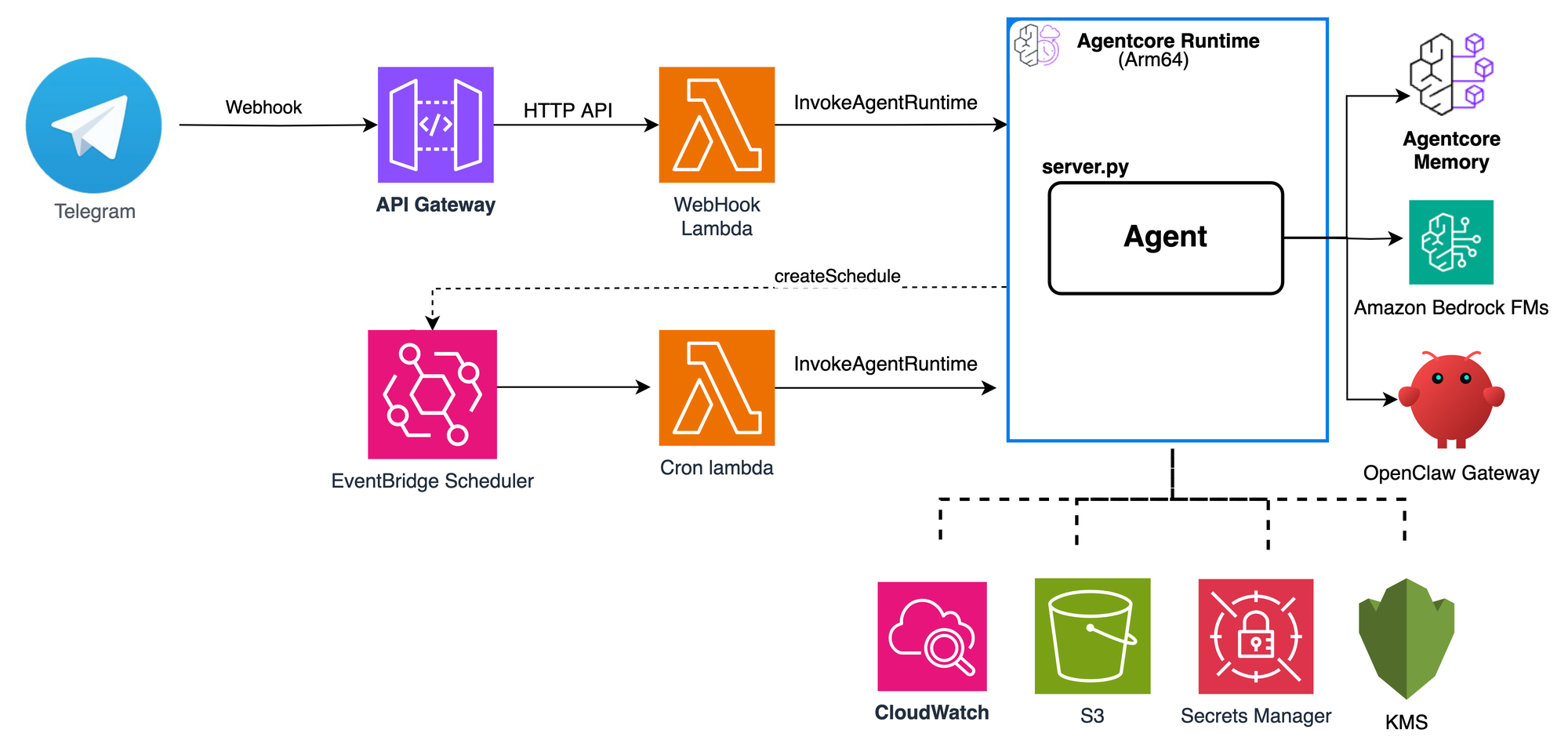
Guide: Building AI Assistants with Persistent Memory Using AgentCore and OpenClaw : The AWS team published an architectural guide demonstrating how to combine the OpenClaw framework with Bedrock AgentCore persistent memory components on serverless runtimes. The article breaks down a two-tier memory architecture featuring short-term event capture and asynchronous long-term fact extraction, cutting multi-turn memory reasoning costs by nearly 90% via prompt caching (Source: AWS Machine Learning Blog)
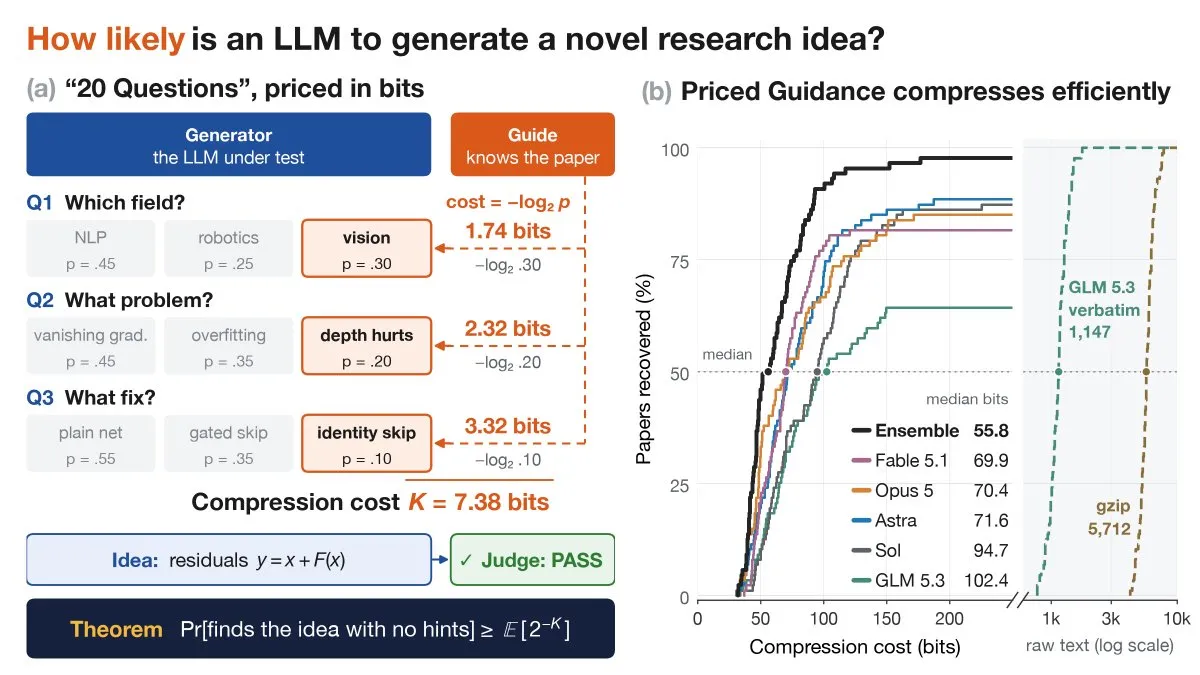
Stanford Proposes Priced Guidance Framework to Quantify LLMs’ Ability to Formulate Original Scientific Hypotheses : Percy Liang’s team proposed “Priced Guidance,” an information-theoretic evaluation paradigm. By formulating a “20 Questions” game, it precisely measures the bits of information required for a model to recover core concepts of newly published papers beyond its pre-training cutoff, establishing a compression-based benchmark to quantify a model’s scientific intuition and frontier generalization ability (Source: percyliang)
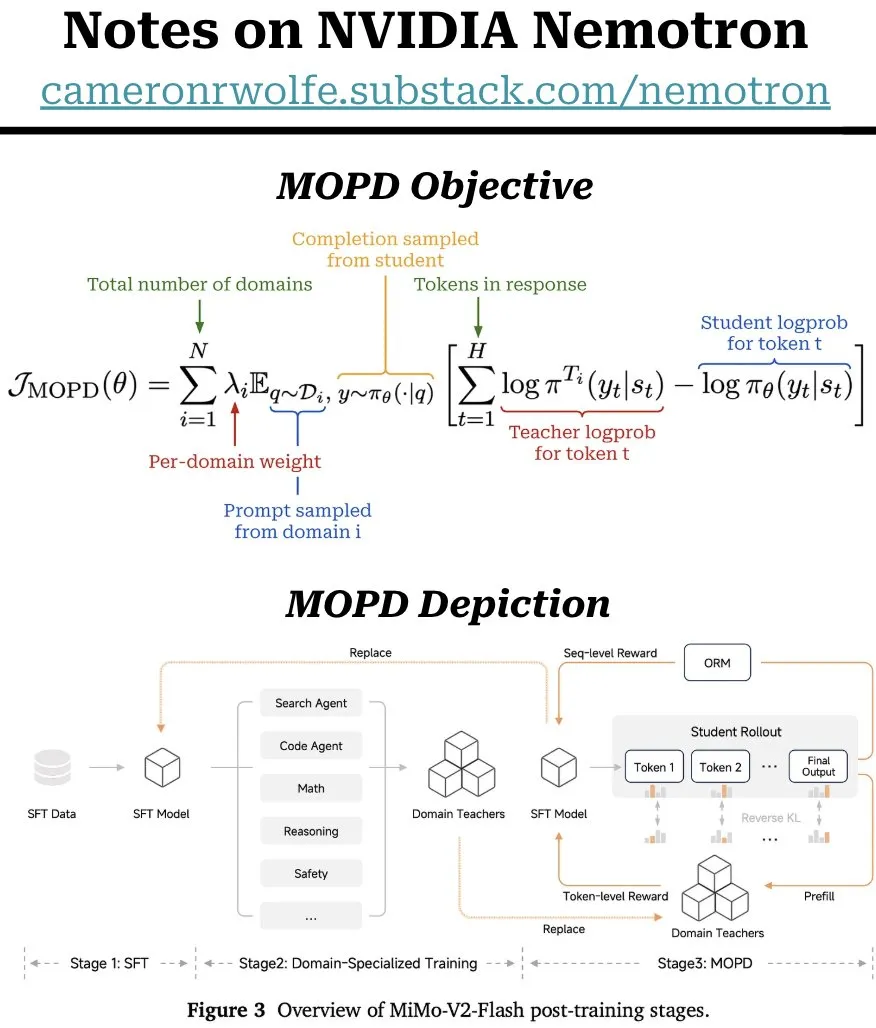
Deconstructing Multi-Teacher On-Policy Distillation (MOPD): Resolving Cross-Domain RL Capability Conflicts : A research paper deconstructed the Multi-Teacher On-Policy Distillation (MOPD) method. Addressing reward conflicts and compute overload when fine-tuning reasoning, coding, and chat capabilities under unified RL, MOPD trains domain-specialized teacher models separately and then provides dense supervision to a student model at the token level via reverse KL divergence, unifying omni-competent capabilities while preserving sample efficiency (Source: cwolferesearch)
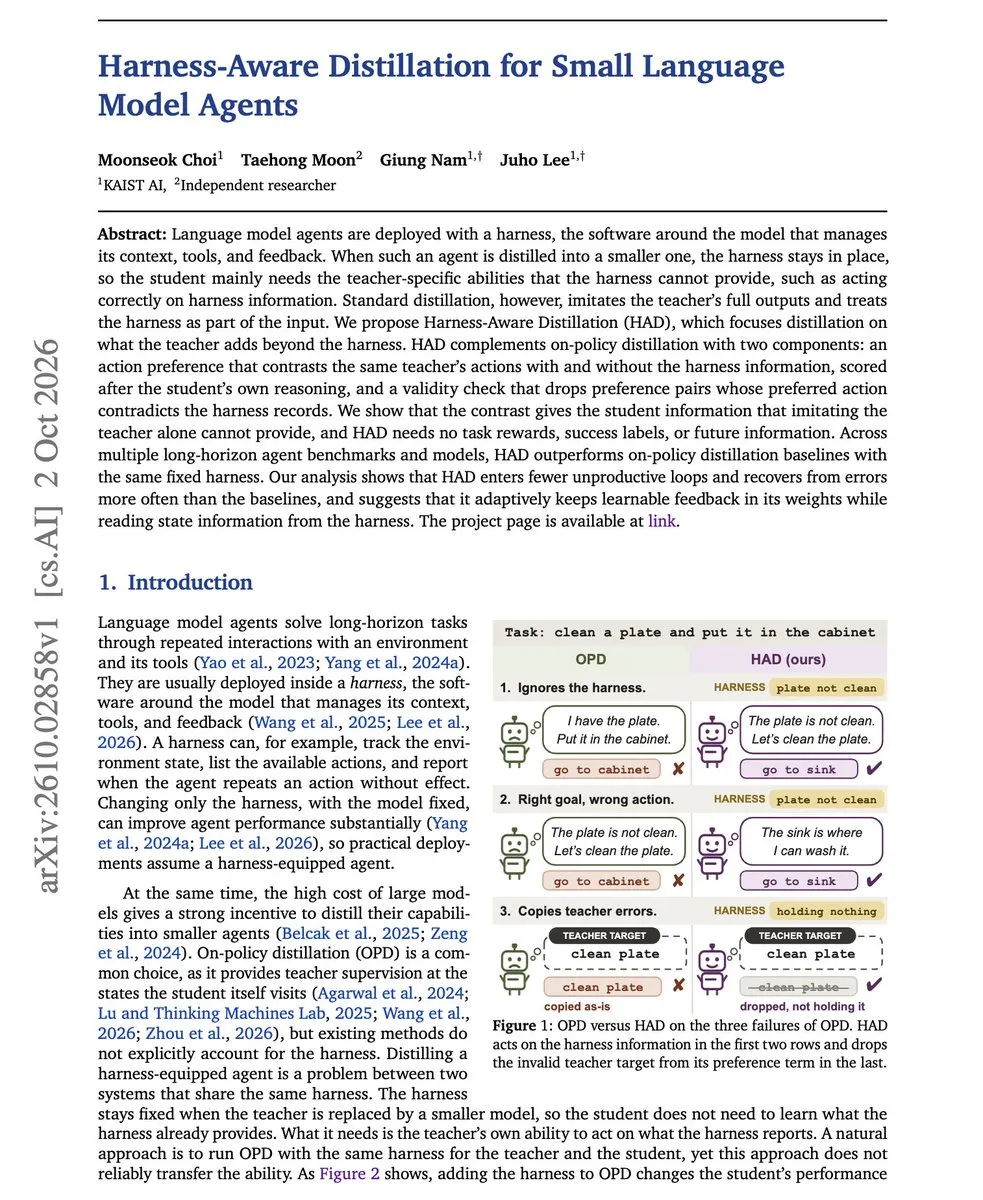
HAD Framework: Boosting Small Language Model Agent Execution via Harness-Aware Distillation : A paper proposed HAD (Harness-Aware Distillation) for small model agents deployed within execution harnesses. By comparing teacher model action discrepancies with and without external state information, it specifically trains small models to leverage framework signals, boosting small model task success rates to 63.4% on the ALFWorld benchmark and resolving nearly 60% of deadlock scenarios (Source: omarsar0)
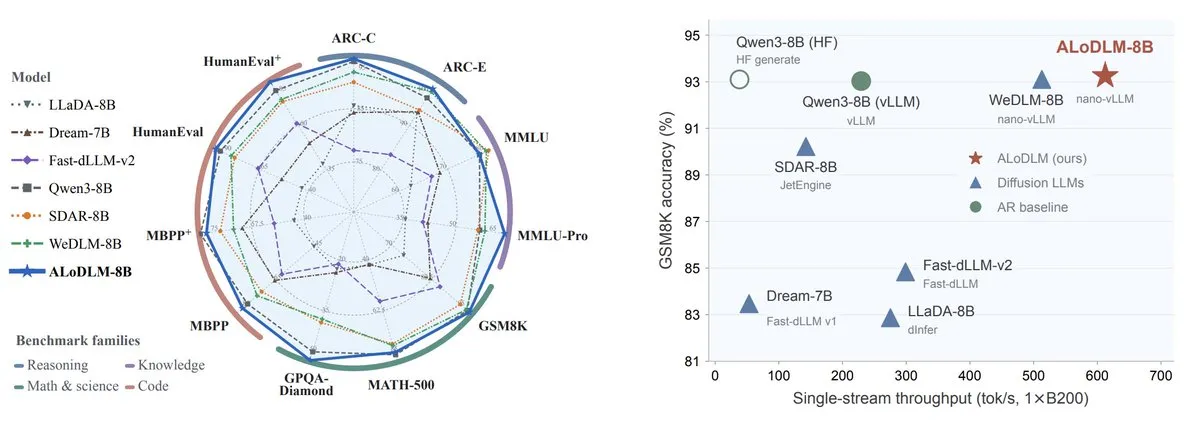
Amazon AGI Open-Sources Adaptive Recurrent Diffusion Language Model ALoDLM : The Amazon AGI research team open-sourced the 8B-parameter ALoDLM architecture and training pipeline. By introducing adaptive recurrent reasoning and progressive error correction within a diffusion language model, it dynamically allocates compute for difficult examples, outperforming autoregressive baselines of comparable scale across multiple comprehensive language understanding and generation benchmarks (Source: arankomatsuzaki)
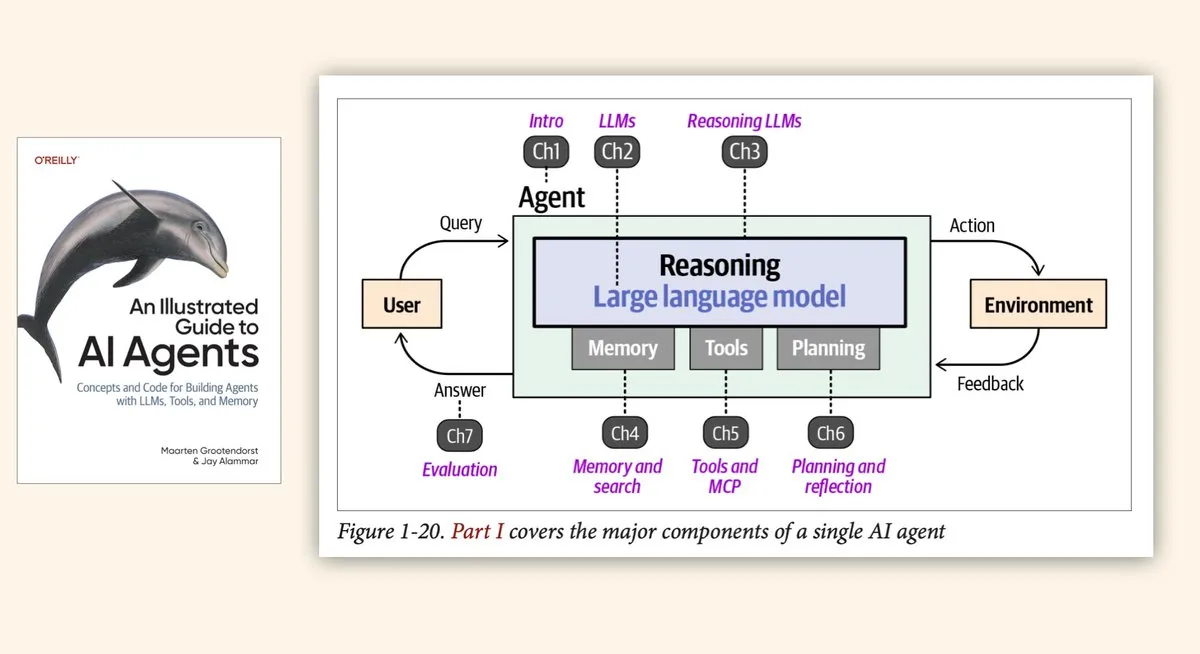
Jay Alammar Shares Core System Architecture Diagram from “Visual Guide to AI Agents” : Prominent technical author Jay Alammar shared the definitive closed-loop architecture diagram for agent systems. It breaks down the recursive loop of LLMs in agent environments—from user goal reception and state maintenance to memory retrieval and environmental action execution—offering developers an essential blueprint for modern autonomous agent systems (Source: Jay Alammar)
💼 Business
AMD Announces Intent to Acquire Fei-Fei Li’s Spatial Intelligence Startup World Labs in $8.2B All-Stock Deal : AMD announced a definitive agreement to acquire World Labs, the world-model unicorn co-founded by Fei-Fei Li, in an all-stock transaction valued at approximately $8.2 billion. Industry analysts note that as the Atlas model proves the viability of real-time 4D reconstruction from sparse views, embodied AI and world models are hitting an industrial inflection point; AMD’s acquisition is aimed at countering NVIDIA and establishing defensible depth across 4D compute silicon architectures and simulation ecosystems (Source: 36氪)
Kuaishou’s Kling AI Selects CICC and Goldman Sachs for Hong Kong IPO, Aiming to Raise Over $1 Billion : Kuaishou’s video generation AI division, Kling AI, has selected CICC, Goldman Sachs, and UBS as its underwriting syndicate to pursue a Hong Kong spin-off IPO, targeting at least $1 billion in proceeds with a potential listing as early as 2027. Kling’s Q2 2026 revenue exceeded 850 million RMB; the spin-off aims to establish dedicated financing channels for compute cluster R&D while Kuaishou retains controlling ownership (Source: 36氪)

AI Cloud Provider Lambda Seeks to Raise $4B at $14.5B Valuation Ahead of IPO : According to The Wall Street Journal, GPU cloud infrastructure provider Lambda is raising up to $4 billion at a $14.5 billion pre-money valuation, led by Coatue and Blackstone. Driven by massive compute commitments from major clients like Anthropic, its order backlog surged to $50 billion; this equity round will secure the construction of next-generation compute facilities ahead of its planned IPO (Source: TechCrunch)
🌟 Community
Enterprises Face “Collaboration Tax” Deploying Agents: Every 1 Hour of Ticket Resolution Incurs 3 Hours of Internal Communication : A survey of 700 enterprise executives by customer communication platform Front sparked widespread debate. Data revealed that adopting agents did not immediately slash labor costs; instead, due to multi-node handoffs and escalations from non-closed-loop agent runs, it incurred a massive unmeasured “collaboration tax”—enterprises spent three times as much time on cross-system handoffs and background verification as on resolution itself, exposing critical governance pain points in end-to-end observability (Source: )
Technical Post-Mortem on Gambling Ads Appending to ChatGPT Chat Titles: Tokenizer Contamination and Truncation Failure : Developers have reconstructed the technical root cause behind illicit gambling ads occasionally appearing at the end of ChatGPT session titles. Pretraining corpora for the o200k tokenizer were contaminated with high-frequency, long tokens from shady websites. When the lightweight title generation model experienced probability drift at the closing EOS control token, it inadvertently sampled high-probability ad substrings from the rare-token “junk drawer” it had rarely encountered (Source: 36氪)
The Rise of Cloud-Native Harness Architecture: Kubernetes Creators Explore Centralized Agent Governance : Stacklok, founded by early Kubernetes core contributors, open-sourced Mecatl, a cloud-native agent harness. The community extensively discussed the architectural evolution of agents from “local terminal scripts” to “centralized enterprise governance platforms,” urging a decoupling of agent state, MCP tool gateways, and sandboxed execution environments to avoid tying core enterprise assets and privileges to individual local machines (Source: Latent Space)
Meta Muse Exposed Compiling Real-Time Social Dossiers on 4 Million Users, Sparking Privacy Concerns : Community disclosures revealed that Meta’s Muse agent updates detailed user dossiers on an hourly basis based on chats and communication logs, detailing social graphs, interpersonal friction, and personal preferences. Although Meta stated that user VMs operate in isolated sandboxes, cross-instance “shared learning experiences” have raised intense alarm regarding covert data collection and targeted ad exploitation (Source: Reddit r/artificial)

Developers Debate AI “Jargonization”: From CoT Compression to Corpus Overfitting : Developer communities have recently voiced frustration over latest coding LLMs repeatedly generating bizarre corporate and test jargon in summaries (e.g., “15/15 all green, single-leg misfire”). Discussions point to vendors aggressively compressing implicit Chain-of-Thought (CoT) into cryptic shorthands to curb token usage; others seized the opportunity to explore whether dense Classical Chinese offers natural engineering advantages for extreme token compression (Source: 量子位)

Prompt Encryption Bypass Vulnerability Exposed: Self-Decryption by Agents Becomes a Security Liability : Security research demonstrated that attackers can bypass external safety filters in systems like Copilot by encrypting malicious prompts; the agent itself autonomously decrypts the payload upon processing, retrieves local secrets, and exfiltrates them over the network. Testing showed that automated model routing makes safety defenses highly erratic, illustrating systemic vulnerabilities in relying on model self-discipline as a security perimeter (Source: Reddit r/artificial)

Extreme Miniaturization: Developer Trains 20K-Parameter Narrative Model MacroStories : An independent developer open-sourced MacroStories, a miniature language model weighing just 81KB (19,969 parameters). Employing a single decoder looped over 4 recurrent iterations, it runs blazing fast on standard CPUs or microcontroller caches while sustaining coherent narrative storylines across a restricted vocabulary, probing the minimal compute frontier required for linguistic coherence (Source: Reddit r/LocalLLaMA)

💡 Other News
Grid Expansion and Transformer Supply Bottlenecks May Halt AI Expansion Before Compute Silicon Does : Energy policy analyses indicate that while U.S. AI data center power demand is projected to surge to 50GW by 2030, lead times for high-voltage transformers and heavy power equipment routinely exceed 5 years, with manufacturers hesitant to build out capacity due to memories of past boom-and-bust cycles. This hard physical mismatch between grid infrastructure and power demand is emerging as the most acute physical constraint on unconstrained compute expansion (Source: Transformer)

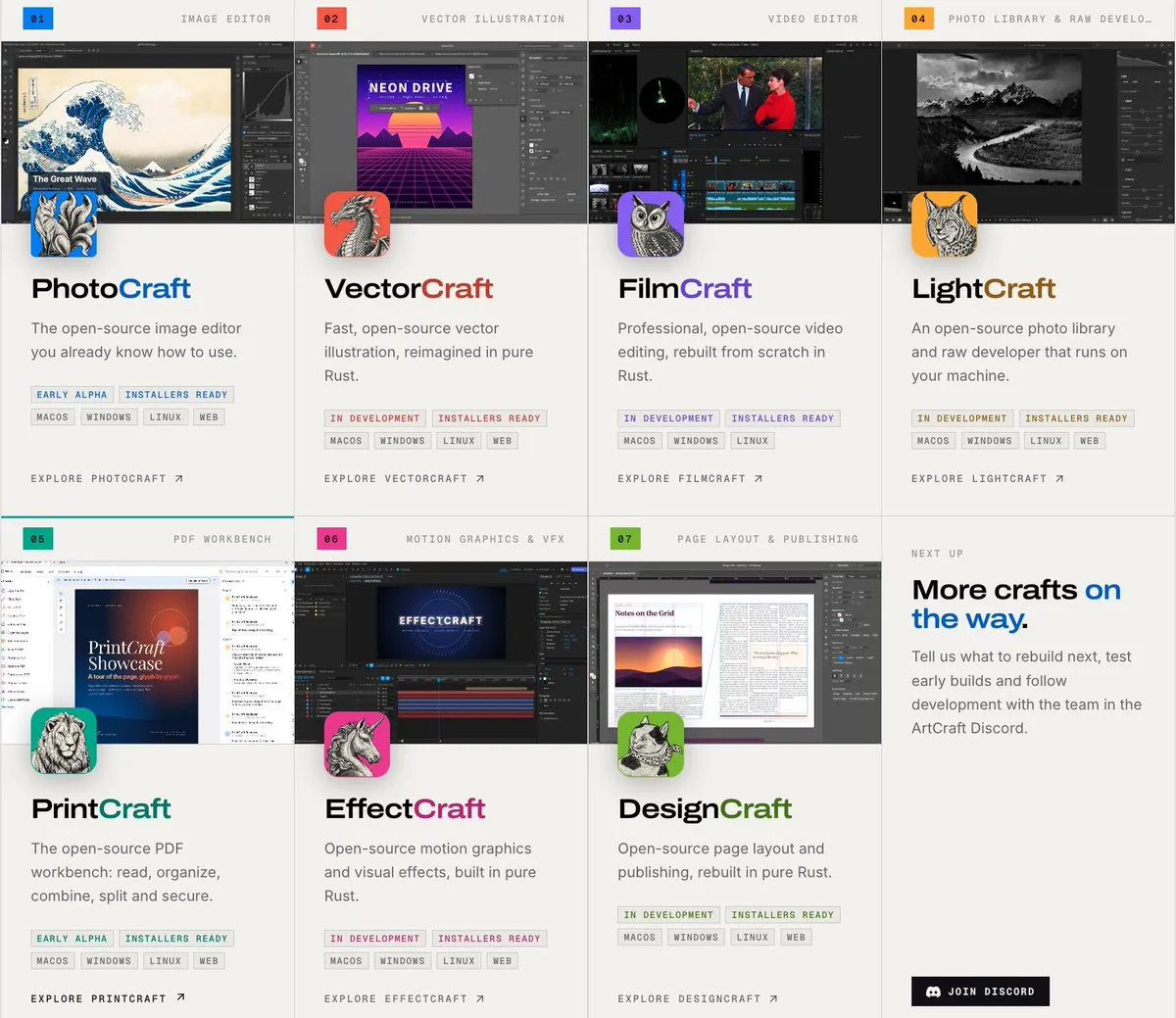
Full Adobe Design Suite Reverse-Engineered into Open Source: Coding LLMs Reshape IP Moats : Open-source project Artcraft utilized frontier coding models like Opus 5.5 to decompile proprietary design software logic and rebuild it as a clean-room open-source Rust implementation, creating an open-source alternative to Photoshop. Community discussions highlighted how coding agents’ ability to rapidly reverse-engineer legacy software is fundamentally eroding the high commercial moats long enjoyed by proprietary enterprise software (Sources: dotey, amasad)
McDonald’s Hit with Antitrust Lawsuit Over Alleged Franchise Price Fixing via AI Pricing Tools : Consumers filed an antitrust class-action lawsuit in Chicago federal court against McDonald’s, alleging that dynamic AI pricing tools mandated across independent franchisees effectively enabled horizontal exchanges of non-public sales data and algorithmic price-fixing, violating consumer protections and distorting market competition (Source: The Guardian)
