
🔥 Spotlight
Global First: “AI Memory” Open-Sourced, MIRIX APP Launched Simultaneously: Researchers from the University of California San Diego and New York University have jointly released and open-sourced MIRIX, the world’s first multimodal, multi-agent AI memory system. This system is the first to integrate “multimodal long-term memory” into an AI’s underlying operating system, achieving deep understanding and long-term tracking through six memory modules and a multi-agent workflow. In ScreenshotVQA and LOCOMO long-dialogue tasks, MIRIX significantly outperforms traditional RAG and long-context methods. A desktop APP has also been launched, supporting local storage, aiming to build personalized AI assistants for users. (Source: 36氪)
NVIDIA’s New Open-Source Model: Triple Throughput, Single-Card Capable, Achieves Inference SOTA: NVIDIA has launched Llama Nemotron Super v1.5, an open-source model designed for complex reasoning and Agent tasks. Optimized through Neural Architecture Search (NAS), the model achieves SOTA performance in science, mathematics, programming, and Agent tasks, while boosting throughput to 3x that of its predecessor. It can run efficiently on a single card, delivering high accuracy, high throughput, and low resource consumption. Part of NVIDIA’s Nemotron ecosystem, it aims to provide high-performance, highly controllable, and easily scalable solutions for enterprise-grade AI application development. (Source: 量子位)
Qwen3-30B-A3B-Instruct-2507 Model Released: Alibaba Cloud’s Qwen team has released the Qwen3-30B-A3B-Instruct-2507 model. This MoE architecture model has only 3B active parameters but shows significant performance improvements, especially in mathematical reasoning (AIME25 increased from 21.4 to 61.3) and long-context understanding (256K tokens), and supports local deployment. Its performance is close to GPT-4o and Qwen3-235B-A22B in non-thinking mode, marking a significant advancement in the open-source domain. GGUF and MLX quantized versions are available on Hugging Face, drawing widespread community attention. (Source: Reddit r/LocalLLaMA)

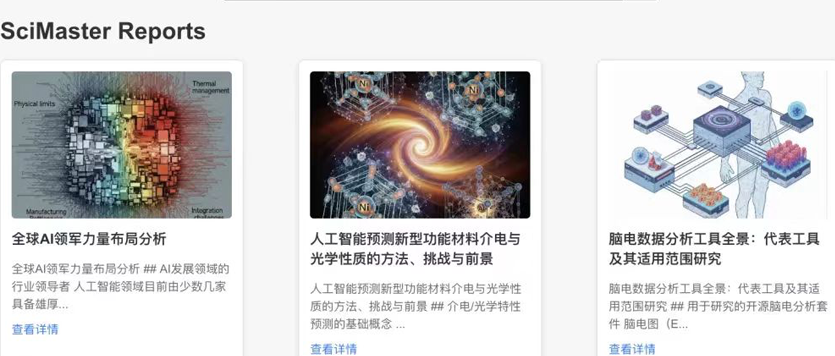
SciMaster: The World’s First General Scientific Agent: Shanghai Jiao Tong University and DeepMotion jointly released and open-sourced SciMaster, aiming to be an expert-level research assistant for everyone. This general scientific agent combines resources from across the web and 170 million scientific papers, offering expert-level in-depth research capabilities. It supports various retrieval methods like WebSearch, WebParse, and PaperSearch, and can automatically correct and supplement information. SciMaster also integrates multiple science-specific tools, supporting both active and automatic invocation, aiming to reshape university research paradigms and advance the AI4S field. (Source: 量子位)
🎯 Trends
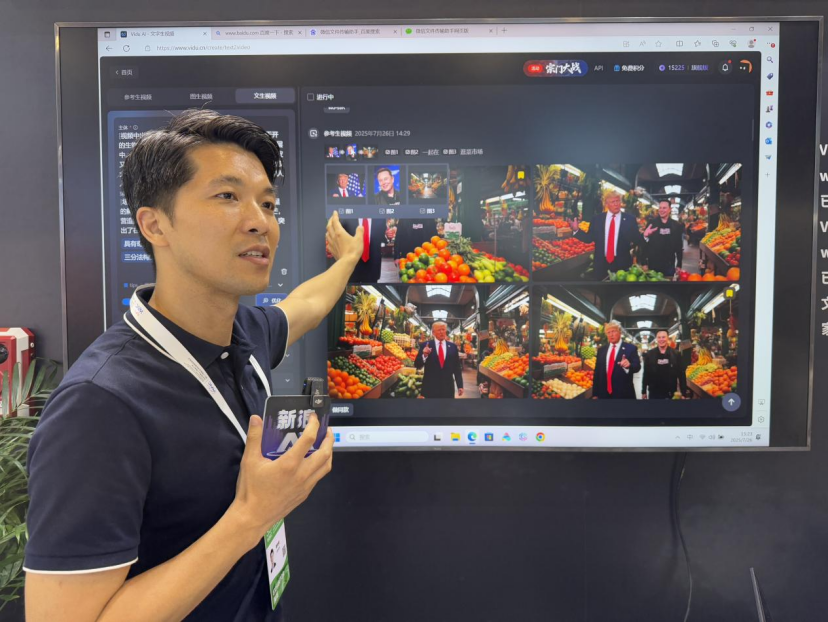
Progress in Domestic AI Video Model “Three Kingdoms Kill”: In China’s AI video generation sector, Kuaishou’s Kwai Ling AI, Shengshu Technology’s Vidu, and ByteDance’s Jiemeng AI are engaged in fierce competition. Kwai Ling AI is known for its strong expressiveness, suitable for dramatic content; Vidu excels in realism and detail, adept at simulating physical laws; while Jiemeng AI stands out for its balanced control and comprehensive tool attributes. All three have made breakthroughs in consistency issues, with different technical focuses. Kwai Ling and Jiemeng are considered stronger contenders for ultimate victory due to their potential in application and ecosystem development. (Source: 36氪)
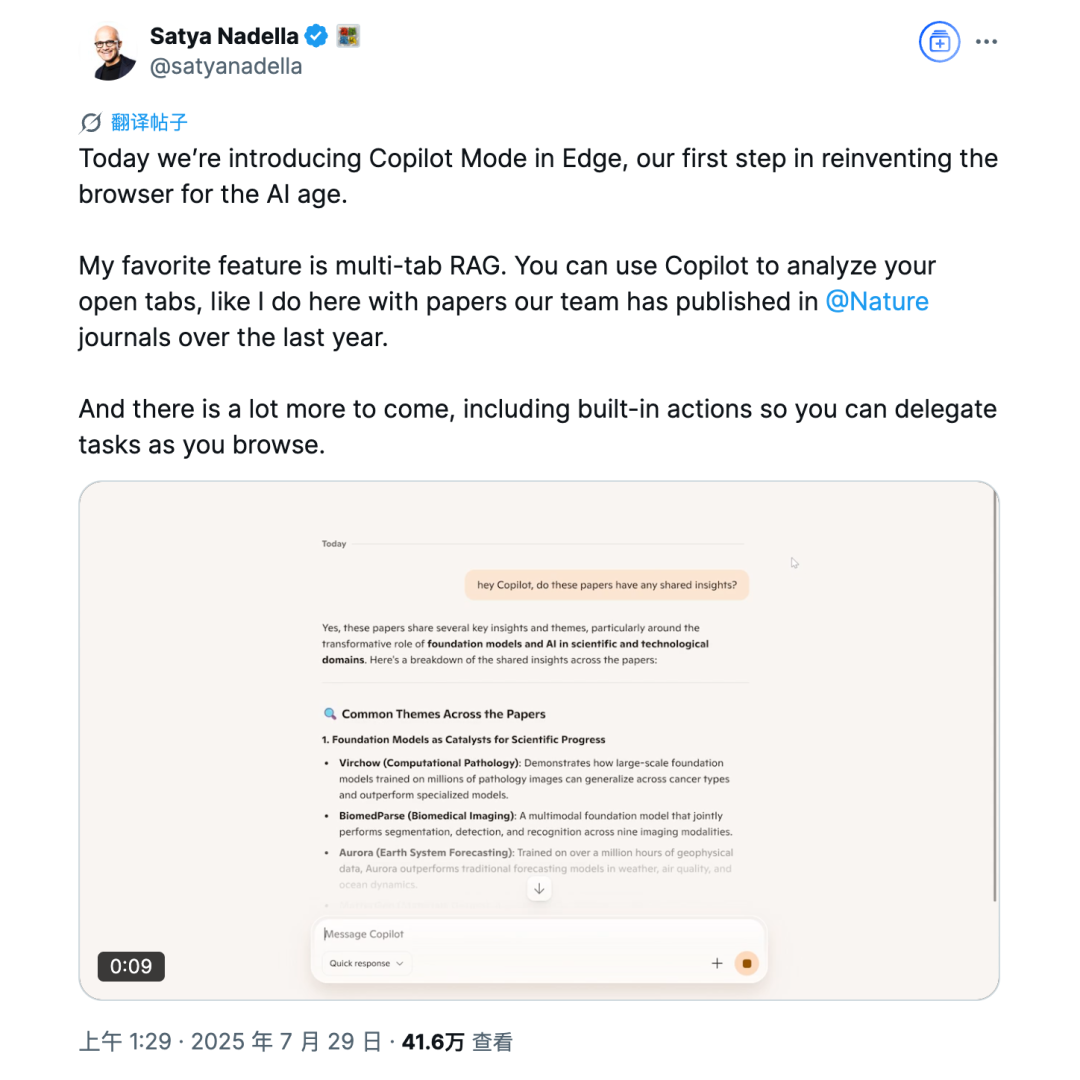
Microsoft Edge Browser Launches Copilot Mode: Microsoft Edge browser has officially entered the AI browser market with the introduction of Copilot mode. This mode can read and understand web content, summarize YouTube videos, compare product information across multiple tabs, and supports voice interaction. Currently in an experimental phase, it offers free features similar to ChatGPT DeepResearch, aiming to transform the browser into a smarter assistive tool. However, its functionalities are not significantly different from existing AI browsers, and it faces challenges regarding user privacy and acceptance. (Source: 36氪)
Medical AI Embraces Systematic Empowerment and Specialized Development: The 2025 WAIC indicates a “comeback” for medical AI, with major companies and startups entering the field. AI is evolving from solving specific “node” problems to empowering entire “processes,” enabling full-lifecycle health management and diagnostic assistance through agents, such as Tencent Health’s “Health Management Assistant.” Concurrently, AI is progressing from general models to vertical specialized models, addressing deeper clinical issues, exemplified by JD Health’s “Jingyi Qianxun 2.0” and United Imaging Intelligence’s “Chest Scan Multi-Check Agent,” enhancing diagnostic efficiency and accuracy. (Source: 36氪)
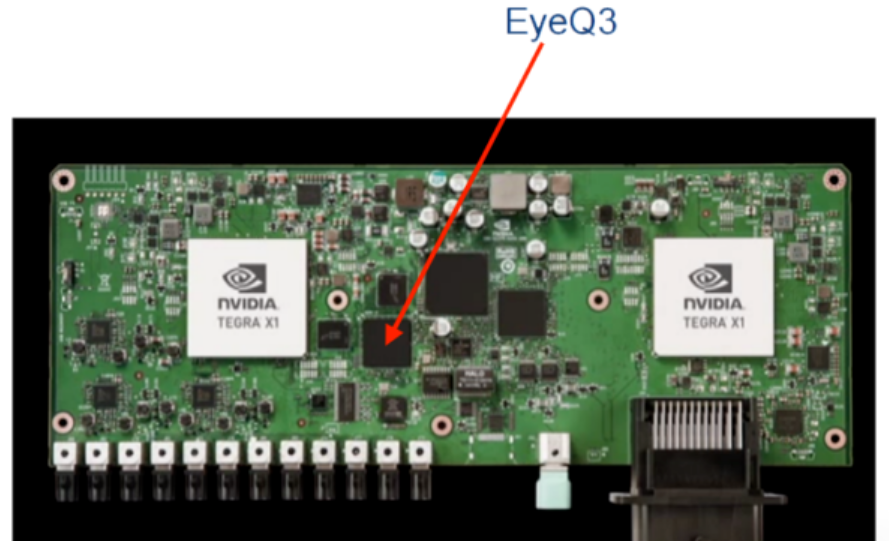
Tesla FSD Chip Continues to Iterate, Targeting L4 Autonomous Driving: Tesla’s intelligent driving chips have evolved from relying on external suppliers (Mobileye, NVIDIA) to fully in-house developed FSD chips. HW3.0 and HW4.0 have been successively launched, significantly boosting computing power and energy efficiency, and enhancing adaptability to complex scenarios. The HW5.0/AI5 chip has entered mass production, utilizing TSMC’s 3nm process, with computing power reaching 2000-2500 TOPS. It is expected to achieve large-scale mass production by 2026, driving the realization of L4 autonomous driving and reshaping the intelligent driving chip market landscape. (Source: 36氪)
🧰 Tools
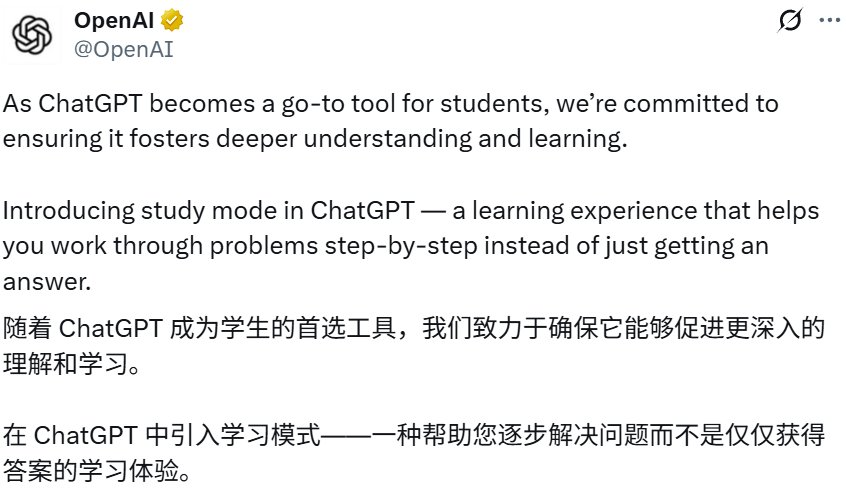
ChatGPT Launches “Learning Mode”: OpenAI has introduced ChatGPT’s “Learning Mode,” designed to help users progressively solve problems and deepen understanding through Socratic questioning, guiding questions, and personalized feedback, rather than directly providing answers. This mode is available to all users (including free users) and is powered by custom system instructions developed in collaboration with education experts. It aims to foster critical thinking and self-directed learning, marking a deeper exploration of ChatGPT’s applications in education. (Source: 36氪)
Google NotebookLM Adds Video Overview Feature: Google NotebookLM has introduced a video overview feature, serving as a visual alternative to audio overviews. Users can leverage an AI host to automatically generate short video summaries containing images, charts, citations, and data, providing clearer visual representations of complex or text-heavy concepts, thereby enhancing learning and comprehension efficiency. This feature currently supports English and desktop platforms. (Source: Google)

Claude Code Supports Multi-Directory Work: Anthropic’s Claude Code has been updated to support working across multiple directories within a single session, allowing users to add working directories by typing /add-dir. This feature significantly enhances the convenience of codebase operations, enabling in-project or cross-project code migration without switching sessions, and allowing the retrieval of memory or rule files from external sources, improving the Agent collaborative programming experience. (Source: dotey)
Tongyi Lingma Launches Qwen3-Coder: Alibaba Cloud’s Tongyi Lingma has launched the AI programming model Qwen3-Coder, available for free use by users on Tongyi Lingma AI IDE, VSCode, and Jetbrains plugin platforms. Qwen3-Coder significantly improves code generation speed and accuracy in real enterprise-level development scenarios and provides a better Agent collaborative programming experience. The model has topped the HuggingFace model leaderboard and is considered the world’s strongest open-source programming model, comparable to Claude4. (Source: 量子位)
BlockDL: Visual Neural Network Builder: BlockDL is a free, open-source GUI tool that allows users to visually design Keras neural networks by dragging and dropping modules. It provides instant code generation and real-time shape validation, helping developers quickly create designs and avoid early errors. The tool also includes a complete learning system and supports advanced structures like skip connections and multi-input/output models. (Source: fchollet)

PopAi AI Slides Agent: PopAi has launched the AI Slides Agent, allowing users to automatically generate beautiful PPT slides with just a single prompt. This tool aims to understand user ideas through AI, enabling intelligent, fast, and effortless slide creation, significantly boosting presentation production efficiency. (Source: kaifulee)
📚 Learning
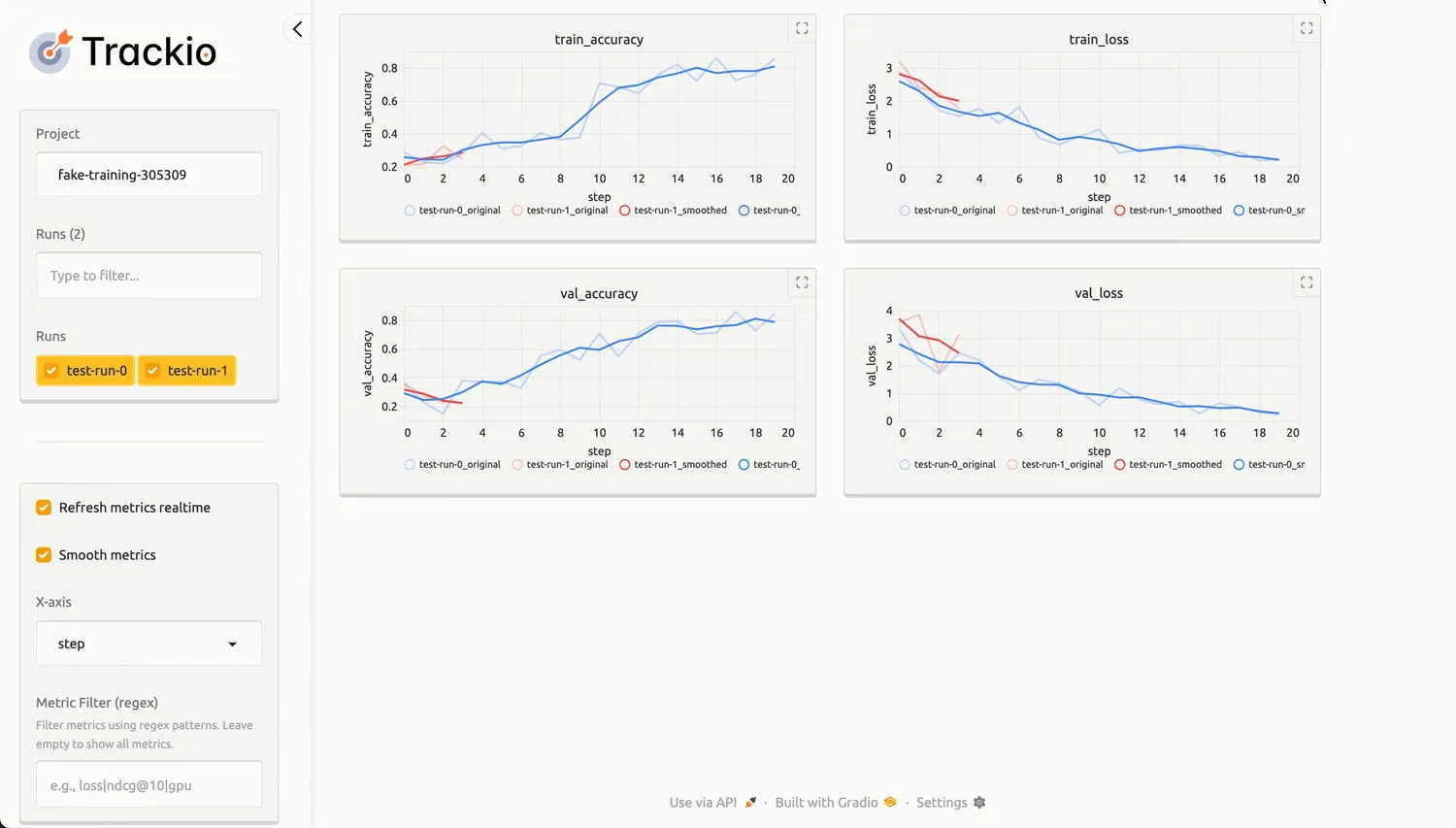
Hugging Face Releases Lightweight Experiment Tracking Library Trackio: Hugging Face has launched Trackio, an open-source Python library designed to provide a lightweight, local-first solution for machine learning experiment tracking. Trackio is compatible with the wandb API, supporting easy sharing of training progress, embedding charts, and standardizing transparent recording of metrics like GPU energy consumption. Built on Gradio and Hugging Face Spaces, it facilitates visualization and sharing of experiment results and integrates natively with the Transformers and Accelerate libraries. (Source: HuggingFace Blog)
Application of LangChain and LangGraph in Context Engineering: LangChain and LangGraph offer various context engineering methods to help developers optimize the performance of LLM applications. LangGraph, through its multi-agent system, has helped enterprises (such as Bertelsmann) reduce content discovery time from hours to seconds, enabling the deployment of specialized agents across content domains and modular API reuse. LangSmith’s new Align Evals feature also simplifies the construction of LLM-as-judge evaluators, making their ratings more aligned with human preferences. (Source: LangChainAI)

LLM Mathematical Problem Generation and Complexity Enhancement: The SAND-Math project proposes a pipeline for generating novel, difficult, and useful mathematical problems and solutions using LLMs. This method first generates high-quality problems and then systematically increases their complexity through a “difficulty enhancement” step. The EDGE-GRPO algorithm effectively mitigates advantage collapse in reinforcement learning through “entropy-driven advantage” and “guided error correction,” improving LLM reasoning performance. The MaPPO framework enhances LLM alignment with human preferences by integrating prior reward knowledge into the optimization objective. These studies collectively advance LLMs in mathematical reasoning and reinforcement learning. (Source: HuggingFace Daily Papers)
LLM Code Interpreter Security Benchmark CIRCLE: CIRCLE (Code-Interpreter Resilience Check for LLM Exploits) is a simple benchmark for evaluating system-level cybersecurity risks of LLM code interpreters. It comprises 1260 prompts targeting CPU, memory, and disk resource exhaustion, designed to assess whether LLMs refuse or generate dangerous code, and to execute code within the interpreter environment to evaluate its correctness or timeout. Tests revealed significant and inconsistent vulnerabilities in commercial models, with defensive capabilities weakening particularly under indirect and social engineering prompts. (Source: HuggingFace Daily Papers)
Goal Alignment in LLM User Simulators: Research reveals the limitations of current LLM user simulators in consistently exhibiting goal-oriented behavior during multi-turn conversations. The User Goal State Tracking (UGST) framework has been proposed to track user goal progress and develop user simulators capable of autonomously tracking goals and generating goal-aligned responses. This method significantly improved goal alignment performance in MultiWOZ 2.4 and τ-Bench benchmarks. (Source: HuggingFace Daily Papers)
LLM Code Completion Model Fine-tuning Tutorial: Oxen.ai has released a series of tutorials on how to fine-tune fast, local “tab tab” code completion models for Marimo notebooks. The goal is to create open-source models that provide a Cursor-like code completion experience, supporting local execution or access via a free API. Early experiments show that fine-tuned Qwen and Llama models have achieved GPT-4 level performance on the MBPP dataset. (Source: Reddit r/MachineLearning)

New Progress in Neural Network Theory and Representation Learning: Addressing the increasing rigor in neural network architecture design, a PhD student sought recommendations for mathematics books to guide research theoretically, rather than relying solely on intuition. Concurrently, the community discussed the latest ideas in representation learning, including Matryoshka learning and contrastive learning, and sought new neural network “tricks” from the past 2-3 years for building better representations, covering both unsupervised and supervised learning problems. Furthermore, the X-Omni framework improved discrete autoregressive image generation models through reinforcement learning, achieving seamless integration of image and language generation. (Source: Reddit r/MachineLearning)
💼 Business
AI’s Polarizing Impact on the Labor Market: AI is significantly transforming the labor market, particularly in hiring and layoffs. The tech industry has seen approximately 80,000 layoffs due to AI automation (e.g., Microsoft’s plan to cut 15,000 jobs), while demand for AI skills outside the tech sector has surged, with related positions commanding a 28% salary premium, averaging nearly $18,000 annually. Fields like marketing, human resources, and finance are rapidly integrating AI tools, and composite AI skills (e.g., communication, leadership) are highly sought after. (Source: 36氪)

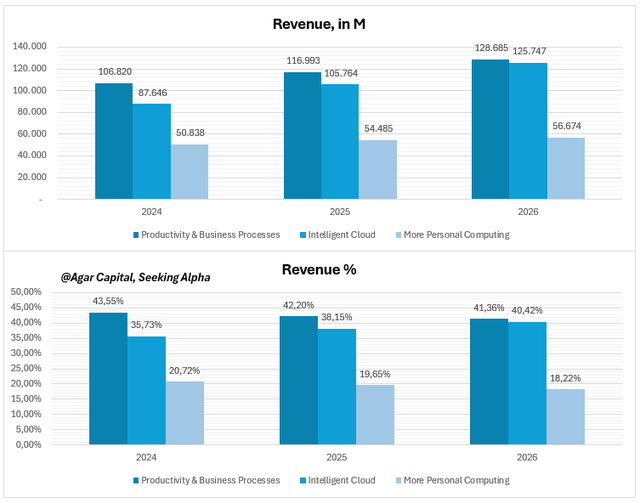
Microsoft Q4 Earnings Outlook: AI Boosts Profit Margins, Not a Gamble: Microsoft’s AI strategy has shifted from cutting-edge technology to economic infrastructure. AI is deeply integrated into core businesses like Azure cloud, Copilot, and Office, and is beginning to yield returns. AI workloads drove Azure cloud growth by 34% year-over-year, and Copilot enterprise users reached 200,000 with accelerating ARPU. Analysts believe Microsoft is undervalued, with its high profit margins and cash flow demonstrating that AI has become a monetizable “superpower,” not just a narrative. (Source: 36氪)
AI Agent Commercialization: Who Can Become a “Cash Cow”?: The 2025 WAIC indicates that AI Agents have moved from concept to practical application, particularly in enterprise services, industrial intelligence, fintech, and smart hardware. Profitable Agent platforms generally feature high average customer value (annual fees of 500k+), high gross margins (≥60%), and monetize through advanced models like “selling access” (system-level binding), “performance-based sharing” (cost-saving commissions), and “selling by resource unit” (AI cloud workforce). Key barriers include deep integration into business processes, compliance with industry regulations, and the ability to integrate with legacy systems. (Source: 36氪)
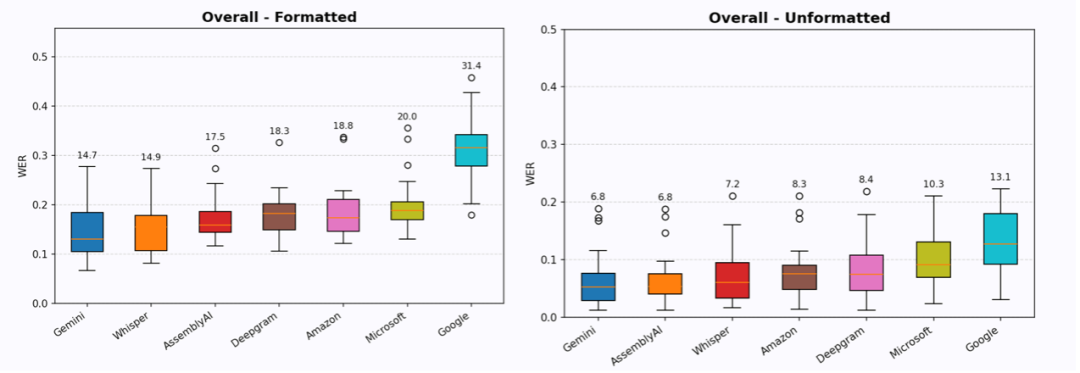
AI Voice Input Sector Secures Tens of Millions in Funding: Voice input startups Willow Voice and Wispr Flow recently completed a $4.2 million seed round and a $30 million Series A funding respectively, indicating capital’s focus on AI voice “input” rather than “output.” These companies aim to provide “zero-edit information” speech-to-text services, generating readily usable text through formatting, context understanding, and contextual recognition. Despite existing gaps, their high user stickiness and conversion rates suggest significant potential for voice input in reducing human-computer interaction friction and improving efficiency, potentially replacing keyboards as a new human-computer interaction paradigm. (Source: 36氪)
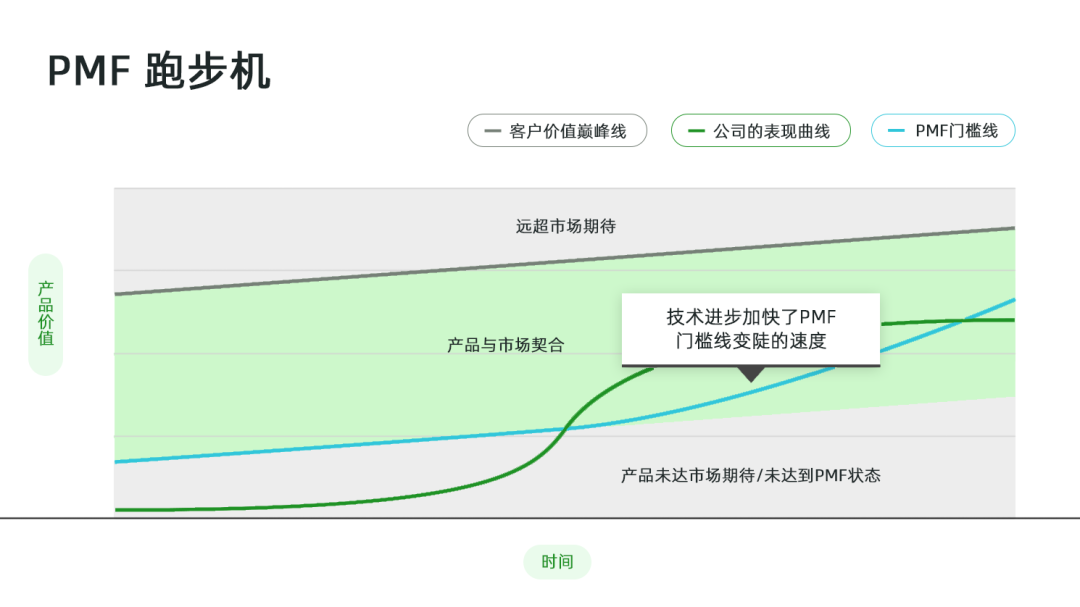
AI’s Accelerating Impact on Product-Market Fit (PMF): In the AI era, PMF transforms from a static milestone into an accelerating treadmill. The widespread adoption of AI tools quickens the pace at which products are replaced, and user expectations grow exponentially, leading to an increased risk of “PMF loss.” Companies must closely monitor changes in user expectations and leverage AI tools to aggregate feedback; assess PMF loss risk levels, considering factors like product usage channels, frequency, mastery of creative workflows, proprietary data, and customer acceptance of new technologies; and adjust product strategies accordingly, allocating more resources to PMF expansion or re-discovery. (Source: 36氪)
GMI Cloud Showcases AI Infrastructure Strength at WAIC2025: GMI Cloud, a leading global AI Native Cloud service provider, demonstrated its robust AI infrastructure capabilities at WAIC2025. Its core offerings include GPU cloud services (based on high-end chips like H200, B200), Cluster Engine, and Inference Engine, aiming to provide secure and efficient AI infrastructure for enterprises. GMI Cloud also launched an AI application building cost calculator and an Inference Engine hands-on experience, assisting developers in precise planning and efficient deployment of AI applications, especially in overseas markets. (Source: 量子位)

🌟 Community
“Pre-training” and “Post-training” Stages of AI Model Training: Social media discussions categorize AI model training into “Pretraining” and “Post-training” stages. Pre-training is likened to a marathon runner’s precise calculation of every segment and every gram of water—an elegant science performed by mathematicians and large-scale distributed systems engineers. Post-training, conversely, is described as “wild west research,” more experimental and exploratory, hinting at the challenges and non-standardized nature it faces in practical applications. (Source: natolambert)
Rapid Development and Challenges of AI-Generated Video: Social media is abuzz with the rapid advancements in AI-generated video, citing models like Runway Aleph and Alibaba Wan 2.2. Users marvel that “video has changed forever,” with the ability to easily transform still images into dynamic footage, even achieving cinematic visual effects. However, some users also point out deficiencies in AI video’s emotional expression and rhythm control, as well as its high demand for computational resources. The phenomenon of “Will Smith eating spaghetti” as an unofficial benchmark for AI video generation is also discussed, reflecting the community’s ongoing attention to AI video quality and realism. (Source: c_valenzuelab)
AI Content Overproduction and Value Shift: Social discussions highlight that as AI creation tools lower production barriers, generating high-quality long-form text content becomes easier, leading to “over-supply.” This makes curation, verification, contextualization, and synthesis skills more valuable, while “taste, theory of mind, and discernment” become key. Some worry this will lead to “pervasive mediocrity,” but others believe AI can accelerate work and inspire more people to participate in creation. (Source: nptacek)
AI API vs. Open-Weight Model Security Debate: Hugging Face CEO Clement Delangue questioned the assertion that “AI API deployment is more responsible than open-weight models,” arguing that APIs, by lowering the barrier to entry, could significantly increase the number of malicious actors without gaining more control. He called for an end to the “open weights are unsafe” narrative, suggesting that the ease of use of APIs might introduce greater risk exposure. (Source: ClementDelangue)

Discussion on AI Agent Parallelization and Efficiency Improvement: The community discusses whether AI Agent parallelization can significantly boost efficiency. Some liken it to “nine women can’t make a baby in one month,” arguing that some tasks are inherently sequential and difficult to parallelize. However, others suggest that working with multiple agents in parallel on different branches/tasks can improve efficiency, especially when handling other issues while waiting for an agent’s response. The discussion also mentions Amdahl’s Law, stating that parallel efficiency depends on the nature of the task, and emphasizes that agents are inexpensive, so even partial parallelization can lead to efficiency gains. (Source: Reddit r/ClaudeAI)
AGI Release and Control Concerns: The community is engaged in a heated debate over whether AGI will be publicly released. Most believe that the company or country that first discovers/creates AGI will keep it strictly confidential to gain a massive advantage, not easily releasing it publicly. Those concerned argue that the emergence of AGI could lead to a loss of control, potentially even surpassing human expectations. Others point out that companies, driven by profit, would commercialize it, while governments might immediately take control. (Source: Reddit r/ArtificialInteligence)
LLM Reliability and “Hallucination” Phenomenon: The community discusses the reliability of LLMs, with some likening them to Google’s “I’m feeling lucky” button, suggesting that LLM answers are sometimes purely a matter of chance. Another user shared an experience of Gemini 2.5 exhibiting “dissociative” abnormal output, raising concerns about model stability and the “hallucination” phenomenon. This uncertainty means users still need to carefully verify LLM outputs. (Source: Reddit r/ArtificialInteligence)
AI’s Redefinition of Human Roles and Job Titles: Elon Musk announced at xAI the abolition of the term “researcher,” retaining only “engineer,” arguing that “researcher” is a relic of academia and emphasizing actual engineering contributions. This view sparked community discussion, with some agreeing that everyone should ultimately be an engineer, while others countered the importance of research to engineering and questioned whether this approach could lead to talent drain. (Source: Yuchenj_UW)
AI’s Impact on Product Manager (PM) Work: Social media discusses AI’s impact on product manager roles, noting that AI is reshaping the product development process. Some believe AI coding has limited impact on engineering teams, but for product and design teams, AI significantly accelerates iteration speed through prototyping. AI PMs shared how to build products to navigate AI-driven changes, emphasizing that product management is no longer “coding by feel” but requires careful management. (Source: amasad)
Discussion on AI and Future Societal Forms: The community discusses whether AI can lead to a future without money and work. Some believe AI can automate most labor, freeing humanity to focus on self-development and connection, but achieving such a utopia requires large-scale shifts in values, access, and ownership, not just technology. Others worry that this future could lead to AI controllers abusing power or AI itself developing unintended goals. (Source: Reddit r/ArtificialInteligence)
💡 Others
Symbiotic Relationship Between AI and Quantum Computing: Quantinuum and Google DeepMind have unveiled the reality of a symbiotic relationship between quantum computing and AI. Quantum computing’s unique capabilities offer new computational paradigms for AI models, while AI can optimize quantum algorithms and hardware design. Their combination is expected to achieve breakthroughs in complex problem-solving, data processing, and other areas, driving the development of cutting-edge technology. (Source: Ronald_vanLoon)

Smart Fitness Equipment AEKE Captures High-End Home Market: Shenzhen-based company AEKE achieved tens of millions in revenue within a month on an overseas crowdfunding platform with its Smart Home Gym K1, a smart fitness equipment priced at 20,000 RMB per unit. This product focuses on strength training and Pilates, offering an integrated hardware-software solution, featuring a 4K touchscreen, self-developed digital servo motor technology, and an AI personal trainer system for personalized training plans and real-time posture correction. AEKE targets the high-end market, emphasizing lightweight design, no-installation, and an aesthetic as a home art piece, while leveraging its AI personal trainer system to boost user stickiness and efficiency in expanding overseas markets. (Source: 36氪)

AIhub Monthly Digest: July 2025: AIhub has released its July 2025 monthly digest, covering key AI events such as the RoboCup robot soccer competition and the ICML machine learning conference. Content includes interviews and summaries of various RoboCup leagues (e.g., RoboCupRescue, Small Size League, 3D Simulation League), ICML invited talks and awards, and an introduction to NASA’s in-vehicle AI research platform OnAIR. Additionally, it touches upon advancements in text-to-sound generation and leveraging feedback in human-robot interaction research. (Source: aihub.org)