



Here is an in-depth analysis, summary, and distillation based on the news and social discussions you provided:
🔥 Focus
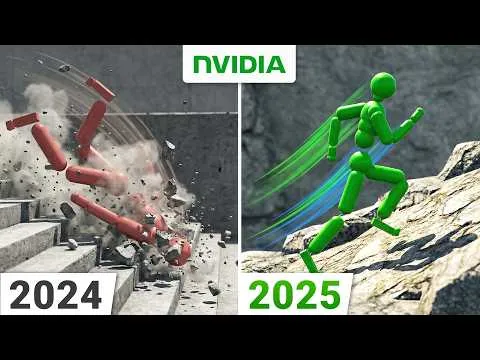
NVIDIA AI Helps Robots Learn to Walk: NVIDIA AI’s research team published a groundbreaking study on reinforcement learning for robot locomotion, enabling robots to learn and adapt to complex walking patterns more effectively through deep learning and simulation technologies. The research leveraged the inference capabilities of the DeepSeek model on Lambda GPU cloud and released a related paper, showcasing the latest advancements of AI in robot control and simulation, which is expected to accelerate the development of embodied AI and general-purpose robotics, laying the foundation for future real-world robot applications. (Source: )
🎯 Trends
OpenAI Introduces Emotion-Adjustable ChatGPT: OpenAI now allows users to directly adjust ChatGPT’s “enthusiasm” level. This new feature aims to provide a more personalized and adaptable user experience, allowing the AI’s tone and style to better match user needs. This marks a new step for AI models in emotional and expressive control, enhancing users’ fine-grained control over AI interactions. (Source: Reddit r/artificial)
NVIDIA Releases Nemotron 3 Hybrid Mamba Transformer Model: NVIDIA AI has launched Nemotron 3, a hybrid model stack combining Mamba, Transformer, and MoE (Mixture-of-Experts) architectures, designed specifically for long-context and agent AI. This model aims to enhance AI’s performance and efficiency in handling complex, long-sequence tasks, signaling a future where AI models will increasingly focus on multi-architecture fusion to achieve more powerful capabilities. (Source: Reddit r/artificial)
MiraTTS: Fast, Realistic Local Text-to-Speech Model Released: MiraTTS is a new Text-to-Speech (TTS) model that stands out for its extremely fast generation speed, high fidelity, and low VRAM usage. The model can generate 100 seconds of 48kHz audio in just 1 second, supports voice cloning, and requires only 6GB of VRAM to run on consumer-grade GPUs. The release of MiraTTS addresses the pain points of existing TTS models in terms of localization, realism, and speed, offering an efficient, high-quality speech synthesis solution for individual users and developers. (Source: Reddit r/ArtificialInteligence)
MiniMax M2.1 Model Achieves Significant Progress in Design and Visual Quality: The MiniMax M2.1 model has made significant breakthroughs in design and visual quality, with further enhancements planned for the M2.5 version. This progress indicates MiniMax’s continuous focus on user experience and the refinement of visual output, striving to deliver higher-quality AI-generated content, especially in the multimodal domain. (Source: MiniMax__AI)
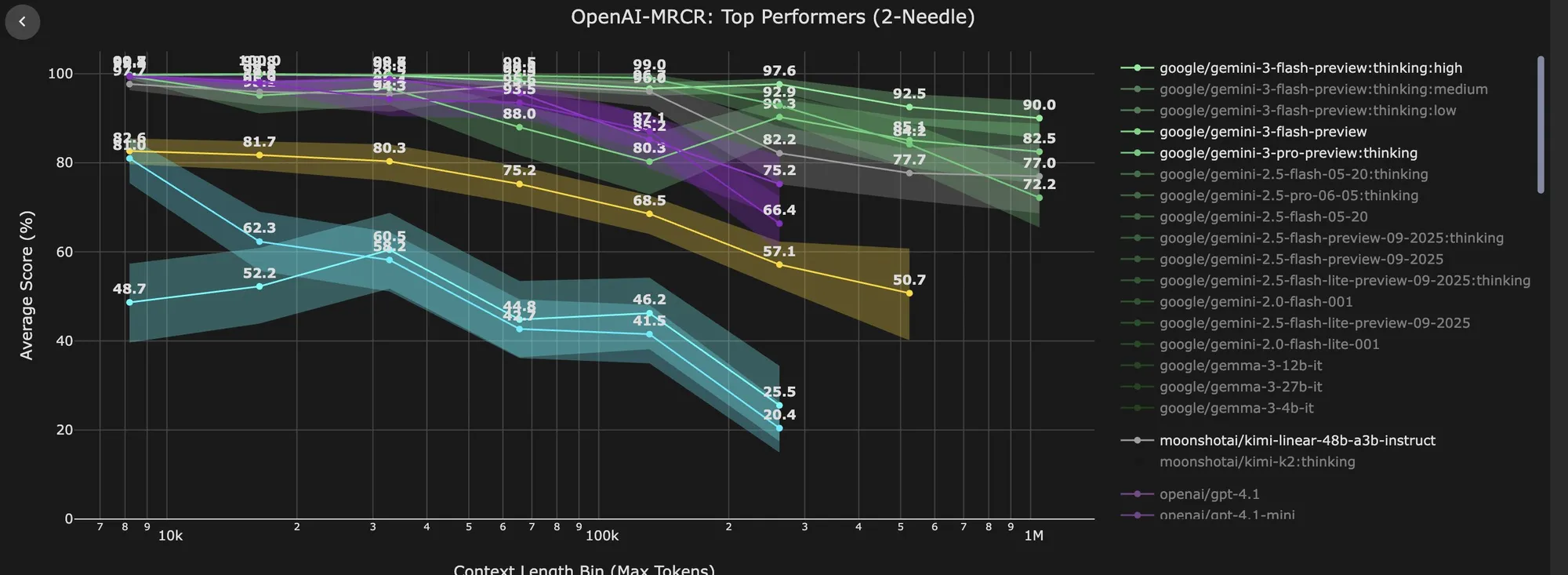
Gemini 3 Flash Excels in Long-Context Processing Capabilities: Gemini 3 Flash has demonstrated outstanding performance in handling long contexts, particularly achieving 90% accuracy with a 1 million context length in OpenAI’s MRCR benchmark, surpassing most models’ performance at 256k context length. This breakthrough is attributed to Google’s deep investment in long-context technology, signaling the immense potential of LLMs in understanding and utilizing ultra-long textual information. (Source: gabriberton)
Gemini CLI Opens Gemini 3 Access to Free Users: The Gemini Command Line Interface (CLI) has opened access to the Gemini 3 model for all free users; users can experience it by simply enabling “Preview Features” in their settings. This move will significantly lower the barrier for developers and general users to access cutting-edge AI models, fostering the development and innovative applications within the Gemini ecosystem. (Source: op7418)

Japanese Government Plans Trillion-Yen Investment to Boost AI Development: The Japanese government, through Minister Takaichi, announced a draft basic AI plan, proposing an investment of over 1 trillion yen to promote public-private cooperation in reliable AI. Japanese AI companies like Sakana AI will actively participate, working together to make Japan an advanced nation in AI utilization. This move demonstrates the Japanese government’s emphasis and determination regarding AI development, aiming to enhance the nation’s competitiveness in the AI sector through large-scale investment and industry-academia-government collaboration. (Source: SakanaAILabs)
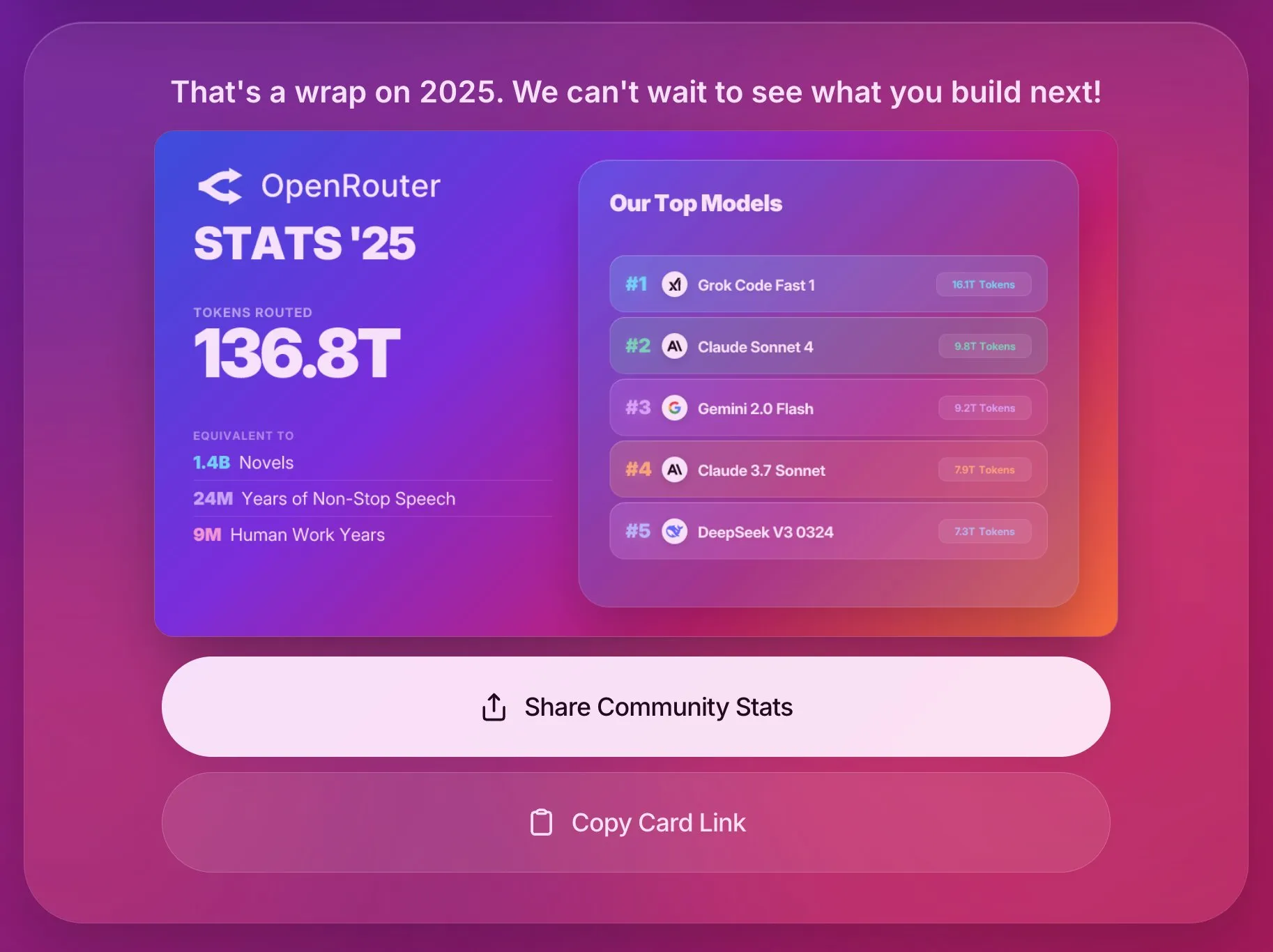
OpenRouter 2025 Annual Report Reveals AI Model Usage Trends: OpenRouter’s 2025 annual statistical review shows that the platform’s total routed tokens reached 136.78T, equivalent to 1.4 billion novels. Grok Code Fast, Claude 4 Sonnet, and Gemini 2.0 Flash ranked among the top three most popular models. The report also highlighted the explosion of multimodal AI, with 17.3 million images generated throughout the year; open-source models accounted for half of the total, with 255 models. These figures reflect the active development and diversified application trends of AI models in text, multimodal, and open-source domains. (Source: dotey)
Significant Breakthrough in AI Video Motion Control Technology: The Kling_ai team has made astonishing progress in AI video motion control, with their tools capable of handling complex actions, achieving gymnastic movements, lip-syncing, and camera movements that were previously difficult for video generation models. This breakthrough is expected to revolutionize AI video production, enabling the generation of more realistic and expressive content, and bringing new opportunities to fields such as film, gaming, and virtual reality. (Source: Kling_ai)
Small Language Models Solve Complex Reasoning Tasks Through Internal ‘Thought’ Processes: Researchers at MIT CSAIL have developed a new training method that enables small language models to perform complex reasoning tasks by generating internal ‘thought’ processes, with results comparable to larger models. This method significantly enhances the reasoning capabilities of smaller models by simulating human thought steps, offering a new approach for deploying high-performance AI in resource-constrained environments. (Source: dl_weekly)
AI-Powered ISP Significantly Improves iPhone Low-Light Photo Quality: A study by Apple shows that an AI-powered Image Signal Processor (ISP) can significantly improve iPhone photo quality in low-light conditions. This technology optimizes image processing through intelligent algorithms, reducing noise and enhancing details, which is expected to greatly improve mobile photography performance under challenging lighting conditions. (Source: Reddit r/artificial)

Half of Steam’s Bestselling Games Come from Developers Embracing Generative AI: Half of the current top 10 bestselling games on the Steam platform are developed by creators who have adopted generative AI technology. This phenomenon indicates that generative AI is playing an increasingly important role in game development, helping developers improve efficiency, innovate content, and ultimately achieve market success, foreshadowing the widespread application prospects of AI in the gaming industry. (Source: Reddit r/artificial)

Al Jazeera Launches New Integrative AI Model ‘The Core’: Al Jazeera has launched its new integrative AI model, ‘The Core’. This model aims to enhance the efficiency of news content generation, analysis, and distribution, supporting various stages of news production through AI technology, potentially including automated reporting, content aggregation, and personalized recommendations, to adapt to the rapidly changing news media landscape. (Source: Reddit r/artificial)

Yunpeng Technology Launches AI+Health Products, AI Large Models Empower Smart Kitchens and Health Management: Yunpeng Technology, in collaboration with Shuaikang and Skyworth, has launched the “Digital Smart Future Kitchen Lab” and smart refrigerators equipped with an AI health large model. The AI health large model aims to optimize kitchen design and operations, while the smart refrigerator provides personalized health management through “Health Assistant Xiaoyun”. This marks a deep application of AI in the home health sector, providing customized services through smart devices.