



🔥 Focus
Claude Fable 5’s Controversial Return and Safety Restrictions: Following its return, Fable 5 has faced widespread criticism from developers due to overly strict safety classifiers. Many normal programming or Q&A requests were flagged as “unsafe,” causing the model to frequently fallback to the older Opus 4.8, and even generating a “TOO_DUMB_TO_NEED_FABLE” downgrade tag in the background. Despite this, Fable 5 still demonstrates a strong absolute advantage in high-judgment tasks such as processing massive multi-page documents, long-step contexts, and proactive vulnerability detection. (Source: QbitAI, WeChat)

Bug Exposed in OpenAI’s Early Scaling Law Paper: Former OpenAI researcher Diogo Almeida revealed that the original 2020 paper that established the industry consensus on Scaling Laws contained a fatal bug. The research team used a fixed token budget for all models during training and artificially cut off the growth of smaller models through learning rate decay. This misled the industry into wasting years of computing power and hundreds of millions of dollars on “oversized, undertrained” models. This finding shakes the absolute rule of “bigger is better” and pushes the industry toward a more efficient training paradigm that balances data and parameters. (Source: QbitAI)

CAS Open-Sources Mandol, a Lightweight Memory-Native Agent Memory System: Institutions including the Institute of Software, Chinese Academy of Sciences (ISCAS) have open-sourced Mandol, a lightweight memory-native Agent memory system. The system represents memory uniformly through structured semantic graphs, merges vector and graph indices within a single address space, and combines intelligent quantized retrieval. While significantly reducing latency and token consumption, it achieves high-precision long-dialogue memory retrieval, providing a new lightweight solution for long-term memory management of edge-side Agents. (Source: Synced)
.jpg)
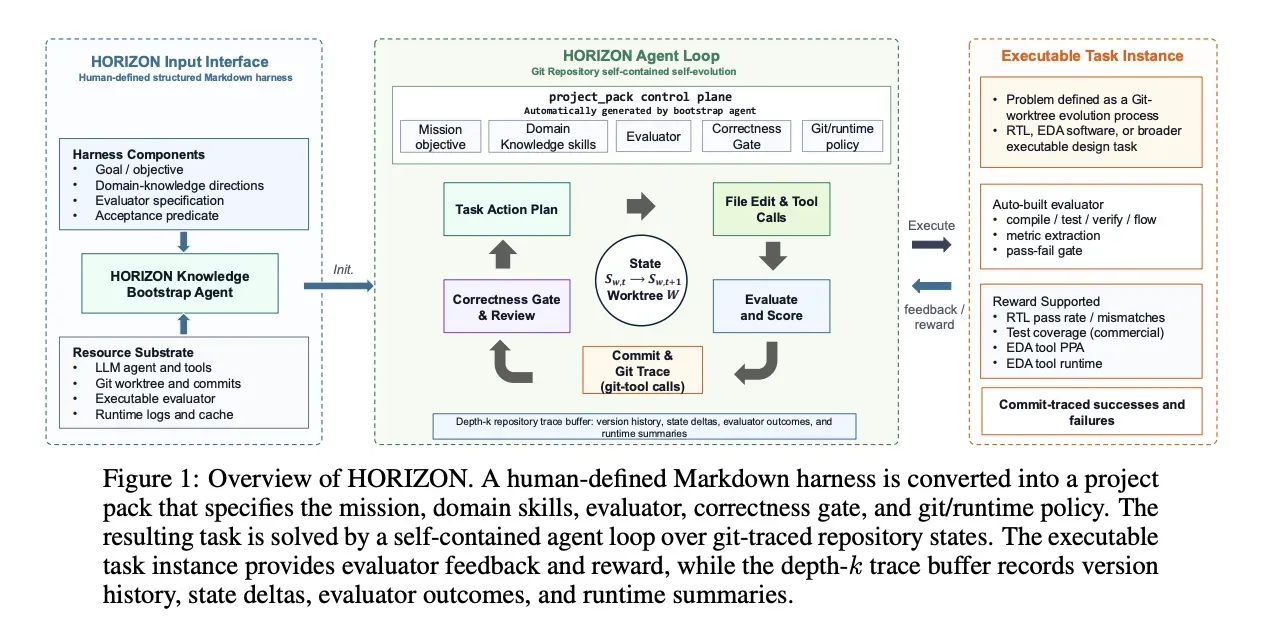
NVIDIA Introduces HORIZON Hardware Design Agent Framework: NVIDIA’s research team has introduced HORIZON, a hands-free Agent framework for hardware design. It treats RTL design as codebase evolution, automatically executing a closed-loop iteration of “plan-edit-test-commit” via git worktrees. It achieved a 100% pass rate on multiple hardware design benchmarks, including ChipBench, providing a brand-new engineering path for automated hardware design and verification. (Source: MarkTechPost)
Study of 26,000 Students Reveals Long-Term Learning Loss from AI-Assisted Homework: A 30-month tracking study of 26,000 middle school students in a Chinese county shows that while using AI for homework assistance improves daily grades and reduces homework time, it leads to a drop of up to 24% in closed-book exam scores. Furthermore, this “learning loss” takes two full years to fully surface in high-stakes entrance exams. Over-reliance on AI for answers (outsourcing) is the primary cause of cognitive decline, warning the education sector to re-evaluate the boundaries of AI use in teaching. (Source: THE DECODER)

🎯 Trends
Three GPT-5.6 Sub-models Leaked, Scheduled for July 7: Developers discovered identifiers for three GPT-5.6 sub-models—Sol, Terra, and Luna—along with a “speed dial” feature in the underlying code of the Codex desktop app. OpenAI plans to release this model series between July 7 and July 9, strategically timing it to coincide with the expiration of Claude Fable 5’s free tier. The Terra model is reportedly capable of achieving GPT-5.5-level performance at half the price, offering extremely high cost-efficiency. (Source: 36Kr)

Former Qwen Lead Junyang Lin Points Out LLMs Shifting to “Training Agents”: After leaving Alibaba, former Qwen technical lead Junyang Lin shared his views, pointing out that large language models are shifting from “training models” to “training agents.” He believes that hybrid thinking modes (the fusion of Chain-of-Thought and intuitive modes) have limitations. The future should focus on closed-loop interactive “agent thinking,” optimizing environment and tool scheduling, rather than simply lengthening reasoning tokens. (Source: MarkTechPost)
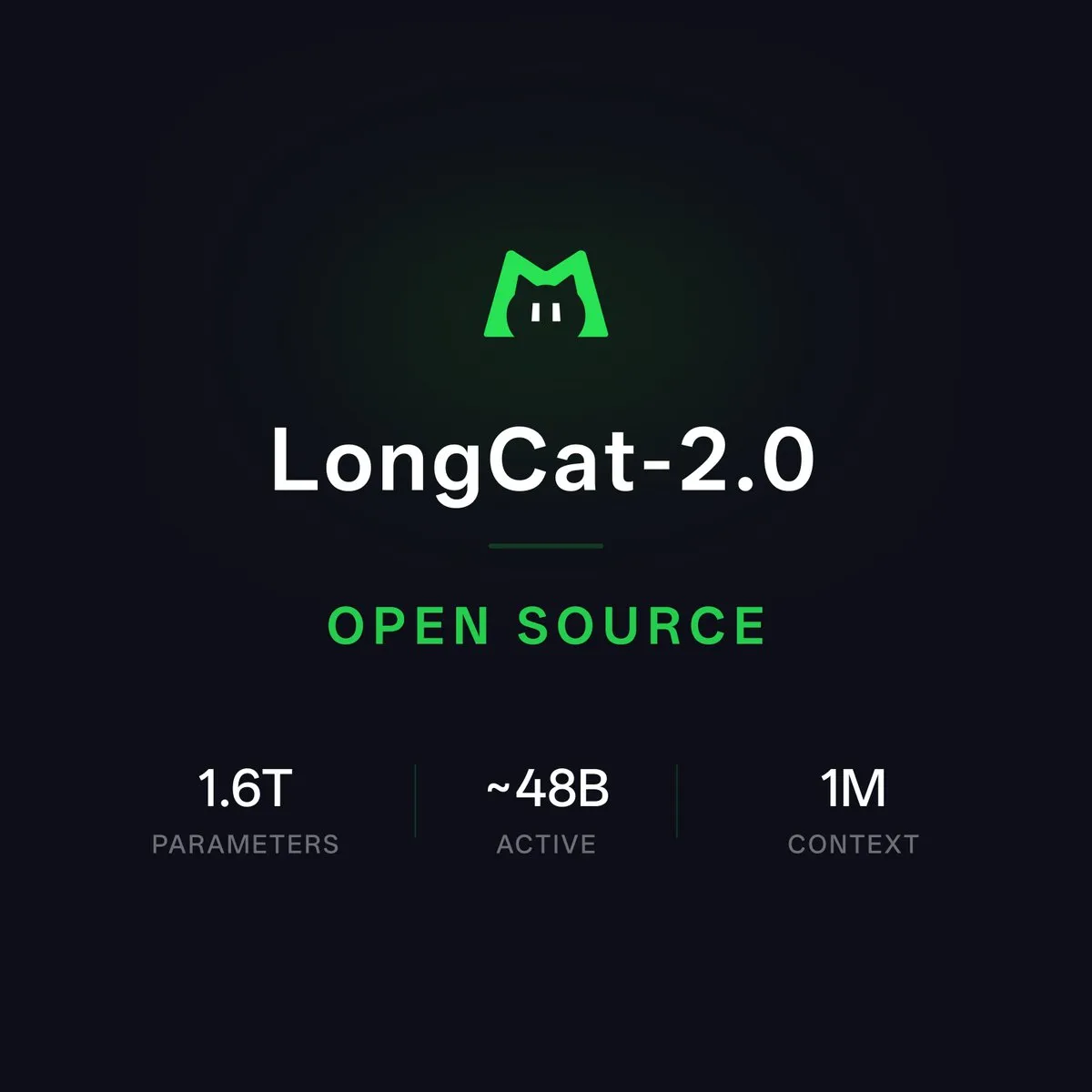
Meituan Open-Sources Trillion-Parameter “Zero NVIDIA” LLM LongCat-2.0: Meituan has released and open-sourced LongCat-2.0, a trillion-parameter MoE model (with ~48B active parameters and 1M context support). The model performs strongly in Agent scenarios and is trained and run entirely on domestic computing clusters, achieving “zero NVIDIA” hardware dependency. (Source: WeChat)
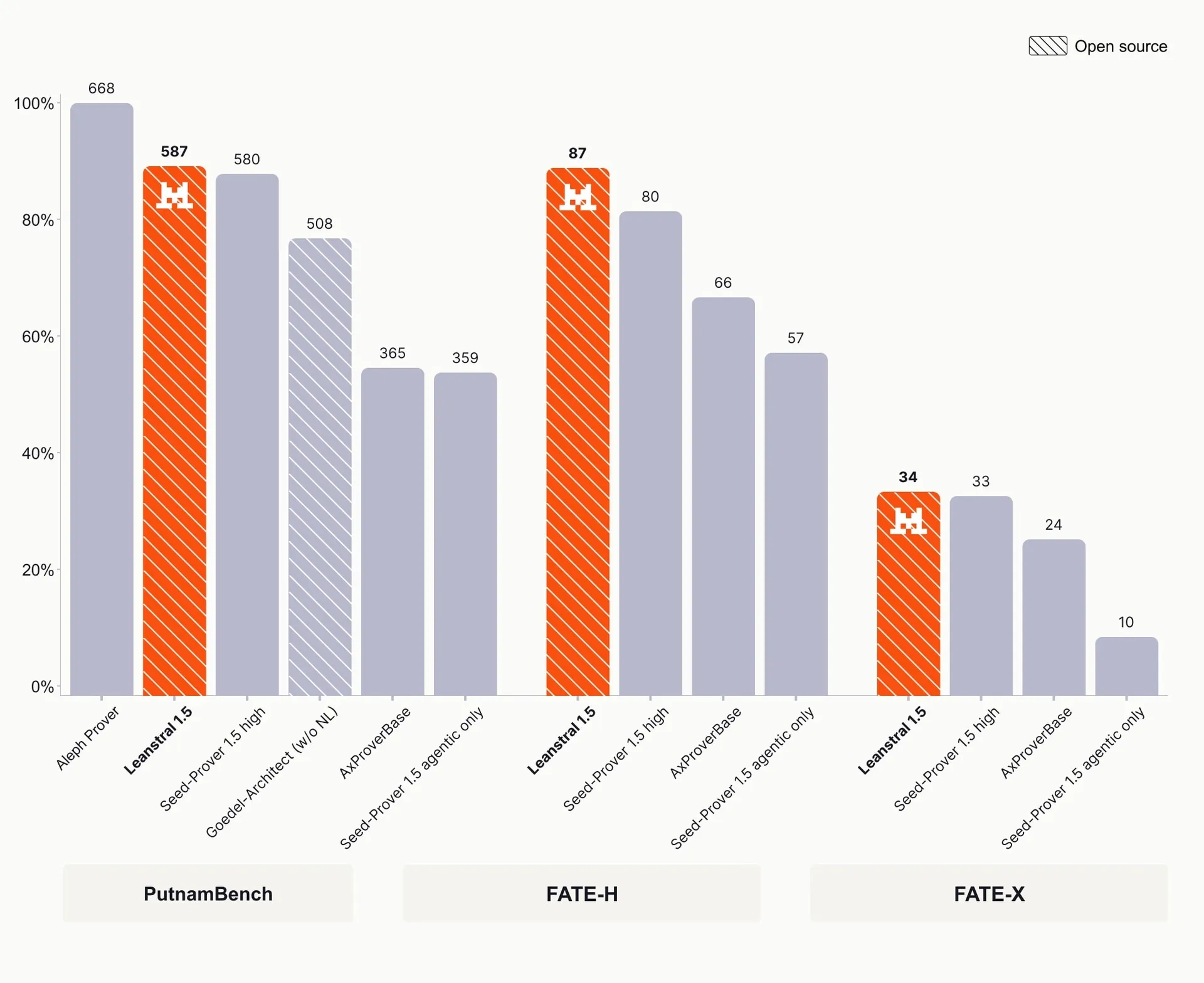
Mistral AI Open-Sources Formal Verification Model Leanstral 1.5: Mistral AI has open-sourced Leanstral 1.5, a math and code verification model specifically designed for Lean 4 formal verification. The model achieved 100% accuracy on the miniF2F math competition benchmark and solved most hard problems on PutnamBench at a very low cost, while successfully identifying 5 unknown bugs across 57 open-source libraries in real-world testing. (Source: THE DECODER)
UK AI Safety Institute Study Shows Static Benchmarks Underestimate AI Agent Capabilities: A study by the UK AI Safety Institute (AISI) indicates that existing static benchmarks severely underestimate the true capabilities of AI agents. When given a larger reasoning compute budget (Test-Time Compute), the success rate of models in cybersecurity and software development tasks can increase by up to 25%, with next-generation models benefiting even more significantly from the extra compute. (Source: THE DECODER)

Google Releases TabFM Zero-Shot Tabular Foundation Model: Google’s research team has released TabFM, a zero-shot tabular foundation model. The model supports direct classification and regression on structured data with mixed numerical and categorical columns without fine-tuning or hyperparameter search; training samples are passed directly as context to complete predictions in a single forward pass. (Source: Reddit r/LocalLLaMA)
🧰 Tools
Open-Source Tool pxpipe Reduces Claude Code Token Costs via Image Compression: The open-source tool pxpipe acts as a local proxy that renders static text, such as Claude Code’s system prompts and historical context, into high-density PNG images, thereby reducing token costs by 59% to 70%. This leverages the API’s fixed pricing mechanism based on image pixel dimensions, though at the cost of increased visual encoding latency and potential recognition errors for characters like precise hashes. (Source: THE DECODER)
LlamaIndex Open-Sources legal-kb to Demonstrate Index v2 Agentic Retrieval: LlamaIndex has open-sourced the legal-kb reference application, demonstrating a “Retrieval Harness” design based on Index v2. It provides Agents with filesystem-like tools (retrieve, findFiles, readFile, grepFile), enabling them to autonomously navigate and verify large document repositories and provide precise visual references with page screenshots and bounding boxes. (Source: MarkTechPost)
vLLM Community Introduces Semantic Router Intelligent Routing Mechanism: The vLLM community has introduced Looper, a Micro-Agent runtime that enables multi-model collaboration through intelligent scheduling (including routing modes like Confidence, Ratings, ReMoM, Fusion, and Workflows) within a single Model API. It significantly reduces inference costs and improves accuracy for complex tasks without changing the client interface. (Source: Synced)
.jpg)
Tencent Hunyuan and UNSW Propose E-GRM Dynamic Routing Framework: In an ACL 2026 paper, Tencent Hunyuan and the University of New South Wales (UNSW) proposed the E-GRM (Efficient Generative Reward Modeling) framework. The framework uses the model’s own consensus (uncertainty) during decoding as a routing signal, executing full Chain-of-Thought (CoT) reasoning only for high-difficulty samples and outputting directly for simple samples. This reduced latency by 62% and saved 49% of compute on the MATH dataset. (Source: WeChat)

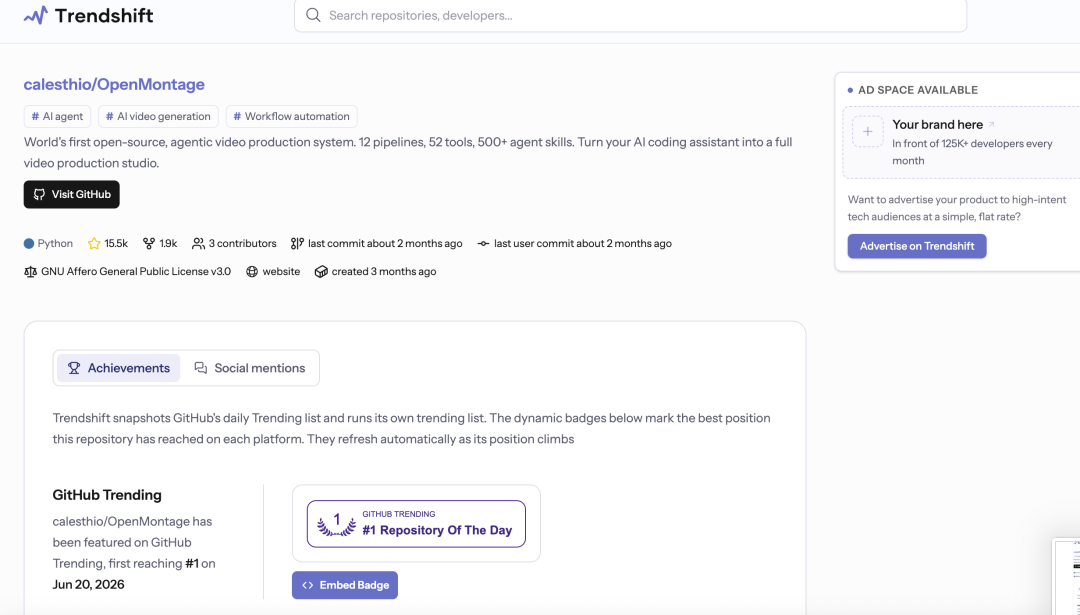
Open-Source Video Production System OpenMontage Goes Viral on GitHub: The open-source video production system OpenMontage has gone viral on GitHub. It modularizes the video editing workflow, supporting programming tools like Claude Code and Cursor as scheduling units to automatically coordinate video generation, voiceovers, data fetching, and rendering. The production cost per video is only about $0.69. (Source: WeChat)
📚 Learning
University of Sydney Proposes LinStereo Global Attention Stereo Matching Model at ECCV 2026: In an ECCV 2026 paper, a research team from the University of Sydney proposed LinStereo, a global attention multi-scale iterative stereo matching model with linear complexity. It utilizes a Position-Aware Linear Attention (PALA) module to replace traditional local recurrent updates, demonstrating strong generalization capabilities in occluded and weakly textured scenes. (Source: Synced)
.jpg)
SJTU Proposes ICRDrag Contextual Region Dragging Model at ECCV 2026: In an ECCV 2026 paper, the Li Niu Lab at Shanghai Jiao Tong University (SJTU) proposed ICRDrag, the first contextual region dragging model. Based on the DiT framework and bidirectional attention constraints, it uses masks to precisely locate local image regions, enabling more natural and accurate object movement, scaling, and deformation editing. (Source: Synced)
.jpg)
Zhejiang University and Others Propose EgoTSR Embodied Task Progress Reasoning Framework at ICML 2026: In an ICML 2026 paper, a team from Zhejiang University and other universities proposed the EgoTSR framework. It aims to address the bias of vision-language models in embodied tasks, where they rely on “temporal order” rather than “physical state” to judge progress. Through three-stage curriculum learning and a subtask planner, the framework enables models to accurately evaluate the actual physical progress of tasks. (Source: Synced)
.jpg)
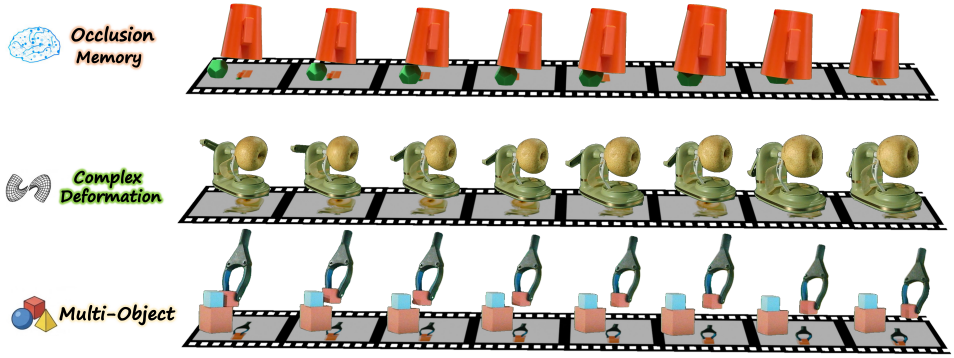
SJTU and Others Propose HAT-4D Monocular Video Interactive Reconstruction Framework at ECCV 2026: In an ECCV 2026 paper, a team from Shanghai Jiao Tong University and others proposed HAT-4D, a multi-agent collaborative 4D interactive reconstruction framework for monocular videos. It uses an Interaction Knowledge Graph (IKG) to encode physical relationships in videos and combines a memory bank mechanism to solve occlusion and deformation challenges, producing high-quality 4D assets with minimal human feedback. (Source: WeChat)
NYU and LeCun’s Team Propose Continual Learning World Model AdaJEPA: NYU and Yann LeCun’s team have proposed AdaJEPA, the first Joint Embedding Predictive Architecture (JEPA) world model that supports Test-Time Adaptation (TTA). Through a closed-loop “plan-execute-observe-update” process during interaction with the environment, it fine-tunes encoder and predictor parameters in real-time, significantly improving planning success rates in out-of-distribution environments. (Source: WeChat)
UPenn GRASP Lab Proposes SymSkill Framework at ICRA 2026 and Wins Awards: The GRASP Lab at the University of Pennsylvania published the SymSkill framework at ICRA 2026 and won two major awards. The framework seamlessly integrates imitation learning with classical task and motion planning. It automatically induces symbolic abstractions and skill libraries from a small number of unlabeled demonstrations, and supports real-time failure recovery for robots under environmental perturbations. (Source: Synced)

SAIS and Others Propose T* Progressive Block Scaling for Diffusion Language Models at ACL 2026: In an ACL 2026 paper, the Shanghai Academy of AI for Science (SAIS) and other institutions proposed the T* framework. Addressing the issues of fragile reasoning capabilities and training collapse in diffusion language models under large generation block settings, it adopts a “small-to-large” progressive block scaling and trajectory-aware reinforcement learning, significantly improving mathematical reasoning accuracy while maintaining parallelism. (Source: Synced)
.jpg)
💼 Business
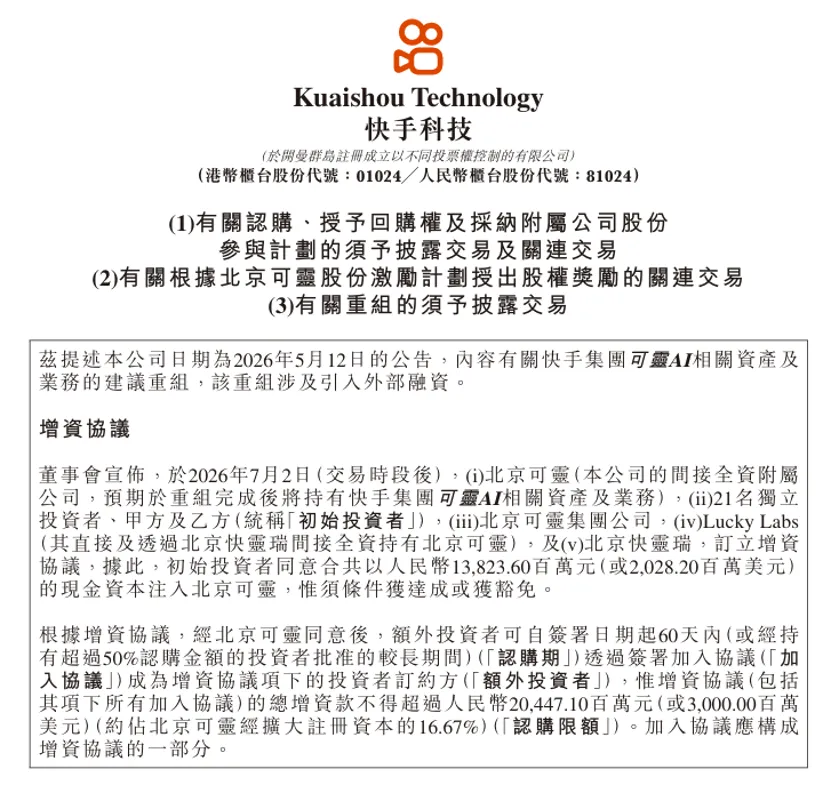
Kling AI Spin-off Financing, Introducing $3 Billion in External Investment: Kuaishou has officially finalized the spin-off financing plan for Kling AI, with a pre-money valuation of $15 billion. Through capital increase and share expansion, it will introduce up to $3 billion in external investment, with industry giants like Alibaba, Tencent, and Baidu rarely co-investing. Kling AI faces pressure from exit clauses if it fails to list on time: if it cannot complete an IPO by October 30, 2031, it must repurchase shares at the original price plus an 8% simple annual interest rate. (Source: 36Kr)
Anthropic in Talks with Samsung to Develop Custom AI Inference Chips: Following OpenAI’s partnership with Broadcom to design inference chips, Anthropic is reportedly in talks with Samsung. It plans to use Samsung’s 2nm process and advanced packaging technology to develop custom AI inference chips. Against the backdrop of skyrocketing compute costs, this move aims to optimize inference energy efficiency through customized hardware and secure core supply chains like HBM. (Source: TechCrunch)
Google DeepMind and Film Studio A24 Form First-of-its-Kind Research Partnership: Google DeepMind and film studio A24 have announced a first-of-its-kind research partnership to anchor cutting-edge AI technology directly in the creative filmmaking process, exploring next-generation entertainment technology and storytelling. Google has also made an investment in A24. (Source: Google DeepMind Blog)

🌟 Community
Veteran Engineer Shawn Presser’s Viral Job Search Sparks Industry Discussion: Shawn Presser, a veteran engineer with 25 years of programming experience, a former core member of John Carmack’s lab, and an early employee at Groq, publicly posted his job search on social media, revealing that he faces homelessness due to unemployment. The post went viral, highlighting the harsh reality that senior technical talent faces in the job market behind the current AI boom. (Source: Synced)
.jpg)
Cloudflare Announces Default Block on Hybrid Crawlers Used for AI Training: Network infrastructure giant Cloudflare has announced that starting September 15, it will block all hybrid-use crawlers used for AI training and Agent services by default. This policy completely overturns the old “allow by default” convention, aiming to protect website content from being “freeloaded” by AI to train models. (Source: 36Kr)
UBTECH Releases U1 Ultra-Bionic Humanoid Robot, Drawing Attention in the Companionship Market: UBTECH has released the consumer-grade U1 ultra-bionic humanoid robot series, starting at 119,800 RMB. The robot features highly realistic skin texture and over 30 micro-expressions, and is equipped with Resonance-LM, the first emotional large model designed specifically for long-term companionship. The first batch of pre-orders has exceeded 11,000 units. (Source: WeChat)

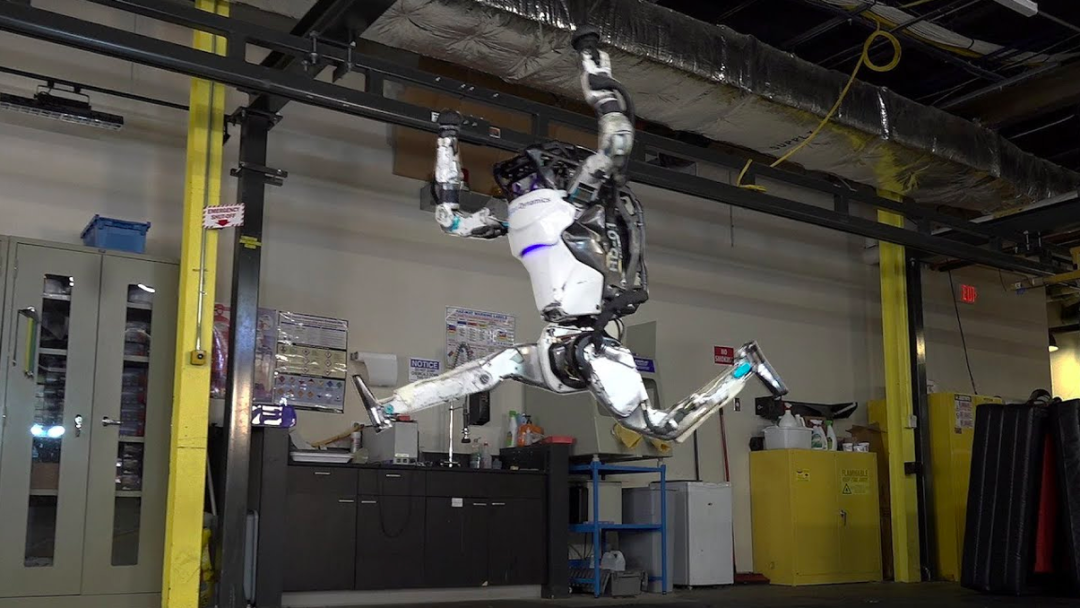
Boston Dynamics’ Valuation Shrinks as Hyundai Completes Full Acquisition: South Korea’s Hyundai Motor Group announced the acquisition of SoftBank’s remaining 9.65% stake in Boston Dynamics for $325 million, making it a wholly-owned subsidiary. Based on this transaction, the overall valuation of the humanoid robot pioneer is only $3.368 billion, which is only half the market value of Unitree, a domestic quadruped/humanoid robot unicorn. (Source: 36Kr)
OASIS Ring Smart Ring Goes Viral, Sparking Discussion on Vibe Coding Hardware: The OASIS Ring smart ring has gone viral due to its “voice input to control AI” feature, becoming another eye-catching AI hardware product after the shadow-style Vibe Coding microphone. The rise of the Vibe Coding concept is reshaping the interaction methods of smart hardware, driving hardware to transform towards lightweight, all-scenario, and non-intrusive directions. (Source: 36Kr)

💡 Others
Anthropic Cracks Down on Underground Access Channels to Claude in Restricted Regions: Anthropic has launched its harshest crackdown yet on attempts to bypass geographical restrictions to access Claude via overseas shell companies, VPNs, relays, and hidden Microsoft Azure channels. It enforces bans through counter-reconnaissance methods such as reading users’ system time zones, IPs, and specific domain lists. Chinese companies like Alibaba have internally announced a reverse ban on Claude Code to prevent data leaks. (Source: 36Kr)
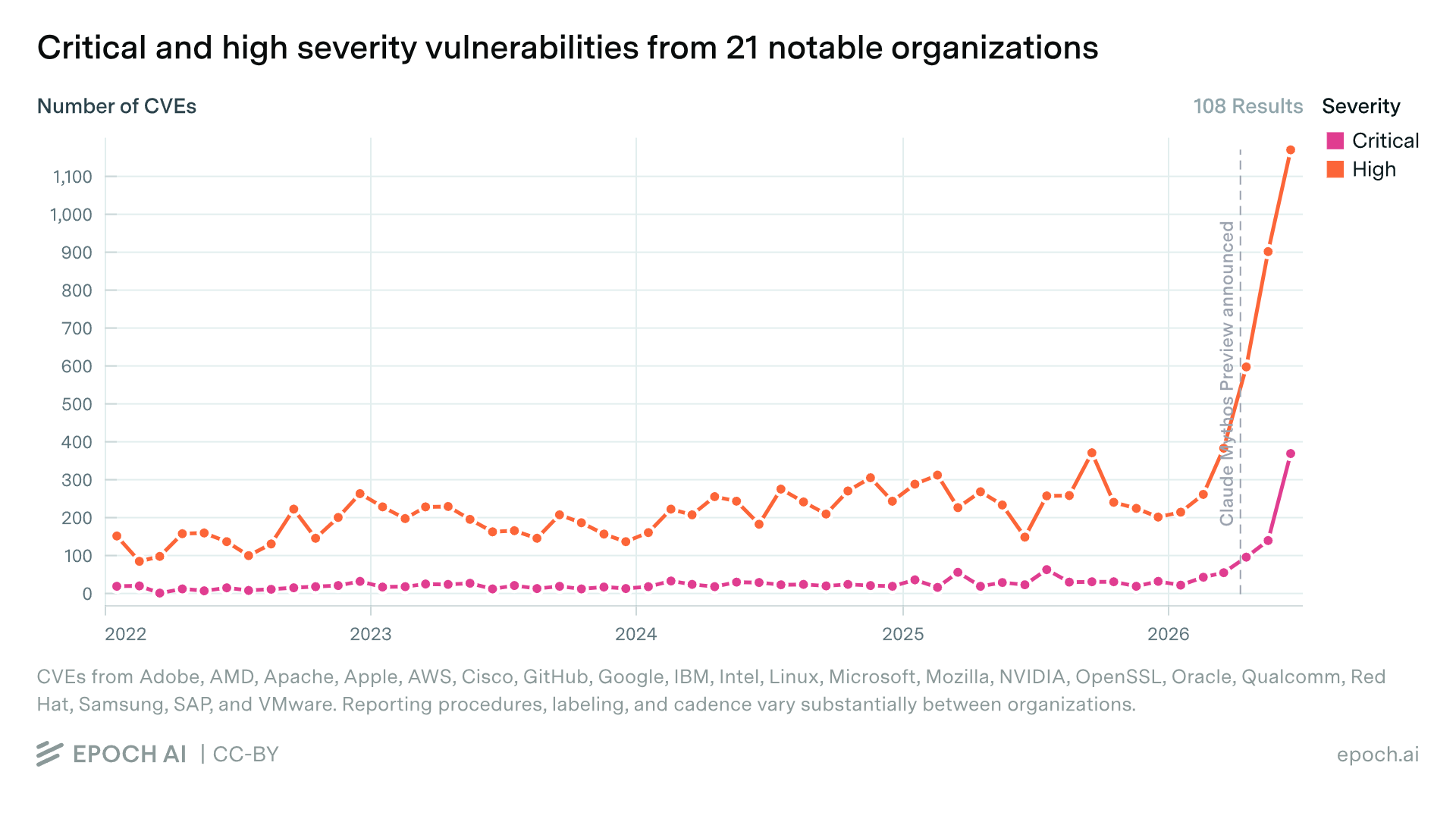
Epoch AI Data Shows AI Bug Hunting Leads to Explosion in CVE Vulnerability Reports: Data from Epoch AI shows that since Anthropic released the preview version of Claude Mythos with autonomous bug-hunting capabilities in April 2026, the number of globally reported high-risk and critical Common Vulnerabilities and Exposures (CVEs) has exploded, hitting a record high of 1,500 in June. This indicates that AI-driven code auditing is reshaping the cybersecurity landscape. (Source: THE DECODER)
Microsoft Rebuilds Copilot and Establishes $2.5 Billion Frontier Company: Microsoft plans to launch a rebuilt version of Copilot in August, merging consumer and enterprise applications and introducing a background autonomous agent called “AutoPilot” to automatically schedule emails and meetings. Meanwhile, Microsoft has established a $2.5 billion Frontier Company, directly dispatching thousands of engineers to enterprises to assist in AI implementation. (Source: WeChat)