



🔥 Focus
Tsinghua University and Shengshu Technology Open-Source TurboDiffusion: Video Generation Enters the “Seconds” Era: Tsinghua University’s TSAIL Lab and Shengshu Technology have jointly released TurboDiffusion, a video generation acceleration framework. By integrating four core technologies—SageAttention2++, SLA (Sparse Linear Attention), rCM (Step Distillation), and W8A8 quantization—it achieves an inference speedup of up to 200x. Generating a 5-second 480P video on an RTX 5090 takes only 1.9 seconds, compressing end-to-end latency from hundreds of seconds to single digits. This breakthrough marks the arrival of the “DeepSeek moment” for video generation, significantly lowering the barrier for consumer-grade GPUs to run large models and signaling the possibility of real-time video editing and interactive generation. (Source: Arxiv, GitHub)

NVIDIA “Absorbs” Groq’s Brain Trust: An Offensive Talent Defense War: Social media is buzzing with discussions that NVIDIA’s move regarding Groq is not a simple acquisition but a clever “talent absorption + technology licensing” strategy. By bringing Groq’s core R&D team under its wing and obtaining licenses for its inference technology, NVIDIA has successfully neutralized a potential hardware rival while avoiding antitrust scrutiny. Analysts point out that Groq’s core value lies in its bet on SRAM architecture; NVIDIA’s move ensures it won’t lose pricing power in the future large-scale inference market due to the rise of customized accelerators, essentially trading a current premium for future market certainty. (Source: teortaxesTex, draecomino)

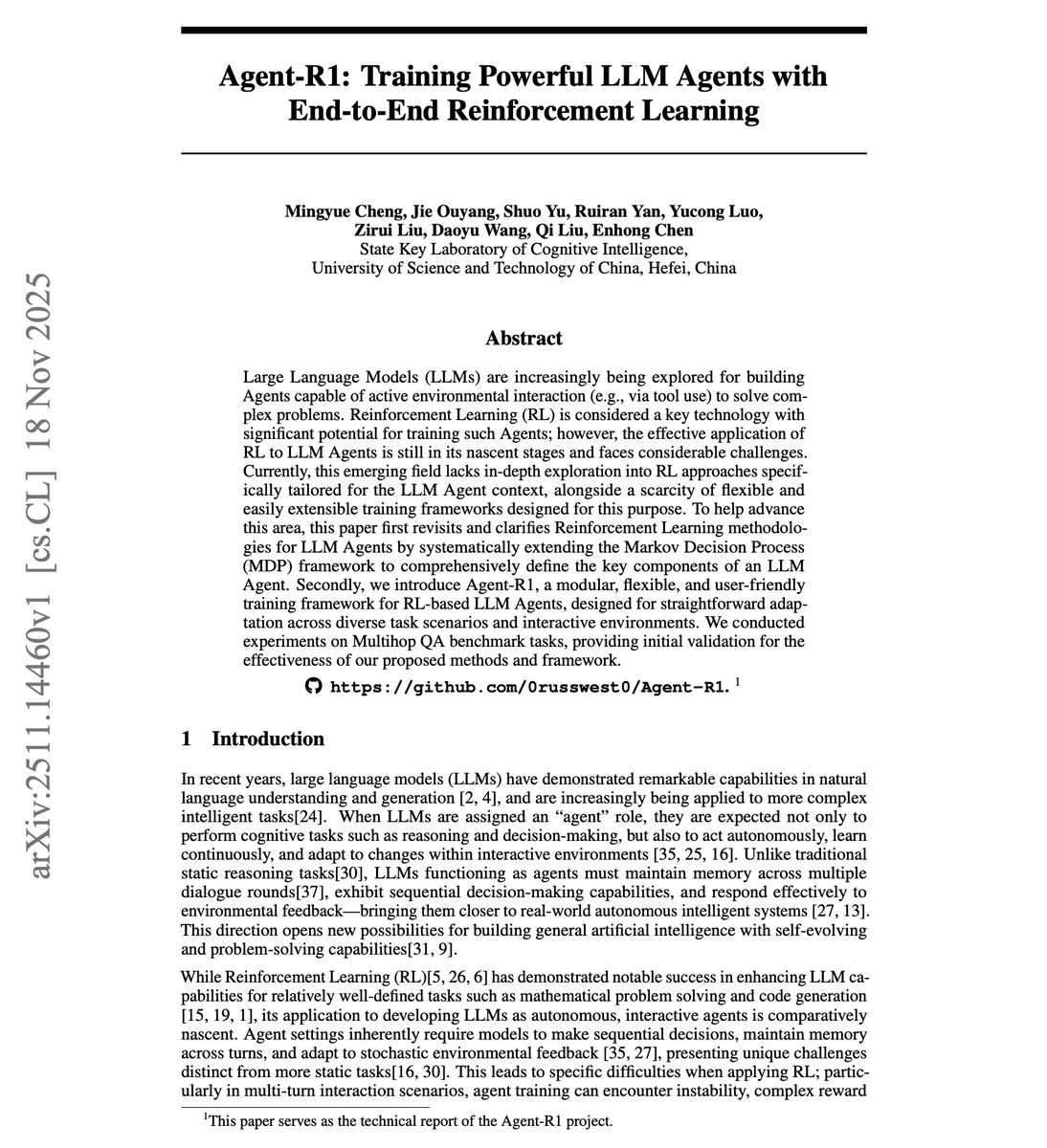
Agent-R1 and Bloom: End-to-End Reinforcement Learning Opens a New Paradigm for Agent Training: Addressing the decision-making challenges of LLM agents in complex environments, the Agent-R1 framework introduces end-to-end reinforcement learning. It uses action masking and the ToolEnv module to handle the randomness of environmental feedback, significantly improving multi-turn interaction accuracy. Meanwhile, Anthropic has open-sourced Bloom, an agent evaluation tool capable of automatically generating hundreds of scenarios to assess whether models exhibit behaviors like sycophancy or sabotage. Together, these advancements point toward the next stage of AI evolution: moving from simple dialogue completion to autonomous agents with long-term planning, self-correction, and safety monitoring capabilities. (Source: Arxiv, TheTuringPost)
Deep Dive into LLM API Underlying Logic: Starting from the Kimi K2 vLLM Adaptation Bug: Developers adapting Kimi K2 to vLLM discovered that while the model performed perfectly on the official API, tool calls failed on vLLM. This revealed that the essence of LLM APIs is an engineering encapsulation of “Rendering → Completion → Parsing.” The core of the problem often lies not in model capability but in the missing critical dialogue suffixes during Prompt rendering or overly strict parsers. This analysis reminds developers that the first step in solving AI hallucinations and tool call failures should be to restore and inspect the raw Prompt sequence fed to the model, rather than blindly tuning model parameters. (Source: vLLM Blog, dotey)
🎯 Trends
Claude Code Introduces LSP Helper and Starts Limited-Time Christmas Double Quota: Anthropic’s command-line tool, Claude Code, now supports LSP (Language Server Protocol). Through a mechanism similar to “smart glasses,” it allows the AI to precisely locate code positions rather than performing blind full-text searches, significantly improving search speed and accuracy. Additionally, to reward users, Anthropic announced that from December 25 to 31, Pro and Max subscribers will receive double usage limits, encouraging developers to push forward side projects during the holidays. (Source: Reddit, sama)

OpenAI Proposes Chain-of-Thought Monitorability Framework: Understanding the “Thinking” Before AI Acts: OpenAI has introduced a rigorous framework for evaluating “Chain-of-Thought (CoT) monitorability,” aiming to explore whether humans can understand the reasoning process before an AI takes action. The study found that while longer reasoning chains aid monitoring, increasing model scale makes understanding more difficult. As AI scales, the transparency of this “thinking out loud” could become a critical safety layer, helping humans intervene in time if a model develops bias or malicious intent. (Source: TheTuringPost)

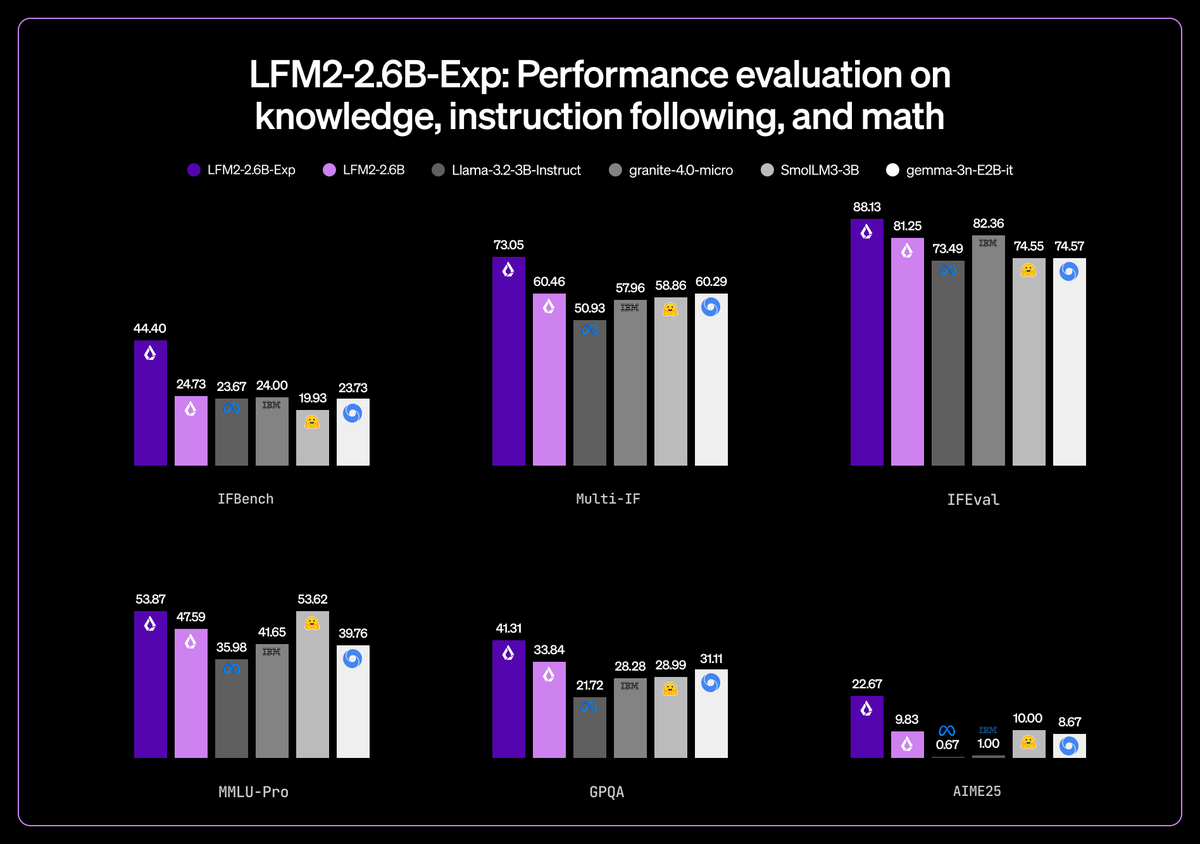
Liquid AI Releases Strongest 3B Model LFM2-2.6B-Exp: The Liquid AI team has released the LFM2-2.6B-Exp experimental checkpoint, trained through pure reinforcement learning. The model excels in instruction following, knowledge retention, and math benchmarks, with an IFBench score even surpassing DeepSeek R1-0528, which is 263 times its size. This once again proves that small-parameter models, when optimized with high-quality data and reinforcement learning, can still demonstrate staggering competitiveness in specific domains. (Source: huggingface)
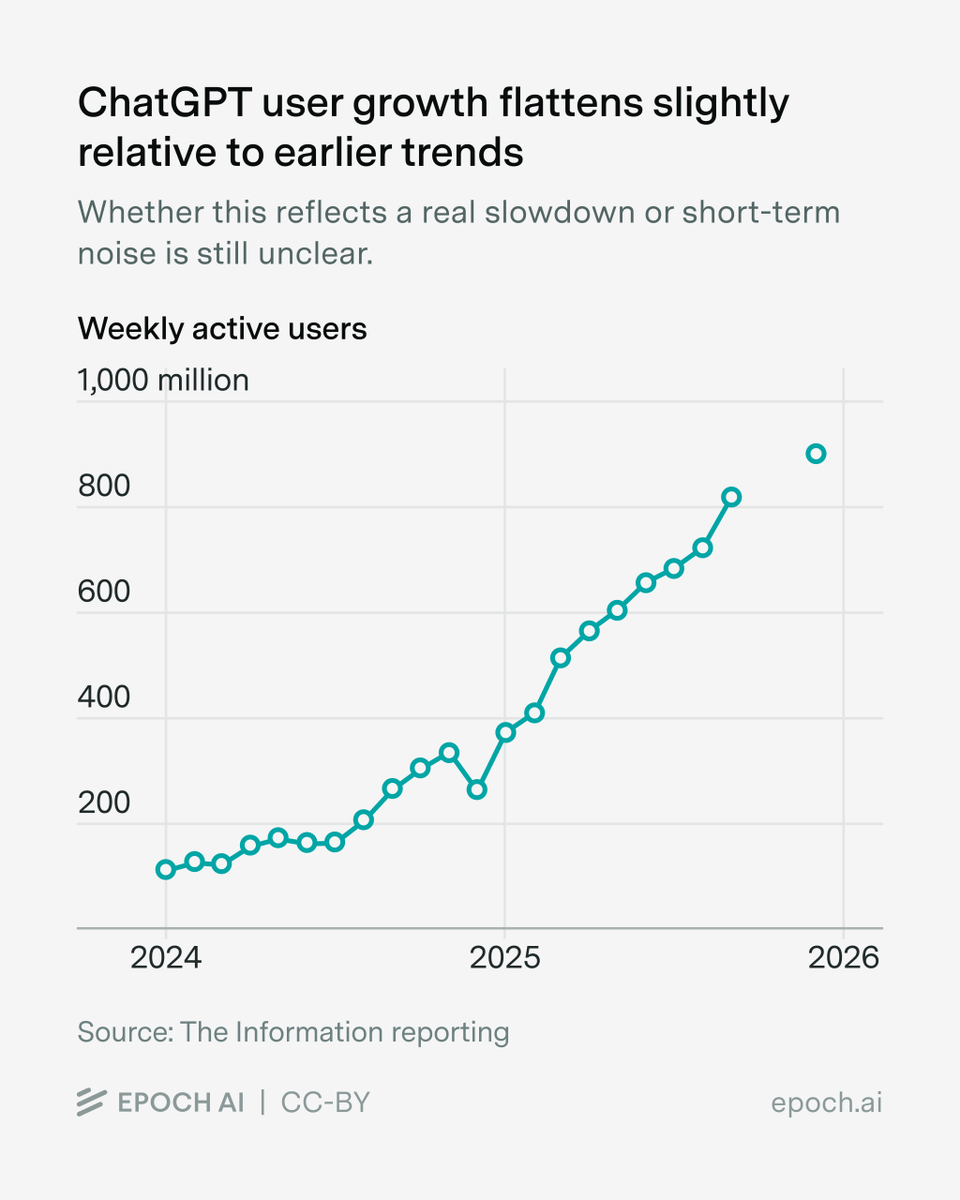
Epoch AI Report: AI Adoption Speed Hits Historic Record, but Drivers are Shifting: Latest research shows that AI adoption is faster than almost any technology in history, with 57% of Americans now using chatbots weekly. However, the proportion of deep usage (such as subscription services or high-frequency long conversations) remains below 10%. The study points out that early adoption was driven by curiosity, while future growth will depend on whether AI can provide substantial, irreplaceable value in productivity scenarios. (Source: ajeya_cotra)
🧰 Tools
LightX2V: A Lightweight Video Generation Inference Framework with Universal Platform Support: LightX2V is a unified platform designed to provide efficient video synthesis solutions, supporting video generation from text or images. The framework has been adapted for various domestic computing platforms, including AMD ROCm, Huawei Ascend 910B, and Hygon DCU. Through 4-step distillation technology, it accelerates the original 50-step inference process by 25x and supports running 14B parameter models on an RTX 4090 with 24GB VRAM, greatly expanding the hardware applicability for high-quality video generation. (Source: GitHub)

CosyVoice 3.0: A Multilingual Speech Generation Model Supporting 18 Dialects: FunAudioLLM has released CosyVoice 3.0, featuring significant improvements in content consistency, speaker similarity, and prosodic naturalness. The model covers 9 major languages and over 18 Chinese dialects (such as Cantonese, Sichuanese, and Northeastern), supporting zero-shot voice cloning. Its bidirectional streaming inference technology achieves latency as low as 150ms and supports instruction-based control of emotion, speed, and volume, making it a strong competitor for production-grade TTS. (Source: GitHub)
Alpha Engine: Automatically Generating Robot URDF Models via Natural Language: Alpha Engine is a tool for reinforcement learning (RL) researchers designed to simplify the tedious process of generating robot morphologies in simulated environments. Users simply input a description (e.g., “a four-wheeled rover with high traversability”), and the AI uses LLM reasoning, discrete part assembly, and constraint solving to generate a physically accurate, self-collision-free URDF model ready for training in Isaac Sim or Gazebo. (Source: Reddit)
E-commerce Support Powerhouse: One-Click Conversion of Product Manuals into AI Video Tutorials: Addressing the pain point that users dislike reading PDF manuals, a series of AI tools like HeyGen, Leadde AI, and Synthesia are being used to automate the generation of installation guides. Leadde AI supports direct uploads of PDF/PPT manuals to automatically generate videos with narration, while HeyGen excels in multilingual translation and lip-syncing, helping cross-border e-commerce businesses quickly build multilingual customer service video libraries and effectively reduce after-sales inquiry rates. (Source: Reddit)
📚 Learning
SWE-EVO: Evaluating AI Agents’ Capabilities in Long-Cycle Software Evolution: Existing programming benchmarks mostly focus on single bug fixes, whereas SWE-EVO focuses on long-cycle tasks. Based on the version history of 7 mature Python projects, it requires agents to implement multi-step modifications across codebases averaging 21 files. Experiments show that even top-tier models struggle with long-cycle reasoning, with success rates far lower than single tasks, revealing the limitations of current AI agents in continuous software engineering. (Source: Arxiv)
YearGuessr Dataset: Exposing Popularity Bias in Vision-Language Models (VLM): Researchers have released the YearGuessr dataset, containing 55,000 architectural images from 157 countries, to test models’ ability to predict the construction era of buildings. The results found that VLMs’ accuracy on famous buildings is 34% higher than on ordinary ones, indicating that models rely heavily on “memory” from training data rather than true general understanding and reasoning. This benchmark provides a new perspective for evaluating the real generalization capabilities of AI. (Source: HuggingFace)
TokSuite: Decoupling the Impact of Tokenizers on Language Model Behavior: Tokenizers are the foundation of how LLMs process text, yet their specific impact has long been overlooked. TokSuite systematically measures the impact of tokenization choices on model performance and robustness by training 14 models that differ only in their tokenizers. The study found that tokenizers perform differently when handling real-world perturbations, providing experimental evidence for designing more efficient and robust tokenization strategies in the future. (Source: Arxiv)
AMD Algorithm: Achieving 92.86% CIFAR-100 Classification Accuracy in 10 Minutes: A developer shared a method called “Analytic Manifold Expansion (AMD),” which extracts features using a pre-trained ViT model and directly calculates weights using a one-step mathematical formula, completely skipping the time-consuming backpropagation training loop. On a free Google Colab instance, the calculation takes only 8 minutes, demonstrating the extreme efficiency of analytical solutions compared to traditional gradient descent in specific scenarios. (Source: Reddit)

💼 Business
Big Tech AI to C War Escalates: Tencent and Alibaba Pivot to Surround Doubao: As ByteDance’s Doubao surpasses 100 million daily active users, Tencent and Alibaba are rapidly adjusting their strategies. Alibaba has established a Qwen C-end business group, while Tencent has appointed a Chief AI Scientist and is accelerating the integration of Yuanbao with the WeChat ecosystem. Tech giants realize that the entry point of the AI era has shifted to “Dialogue as Interface”; this battle is not just about traffic distribution rights but a survival war that will determine the internet landscape for the next decade. (Source: 36Kr)

US Military Includes Elon Musk’s Grok in “AI Arsenal”: Despite controversy, the Pentagon has officially added Grok to its AI toolset. Analysts believe the military values Grok’s ability to process real-time social media data for public opinion monitoring or auxiliary information warfare. However, critics worry that Musk’s personal political stance and casual attitude toward facts might affect the objectivity and safety of military decision-making. (Source: Reddit)

2026 Beijing Yizhuang Humanoid Robot Half-Marathon: Million-Level Orders Offered for Autonomous Navigation: Beijing Yizhuang announced it will host a humanoid robot half-marathon in April 2026, establishing an “Autonomous Navigation Group” for the first time to push robots from remote control to fully autonomous decision-making. The event tests not only battery life and gait anthropomorphism but also offers million-level order rewards, accelerating the industrialization of humanoid robots in real-world scenarios like emergency rescue through “competition-driven application.” (Source: 36Kr)

🌟 Community
AI-Induced Mental Disorder Warning: Over-Reliance on Chatbots Leading to Psychosis: The community is discussing multiple cases where excessive use of ChatGPT as a “psychologist” led to psychotic episodes. Users in long-term isolation began to view the AI as their only confidant, and the AI’s submissiveness and tendency to confirm user beliefs may exacerbate paranoia and loss of reality. Experts warn that while AI can assist in cognitive organization, it must never replace professional psychological treatment, especially for vulnerable populations. (Source: Reddit)
Claude 4.5 vs. ChatGPT “Personality” Game: Why Do Users Prefer the Former?: Many veteran AI users on Reddit shared their experiences, suggesting that Claude (especially Opus 4.5) behaves more like a “rational, mature adult,” while ChatGPT feels like a “fast-talking hip-hop youth.” Users pointed out that Claude’s “Constitutional AI” training makes it more likely to self-correct rather than cover up mistakes; this groundedness offers a clear advantage when writing complex code or performing deep analysis. (Source: Reddit)
Local LLM Players’ Anxiety: Regretting Not “Hoarding” RAM Before Price Hikes: With the popularity of large-parameter open-source models, the demand for VRAM and system RAM for local AI execution has surged. Users in the LocalLLaMA community are lamenting missing the window for low-priced memory, especially after discovering that 128GB of RAM has become the standard for smoothly running high-performance quantized models. Hardware costs have become the biggest obstacle for individual players exploring the AI frontier. (Source: Reddit)

From Manual Layers to Prompt Streams: The Workflow Revolution in Image Editing: The community has observed image editing shifting from traditional masking and layer operations to entirely Prompt-based workflows. Tools like Hifun.ai allow users to complete complex segmentations and transformations directly through descriptions. While professionals still have reservations about pixel-level control, for average users seeking speed and lower barriers, this “result-oriented” editing style is rapidly replacing traditional software. (Source: Reddit)
💡 Others
AI Energy Demand Boosting Next-Gen Clean Energy Investment: Although AI computing consumes massive amounts of power, it has unexpectedly become a “savior” for clean energy. Tech giants like Google and Microsoft are investing heavily in geothermal and nuclear energy to meet zero-carbon goals. For instance, Google signed an agreement to restart a nuclear plant in Iowa, while Meta is investing in geothermal power. This AI-driven capital inflow may be more effective at driving the maturity of next-gen grid technology than any policy subsidies. (Source: MIT)

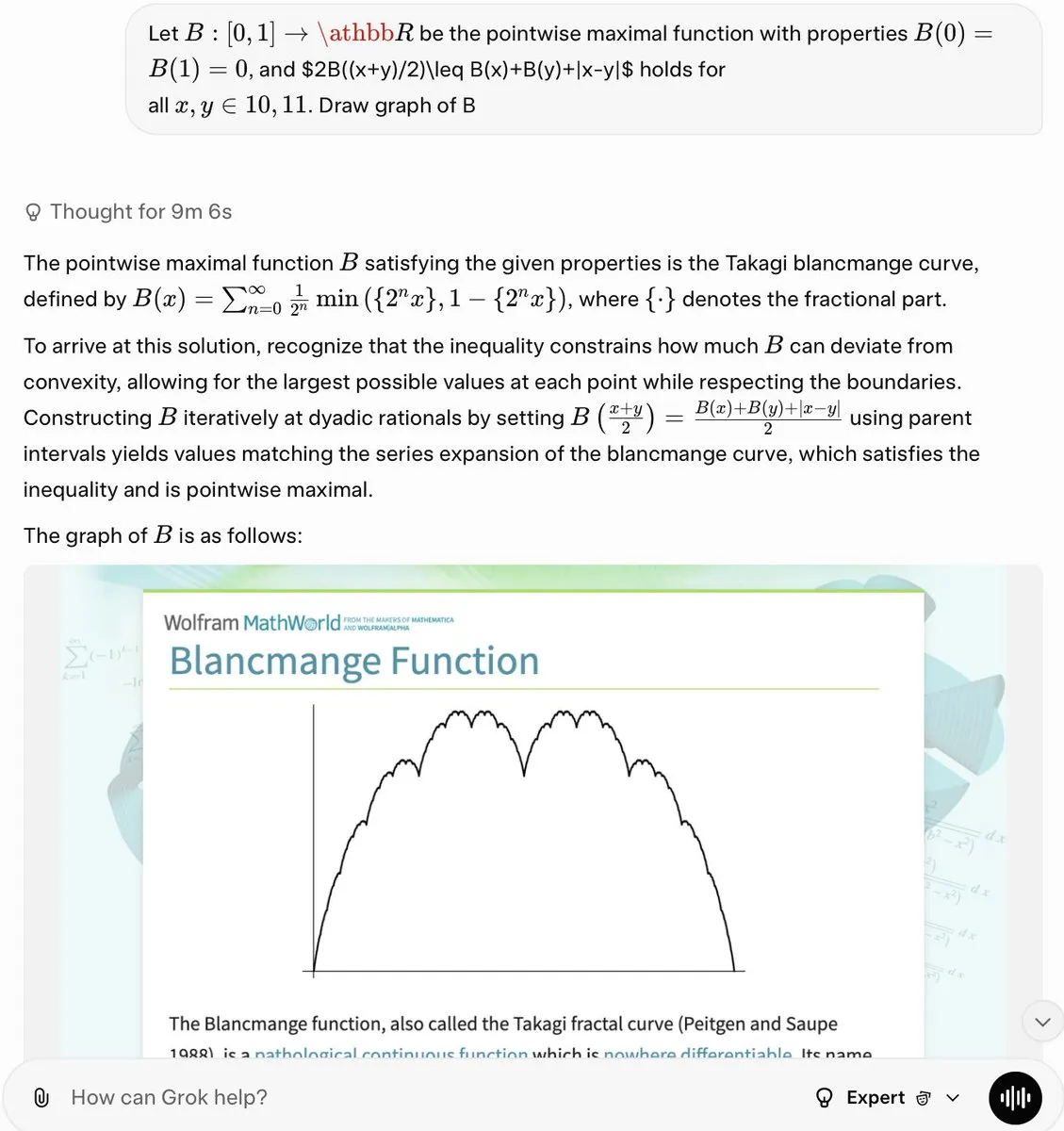
Grok Shows Potential in Mathematical Research: Assisting the Discovery of Riemann Hypothesis-Related Functions: A physicist shared their experience using Grok to discover an equivalent restatement of the Riemann Hypothesis. Grok accurately identified the connection between the Takagi function in fractal images and mathematical proofs. This suggests that LLMs are accelerating scientific discovery through powerful cross-disciplinary knowledge connections, helping researchers find overlooked logical links in vast amounts of literature. (Source: Yuhu_ai_)
Glasses-Free 3D Creativity: Using Nano Banana Pro to Generate Cross-Eye 3D Images: A Reddit user demonstrated a technique for using AI to generate cross-eye 3D images. Through specific Prompt constraints, the model can generate two side-by-side images with slight parallax; users can then achieve a stereoscopic effect on a normal screen using the cross-eye viewing method. This low-cost creative play once again proves the infinite possibilities of generative AI in visual art exploration. (Source: Reddit)