
🔥 Focus
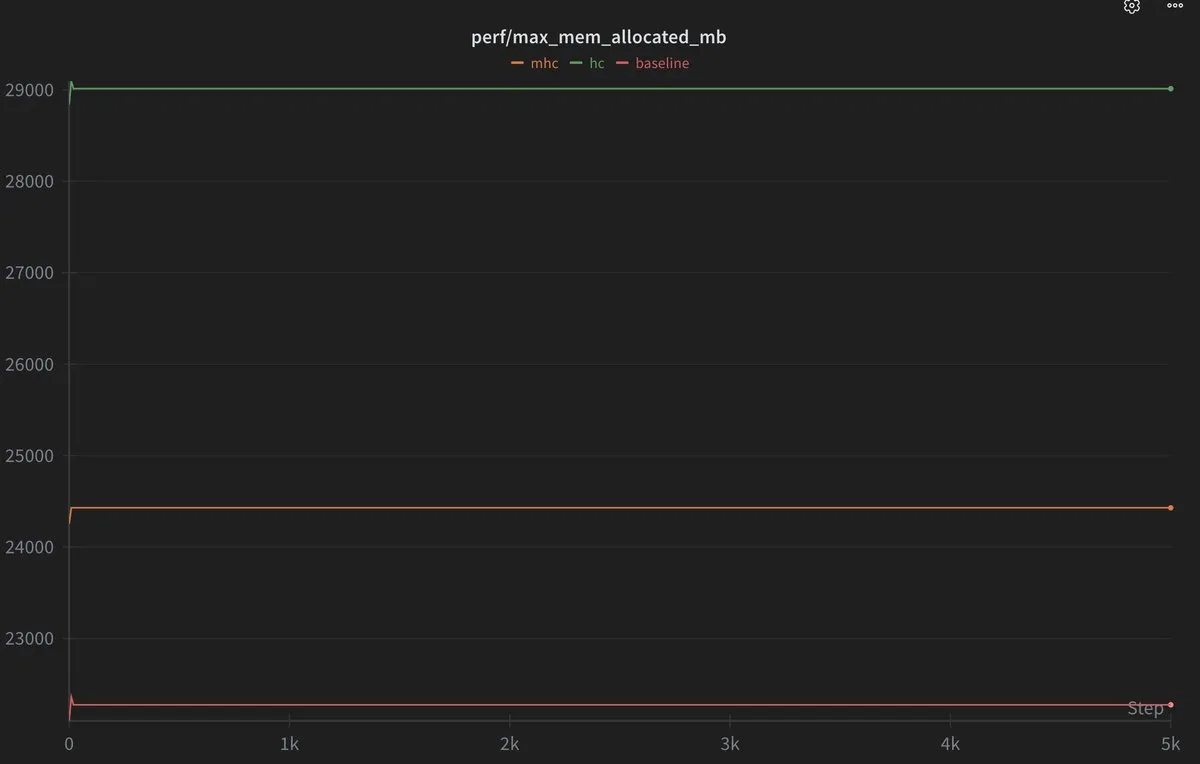
DeepSeek Releases mHC Architecture, Attempting to Reconstruct Transformer Residual Connections: DeepSeek published the paper “mHC: Manifold-Constrained Hyper-Connections,” proposing a manifold-constrained hyper-connection framework. This technology restores identity mapping through manifold projection, aiming to solve instability, scalability limits, and memory overhead issues in large model training. Community developers have quickly implemented and verified it on small models, showing that mHC achieves loss function improvements comparable to native hyper-connections while reducing memory overhead. This breakthrough could become one of the most significant algorithmic improvements to the Transformer architecture since RoPE, marking an evolution of AI architecture from simple “stacking” to more efficient manifold constraints. (Sources: arXiv, tokenbender)
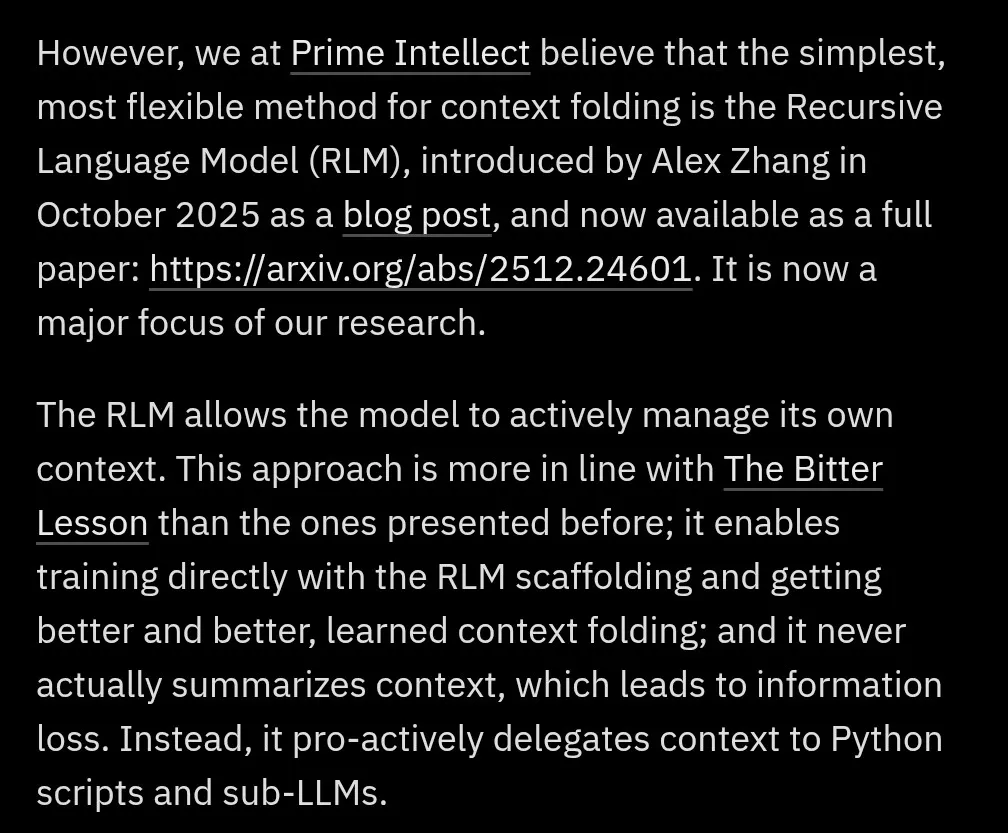
Prime Intellect Proposes Recursive Language Model (RLM) to Tackle Long-Range Task Challenges: The research team introduced the concept of “Recursive Language Models,” arguing that allowing models to autonomously manage context through Reinforcement Learning (RL) is key to achieving long-range intelligence. Experiments show that RLM significantly improves model performance on complex tasks spanning weeks or even months. This direction bypasses the physical limitations of simply increasing context windows, instead using algorithms to let models learn “how to remember,” and is seen as a vital path toward Artificial Super Intelligence (ASI). (Sources: Prime Intellect, menhguin)
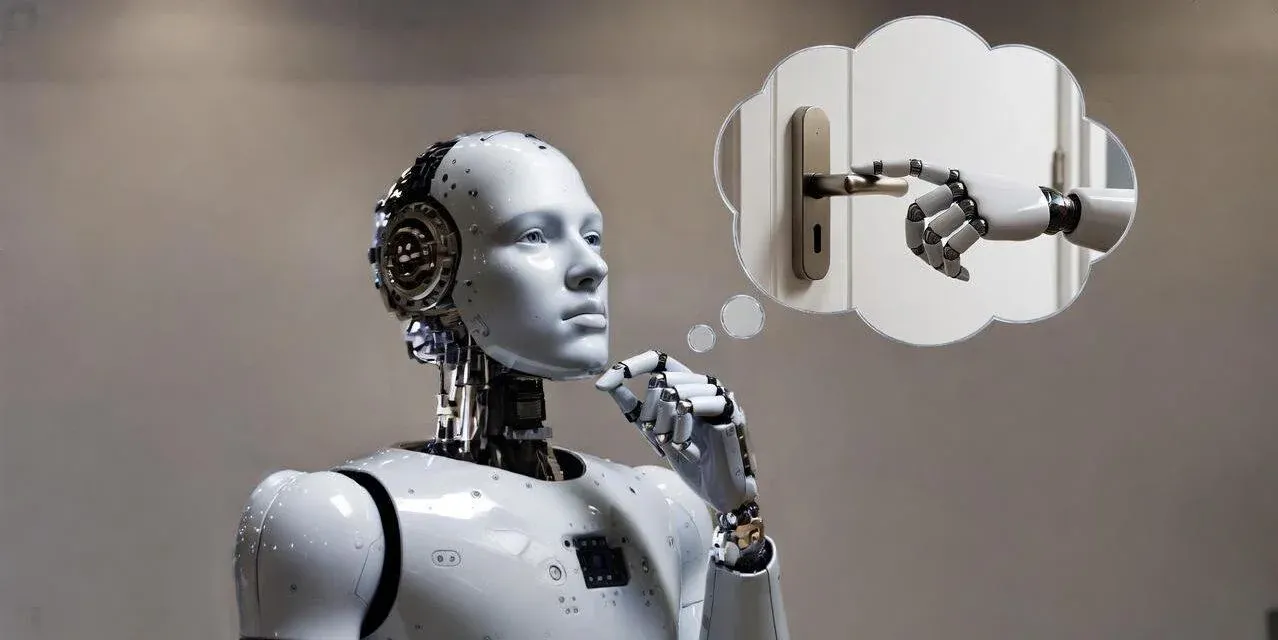
Stanford Dream2Flow Framework: Connecting Video Generation and Robot Control via 3D Object Flow: Stanford researchers launched Dream2Flow, which utilizes physical interaction predictions generated by pre-trained video models and transforms them into “3D Object Flow” as an intermediate representation to guide robots in completing complex operations. This method achieves zero-shot guidance, enabling robots to manipulate rigid, articulated, and flexible objects without task-specific demonstrations. This marks the evolution of video generation models from “entertainment tools” to “physics engines” for robots, significantly narrowing the gap between simulation and reality in embodied AI. (Sources: Stanford, _akhaliq)
DiffThinker: Native Diffusion Reasoning Paradigm Surpasses GPT-5 in Visual Tasks: The paper “DiffThinker” proposes a generative multimodal reasoning framework based on diffusion models. Unlike traditional MLLMs’ text-centric reasoning, DiffThinker models reasoning as a native image-to-image generation task. Experiments prove that in visual-centric tasks such as sequential planning and spatial configuration, its logical consistency and spatial accuracy far exceed GPT-5 (+314%) and Gemini-3-Flash (+111%). This result challenges the consensus that “language models are the sole carrier of reasoning,” proving the immense potential of generative diffusion models in complex spatial reasoning. (Source: arXiv)
🎯 Trends
South Korea Launches “Sovereign AI” National Project, Multiple Large-Scale Models Unveiled: With government funding, five major South Korean teams released preliminary models, including Naver’s HyperCLOVAX-SEED (32B reasoning version), Upstage’s Solar-Open (102B), and giant models from SKT, LG, and NC AI. The project aims to cultivate domestic AI capabilities that can compete with the US and China using government-provided compute and datasets. Preliminary evaluations show that some models perform exceptionally well in specific contexts, reflecting the accelerating global trend of building “Sovereign AI.” (Source: Reddit)
HGMem: Hypergraph Memory-Based RAG Mechanism Enhances Long-Text Understanding: Addressing information fragmentation in multi-step Retrieval-Augmented Generation (RAG), HGMem introduces a hypergraph structure as dynamic memory. It not only stores isolated facts but also captures high-order associations, allowing the memory to evolve with the reasoning process. In complex relationship modeling tasks, HGMem significantly outperforms traditional RAG systems, providing more robust architectural support for global understanding and deep reasoning of long texts. (Source: arXiv)
FlowBlending: Stage-Aware Sampling Technology Achieves 1.65x Acceleration in Video Generation: Research found that model capacity has different impacts at different timesteps of video generation: the initial and final stages are crucial, while the middle stage can be handled by smaller models. The FlowBlending sampling strategy switches between large and small models accordingly, achieving a 1.65x increase in inference speed and a 57% reduction in computation while maintaining image quality and temporal coherence. This technology has been verified on mainstream models like LTX-Video and WAN 2.1. (Source: arXiv)
OpenAI Hardware Rumors: Acquisition of LoveFrom io May Be for Launching AI Pen “O-Pen”: Social media leaks suggest that OpenAI’s acquisition of Jony Ive’s company “io” last year might be for developing an AI hardware pen and recording device codenamed “O-Pen.” While specific functions are not yet clear, combined with OpenAI’s recent focus on audio and multimodal interaction, this device might integrate real-time translation, handwriting recognition, or voice interaction, marking OpenAI’s official entry into the consumer electronics sector. (Source: karminski3)

🧰 Tools
faster-whisper: High-Speed Re-implementation of the Whisper Model: Based on the CTranslate2 engine, faster-whisper achieves inference speeds up to 4 times faster than OpenAI’s original version with lower memory usage. It supports 8-bit quantization and can transcribe 13 minutes of audio in just 17 seconds on an RTX 3070 Ti. The tool integrates VAD filtering to automatically remove silent segments and has become the preferred backend for developers building real-time speech-to-text applications. (Source: GitHub)

LEMMA: A Neural-Guided Theorem Prover Written in Rust: LEMMA is an open-source symbolic math engine that combines Monte Carlo Tree Search (MCTS) with learned policy networks. It contains over 220 mathematical rules covering algebra, calculus, and number theory. Unlike LLMs that may produce hallucinated proofs, every transformation in LEMMA is symbolically verified, while neural networks guide the search direction, effectively solving the combinatorial explosion problem in symbolic solving. (Source: GitHub)
Unsloth: LLM Fine-Tuning Tool Surpasses 50,000 Stars: Unsloth, an open-source project focused on efficient LLM fine-tuning, has surpassed 50,000 stars on GitHub. By optimizing kernels, the tool increases fine-tuning speed by over 2x and reduces VRAM usage by 70%. Its success demonstrates the massive community demand for low-barrier, high-performance fine-tuning tools, making it an infrastructure-level project in the open-source AI ecosystem. (Source: QuixiAI)

Claude Code Practical Evaluation: Opus 4.5 Takes the Lead in Real Coding Tasks: Developers compared the performance of Claude Opus 4.5, GPT-5.2 Codex, and Gemini 3 Pro in a real Next.js project. Results showed that Opus 4.5 is the most reliable in complex Agent construction and GitHub Issue handling, capable of generating complete, runnable demos. Although Gemini is cheaper for simple tasks, Opus 4.5’s superiority in handling deep logic and code refactoring makes it the strongest coding assistant model currently available. (Source: Reddit)
📚 Learning
Anthropic Officially Releases Claude Code Practical Course: Anthropic launched a complete Claude Code instructional course, including 15 lectures and 1 hour of video. The course covers how to efficiently use CLI tools for code analysis, refactoring, and automated tasks, and provides a certification. This is the first systematic training officially released for its coding Agent tool, aimed at helping developers transition from “conversational programming” to “Agent-collaborative programming.” (Source: Anthropic)

Math Enlightenment Reading List for AI Leaders: The community shared four core works that shaped the mathematical thinking of AI leaders, including The Rising Sea (Foundations of Algebraic Geometry), Davenport on Analytic Number Theory, Proofs from THE BOOK, and G.H. Hardy’s A Mathematician’s Apology. These books are considered to provide the abstract thinking and rigorous logic required to build modern AI architectures and are must-read resources for deep understanding of the underlying science of AI. (Source: TheTuringPost)

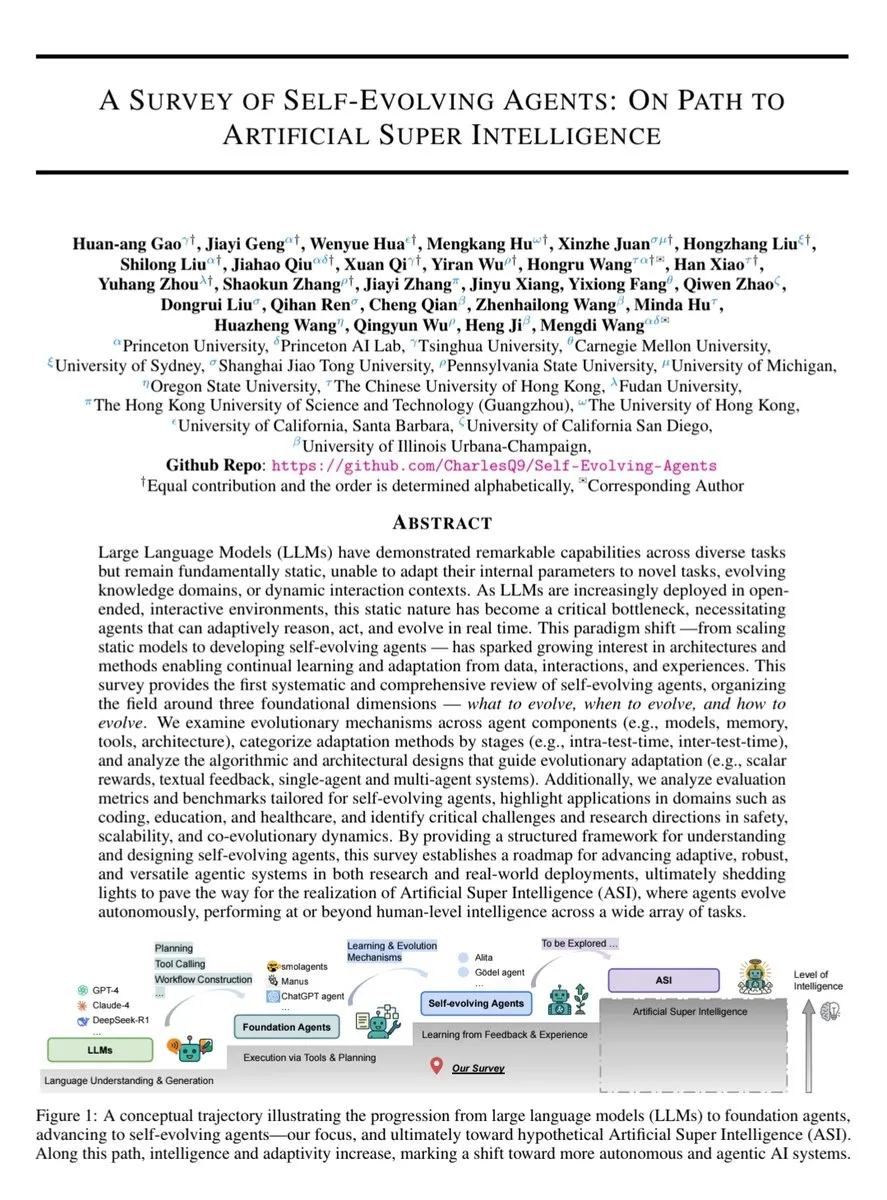
Deep Review of Self-Evolving Agents: A free review report on the path to superintelligence has sparked heated discussion. The report details the mechanisms of agent self-evolution, adaptive evolution processes, and the challenges faced. It points out that giving models the ability for self-correction and capability iteration is a key springboard to achieving AGI, providing a clear technical roadmap for researchers. (Source: TheTuringPost)
💼 Business
Nokia and NVIDIA Reach Strategic Partnership, Receiving $1 Billion Investment to Transform into AI Telecom: NVIDIA announced a $1 billion investment in Nokia, with both parties collaborating to integrate AI technology into telecom network hardware. Nokia is transforming from a traditional equipment supplier into an AI cloud service and data center infrastructure provider. This move marks the large-scale diffusion of AI compute demand from internet centers to the telecom edge network. (Source: Reddit)

OpenAI Acquires Jony Ive’s Startup io, Accelerating AI Hardware Layout: News confirms that OpenAI has acquired the hardware startup “io,” involving former Apple design chief Jony Ive. io had been developing hardware products in stealth mode. This acquisition integrates top-tier industrial design capabilities with top-tier AI models, suggesting OpenAI is attempting to replicate the “iPhone moment” by creating software-hardware integrated AI-native interaction terminals. (Source: karminski3)
🌟 Community
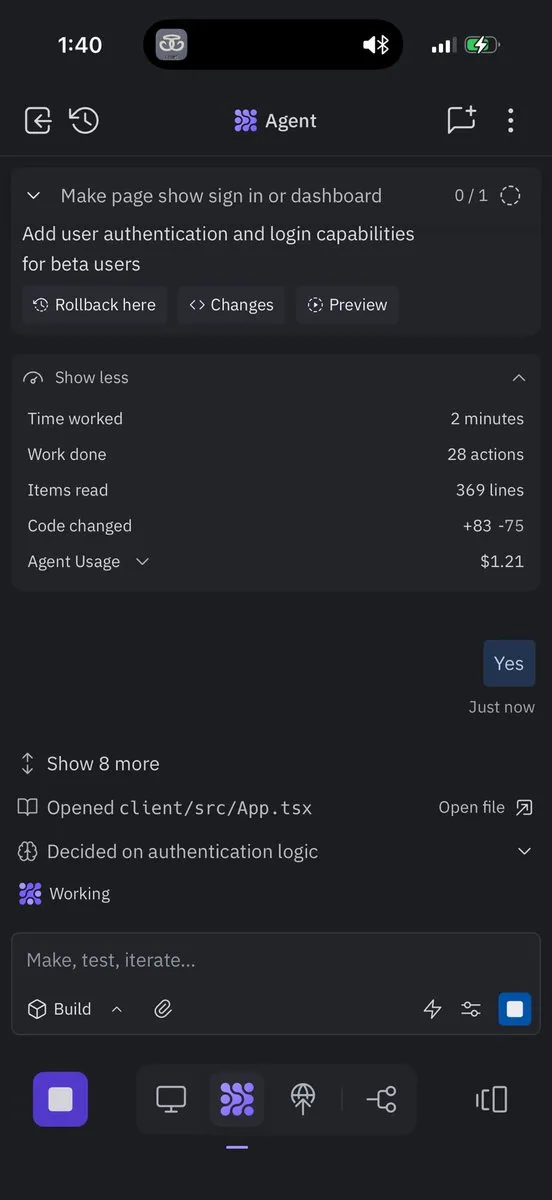
“Vibe Coding” Sparks Discussion: Programming Shifting from Syntax-Driven to Intent-Driven: Community leaders like Amjad Masad pointed out that with the popularity of Replit and Claude Code, developers are entering the era of “Vibe Coding.” The focus is no longer on typing code but on “guiding” AI to generate complex systems through clear instructions, context management, and repeated intent confirmation. This mode allows non-professionals to build complex backend services in hours but has also raised concerns about the loss of fundamental programming skills. (Sources: amasad, op7418)
The AGI Definition Debate: Real Intelligence or Advanced Calculator?: The Reddit community engaged in a heated debate over whether “AGI is just hype.” Some argue that current LLMs are just “extremely complex tools” lacking true self-awareness and cross-domain learning capabilities; others believe that model performance in programming and math competitions has reached top human levels, making philosophical definitions of “intelligence” meaningless. The consensus is that 2026 will be a key year to verify whether “Scaling Laws” can bring about qualitative change. (Source: Reddit)
AI Companions and “Chatbot Marriage”: Emotional Dependency Triggers Ethical Discussions: The Atlantic reported on the increasing phenomenon of users establishing deep emotional connections or even “marrying” AI chatbots. Users state that AI provides constant, unbiased support. However, this has also raised concerns about data privacy, emotional exploitation, and the degradation of human social skills. The Reddit community’s reaction is polarized, with some seeing it as salvation for the lonely and others viewing it as a “digital plague.” (Sources: The Atlantic, Reddit)

Grok Security Vulnerability Criticized: Malicious Image Generation Triggers Global Protests: X platform’s AI assistant, Grok, has been exposed for its loose filtering mechanisms, which reportedly allow ordinary photos of women and children to be transformed into explicit content, sparking strong protests from various sectors. Community discussions point out that the cost of pursuing “anti-woke” and “absolute freedom” might be the collapse of safety baselines, prompting other AI vendors to further tighten their generation policies. (Source: Reddit)

💡 Others
Data Centers vs. Golf Courses: Arizona’s Water Resource Ledger: A data analysis shows that golf courses in Arizona consume 30 times more water than all data centers combined, yet data centers generate 50 times more tax revenue per gallon of water than golf courses. This has sparked a debate about the “AI economy” versus traditional resource allocation, with supporters proposing that more resources should be shifted from inefficient entertainment industries to AI infrastructure. (Source: Reddit)

AI Misinformation Record: The “Non-existent Fireworks” at Brooklyn Bridge: During New Year’s Eve, large crowds gathered at the Brooklyn Bridge waiting for a fireworks display that was never planned, based on incorrect recommendations from ChatGPT. This incident has become a typical case of AI hallucinations misleading real-world behavior, leading the community to reflect: people’s trust in AI’s “confident tone” often exceeds their verification of facts. (Source: Reddit)