
🔥 Focus
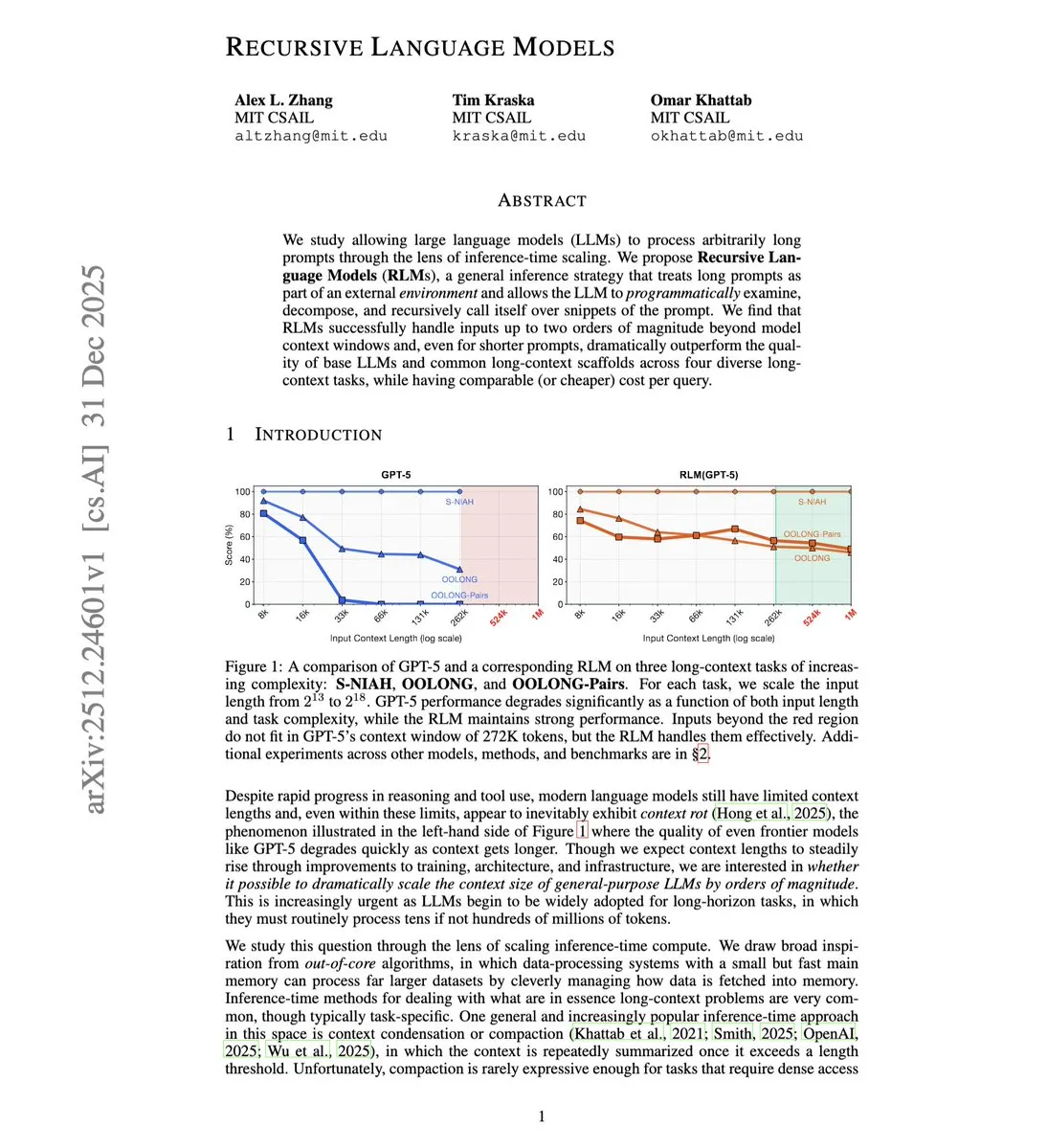
MIT Releases Recursive Language Model (RLM): Breaking the 10 Million Token Processing Limit: Researchers at the Massachusetts Institute of Technology (MIT) have proposed a new paradigm of Recursive Language Models (RLM) that stores long texts in an external code environment, allowing the model to process them by recursively calling itself through program writing. This method completely decouples input length from the model’s context window limitations, maintaining stable performance at a scale of 10 million+ Tokens while reducing inference costs by approximately 60% compared to traditional long-context solutions. This technology marks the evolution of AI from “full-text reading” to “on-demand indexing,” addressing the “context decay” pain point of large models when handling ultra-long documents. (Source: lateinteraction, MIT)
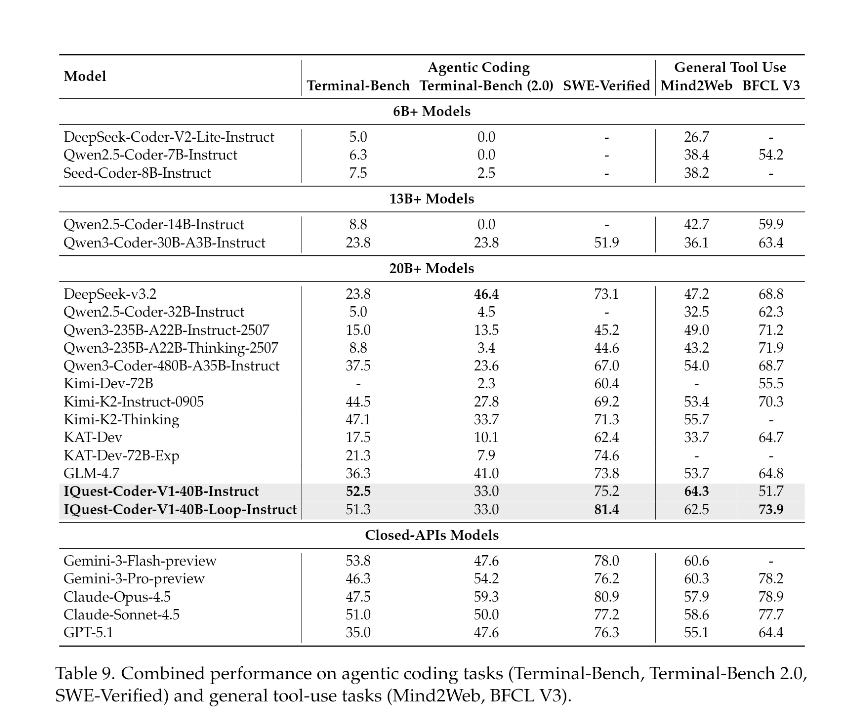
IQuest-Coder-V1 Released: The “DeepSeek Moment” for Domestic Coding Agents: Zhizhi Innovation Research Institute, under Jiukun Investment, released the open-source coding model IQuest-Coder-V1, which surpassed Claude Opus 4.5 with an 81.4% accuracy rate in the SWE-Bench Verified test. The model utilizes a Loop architecture and a code-flow training paradigm, enabling it to autonomously complete the entire process from requirement understanding to testing and debugging. Although the score was later corrected to 76.2% following community feedback regarding a “future submission” vulnerability, its demonstrated capability for closed-loop execution of complex tasks is still regarded as a significant technical breakthrough in the Agent field for 2026. (Source: Zhizhi Innovation, Reddit)
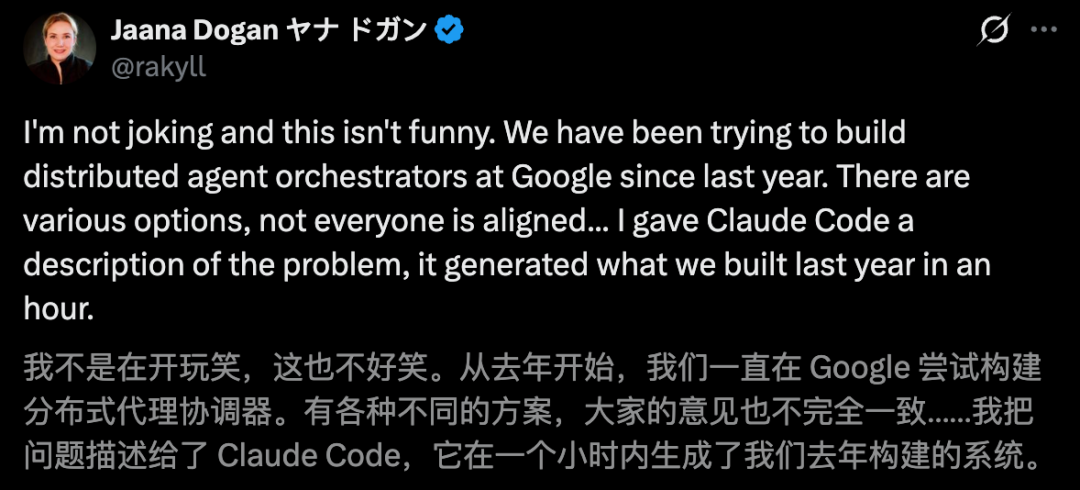
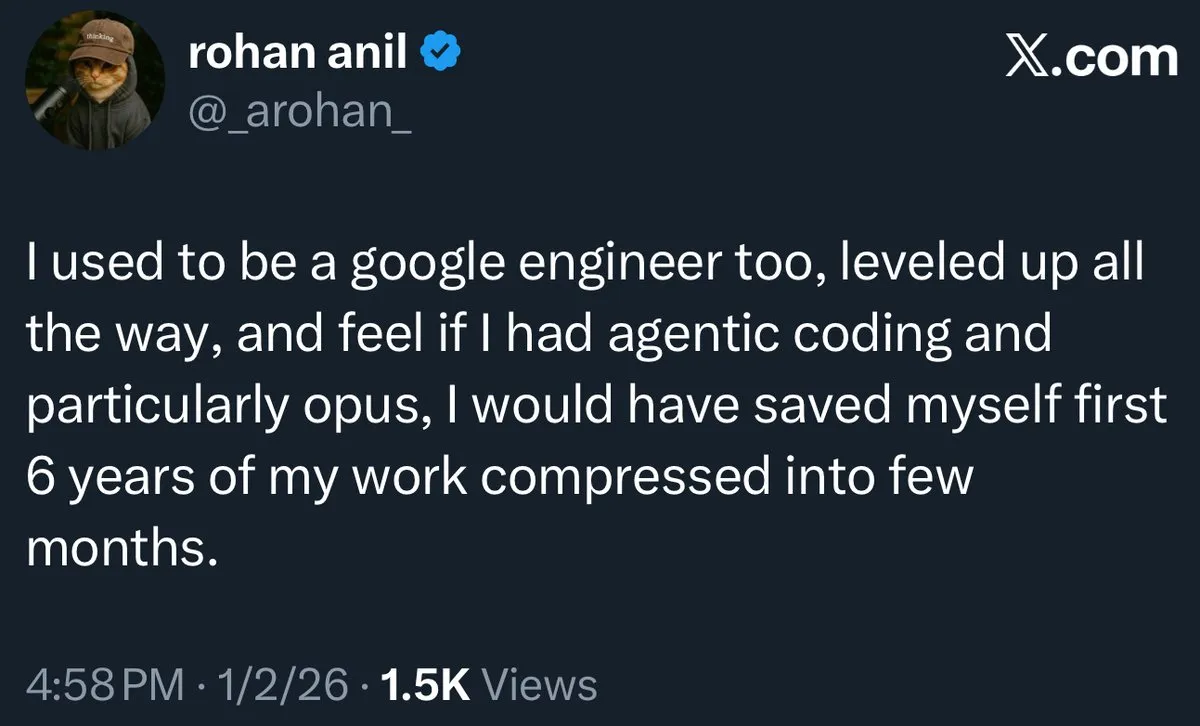
Anthropic’s Massive Purchase of One Million TPUs: Firing the First Shot in “De-CUDA”: Anthropic plans to spend $21 billion to procure 1 million Google TPU v7 chips from Broadcom to build its own supercomputing cluster. This move signifies Anthropic’s intent to break free from dependence on NVIDIA’s CUDA ecosystem and seize computing power sovereignty. Meanwhile, Claude Opus 4.5 has shown startling efficiency in practical applications, with Google engineers claiming it replicated a team’s year-long work within an hour. Anthropic is maintaining its lead through a “less is more” strategy, focusing on data quality and post-training techniques with only a fraction of its competitors’ resources. (Source: SemiAnalysis, Xinzhiyuan)
OpenAI’s 2026 Make-or-Break Point: $100 Billion Financing and First AI Hardware “Pen” Finalized: OpenAI expects a cash loss of $17 billion in 2026, and Sam Altman is planning a new funding round of up to $100 billion. To find a new traffic entry point, OpenAI’s first AI hardware form has been confirmed as an “AI Pen” designed with Jony Ive’s involvement. The device features audio interaction and local model execution capabilities, aiming for a “low-presence, high-involvement” lakeside cabin-style interaction experience. 2026 will determine whether OpenAI reaches the pinnacle of AGI or becomes Silicon Valley’s largest financial bubble. (Source: Economist, Liangziwei)

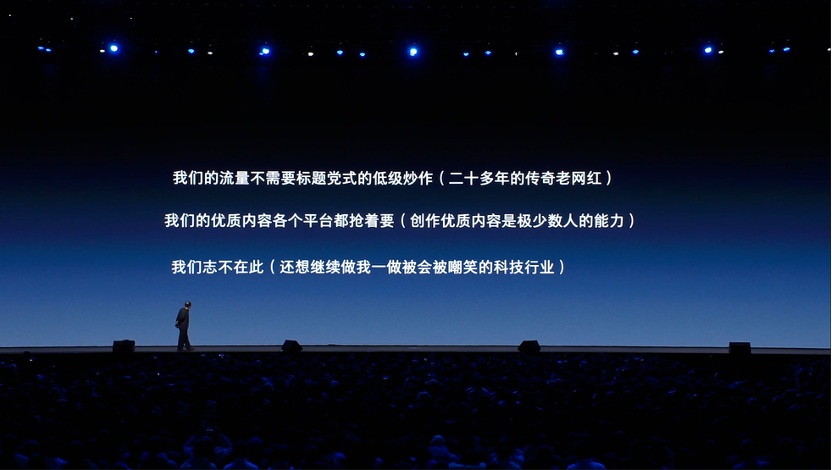
Luo Yonghao’s “Tech Spring Festival” Returns: Doubao AI’s Emotional Interaction Becomes a Highlight: At his 2025 annual sharing session, Luo Yonghao demonstrated the latest version of Doubao AI. Its emotional conversation capabilities showed a high degree of human-likeness during on-site debates, capable of judging user emotions through speech rate and tone and providing anthropomorphic responses like “suppressing anger.” Additionally, Luo promoted hard-tech products such as DJI panoramic drones and exoskeleton robots, reflecting the accelerated integration of AI with hardware, transforming from pure tools to emotional companions and productivity-enhancing devices. (Source: 36Kr, Kevin’s Stuff)
🎯 Trends
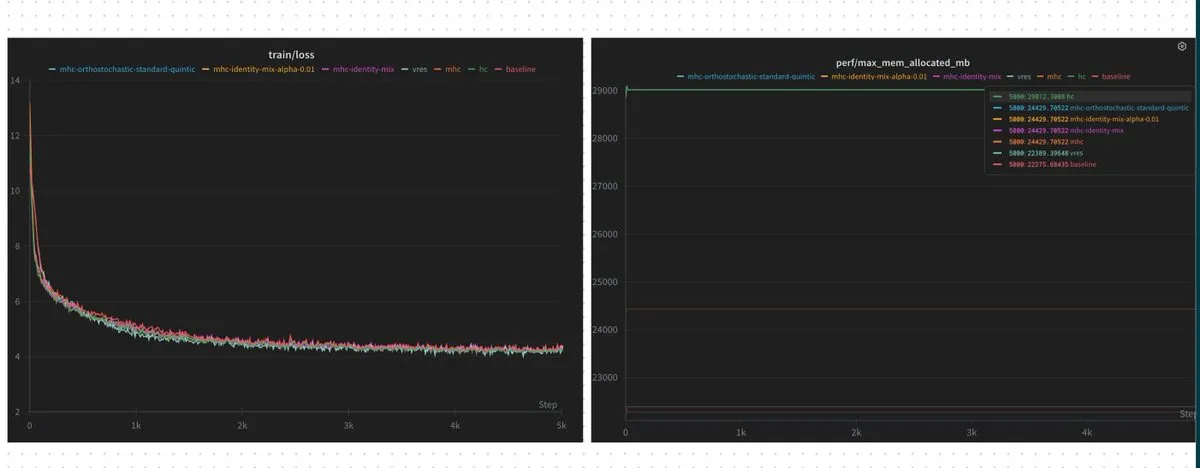
DeepSeek Releases mHC Architecture: Overcoming Training Instability in Hyper-connected Networks: Liang Wenfeng’s team released a paper on the Manifold-constrained Hyper-connection (mHC) architecture. By projecting matrices onto bi-stochastic manifolds, it solves the numerical explosion problem that occurs when deep residual networks are stacked across many layers. Experiments prove that just one Sinkhorn iteration can control the gain within a stable range. This research provides theoretical support for the deep scaling of ultra-large-scale models, further consolidating DeepSeek’s position in underlying architectural innovation. (Source: DeepSeek, Reddit)
Meta Departure Wave and Llama 4 Cheating Controversy: Yann LeCun and Tian Yuandong have left Meta. LeCun criticized Meta’s internal “addiction” to LLMs, calling them a “dead end,” and pointed out that Llama 4 engaged in “cheating” by using different models for different leaderboards in benchmarks. Tian Yuandong revealed that his team faced management distrust and marginalization during Llama 4’s R&D. Both have chosen to start their own ventures after leaving; LeCun will establish AMI to continue exploring world model paths based on V-JEPA. (Source: Liangziwei, FT)

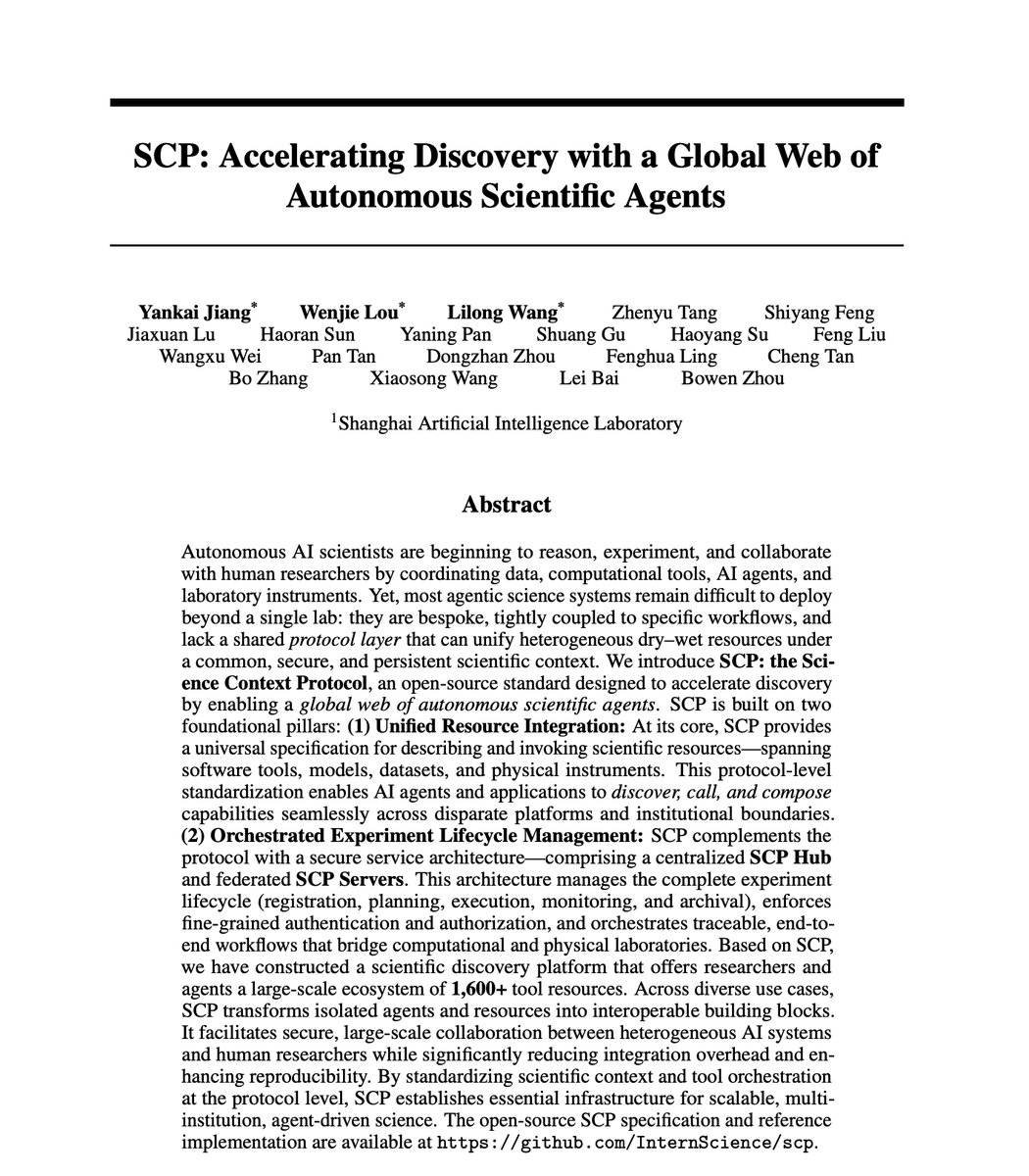
New Standard for Scientific Intelligence: SCP Protocol Opens Autonomous Scientific Agent Network: 2026 is regarded as the inaugural year for Scientific AI Agents. The newly proposed Scientific Context Protocol (SCP) aims to connect isolated Agents, tools, and instruments to build an interoperable scientific research network. The protocol has been demonstrated on the Intern-Discovery platform, covering over 1,600 tools in biology, physics, and chemistry, supporting the automatic execution of wet lab protocols from PDFs and AI-driven molecular screening. (Source: omarsar0)
Agent Infra’s “Home Invasion” Scheme: Big Tech is Clearing the Field: With Meta’s acquisition of Manus, Agent Infra (Agent foundation) has become the focus of competition. Tech giants are “incorporating” third-party interfaces through the MCP protocol and native sandbox permissions, demoting Agents from independent applications to a right-click menu item in the operating system. This means the value of general-purpose Agents will plummet, while vertical Agents with industry know-how and business “hidden rules” will become the last bastion for entrepreneurs. (Source: Wang Zhiyuan)
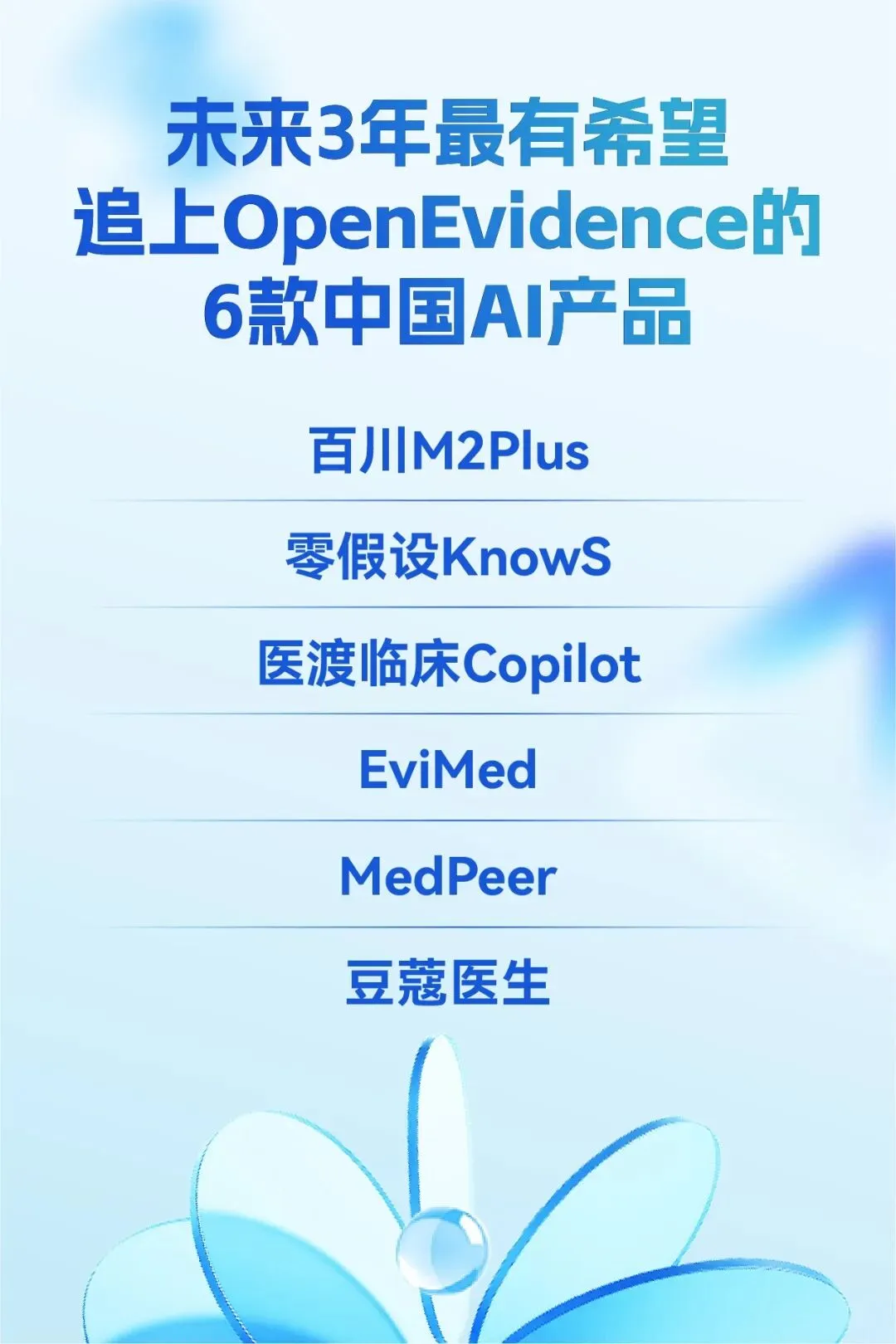
“Demystifying” Chinese AI Healthcare: The Rise of Ant Afu and Vertical Copilots: Ant Group has upgraded its AI health application AQ to “Ant Afu,” emphasizing no ads and no ranking interference in an attempt to build medical trust. Meanwhile, domestic products like Doukou Doctor and Yidu Clinical Copilot are accelerating their pursuit of OpenEvidence. By integrating into doctor workflows, focusing on specialized fields (such as obstetrics and gynecology), and adopting To B charging models, they are exploring a sustainable implementation path distinct from overseas free models. (Source: 36Kr, Artery Network)
🧰 Tools
LangGraph “Content Factory”: Transitioning from Chatbots to AI Workforce: The LangChain community launched a multi-agent system tutorial based on LangGraph. By creating a “Content Factory” model, professional editor and writer Agents collaborate through a shared state. This approach transcends single-model limitations and achieves the pipelining of complex content production, serving as a typical case of AI Agents entering actual production environments. (Source: LangChainAI)

LlamaSheets: Conquering LLM-Native Parsing of Excel Data: LlamaIndex introduced LlamaSheets (Beta), specifically designed to handle messy Excel data. It can identify complex layouts such as merged cells and hierarchical rows/columns, converting them into LLM-readable Parquet files. This solves the efficiency and understanding issues LLMs face when processing unstructured tabular data like financial statements. (Source: jerryjliu0)
AgentFS: A Code Filesystem Supporting Multi-Agent Collaboration: The Turso team open-sourced AgentFS, which utilizes a Copy-on-Write mechanism. It allows several AI Agents to work on the same codebase simultaneously; each Agent’s changes are isolated, non-conflicting, and do not affect the host files. This tool significantly enhances the collaboration efficiency of Agent clusters in complex software engineering. (Source: mattrickard)
New TTS Choices: VibeVoice and MorVoice Challenge ElevenLabs: In response to ElevenLabs’ expensive pricing, the community is promoting VibeVoice Large as a more natural, document-textured local alternative. Meanwhile, MorVoice has shown faster iteration speeds and a free experimental experience in short video creation, signaling a shift in the TTS field from “premium services” to “high-efficiency tools.” (Source: Reddit, ArtificialInteligence)
📚 Learning
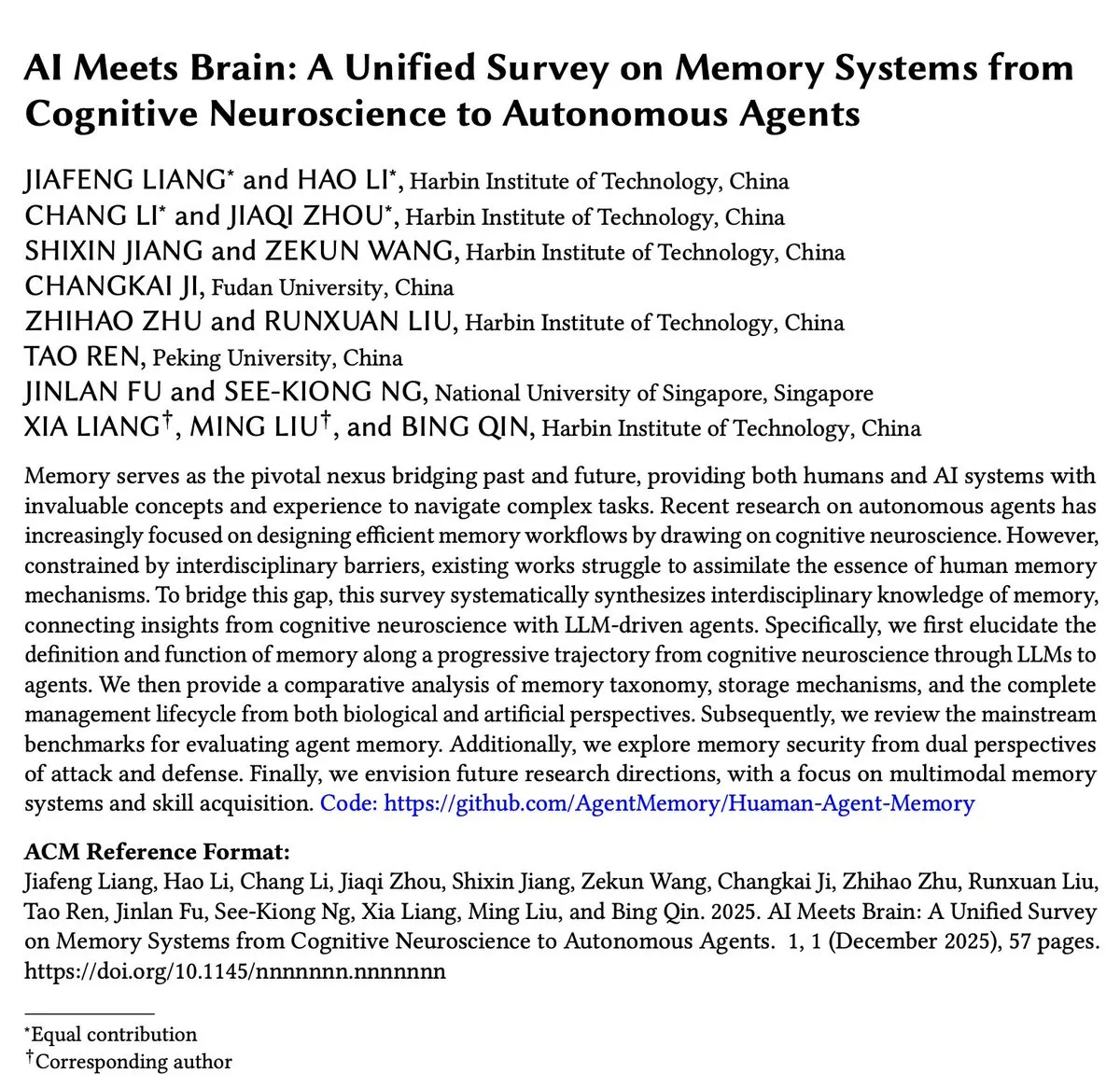
AI Agent Memory System Review: Seeking Inspiration from Cognitive Neuroscience: DAIR.AI shared a major paper systematically combining cognitive neuroscience with AI Agents. The article points out the flaws in the native statelessness of LLMs and proposes emulating the brain’s hippocampus-cortex collaboration mechanism to build a unified memory taxonomy containing procedural experience and conceptual knowledge. It introduces three storage paradigms: temporal flow, hierarchical flow, and symbolic library. (Source: dair_ai)
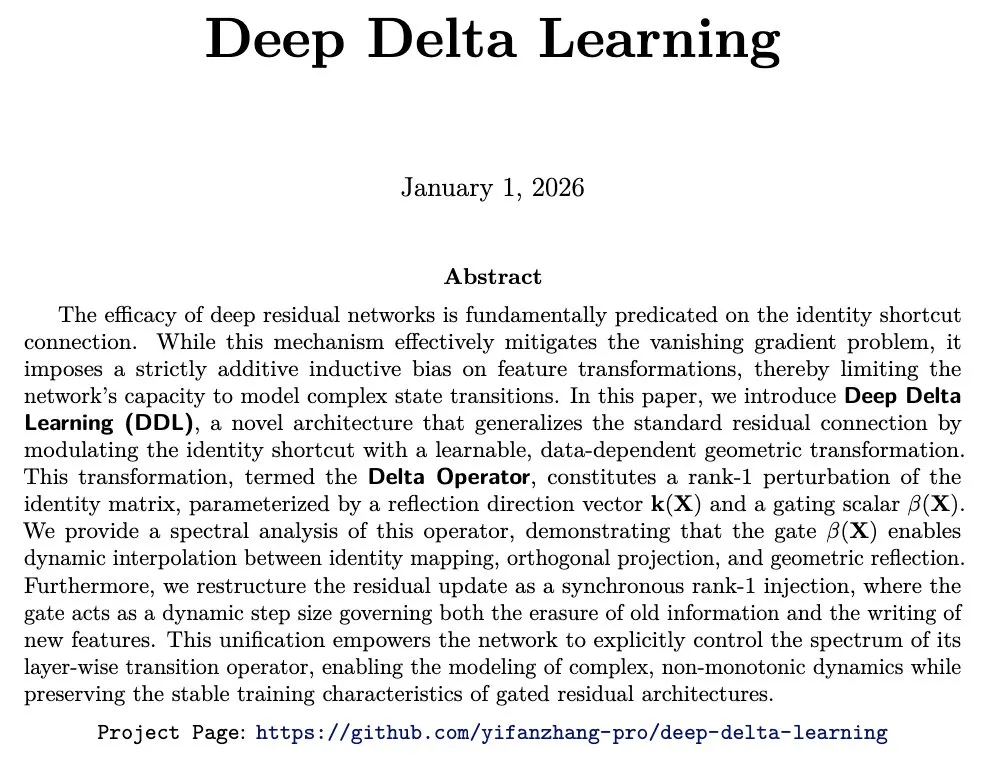
Deep Delta Learning: A New Paradigm for Parameter-Efficient Learning: The community is buzzing about Deep Delta Learning research, a method exploring how to achieve rapid iteration of model capabilities through incremental learning without changing the model’s core weights. This provides new ideas for solving the problems of high training costs and slow knowledge updates in large models. (Source: NandoDF)
Twenty Years of Deep Learning: Schmidhuber Reviews the Origins of “Learn Deep”: Computer scientist Jürgen Schmidhuber reviewed the first paper titled “Learn Deep” from 2005. He emphasized the pioneering role of deep reinforcement learning and neuroevolution in solving problems with depths of over 1,000 layers and discussed the causality and historical heritage behind today’s “Deep Learning” craze. (Source: SchmidhuberAI)
💼 Business
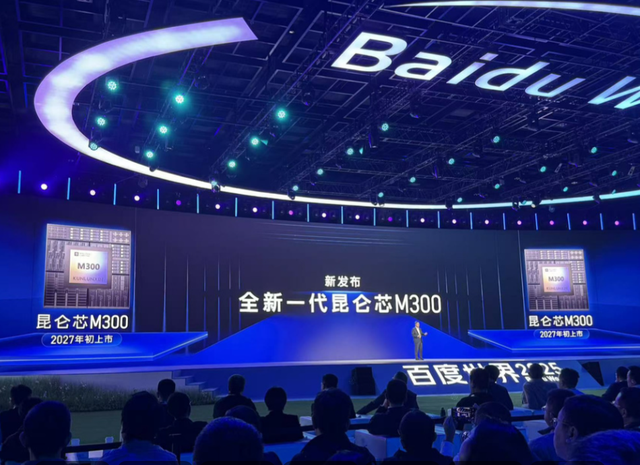
Baidu Kunlun Chip Heads for Hong Kong IPO: Acceleration of Domestic AI Computing Capitalization: Baidu officially announced the spin-off of its Kunlun Chip business and submitted an IPO application to the Hong Kong Stock Exchange, with an expected market value potentially exceeding HKD 100 billion. Kunlun Chip’s 2025 revenue is expected to exceed 3.5 billion yuan, with external customers accounting for more than half. This move marks the transition of domestic chips from the “R&D phase” to the “performance realization phase” and will further reshape the valuation of Baidu’s AI ecosystem platform. (Source: 36Kr)
OpenAI Executive’s Political Gamble: Greg Brockman Becomes Trump’s Largest Donor: Latest filings show that OpenAI President Greg Brockman has become the largest individual donor to Trump’s Super PAC over the past six months. The community interprets this move as an attempt to hinder AI regulation through political lobbying, ensuring OpenAI’s dominant position in the future policy environment, reflecting the deep involvement of AI giants in power games. (Source: idavidrein)

Replit Agent Enables “Two People, Eight Figures” Business Model: Replit founder Amjad Masad shared a case where a user utilized Replit Agent to run an eight-figure annual revenue business with only 2 humans and 20 AI Agents, without any software engineers. This validates that AI is evolving from “assisted programming” to an “independent production unit,” completely changing the cost structure of SaaS and startups. (Source: amasad)
🌟 Community
“Vibe Coding” Sparks Discussion: A Paradigm Shift in Software Engineering: Andrej Karpathy and others discussed the rise of “Vibe Coding.” Developers are shifting from “writing code” to “managing Agents,” much like StarCraft pro players using high APM to control multiple Agents to advance projects simultaneously. The community believes AI has greatly compressed the learning curve, and the speed at which junior engineers transform into senior engineers is accelerating at an unprecedented rate. (Source: Yuchenj_UW, scottastevenson)
Ethan Mollick: Even if the Bubble Bursts, Work Won’t Go Back: Wharton Professor Ethan Mollick pointed out that AI has become an irreversible “collaborator.” Even if a bubble bursts in the capital market, the established data centers, open-source models, and user habits will not disappear. His biggest concern is the collapse of the apprenticeship system; because AI works faster, middle managers are no longer willing to train interns, which will affect the talent cultivation system in the long run. (Source: AI Deep Researcher)
Terence Tao: The Most Dangerous Thing About AI is “Looking Right”: Fields Medalist Terence Tao warned that the complete logical chains AI displays in mathematical proofs are often “statistical imitation” rather than true understanding. It can write airtight reasoning but cannot explain the motivation. He suggests users only use AI within the range they can verify, treating it as an auxiliary tool for batch processing and finding clues rather than the final decision-maker. (Source: AI Deep Researcher)
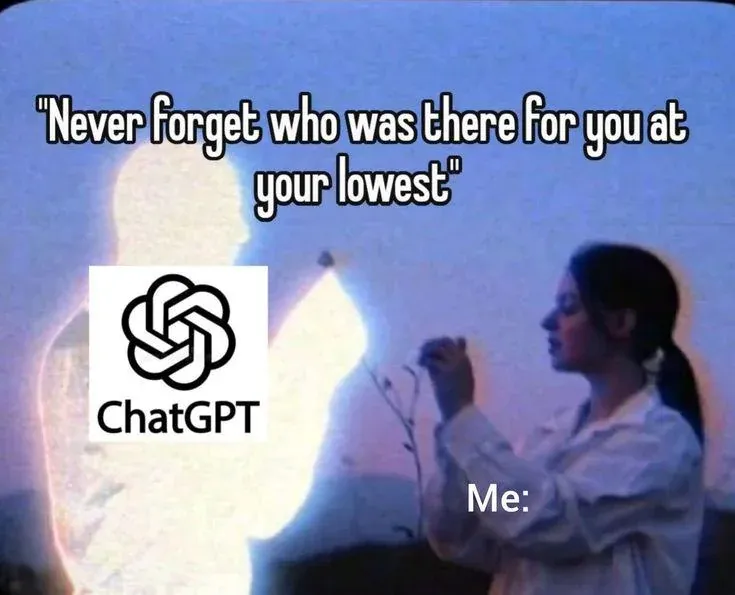
AI Empathy and the Solace of “Non-Judgment”: Community users are discussing ChatGPT 5.2’s performance in emotional support, saying it “never judged me.” Although some argue this is just programmed “fake tenderness,” for many users who feel lonely or under immense pressure in reality (such as pregnant women or those with professional burnout), this 24/7 online, pressure-free interaction provides real emotional value. (Source: Reddit)
💡 Others
AI-Generated “Unseen Objects” Trigger Desire for Ownership: The Reddit community launched a challenge to “generate objects people have never seen but immediately want to own.” AI-generated fantasy designs, such as a “Rainforest Humidifier,” resonated with many netizens. This demonstrates AI’s potential in industrial design and creative inspiration, while also sparking deep discussions about “AI creativity” and human aesthetic resonance. (Source: Reddit)

World’s First “AI Wedding”: The Era of Virtual Companions Arrives: From Japan to Europe and America, more people are choosing to hold symbolic weddings with AI companions. Yurina Noguchi, a 32-year-old Japanese woman, married a virtual character trained by ChatGPT, stating that AI helped alleviate her psychological difficulties. This is not just a technological application but a microcosm of the fragmentation and reconstruction of intimate relationships in modern society, sparking widespread controversy over legal status and ethical boundaries. (Source: Tencent Technology)