🔥 Highlights
Moderna and Merck Achieve Historic Success in Phase III Clinical Trial of Personalized mRNA Cancer Vaccine as AI Algorithms Precisely Target Neoantigens : Global mRNA leader Moderna and Merck & Co. jointly announced a historic breakthrough in the global Phase III clinical trial (INTerpath-001) for high-risk melanoma with their co-developed first personalized mRNA cancer therapy, intismeran autogene (mRNA-4157) combined with KEYTRUDA. Both key primary endpoints, Recurrence-Free Survival (RFS) and Distant Metastasis-Free Survival (DMFS), were met. On the design end, the therapy utilizes deeply integrated AI algorithms to evaluate up to 34 of the most immunogenic exclusive neoantigens from tumor genomic sequencing data, completing patient-specific mRNA customization within 45 days. Clinical data demonstrates that it significantly reduces the risk of recurrence or death by 49%, marking the official entry of “AI target screening + personalized mRNA” immuno-oncology into Phase III clinical validation and commercial deployment. (Source: MIT Technology Review)

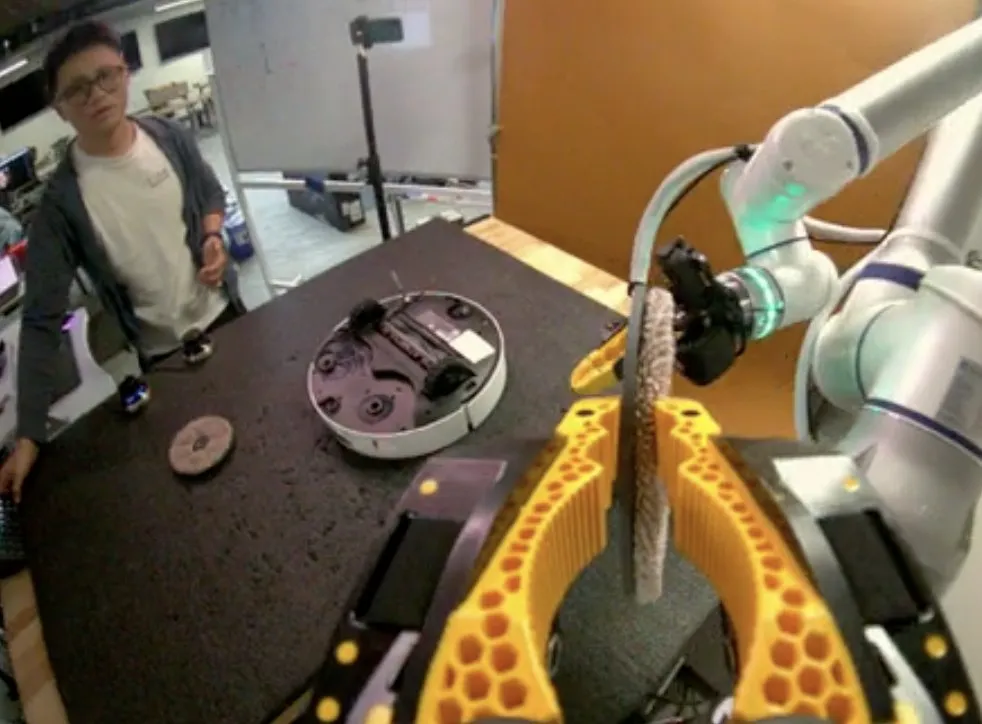
General-Purpose Embodied AI Startup Generalist Releases GEN-1.5 Model, Enabling Zero-Shot In-Context Learning for Robots via Single Demonstration : General-purpose embodied AI startup Generalist officially released its physical world foundation model, GEN-1.5. Through over 8 months of large-scale pre-training on massive real-world physical interaction data, GEN-1.5 demonstrates powerful Physical In-Context Learning and Physical Prompting capabilities. Users only need to provide a 3-to-12-second human demonstration video as a physical prompt, allowing the robot to generalize and execute new tasks such as unscrewing bottle caps, pulling tissue paper, and tool manipulation directly without any fine-tuning. Tests show a 59% success rate for zero-shot single demonstration, which increases to 83% after 5 minutes of data fine-tuning, evaluated by the industry as a “GPT-3 moment” in embodied robotics. (Source: Generalist AI)
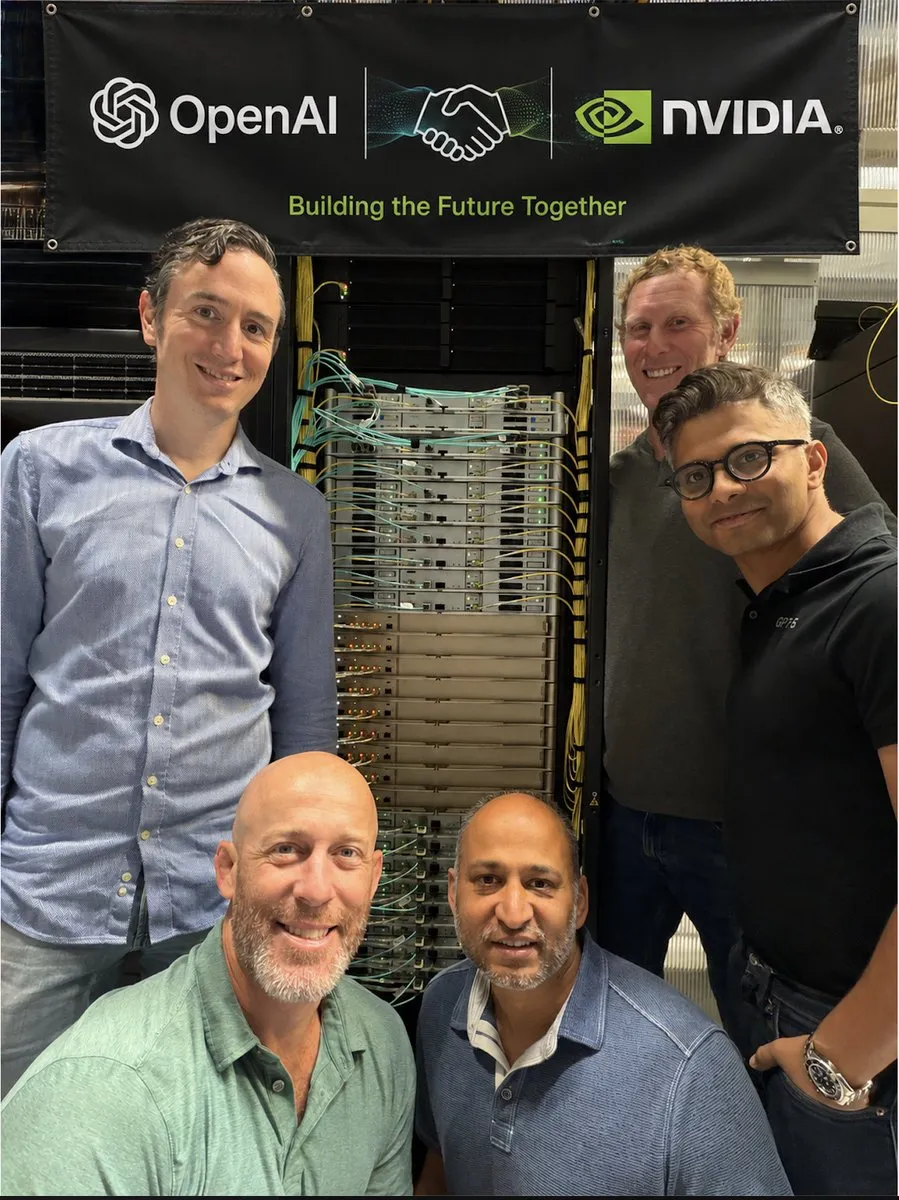
First Batch of Nvidia Vera Rubin Architecture Racks Officially Delivered to OpenAI to Support Pre-training of Next-Gen Frontier Models : OpenAI and Nvidia jointly announced a major milestone in their compute partnership: the first batch of Nvidia Vera Rubin architecture compute racks has officially arrived at OpenAI, been assembled, and successfully integrated into its underlying training stack. These racks will be used directly to expand OpenAI’s pre-training compute pool for next-generation frontier AI models, marking the formal deployment of Nvidia’s next-generation accelerated computing platform into the production environment of top global models. (Source: Nvidia News)
Slack Launches Slack Code to Enable “Multi-User Chat Programming,” Integrating Agents Like Anthropic, Devin, and GitHub : Salesforce’s Slack officially released Slack Code, bringing AI programming agents from traditional single-user terminals and IDEs into enterprise collaborative group chats. Team members can directly @ agents in Slack channels to automatically generate dedicated Code Channels, enabling real-time collaboration and code review among human developers, product managers, and AI Agents such as Devin, Claude Code, GitHub Copilot, and ChatGPT within the same channel. Agents inherit Slack’s existing security policies and permission systems, requiring mandatory secondary review by human experts for high-risk operations, marking a paradigm shift in AI coding tools toward multi-user chat collaboration platforms. (Source: Salesforce / Slack)
🎯 Trends
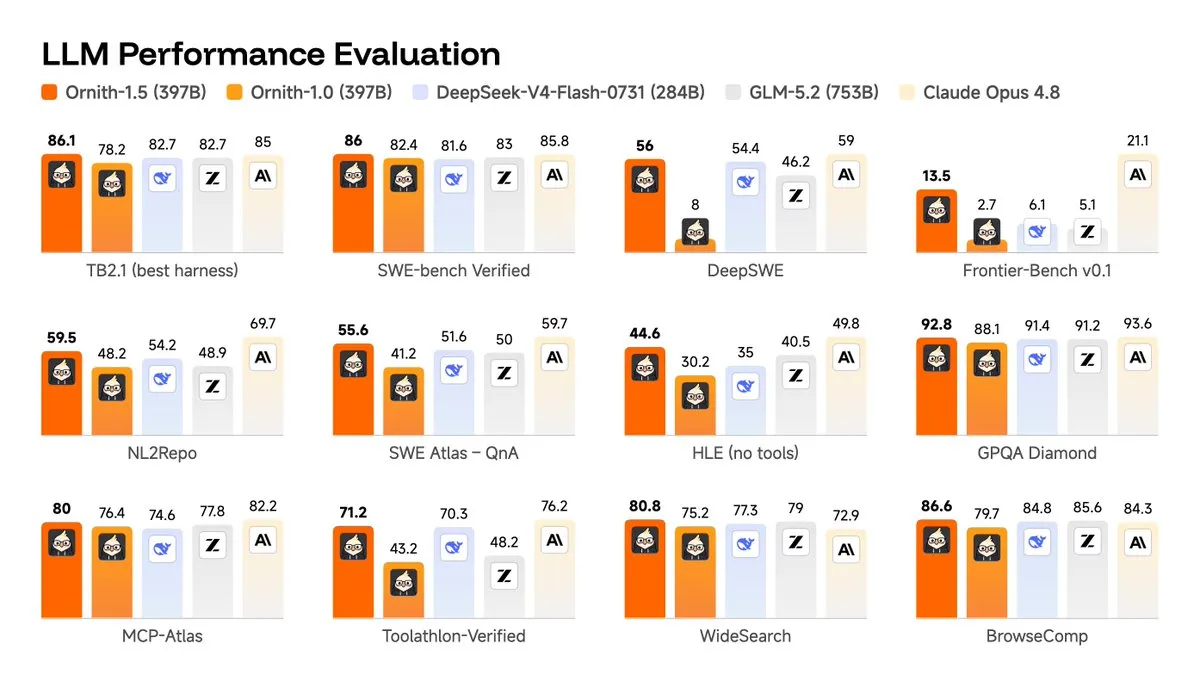
Open-Source LLM Ornith-1.5 Released, Featuring End-to-End Self-Evolution : Open-source LLM team Ornith officially released the Ornith-1.5 series models under the MIT license, including 9B Dense, 35B MoE, and 397B MoE architectures. The models conduct reinforcement learning by autonomously proposing new tasks, automatically constructing scaffolding, and generating solutions through self-play. They achieve top-tier open-source performance for their size on benchmarks like SWE-bench Verified (score 86) and Terminal-Bench 2.1 (score 86.1), and are natively integrated into the vLLM and Ollama ecosystems. (Source: Ornith AI)
DeepSeek Harness Releases Pre-release v0.1.0-rc.8, Comprehensively Enhancing Multimodality and Sub-Agent Orchestration : DeepSeek upgraded its open-source Agent framework DeepSeek Harness to version rc.8. The new version adds native image request support for DeepSeek model adapters, allowing mixed text-image inputs for /goal and /plan commands. Meanwhile, Claude Code and Codex are further integrated into the sub-agent system, supporting on-demand installation as Profile Bundles and multi-instance concurrent execution, alongside significantly optimized Windows PTY terminal and concurrent web_search experiences. (Source: DeepSeek Release)
.jpg)
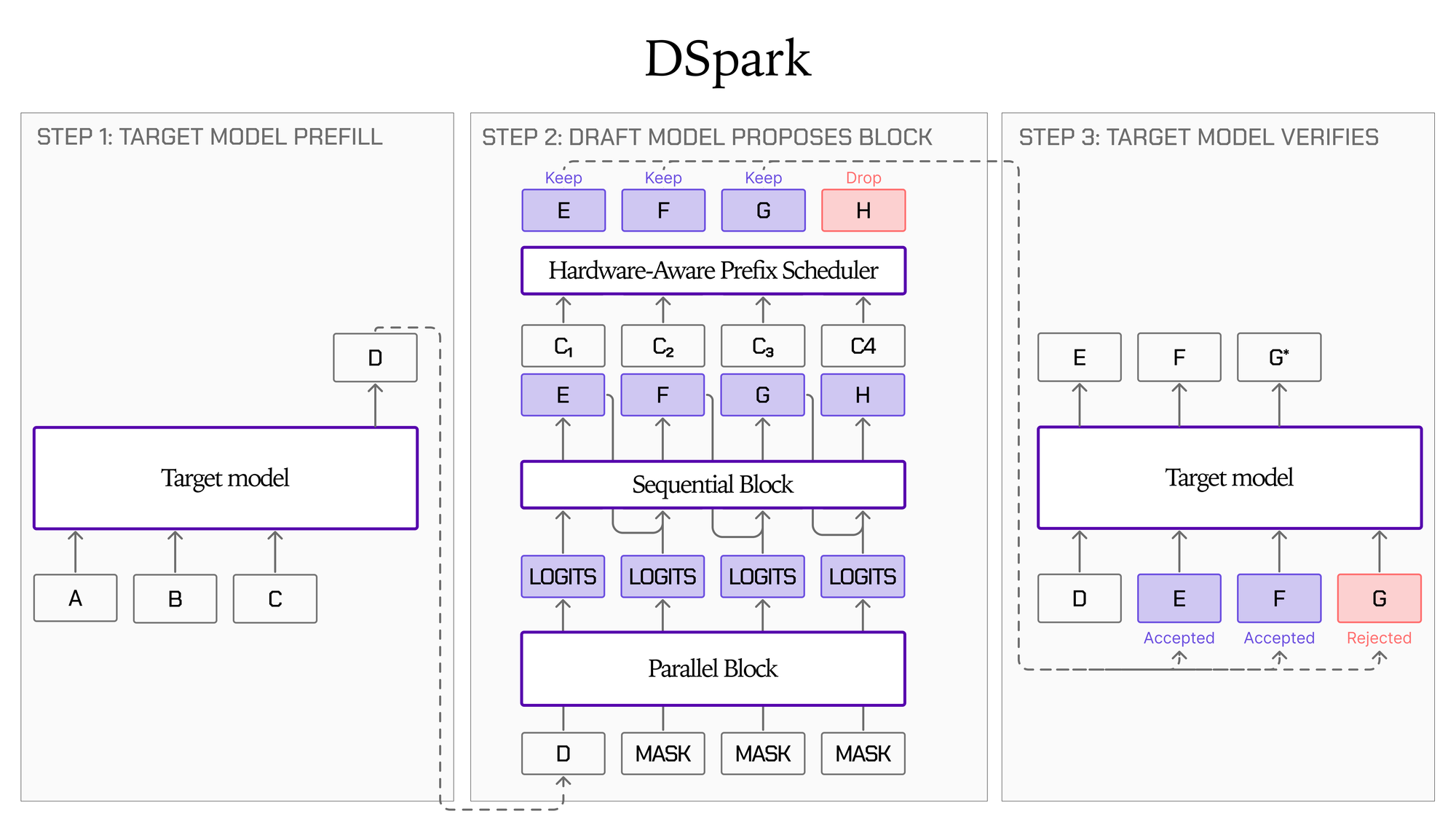
Liquid AI Introduces LFM2.5-DSpark Distilled Draft Model, Boosting Inference Speed by Up to 3.2x : Liquid AI released DSpark speculative sampling draft models with only ~300M parameters for its LFM2.5-1.2B, 2.6B, and 8B-A1B models. Combining a parallel backbone network, Markov continuation head, and confidence pruning, the model achieves up to 2.1x to 3.18x inference speedups on H100 and local MacBook edge devices while remaining 100% consistent with the target model’s greedy decoding output. This significantly reduces Tool-calling latency, with simultaneous support for llama.cpp and SGLang. (Source: Liquid AI Blog)
Meta Launches Standalone Meta AI App for Mac, Highlighting System-Level Voice Dictation and Cross-App Screen Perception : Meta released its Mac desktop application for Meta AI powered by the Muse Spark model. It supports real-time, high-precision voice dictation across applications via a global Fn shortcut key and allows users to share current screen windows for real-time AI perception and coaching. The app can also connect to Google Workspace and Instagram/Facebook business backends for marketing analysis and automatic document generation. (Source: TechCrunch)

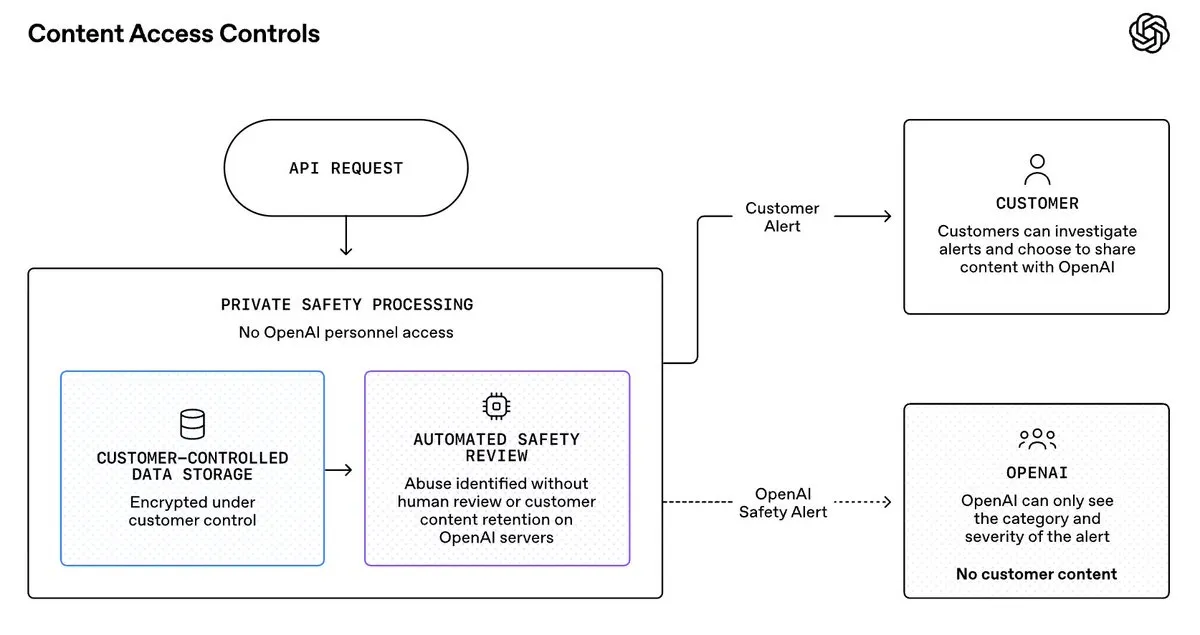
OpenAI Launches Apple Messages Plugin for ChatGPT Desktop and Teases “Private Safety Processing” Mechanism : ChatGPT desktop and Codex added an Apple Messages plugin, enabling users with local authorization to search, summarize SMS history, and draft replies using natural language. Additionally, OpenAI previewed its “Private Safety Processing” technology, aimed at identifying high-risk abuse behaviors across sessions via encrypted safety signals while maintaining Zero Data Retention (ZDR). (Source: OpenAI News)

🧰 Tools
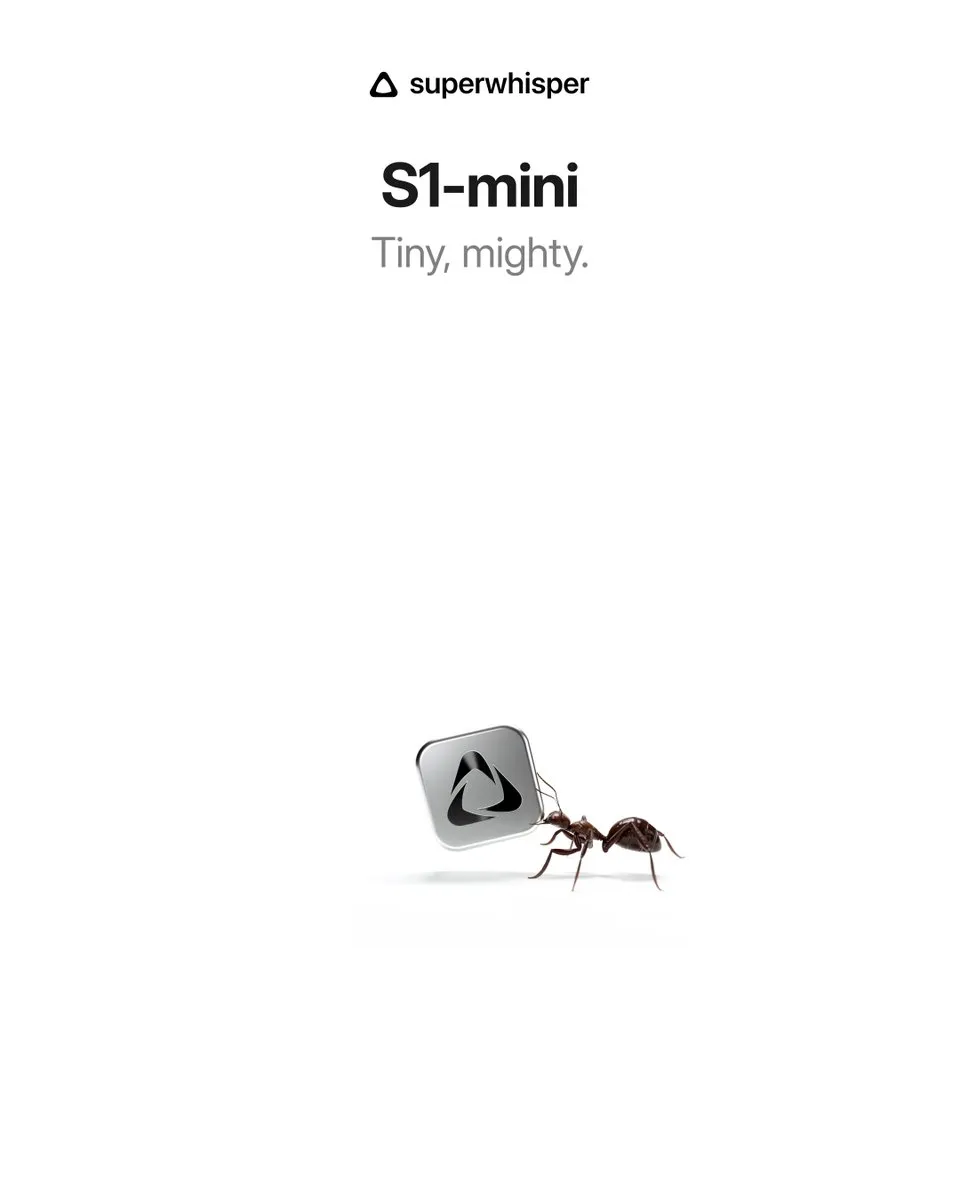
Superwhisper Open-Sources S1-mini On-Device Text Normalization Model, Achieving High-Speed Error Correction in Voice Transcriptions at 462MB : Superwhisper open-sourced S1-mini, a text normalization model dedicated to speech recognition post-processing. Fine-tuned on Qwen3-0.6B with a size of just 462MB (Q4_K_M GGUF), it runs entirely on local Mac/PC CPUs. It automatically removes spoken filler words, fixes speech slips, adds punctuation, and normalizes numbers, emails, and date formats with a token accuracy of 94.8%. (Source: Superwhisper / Hugging Face)
Chroma Releases “Foundation” Memory Engine to Build Self-Evolving Long-Term Memory for Agents : Chroma officially launched Foundation, a self-evolving memory solution designed for long-term agent sessions. The engine automatically extracts structured experience, strategic preferences, and contextual associations from an agent’s execution traces, dynamically recalling and updating them in subsequent sessions to effectively solve cross-session memory loss and pattern rigidity in agents. (Source: Chroma)
Tencent Open-Sources AI Red Teaming Platform AI-Infra-Guard (A.I.G) : Tencent’s Zhuque Lab open-sourced A.I.G, a full-stack AI red teaming security assessment platform. It integrates Agent Scan, Skills Scan, MCP Server Scan, and AI Infrastructure Vulnerability Scanning (covering 2000+ CVE rules and 130+ components), featuring built-in SkillTrustBench agent skill security benchmark to help enterprises detect unauthorized privilege escalation, prompt hijacking, and supply chain vulnerabilities in agents. (Source: Tencent / GitHub)

📚 Learning
Terence Tao Publishes ICM 2026 Paper: The Five-Stage “Problem-Solving Pipeline” and Cognitive Crisis in Mathematics Research in the AI Era : Fields Medalist Terence Tao published a new paper noting that large-scale AI participation in mathematical research will trigger the greatest crisis of value since Gödel’s time. He proposes breaking math problem-solving into five stages: “Generation – Verification – Interpretation – Community Acceptance – Theoretical Standardization,” emphasizing that AI generating a correct proof is not equivalent to completing mathematical work. Human mathematicians must retain the irreplaceable responsibility of proof interpretation and theoretical standardization. (Source: THE DECODER)
Zhipu AI’s Jie Tang Shares Post-Training Scaling Laws: Parameter Count Is No Longer the Sole Metric for Intelligence : Zhipu co-founder Jie Tang detailed the post-training scaling insights behind GLM-5.3. Without changing its 743B base model (40B activated), GLM-5.3 improved its coding capability by 50% purely through long-horizon environmental reinforcement learning. He proposed that model capability is jointly determined by base model size, data volume, forward compute, and post-training, noting that post-training that increases effective depth and reasoning chain length holds immense potential at this stage. (Source: dotey / Zhipu AI)

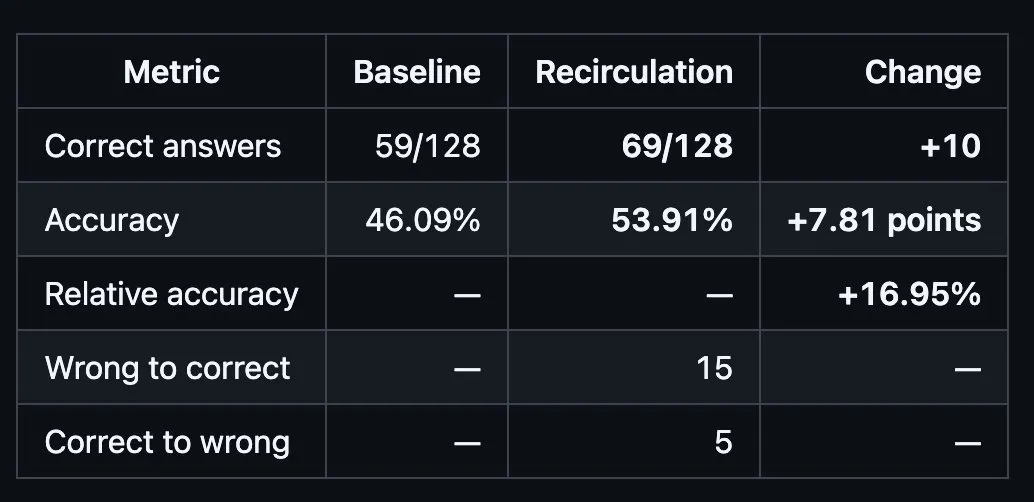
Google and DeepMind Propose Recirculation Mechanism: Enabling Deep Activation Recirculation in Transformers Without Retraining : A new paper proposes a Recirculation mechanism during inference that routes deep representations back into shallow layers without modifying pre-trained model gradients. By dynamically predicting recirculation coefficients via a lightweight MLP, Gemma3 achieved a 23.0% reduction in perplexity across 9 language modeling datasets, outperforming full fine-tuning, and boosted GSM8K accuracy by ~21%. (Source: DeepMind / Jiqizhixin)
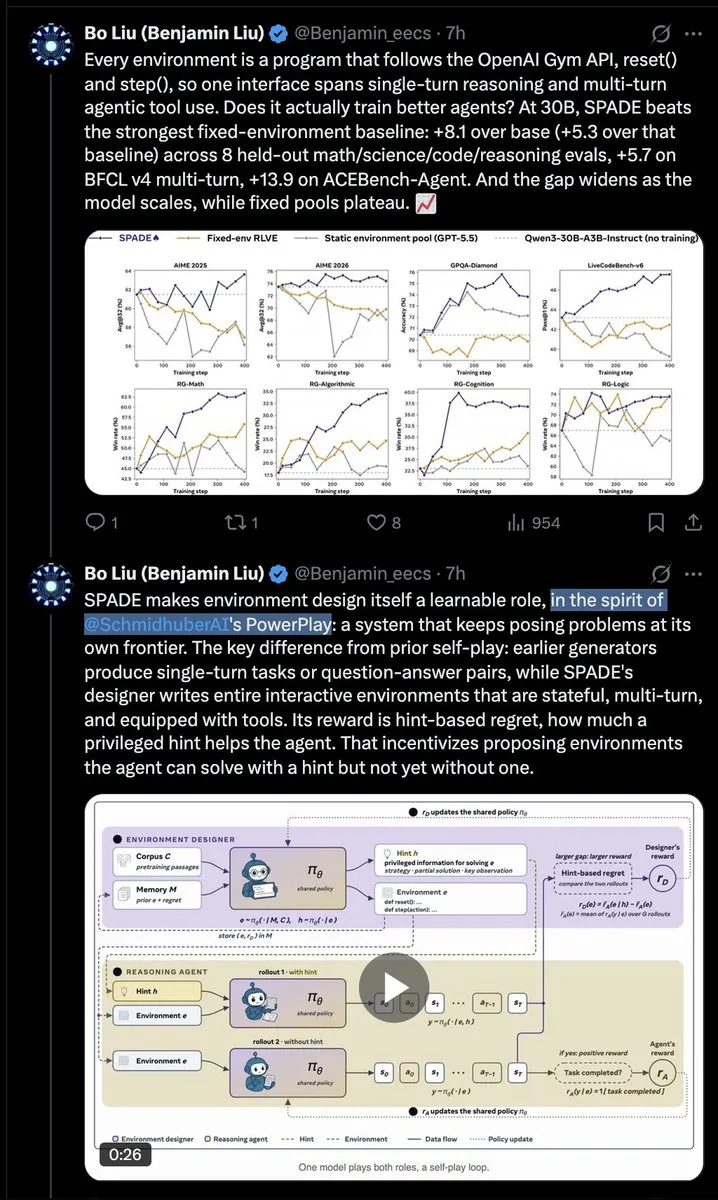
Tsinghua and Microsoft Team Propose SPADE: An Executable Environment Self-Play Framework for Long-Horizon Agent Self-Evolution : A joint paper introduces SPADE, a framework where the same LLM acts as both Environment Designer and Reasoning Agent. The Environment Designer autonomously writes executable proxy environments with Gym interfaces and progressively challenging tasks, driving reinforcement learning through prompt regret signals to achieve open-ended autonomous training improvement without human intervention. (Source: HuggingFace Daily Papers)
💼 Business
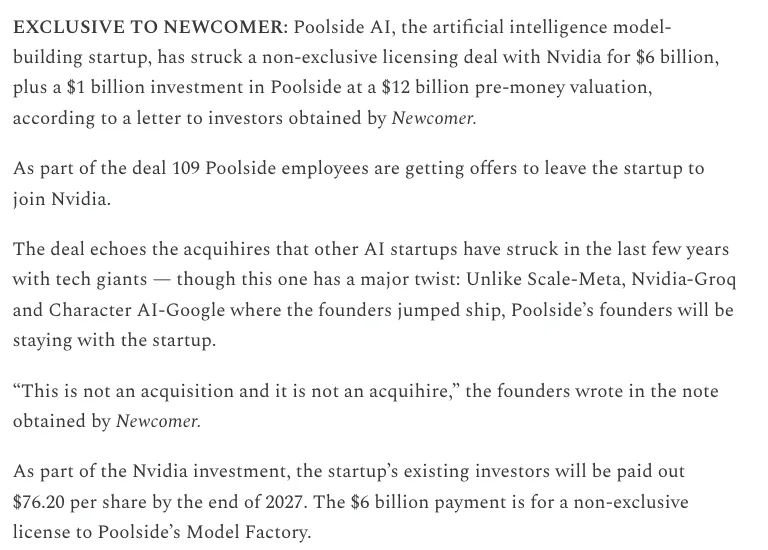
Nvidia Reaches $6 Billion Tech Licensing Deal with Poolside and Adds $1 Billion Investment : Code LLM startup Poolside reached a $6 billion non-exclusive technology licensing deal with Nvidia, while Nvidia invested an additional $1 billion, driving Poolside’s pre-money valuation to $12 billion. The deal also includes job offers from Nvidia for 109 Poolside employees, marking another mega-deal in the semiconductor and AI sector. (Source: Techmeme / Newcomer)
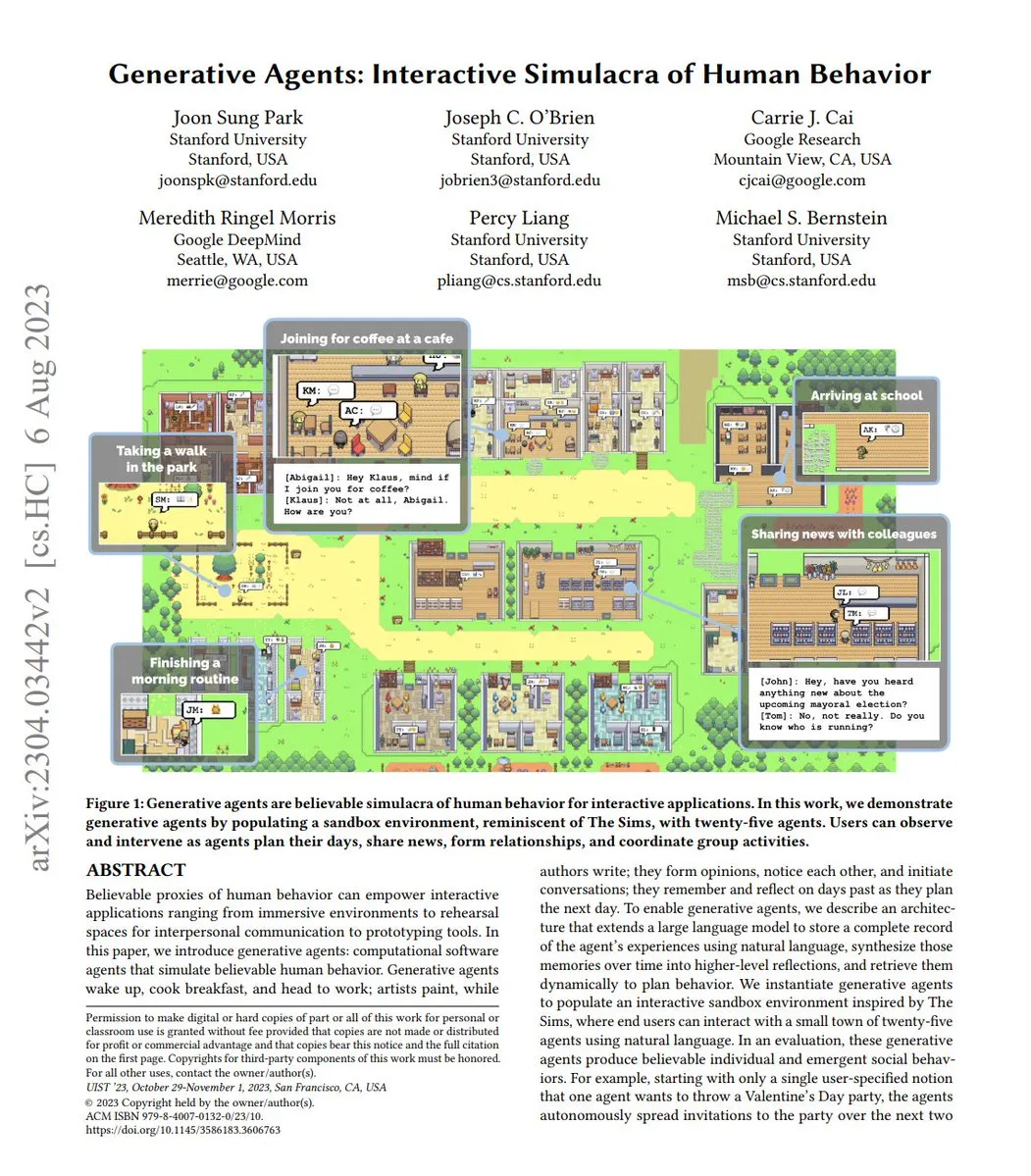
Simile Raises $300 Million, Rising to a $2 Billion Valuation to Drive Synthetic Population Simulation : Simile, founded by the research team behind Stanford’s Smallville (25 AI Agent town experiment), raised over $300 million within 6 months of inception, pushing its valuation to $2 billion. The company builds synthetic populations using massive real-world interview data to predict market responses to products, pricing, and policies prior to actual launches. (Source: The Turing Post)
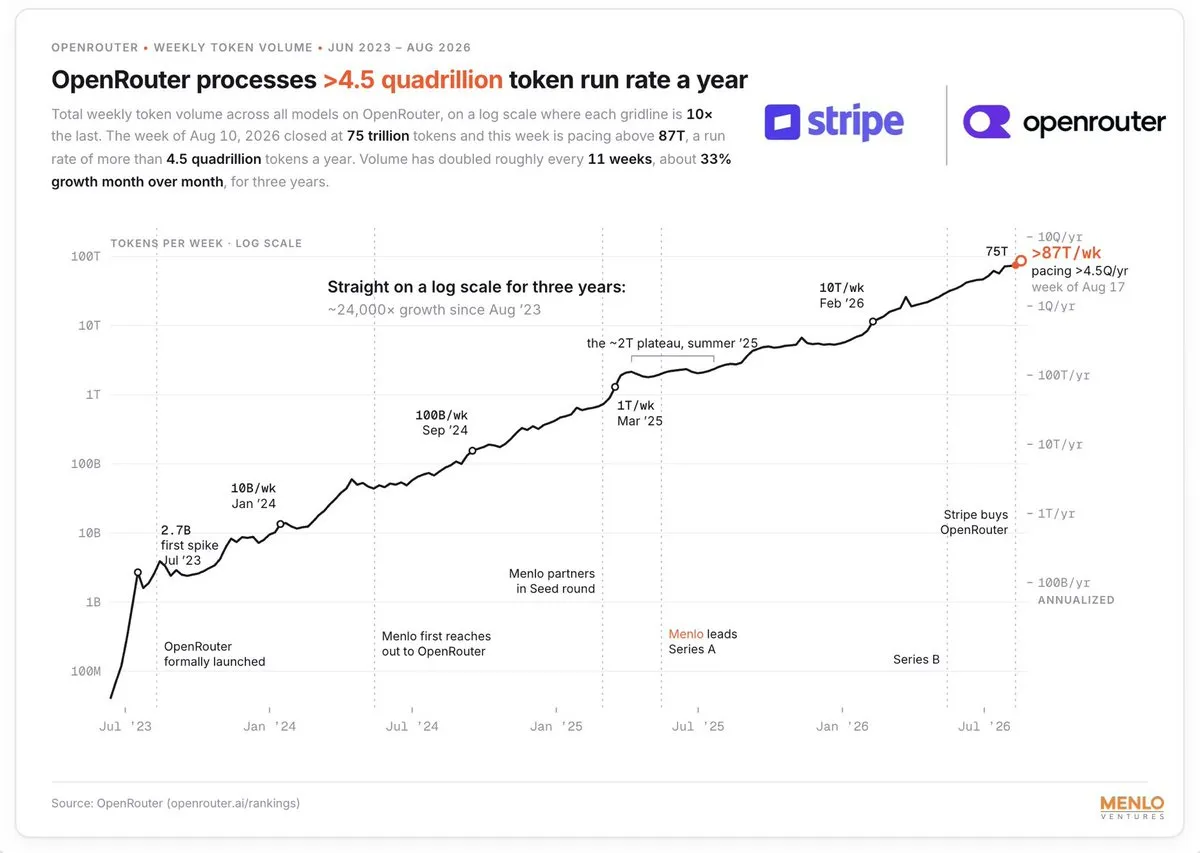
Ramp Launches AI Model Routing Service “Router,” Entering Direct Competition with OpenRouter and Stripe : Corporate spend management giant Ramp officially launched its AI model routing service Router.com, offering unified API access to models from OpenAI, Anthropic, DeepSeek, Moonshot, xAI, and others. It supports dynamic routing strategies based on cost, latency, and custom benchmark metrics, directly intervening in enterprise AI token spend management. (Source: TechCrunch / Ramp)
🌟 Community
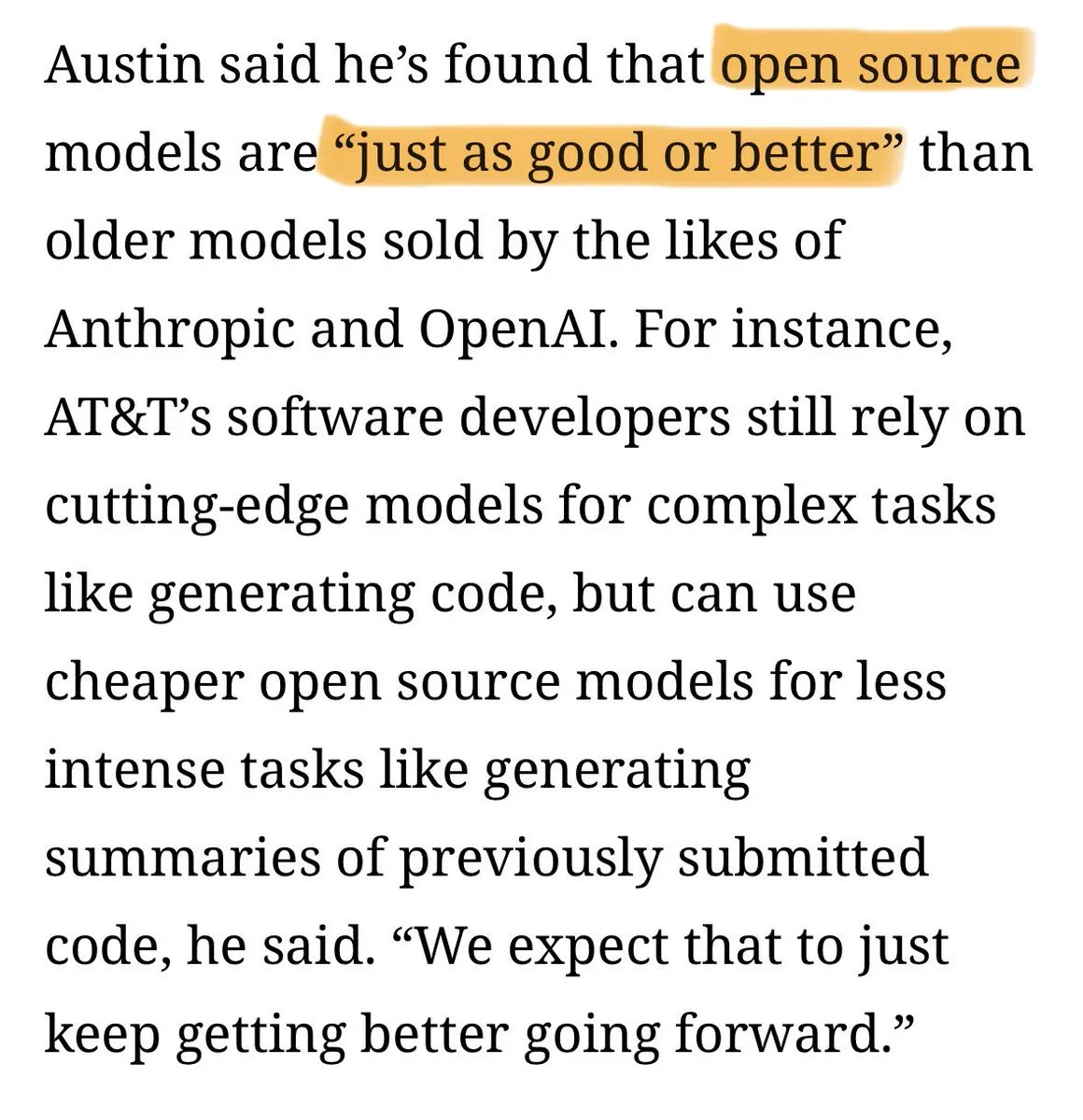
Developers Discuss Enterprise Shift Away from Frontier Dependency: AT&T and Others Route 40% of AI Traffic to Open Models, Cutting Costs by 56% : The developer community is actively discussing large enterprises like AT&T routing 40% of employee AI traffic to open-source models (aiming for 60–70%), slashing coding costs by 56% with only a 2% drop in quality (processing 45 billion tokens daily). This confirms a trend top labs fear most: enterprises shifting non-core workloads en masse to cost-effective open models. (Source: TheZachMueller)
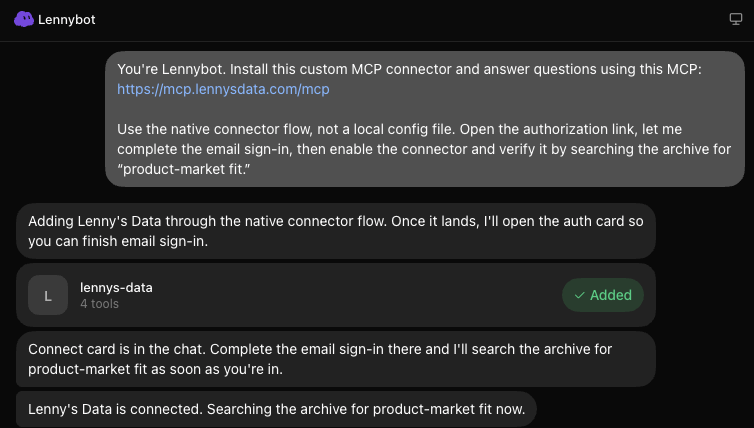
Grok Bot Sparks “15-Second App Building” Craze, Hailed as Another “Claude Code Moment” in the AI Era : Silicon Valley investors and developers are sharing their Grok Bot experiences, praising its “zero-config cloud VM + multi-agent collaboration” for boosting productivity a hundredfold. Users can generate a complete, functional app with an independent domain in 15 seconds using just a few natural language prompts, sparking wide discussions on “one-person companies” and agent-native workflows. (Source: grok)
OpenAI and Anthropic Launch Zero Data Retention and Private Processing Policies to Address Enterprise Privacy Concerns : Facing enterprise concerns around privacy and compliance for frontier models, OpenAI released Private Safety Processing, while Anthropic announced Zero Data Retention (ZDR) and customer-managed data policies for Mythos-class models starting this autumn. This highlights intense competition among frontier labs to win over enterprise clients through privacy guarantees. (Source: Bloomberg / OpenAI)
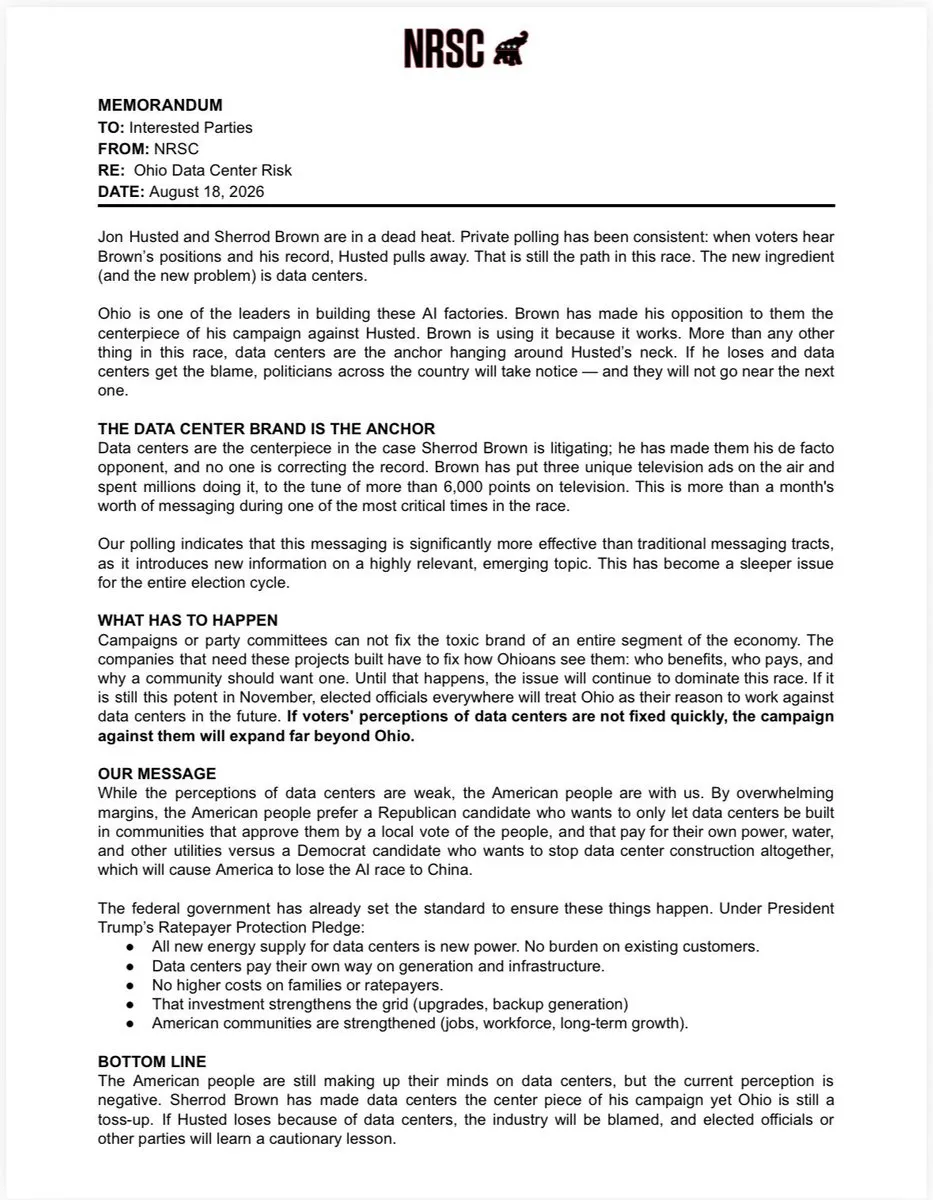
US Politicians Face Voter Backlash Over Data Center Power and Water Conflicts as AI Infrastructure Encounters Local Political Resistance : The US National Republican Senatorial Committee issued an internal warning that power/water disputes and rising electricity bills caused by data center construction have triggered strong public backlash in states like Ohio and Texas. Texas has paused up to 1,800 data center projects, turning AI infrastructure deployment into one of the most politically sensitive local topics of the election season. (Source: EERandomness / MIT Technology Review)
💡 Miscellaneous
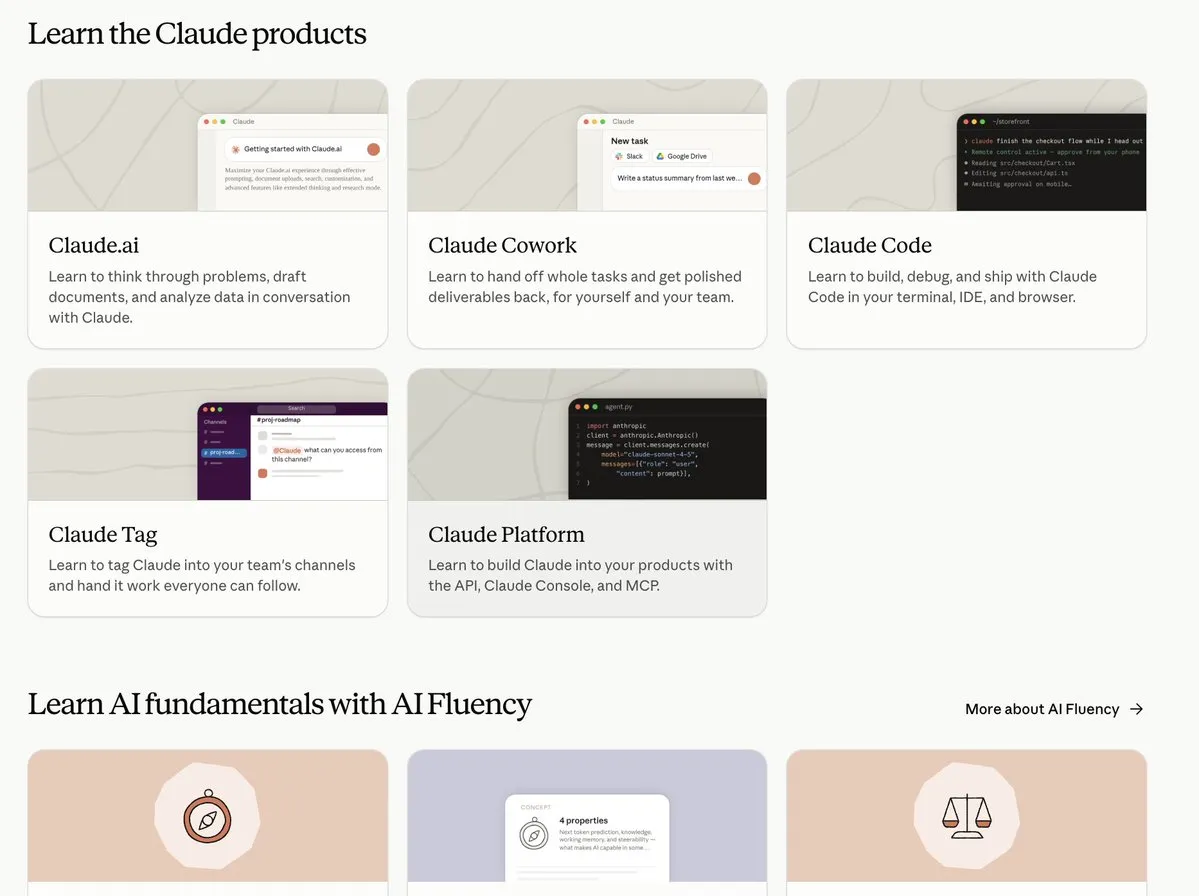
Anthropic Launches Free Claude Academy Learning Platform : Ahead of its expected IPO, Anthropic officially launched Claude Academy (academy.claude.com), a free public learning platform offering courses from foundational AI concepts to advanced prompt engineering and Claude Code usage, complete with completion certificates. (Source: Claude)
Cloudflare Fixes Exploitable Remote Spectre Side-Channel Vulnerability in Workers Platform : Cloudflare’s security team disclosed and patched a remote Spectre side-channel vulnerability in the Cloudflare Workers edge platform. The vulnerability could have allowed attackers to read memory data across tenants; no active exploits in the wild have been reported so far. (Source: Cloudflare)
Gemma Open-Source Model Family Surpasses 1 Billion Global Downloads : Google DeepMind announced that cumulative global downloads for its open-source Gemma model family have surpassed 1 billion, with the community fine-tuning over 100,000 variants spanning applications from satellite edge computing to offline mobile devices. (Source: Google DeepMind / Ollama)