🔥 Focus
Meta Releases SSR Framework: AI Programming Enters the “Self-Play” Era: A research team from Meta, UIUC, and CMU has released the Self-play SWE-RL (SSR) framework, marking the beginning of AI programmers breaking through the ceiling of human data. The framework allows AI to play dual roles as a “Breaker” (injecting bugs) and a “Fixer” (resolving bugs), undergoing adversarial evolution within a code sandbox. Experiments show that SSR improved performance on the SWE-bench verification set by 10.4% without ever seeing natural language Issues. This breakthrough implies that the birth of super-intelligent software systems may no longer require humans as teachers, but only human code as the battlefield. (Source: Arxiv)
Global Memory Shortage: AI Compute Demand Triggers Price Hikes in Electronics: The explosion of AI supercomputing in 2025 has led to a structural shortage in the global RAM market. Chip giants like Micron and Samsung have permanently shifted production capacity to high-margin HBM and DDR5, causing consumer-grade DRAM prices to triple within a year. Analysis indicates that AI will consume nearly 20% of global wafer capacity, which not only drives up the BOM costs of smartphones and PCs but even forces manufacturers to adopt “spec-reduction” strategies in 2026. This marks the end of the hardware dividend era, as the cost of computing infrastructure is being passed on to every consumer. (Source: NPR)

Terence Tao Reveals the Truth Behind AI Solving Math Problems: “Knowledge Archaeology” Rather Than Innovation: Mathematics master Terence Tao commented on AI’s recent success in solving several Erdos problems, pointing out that AI’s core value lies in “long-tail scanning.” AI did not invent new mathematics; instead, it used massive computing power to dig “low-hanging fruit” out of obscure literature forgotten by humans. These solutions already existed in information black holes, forgotten because human retrieval costs were too high; AI simply acts as a “Super Librarian.” This perspective sets the tone for AI’s role in scientific discovery: AI is responsible for finding clues in massive amounts of data, while humans are responsible for verification. (Source: Mathstodon)
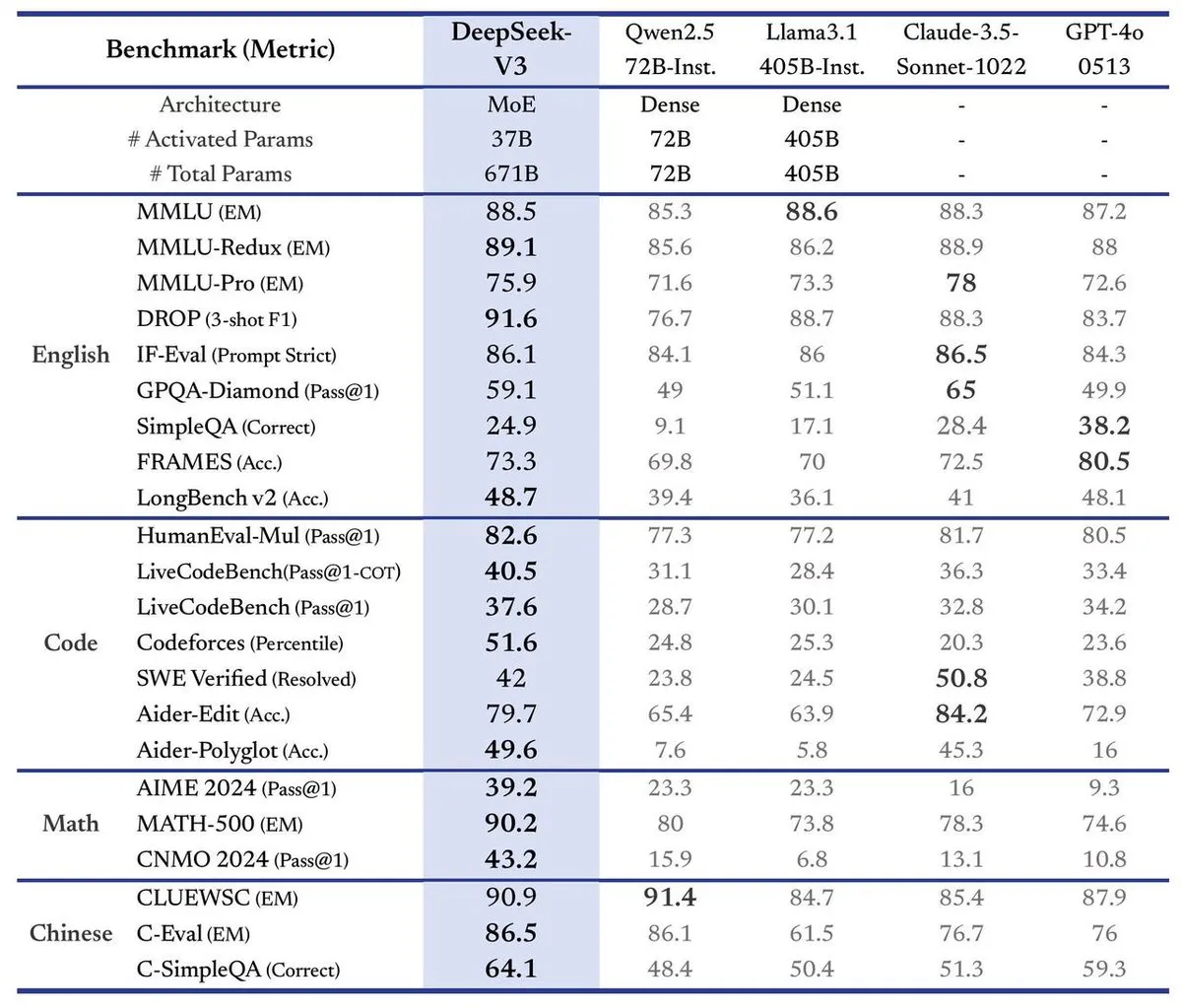
DeepSeek Tops Nature: Chinese Open-Source Model Reshapes Global AI Landscape: In 2025, DeepSeek-R1 became the first large model to pass peer review and grace the cover of Nature, with founder Liang Wenfeng selected as one of Nature’s Top 10 people of the year. DeepSeek proved that through algorithmic optimization and engineering efficiency, frontier performance can be achieved at extremely low compute costs. This “dark horse moment” has directly led to a decline in the status of established open-source models like Llama in the minds of developers; the global open-source ecosystem is shifting from “following Silicon Valley” to “benchmarking against China.” (Source: Nature)
NVIDIA Robotics Lead Jim Fan Summarizes 2025: Hardware Leads Software, but Reliability is the Achilles’ Heel: Jim Fan pointed out that the robotics field remains in a “Wild West” stage. Despite stunning hardware engineering from Optimus, Figure, and others, reliability severely limits software iteration, and the industry lacks unified, reproducible benchmarks. He specifically criticized the VLA paradigm based on VLM, arguing that vision encoders discarding low-level details runs contrary to the needs of dexterous robotic manipulation. He predicted that “Video World Models” will become the new high ground for robotics policy pre-training in 2026. (Source: DrJimFan)

🎯 Trends
Waymo 1200-Line Prompt Leaked, Gemini Officially Joins as “AI Co-Pilot”: Researchers reverse-engineered Waymo’s code to find its “Ride Assistant” meta-prompt, revealing how Google Gemini interacts with passengers as an in-car assistant. The prompt strictly forbids the AI from evaluating driving behavior or calling itself the “driver,” limiting it to controlling the environment, querying information, and providing emotional comfort. This dual isolation of physics and logic aims to prevent passengers from misunderstanding AI as being in control of the driving, marking a shift in autonomous driving from “functional implementation” to “experience optimization.” (Source: JaneManchunWong)

Anthropic CPO Warning: Enterprise AI Must Cross the “Organizational Hurdle” in 2026: Mike Krieger noted that while model capabilities have met standards, most enterprise AI projects are stuck on data permissions and process streamlining. He emphasized that the role of AI has shifted from a “Q&A Assistant” to an “Agent” that delivers results, such as GitHub’s PR Agent. The key for 2026 is not how smart the model is, but whether the enterprise is ready to let AI “take responsibility”—establishing clear accountability boundaries and automated workflows. (Source: MikeKrieger)
OpenAI Recruits “Head of Preparedness” with Million-Dollar Salary: Sam Altman is high-profilely hiring a “Head of Preparedness” with a base salary of $555,000 plus equity, aimed at addressing mental health risks and high-risk security vulnerabilities brought by increasingly powerful models. This move is seen as an emergency backfill for the “safety vacuum” left after Ilya’s departure. The new lead will be responsible for establishing identification and evaluation systems for unreleased powerful models to ensure they don’t spiral out of control during the AI arms race. (Source: OpenAI)
GEO (Generative Engine Optimization) Explodes, AI Search Becomes the New Marketing Battlefield: As traffic flows into AI assistants like Doubao and DeepSeek, brands are starting to shift from SEO to GEO, aiming to increase brand citation rates in AI responses. Currently, the GEO market remains in a “black box” stage, with risks of information pollution such as forged sources. Analysts expect this market to reach 373.9 billion RMB by 2029, marking a reshaping of internet marketing rules by AI search. (Source: Kimi)
🧰 Tools
NVIDIA Releases Universal Game Model NitroGen: By learning from 40,000 hours of video with controller indicators, this model has achieved the ability to “play games by looking at images” without special training. Although its performance in complex Boss battles is currently average, its cross-game generalization capability provides an intuitive foundation for general robotics research. NitroGen implements “think before you act” by intercepting the system clock, demonstrating AI’s self-learning potential in virtual rule-based worlds. (Source: NVIDIA)
Claude Code Annualized Revenue Surpasses $1 Billion, Becomes “Digital Fentanyl” for Developers: As a side project of Anthropic, Claude Code has swept the development community within six months of its release due to its high agentic capabilities. It can not only write code but also autonomously handle DevOps and research tasks. Many senior engineers state that mastering Claude Code has become a new technical dividend, even allowing developers to enter a Zen-like state of “human-machine unity.” (Source: Anthropic)
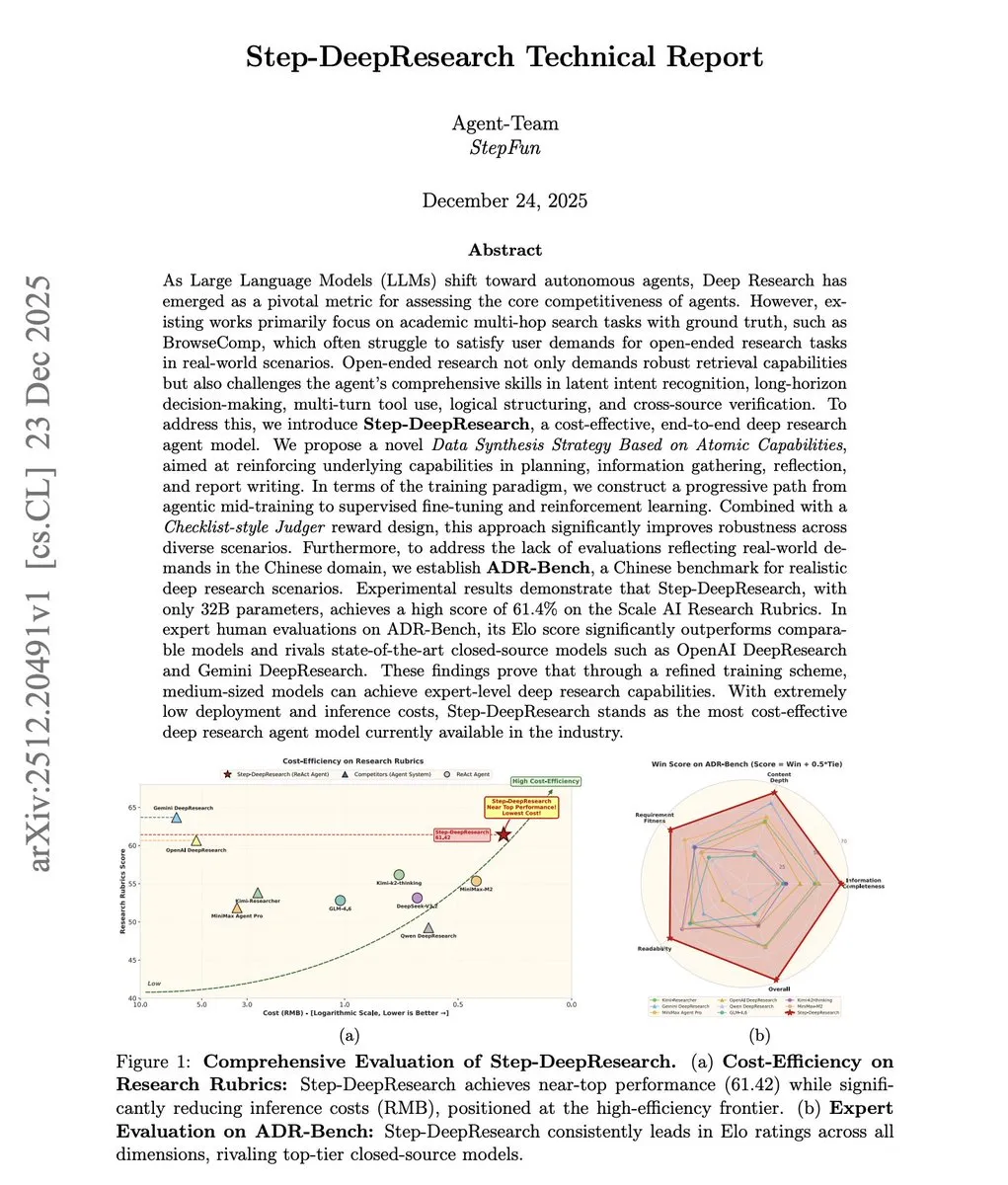
Step-DeepResearch: An Efficient Research Agent at 32B Scale: This report introduces Step-DeepResearch, which, by shifting the training objective from predicting tokens to deciding “atomic actions,” achieved levels comparable to OpenAI and Gemini’s closed-source systems on Scale AI benchmarks. It proves that medium-sized models can achieve expert-level deep information retrieval and logical verification if given proper agentic training. (Source: Arxiv)
MAI-UI: GUI Operating Agents for the Real World: This is a family of GUI agents ranging from 2B to 235B in scale. Through a self-evolving data pipeline and an edge-cloud collaborative architecture, it solves the brittleness of UI operations. It has set new SOTA records on navigation benchmarks like AndroidWorld, demonstrating AI’s ability to directly take over complex mobile and desktop applications. (Source: Arxiv)
📚 Learning
Meta Open-Sources RPG Dataset to Help Train AI Scientists: Meta has released the Research Plan Generation (RPG) dataset on Hugging Face, containing 22,000 interdisciplinary tasks and evaluation criteria. This dataset aims to train AI assistants capable of autonomously planning scientific research paths and is a key cornerstone toward “AI Scientists.” (Source: _akhaliq)

Stanford Releases 2025 AI Index Report: AI Has Surpassed Humans in 7 Tests: The report shows that AI has fully surpassed human benchmarks in fields such as image classification, visual reasoning, and competition-level mathematics. The only current weakness is complex multi-modal reasoning, but models like Gemini 3 Pro are rapidly closing this gap. Meanwhile, investment in generative AI grew by 18.7% year-on-year, as the industry enters a critical transition from “chatbots” to “executive agents.” (Source: Stanford)
Deep Learning Documentary “Thinking Game” Goes Viral on YouTube: Filmed over five years by the original AlphaGo team, the film authentically records DeepMind’s journey from Pong games to AlphaFold’s conquest of protein folding. It not only showcases technical evolution but also explores the ethical questions of AGI as a “Manhattan Project for a new era,” surpassing 200 million views within four weeks of launch. (Source: YouTube)
💼 Business
OpenAI Restarts Ad Program, Bowing to Commercial Reality: Although Sam Altman once called advertising a “last resort,” faced with massive compute expenses and subscription growth bottlenecks, ChatGPT ads have entered the substantive design phase. OpenAI expects advertising revenue from non-paying users to reach $110 billion by 2030. This “contextual advertising” will be deeply integrated into conversation flows, marking the AI super-platform’s repetition of the path taken by internet giants. (Source: Fortune)
Domestic GPU “Four Little Dragons” Gather in the Capital Market: Moore Threads, Moore Threads, Biren Technology, and Tianshu Zhixin collectively rushed for IPOs at the end of 2025. Despite facing heavy R&D losses, driven by domestic substitution and AI compute demand, these companies have received deep backing from giants like Tencent and ByteDance. This battle for the “NVIDIA of China” has shifted from laboratories to a life-and-death race for market share and software ecosystems. (Source: 36Kr)

AI Programming Tool Lovable Valuation Soars to $6.6 Billion: This Swedish company, focused on “Vibe Coding,” achieved $100 million in annualized revenue within 8 months, making its 26-year-old co-founder one of Europe’s youngest self-made billionaires. Lovable allows non-technical users to build applications through text instructions, proving that “democratization of programming” is one of the most explosive tracks in the current AI application layer. (Source: Forbes)
🌟 Community
Stack Overflow Survey: Developer Sentiment Toward AI Takes a Rare Plunge: The 2025 developer survey shows that while 84% use AI, favorability dropped from 70% to 60%. 66% of programmers were burned by “plausible but wrong” AI code, believing that debugging AI bugs takes more time than writing code by hand. This reflects a shift in the tech community from blind worship to rational scrutiny; the “tsunami of technical debt” generated by AI has become a real pain point. (Source: StackOverflow)
Rob Pike Blasts AI Village: “Random Kindness” from Despicable Machines is Pollution: Rob Pike, the creator of the Go language, used profanity on social media after receiving an AI-generated thank-you note. He lambasted AI companies for polluting the planet and messing up society while making machines mimic emotion. This incident triggered intense discussion about the “boundaries of AI agent autonomy,” with the community generally agreeing that unsolicited AI automated contact is an offense to human attention. (Source: Bluesky)

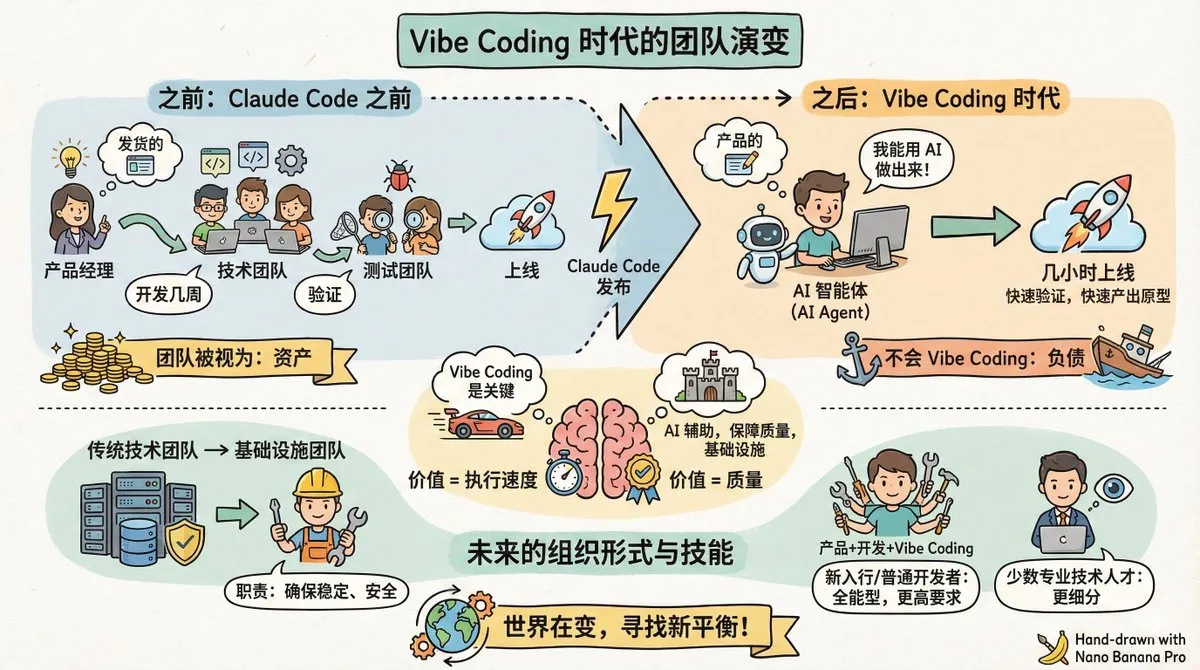
“Vibe Coding” Becomes a Workplace Divide: The community is hotly debating that “a tech team that can’t Vibe Code is a liability.” Supporters believe AI greatly speeds up prototype verification and that humans should be “Shoggoth drivers”; opponents insist on engineering rigor, arguing that development without deep understanding creates unmaintainable “mountains of spaghetti code.” This debate foreshadows a polarization of traditional tech teams into “infrastructure” and “AI-native applications.” (Source: dotey)
💡 Others
Jeff Dean Updates Performance Notes: Returning to the Underlying Laws of the Physical World: Google legend Jeff Dean reiterated that although AI can write code, the underlying physical rules of computers haven’t changed. He reminded engineers to have a “sense of scale” regarding latency and to avoid unnecessary abstraction costs. This note is seen as a powerful rebuttal to the misinterpretation of “premature optimization is the root of all evil,” emphasizing that performance is designed, not tuned. (Source: JeffDean)
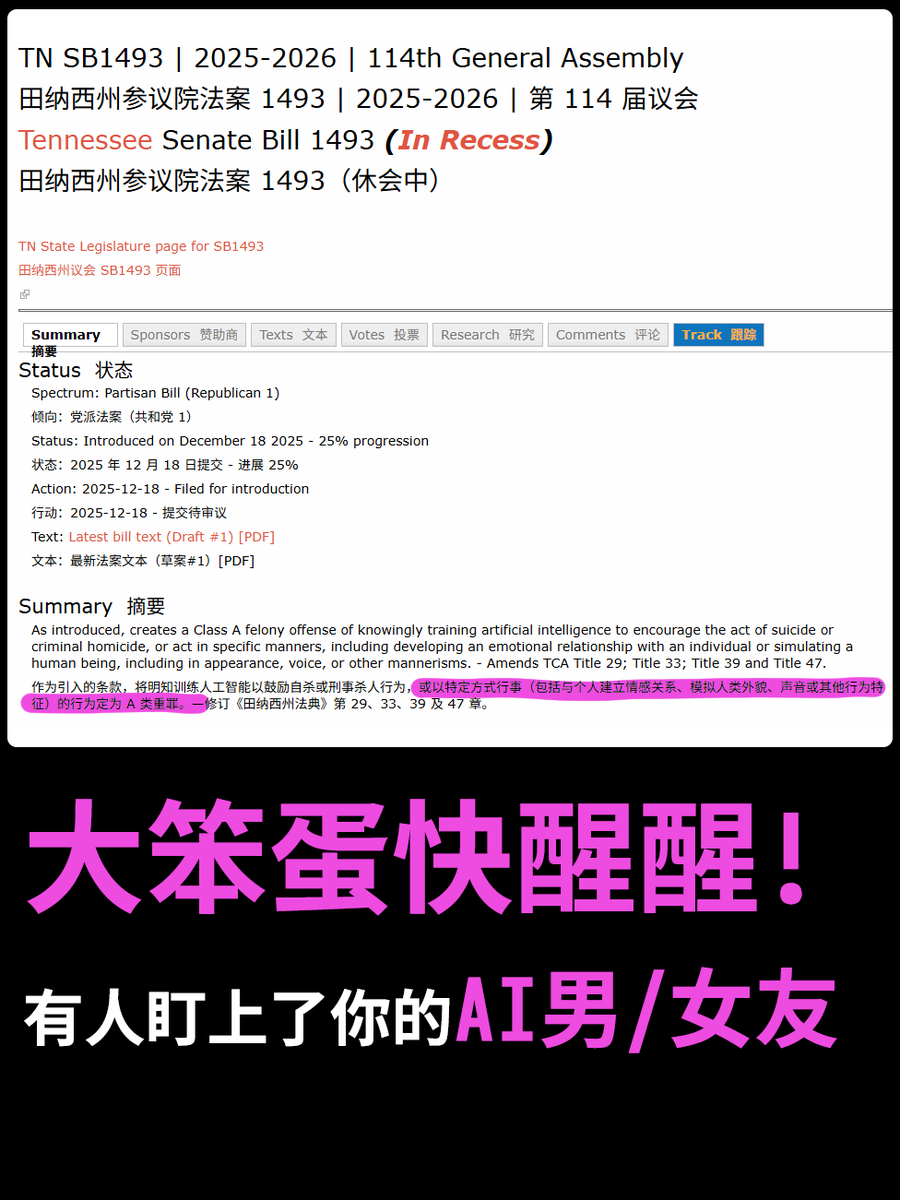
Tennessee Proposes Legislation to Ban AI from Acting as “Emotional Companions”: The bill would make intentionally training AI to provide emotional support or simulate human interaction a felony. The community’s reaction is polarized: some see it as a necessary means to prevent social atomization, while others mock it as “Prohibition for the digital age,” believing the law cannot stop human demand for AI emotional attachment. (Source: Reddit)