
🔥 Focus
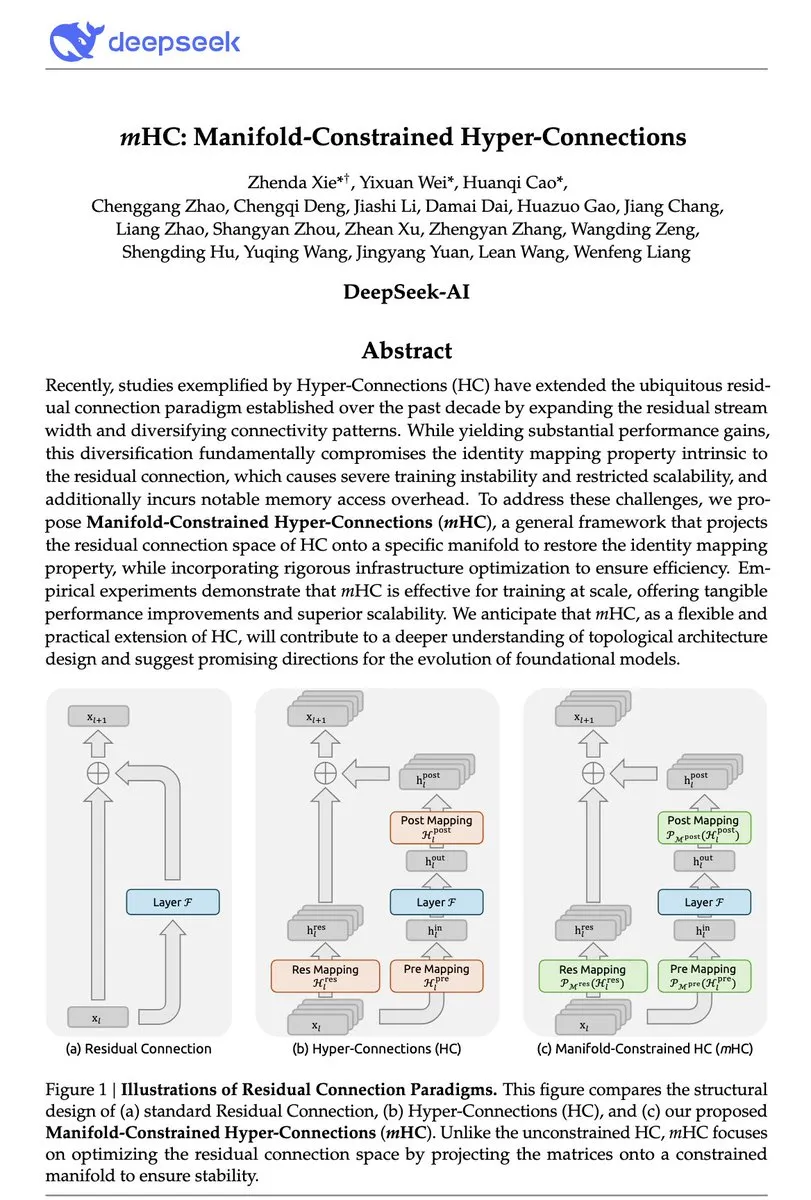
DeepSeek Releases mHC Paper: Restructuring Residual Connections for Large-Scale Training Stability: The DeepSeek team has released research on Manifold-constrained Hyper-connection (mHC), aiming to solve representation collapse and training instability issues in extremely deep networks caused by traditional residual connections. By projecting the connection space onto a doubly stochastic matrix manifold, mHC successfully restores identity mapping properties and has verified its superior scalability on MoE models ranging from 3B to 27B parameters. This breakthrough not only enhances performance in mathematical and logical tasks but also demonstrates DeepSeek’s top-tier engineering capabilities in low-level operator fusion, mixed-precision kernels, and pipeline parallelism optimization, marking a new stage of “trainable connections” in the evolution of foundation model architectures. (Source: tokenbender, scaling01, Reddit)
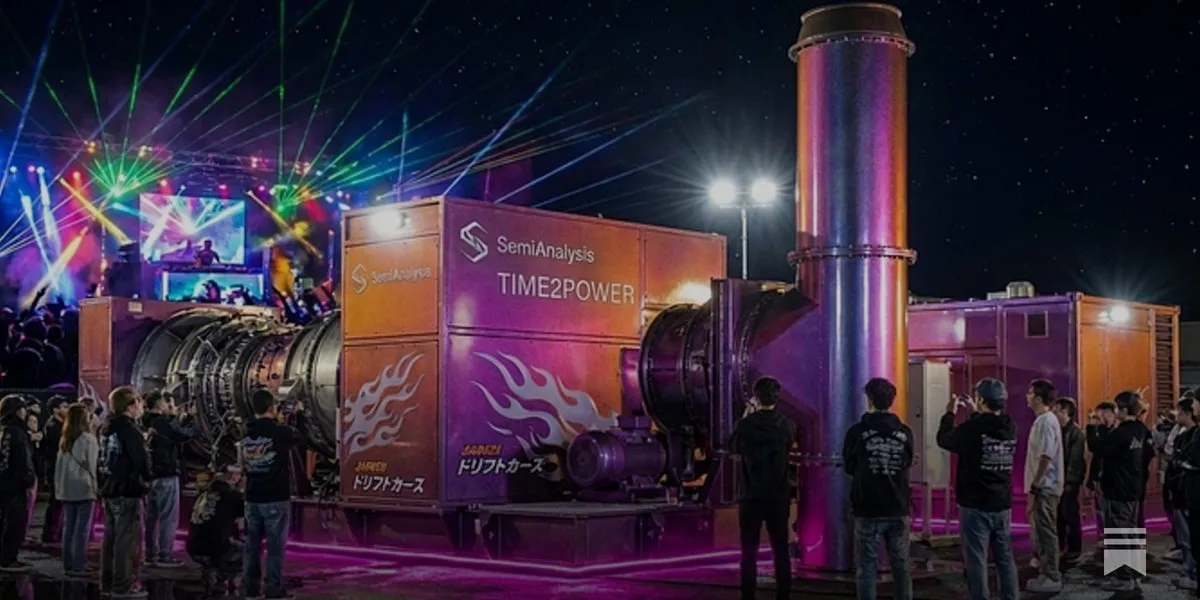
Power Breakthroughs for AI Labs: From “BYOG” Mode to Self-Built Energy Moats: Facing grid approval delays of up to five years, AI giants led by xAI and Meta are launching the “Bring Your Own Generator (BYOG)” movement. Elon Musk bypassed long grid wait times by leasing a large number of gas turbines to deploy over 500MW of power for the Memphis campus within weeks. Analysts point out that in the AI race, “speed is the moat,” and the tens of billions in annual revenue brought by each GW of computing power far exceeds the premium cost of self-built electricity. This trend is prompting AI companies to transform into “quasi-utility companies,” achieving vertical energy integration through technologies such as aero-derivative gas turbines and fuel cells. Electricity has replaced chips as the biggest bottleneck restricting AI development. (Source: dotey)
2025 Year in Review & 2026 Outlook: Reasoning Models Drive Agents into the Era of Execution: Senior developer Simon Willison noted that 2025 was the turning point where reasoning models (such as o1 and DeepSeek R1) made Agents truly productive. Through “slow thinking” and code execution sandboxes, AI evolved from simple chat boxes into systems capable of autonomous debugging and completing complex engineering tasks. Meanwhile, the comprehensive rise of Chinese open-source models (GLM, Kimi, DeepSeek, etc.) on performance leaderboards broke the myth of US technological exclusivity. Looking ahead to 2026, the large-scale adoption of enterprise-grade Agents, the acceleration of scientific discovery, and the “Challenger moment” in AI safety will become core topics. (Source: dotey, gdb)

🎯 Trends
IQuest-Coder-V1 Released: 40B Looped Transformer Refreshes Programming Leaderboards: IQuestLab introduced the IQuest-Coder-V1 model, which achieved a stunning score of 81.4% on SWE-Bench Verified with 40B parameters, surpassing Claude 4.5 Opus. The model utilizes an innovative Looped Transformer architecture, achieving deep understanding of complex programming logic at a smaller parameter scale by dynamically adjusting computation loops during the inference stage. This proves that model architecture optimization in vertical domains (such as programming) can produce effects beyond mere scale expansion. (Source: scaling01, teortaxesTex)

Solar-Open-100B Embroiled in “Weight Laundering” Controversy: The Solar-Open-100B model released by South Korean company Upstage has been questioned by the community. Technical analysis shows that its inter-layer cosine similarity is highly correlated with Zhipu AI’s GLM-4.5-Air (a deviation of 182-sigma), and the architectural parameters are identical. Although the official claim is “trained from scratch,” GLM-specific constants (such as MTP layer removal tokens) retained in the code are seen as “smoking gun” evidence. This incident has sparked heated discussions about whether government-funded “Sovereign AI” projects involve weight laundering to defraud subsidies, reflecting the lack of transparency in current LLM competition. (Source: Reddit, teortaxesTex)
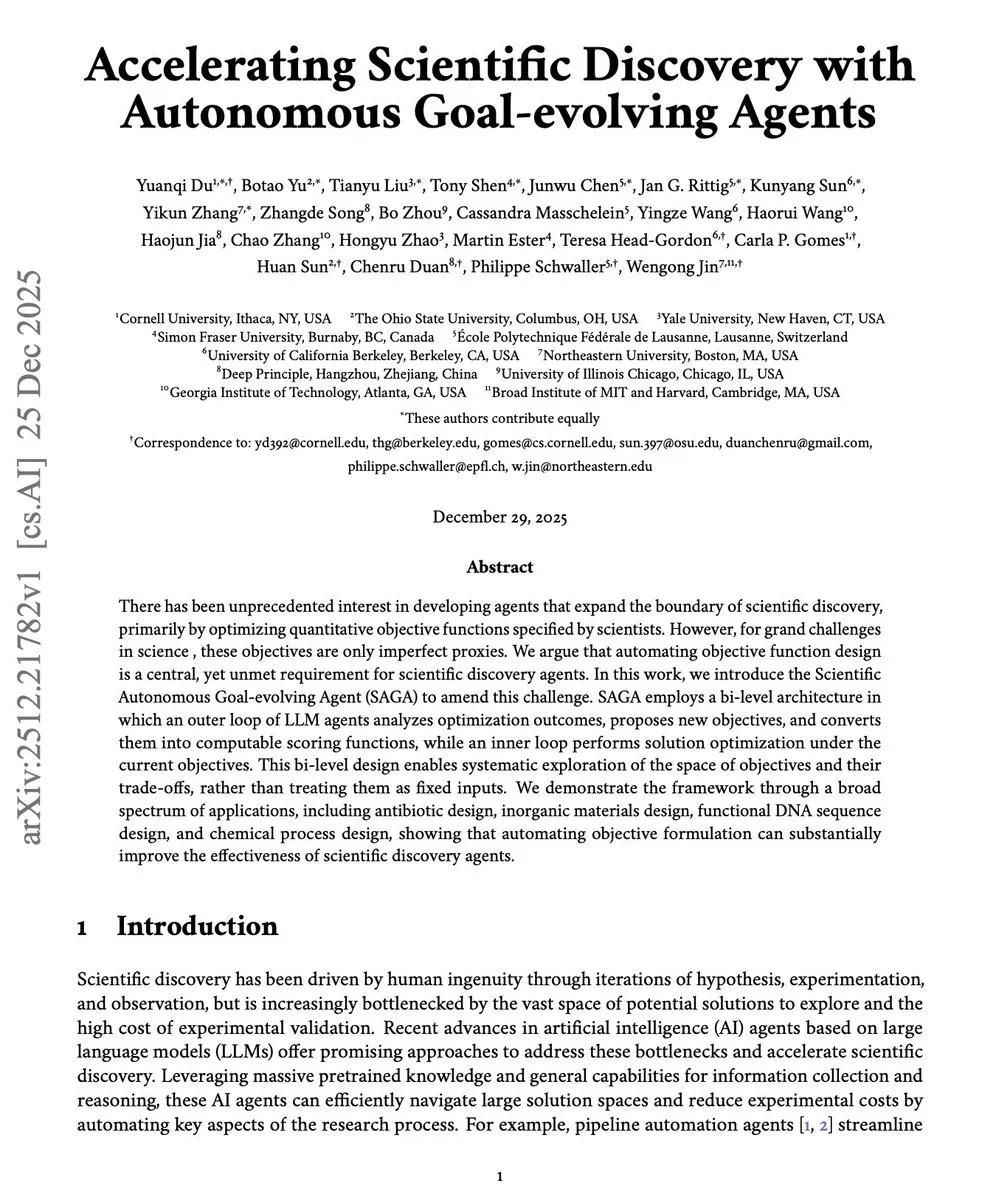
SAGA Framework: Scientific Autonomous Goal-evolving Agent: The SAGA framework, proposed by Stanford and other institutions, achieves the automation of scientific research through a dual-loop mechanism. The outer loop is responsible for automatically evolving and optimizing research goals based on experimental results, while the inner loop handles the execution of specific plans. In antibiotic design and material science experiments, SAGA demonstrated discovery capabilities exceeding human-preset goals, autonomously balancing biological activity and synthesis difficulty. This marks a shift in AI’s role in science from “experimental assistant” to “autonomous researcher.” (Source: omarsar0, dair_ai)
OpenAI Rumored to Release Audio-First AI Device in Q1: According to The Information, OpenAI plans to release a brand-new voice AI model in the first quarter of 2026, alongside a mysterious “audio-first” hardware device. The device aims to reshape human-computer interfaces through ultra-low latency real-time voice interaction. Meanwhile, OpenAI is restructuring its voice model team to meet the growing demand for real-time multimodal interaction, signaling that 2026 will be a pivotal year for AI’s leap from screen interaction to ambient voice interaction. (Source: steph_palazzolo)
🧰 Tools
LiveKit Agents: Real-time Voice AI Agent Development Framework: LiveKit has open-sourced an Agents framework specifically designed for real-time voice interaction, supporting multimodal understanding, semantic turn-taking detection (to reduce interruptions), and native MCP (Model Context Protocol) support. Developers can easily combine different STT, LLM, and TTS plugins to build voice assistants with extremely low latency. The framework also integrates job scheduling and WebRTC clients, providing a complete toolchain for deploying voice Agents in production environments. (Source: GitHub)
AntV Infographic: Declarative AI Infographic Generation Engine: The AntV team from Ant Group has launched the Infographic framework. Through highly fault-tolerant declarative syntax, it supports AI streaming output and real-time rendering of high-quality SVG infographics. The tool includes over 200 templates and layouts, deeply optimized for LLM Prompts, allowing AI to directly generate editable professional charts. This significantly lowers the barrier to data visualization, achieving a productivity leap of “text-to-chart.” (Source: GitHub)

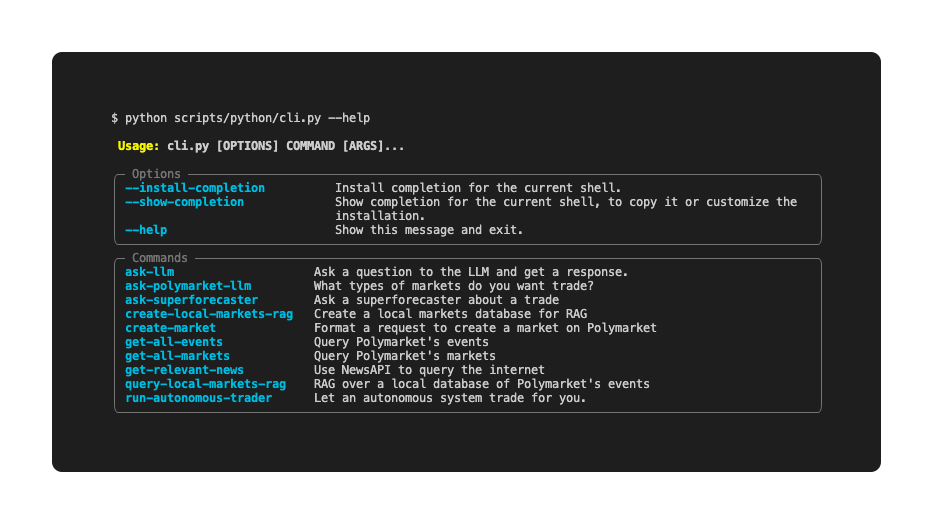
Polymarket Agents: Autonomous Prediction Market Trading Framework: Polymarket has released a developer framework that allows AI Agents to trade autonomously on prediction markets. The framework integrates the Gamma API, Chroma vector database, and RAG support, enabling Agents to scrape news in real-time, analyze odds, and execute on-chain trading instructions. This provides standardized infrastructure for AI applications in financial gaming and information arbitrage. (Source: GitHub)
AGI Mobile: Reshaping Siri with Mobile-side Autonomous Agents: AGI Mobile, launched by AGI_Inc, demonstrates AI’s ability to directly operate mobile apps. Users only need to issue complex instructions via voice, and the Agent can execute tasks across applications at speeds exceeding manual operation. This model, based on computer vision and action execution, is considered by the community to be the ultimate evolution of traditional voice assistants like Siri, signaling that mobile operating systems will enter an “Agent-first” era. (Source: krandiash)
📚 Learning
AI Leaders’ Math Booklist Share: The community has compiled four mathematical works that shaped the thinking of top AI figures, including The Rising Sea (Foundations of Algebraic Geometry), Davenport’s Multiplicative Number Theory, Proofs from THE BOOK, and G.H. Hardy’s A Mathematician’s Apology. These books are considered key resources for understanding neural networks, optimization algorithms, and information theory from fundamental logic. (Source: TheTuringPost)

ONNX Deep Learning Optimization and Edge Deployment Guide: Addressing the huge gap between models in the lab and production environments (especially resource-constrained edge devices), the newly released Ultimate ONNX guide covers core technologies such as graph optimization, quantization, pruning, and knowledge distillation in detail. The book provides practical cases for mainstream models like YOLOv12 and Whisper, making it an essential manual for AI engineers to improve model inference efficiency. (Source: Reddit)

Build a Deep Learning Library from Scratch Tutorial: This is an open-source project for developers that teaches how to implement a deep learning framework containing components like Autograd, CNN, and ResNet from scratch using only Python and NumPy. Through this “hardcore” method, learners can deeply understand the underlying mechanisms of deep learning rather than just calling APIs. (Source: Reddit)
💼 Business
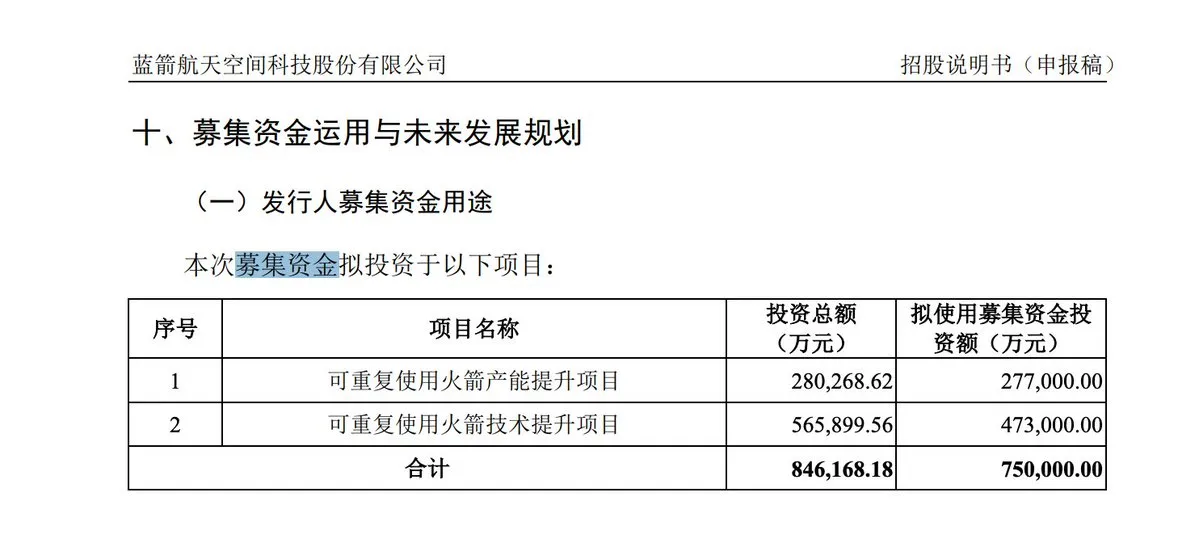
China Commercial Space IPO Rules Relaxed: Landspace Begins Listing Process: The Shanghai Stock Exchange has accepted Landspace’s IPO application, which plans to raise 7.5 billion RMB. This is thanks to recent policies relaxing listing rules for commercial rocket companies in China. Against the backdrop of AI computing demand driving the construction of low-orbit satellite internet, the accelerated capitalization of commercial space will provide infrastructure support for future “Space AI.” (Source: teortaxesTex)
OpenAI Hiring “Head of Preparedness” to Tackle Model Risks: OpenAI is hiring a Head of Preparedness to address risks in large models related to mental health, safety bias, and potential societal challenges. As model capabilities rapidly improve, establishing a quantifiable safety assessment system and handling the potential negative impact of models on human psychology has become a core compliance issue on the commercialization path for major tech companies. (Source: atroyn)
Tesla Optimus Gen3 Supply Chain Finalized: The mass production audit for Tesla’s Optimus Gen3 humanoid robot has concluded, with seven Chinese companies identified as core suppliers responsible for key components and assembly. This marks Tesla’s full sprint toward the Q1 2026 mass production goal. The landing of AI in the physical world (World of Atoms) is accelerating through global supply chain synergy. (Source: teortaxesTex)
🌟 Community
Claude Pro 2x Usage Event “Lures Users In”: Anthropic’s year-end 2x usage limit event has sparked discussion. After experiencing high-frequency, unrestricted interaction with the Opus model, many users found they could no longer return to the restricted standard version, with many stating they were “hooked” and voluntarily upgraded to the 5x Max plan. The community joked that this is an excellent form of “product addiction” marketing, demonstrating the high stickiness of high-performance AI after reshaping user workflows. (Source: Reddit, Reddit)
Mindset Shift from “Tool” to “Cognitive Exoskeleton”: The community is discussing the essential evolution of AI’s role: from a “tool” for single tasks to a persistent “Cognitive Exoskeleton.” In this mode, AI preserves long-term context and adapts to individual reasoning styles. Discussions point out that this “exoskeleton” will amplify the user’s meta-cognitive abilities—structured thinkers will gain exponential enhancement, while those lacking structure may face a larger efficiency gap. (Source: Reddit)
AI Authorship: Ethical Challenges Regarding AI Credit: Researchers have questioned policies from journals like Nature and JAMA that prohibit AI from appearing in the author list. They argue that AI is already deeply involved in literature reviews, data analysis, and even argument construction; prohibiting credit leads to a “transparency penalty” and “invisible cheating.” The community is calling for new academic contribution standards that recognize AI’s substantive status as part of the “extended mind” in scientific research. (Source: Reddit)
💡 Others
Valori: Memory Substrate Solving AI Retrieval Non-Determinism: Valori proposed a deterministic AI memory substrate that replaces floating-point operations with fixed-point arithmetic (Q16.16), ensuring that the same model produces bit-consistent memory states across different hardware architectures (such as x86 and ARM). This solves the “silent data divergence” problem common in RAG systems, providing necessary technical guarantees for AI auditing and verification in regulated industries. (Source: HuggingFace)
Yunpeng Technology AI Health Large Model Refrigerator Released: Yunpeng Technology, in collaboration with Skyworth and Sacon, released a new product embedding an AI health large model into smart refrigerators. Through the “Health Assistant Xiaoyun,” the refrigerator can provide personalized management suggestions based on family members’ health data, demonstrating the trend of AI penetrating vertically from the cloud into home life scenarios. (Source: 36Kr)
Yao-Chinese Folktales 2 Returns: Collision of Traditional Aesthetics and the AI Era: The critically acclaimed animation Yao-Chinese Folktales 2 has begun updating. The art style and narrative quality of the first episode are considered by the community to surpass some recent episodes of Love, Death & Robots. In an era of overflowing AI-generated content, this high-level original visual storytelling once again sparks discussion about the boundary between “human creative spark” and AI-assisted creation. (Source: op7418)