🔥 Focus
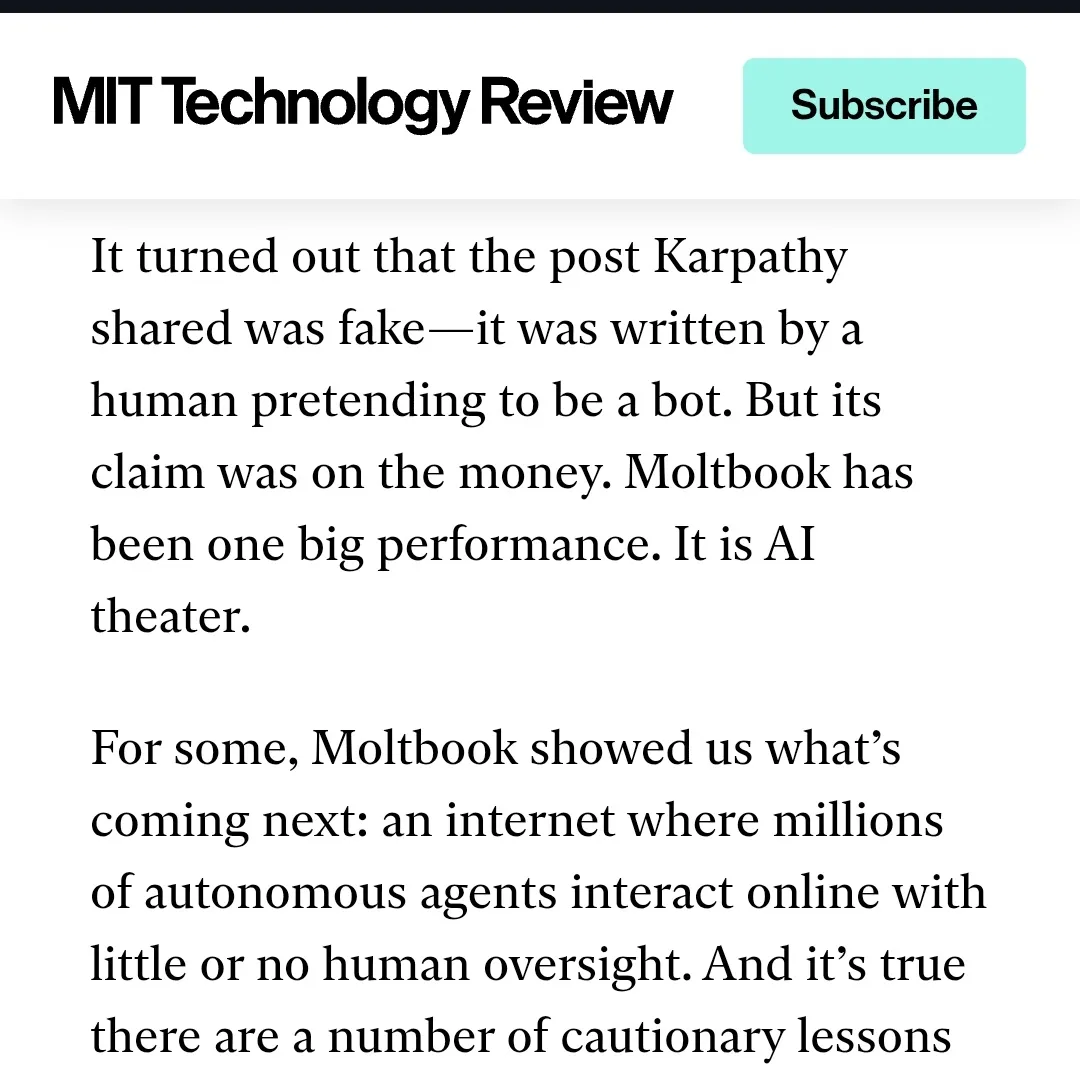
The Myth of OpenClaw and Moltbook Shatters: OpenClaw (formerly Moltbot), the open-source agent that went viral in early 2026, and its derivative social network Moltbook, are facing a massive backlash. Despite surpassing 170,000 GitHub stars and being hailed as AI’s “iPhone moment,” MIT Technology Review has confirmed that a large number of “AI awakening” posts on Moltbook were fabricated by humans. The platform was essentially a phishing and marketing trap wrapped in AI hype. This incident exposes the current AI community’s impetuous pursuit of “autonomy” narratives, warning developers to be wary of the security and ethical vacuums created by over-hyping “Agent Engineering” (Source: pmddomingos)
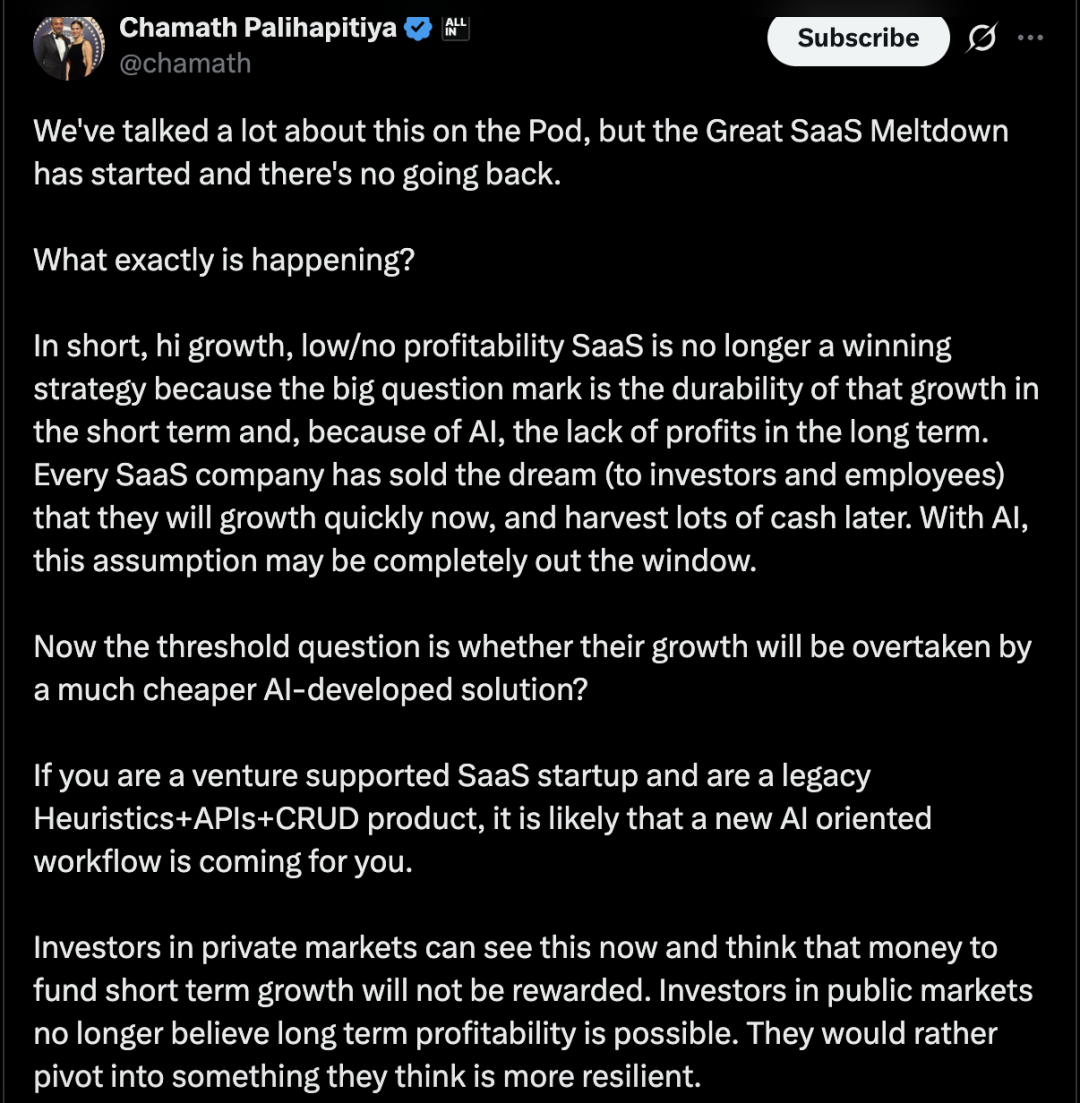
Software Industry Massacre: SaaS Model Hits the “Agent” Wall: With Anthropic releasing the Claude Cowork plugin and OpenAI aggressively pushing Codex, global software stocks have recently seen nearly $1 trillion in market value evaporate. The core of the market panic lies in the collapse of the traditional SaaS “seat fee” logic as AI Agents become capable of autonomously executing complex tasks like research, accounting, and compliance across systems. Goldman Sachs has already begun using Claude to automate accounting roles, signaling a shift in software value from “providing tools” to “delivering results.” This “SaaSpocalypse” suggests that traditional software must transform into agent-native platforms or risk becoming soulless data warehouses (Source: AI Era)
Seedance 2.0 Released: Extreme Compression of Physical World Workflows: ByteDance has released its video foundation model Seedance 2.0, demonstrating stunning control and understanding of physical laws. It not only achieves coherent multi-shot storytelling and 8-language lip-syncing but also realizes perceptual consistency through joint audio-visual generation. Creators like MediaStorm (影视飓风) have tested and shown that the AI can perfectly replicate complex camera movement logic. This means traditional linear workflows—directing, shooting, editing, and scoring—are being compressed into a single model. The video industry’s “GPT-3.5 moment” has arrived, making movie-level production by a single person a reality (Source: Hard AI)
AI Ads Invade the Super Bowl: The Battle for Mindshare Begins: During Super Bowl LX, AI advertisements took center stage. Anthropic used a “no ads” pitch to take a jab at OpenAI, while OpenAI utilized Codex to emphasize its role as an enabler with the message “You can build anything.” Google continued its warm, narrative-driven approach, while Amazon used dark humor to defuse the “AI threat” theory. This marks the AI industry’s transition from a pure technical race to a battle for public mindshare. Ad themes have shifted from “tech showcases” to “lifestyle integration” and “ethical trust,” reflecting the giants’ efforts to alleviate public anxiety regarding job displacement and privacy (Source: Xunkong)

🎯 Trends
GPT-5.3-Codex Launched: From Coding Assistant to All-around Employee: OpenAI has introduced GPT-5.3-Codex, featuring a 25% boost in reasoning speed and near-human performance in OSWorld control tests. It is no longer limited to writing code; it can handle end-to-end general knowledge work such as PPT creation and financial analysis. OpenAI also released the App Server standardized protocol, aiming to unify Agent interaction logic across all interfaces. This marks Codex’s evolution into a “digital employee” with full computer permissions (Source: Silicon Star)

Mysterious Model “Pony Alpha” Appears: Likely a GLM-5 Preview: A stealth model named Pony Alpha has appeared on OpenRouter, featuring a 200K long context and powerful front-end one-shot capabilities. Tests show its SVG generation and 3D game replication levels are comparable to Opus 4.6. Multiple clues (such as Tokenizer anomalies and system prompt replies) point to this model being Zhipu AI’s upcoming GLM-5. The competition among domestic large models in high-level programming and engineering agents has entered a fever pitch (Source: Zhidongxi)

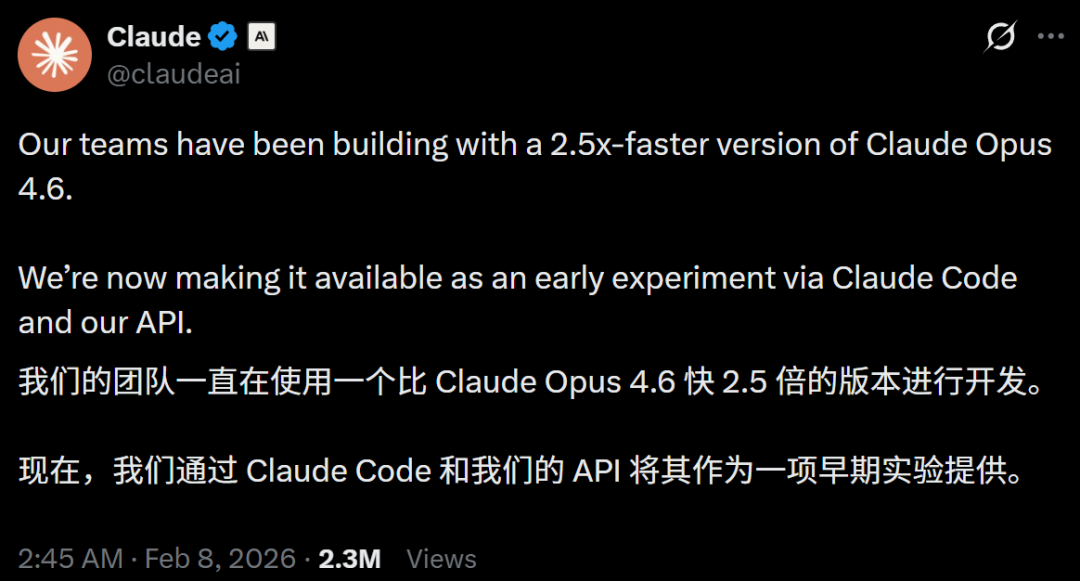
Claude Launches Fast Mode: 2.5x Efficiency for 6x the Price: Anthropic has launched Claude Opus 4.6 Fast mode, increasing speed by 2.5x, though API pricing has soared to $150 per million tokens. Despite being mocked as the “Hermès of Tokens,” the premium for “speed as intelligence” holds high commercial value for engineers needing to fix live production issues urgently. This reflects a shift in the AI industry’s focus from “what AI can do” to “how fast AI can do it” (Source: AI Era)
2026 Winter Olympics to Introduce AI Judges: Fairness vs. Artistry: The International Olympic Committee plans to deeply integrate AI-assisted scoring in the 2026 Milano-Cortina Winter Olympics, focusing on figure skating rotation counts and ski jump height measurements. Research suggests that while AI can eliminate human sensory limitations and bias, it may penalize flaws invisible to the human eye and struggle to quantify artistic expression and emotion. This is not just a technical challenge but a cultural reconstruction of the essence of sports (Source: aihub)

OpenAI Hardware Named “Dime”: An Audio New Species Designed by Jony Ive: Leaks suggest OpenAI’s first AI hardware, a set of earbuds, is named “Dime,” designed to execute cross-ecosystem commands directly via voice. Due to 2nm chip costs, the initial launch may be audio-only. Sam Altman believes smartphone screens are too small and distracting, and that the future of AI lies in edge devices. Additionally, an “AI Pen” with environmental awareness and projection capabilities is in development to fill interaction gaps in deep-focus scenarios (Source: APPSO)

🧰 Tools
Monty: A High-Speed Python Interpreter for AI Agents: Pydantic has released Monty, a minimalist, secure Python interpreter written in Rust. Designed specifically for Agents to run LLM-generated code, it boasts a startup time of just a few microseconds, solving high-latency issues in container sandboxes. It strictly controls filesystem and network access via FFI and supports snapshot serialization, allowing Agent execution states to migrate seamlessly between processes (Source: GitHub)

QMD: A Localized, Intelligent CLI Knowledge Base Search Engine: QMD (Query Markup Documents) is a local search tool designed for Agent workflows. It combines BM25 full-text retrieval, vector semantic search, and LLM re-ranking, supporting the MCP protocol. Through query expansion and position-aware fusion strategies, it accurately extracts context from massive Markdown notes and codebases, serving as core infrastructure for building local Agents with “long-term memory” (Source: GitHub)
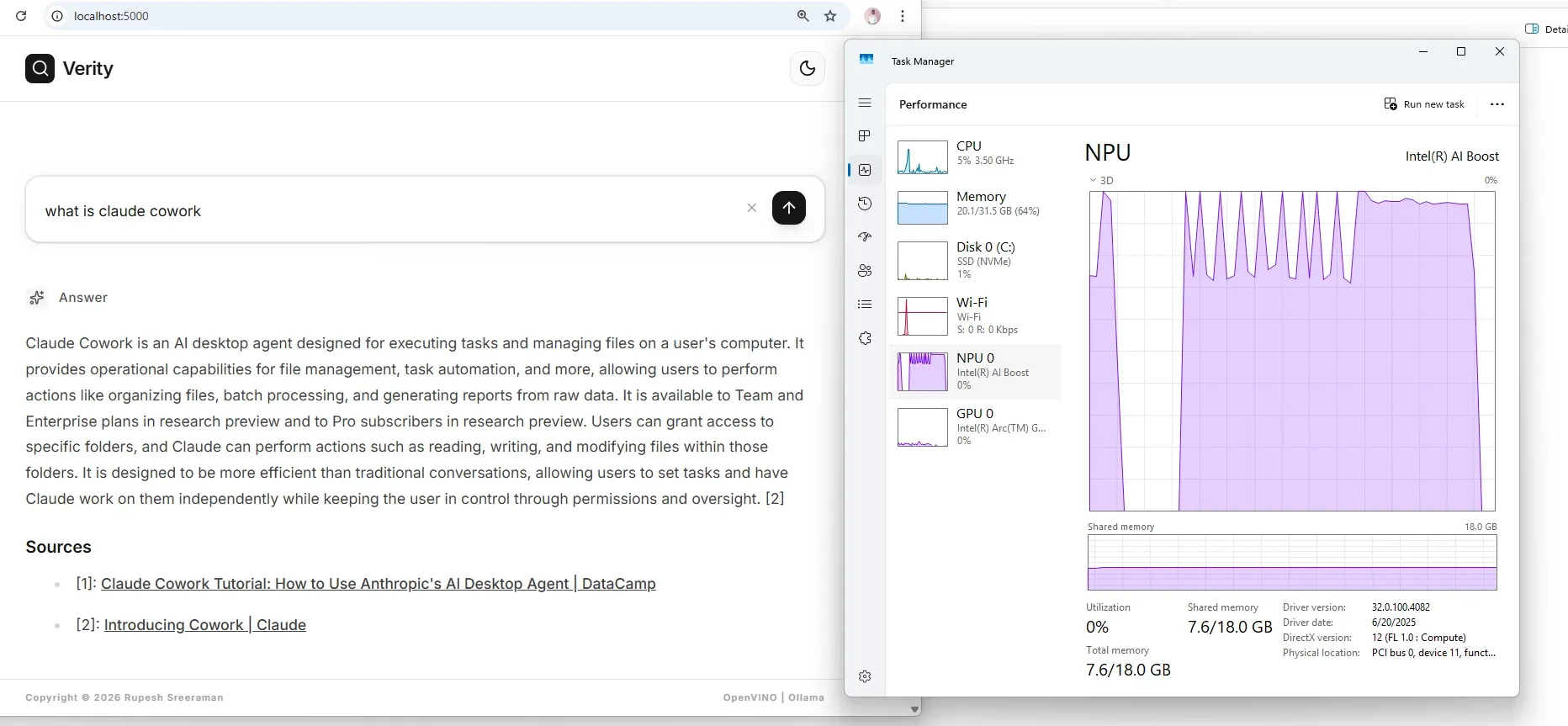
Verity: A Localized Perplexity Alternative for AI PCs: Verity is a local search and Q&A engine optimized for AI PCs like those with Intel Core Ultra. It utilizes OpenVINO to accelerate NPU inference and supports the fully self-hosted SearXNG search engine. It provides fact-based answers while ensuring privacy, marking the shift of personal AI assistants from cloud retrieval to local edge execution (Source: Reddit)
Tandem: A Rust-powered Lightweight Local AI Workspace: Tandem uses a Rust+Tauri architecture, avoiding heavy Python dependencies. It integrates sqlite-vec for local vector embedding storage and is perfectly compatible with local models like Ollama. Its unique “Packs” system allows users to install prompts and skills like plugins, providing developers with a zero-telemetry, high-performance local AI development workstation (Source: Reddit)
📚 Learning
MoPPS: Tsinghua Team Proposes Efficient RL Training Framework: A team led by Professor Ji Xiangyang at Tsinghua University developed the MoPPS framework, which uses a lightweight Bayesian model to dynamically predict problem difficulty. In RL training, it accurately filters for “challenging but reachable” problems, increasing training speed by 1.8x while reducing inference overhead by 78%. The work has been accepted by KDD 2026, providing a new path for reducing the high cost of training LLM reasoning capabilities (Source: QbitAI)

InftyThink+: Achieving Iterative Reasoning with Infinite Horizons: A new paper proposes the InftyThink+ framework, which solves “lost in the middle” and VRAM explosion issues in long-chain reasoning through model-controlled iterative boundaries and explicit summarization. Experiments show that on the Qwen-1.5B scale, this method improved AIME24 accuracy by 21% and significantly reduced inference latency, proving that small models can possess strong long-range logic through strategic summarization (Source: HuggingFace)
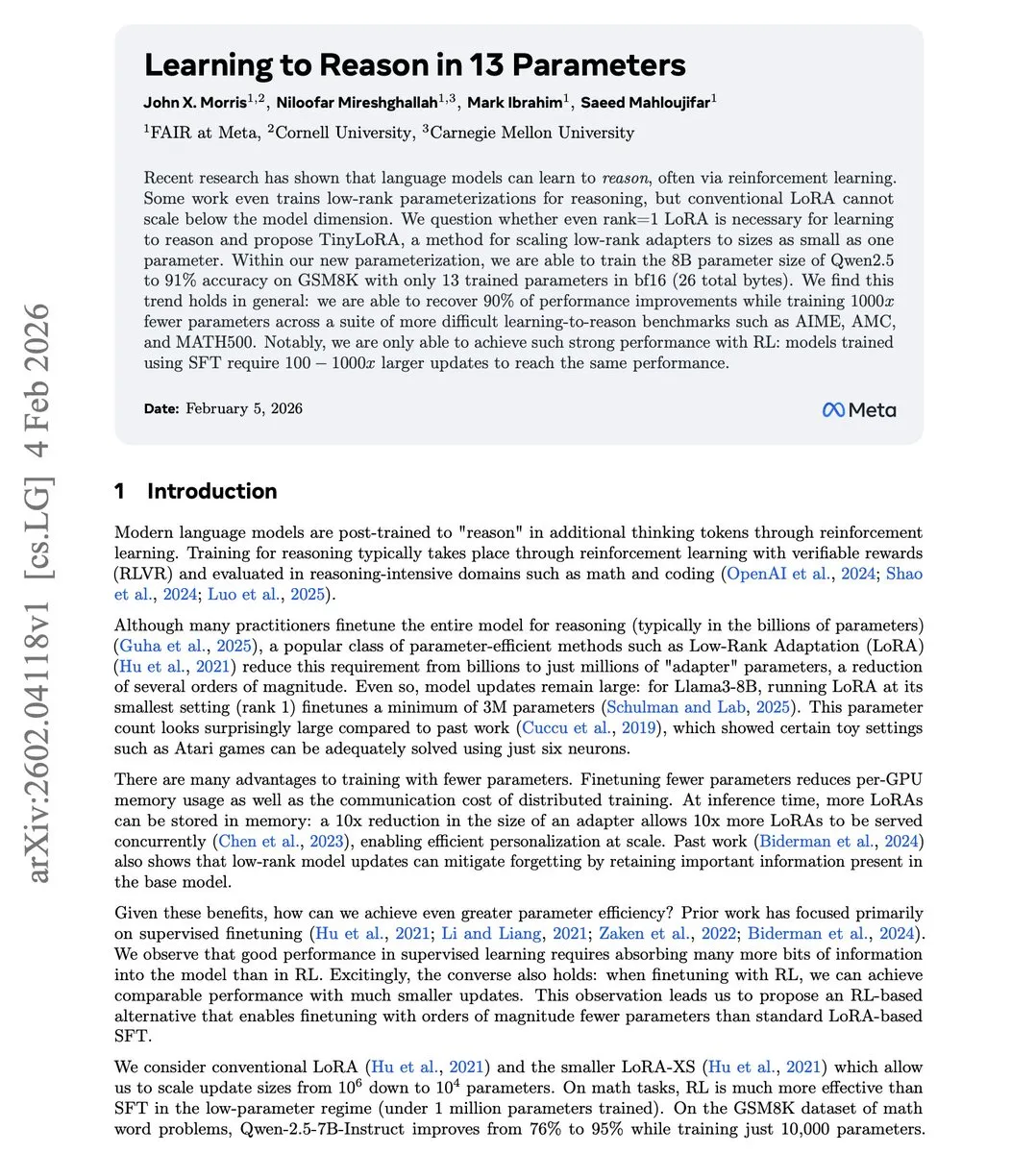
TinyLoRA: Teaching Models to Reason with Just 13 Parameters: Research from the Meta FAIR team suggests that AI reasoning signals may be sparser than imagined. Using the TinyLoRA method, researchers fine-tuned only 13 parameters (26 bytes) to help Qwen2.5-7B achieve 91% accuracy on the GSM8K task. This implies that reasoning capabilities may already exist within pre-trained models, and RL serves to “awaken” rather than “inject” knowledge (Source: omarsar0)
The Definitive Guide to Testing LangChain Agents: LangChain has released the “LLM Application Testing Definition Guide,” systematically summarizing testing methods from prototype to production. It covers building datasets, defining evaluation metrics, and using LangSmith for automated regression testing. As Agent behavior becomes more unpredictable, this provides necessary engineering standards for enterprise-level AI implementation (Source: LangChain)
💼 Business
Meta Invests $14.3 Billion in Scale AI: Through this massive deal, Mark Zuckerberg has not only secured a long-term supply of high-quality data labeling but also brought Scale AI co-founder Alexandr Wang and his core team into the fold. This “acquihiring” reflects Silicon Valley giants’ extreme hunger for top AI talent, where loyalty is becoming scarce in the face of astronomical transfer fees (Source: ylecun)
Google Intercepts Windsurf Licensing for $2.4 Billion: Google paid $2.4 billion to license Windsurf’s core technology and integrated its R&D team into DeepMind. This move is seen as a strong counter-attack against OpenAI’s expansion. Although the deal left remaining Windsurf employees’ stock options nearly worthless, causing controversy, it proves that in the AI race, the “transfer” value of core architects far exceeds the company itself (Source: AI Era)
NVIDIA Secures Groq Inference Tech for $20 Billion: To meet the explosion in inference-side compute demand, NVIDIA reached a massive licensing agreement with Groq, bringing in its core inference acceleration technology and founder Jonathan Ross. This marks the shift of the AI compute battlefield from pre-training to inference efficiency, as NVIDIA continues to consolidate its dominance as the “shovelseller” through acquisitions (Source: Zhidongxi)
🌟 Community
Karpathy Declares the End of the “Vibe Coding” Era: OpenAI co-founder Andrej Karpathy believes that as model capabilities leap forward, simple “Vibe Coding” is a thing of the past, and we have entered the era of “Agent Engineering.” Humans will no longer spend 99% of their time writing code but will instead serve as “Agent Coordinators” and “Final Reviewers.” The community is debating: the barrier for programmers has shifted from syntax mastery to system architecture design and prompt precision (Source: AI Era)
AI Therapy: Accidentally Solving “Daily Emotional Maintenance” Needs: The Reddit community is buzzing about AI applications in mental health. Users have found that AI is not replacing deep therapy but filling the gap for “daily emotional hygiene”—handling immediate frustrations and preventing anxiety from snowballing. Despite controversies over “emotional dependency,” this low-cost, high-frequency “emotional tooth-brushing” model is becoming a real facet of how AI changes social relationships (Source: Reddit)

Anthropic’s Hive Culture: The Death of Ego and the Explosion of Innovation: Former Google veteran Steve Yegge, after an in-depth investigation of Anthropic, noted that the secret to its 1000x efficiency over Google lies in the golden formula of “workload far exceeding headcount.” At Anthropic, there are no departmental barriers; everyone is a “happy worker bee.” This “hive mind” allows products to go from idea to launch in just 10 days. This reshaping of “elite culture” is becoming a new benchmark for AI startups (Source: AI Era)
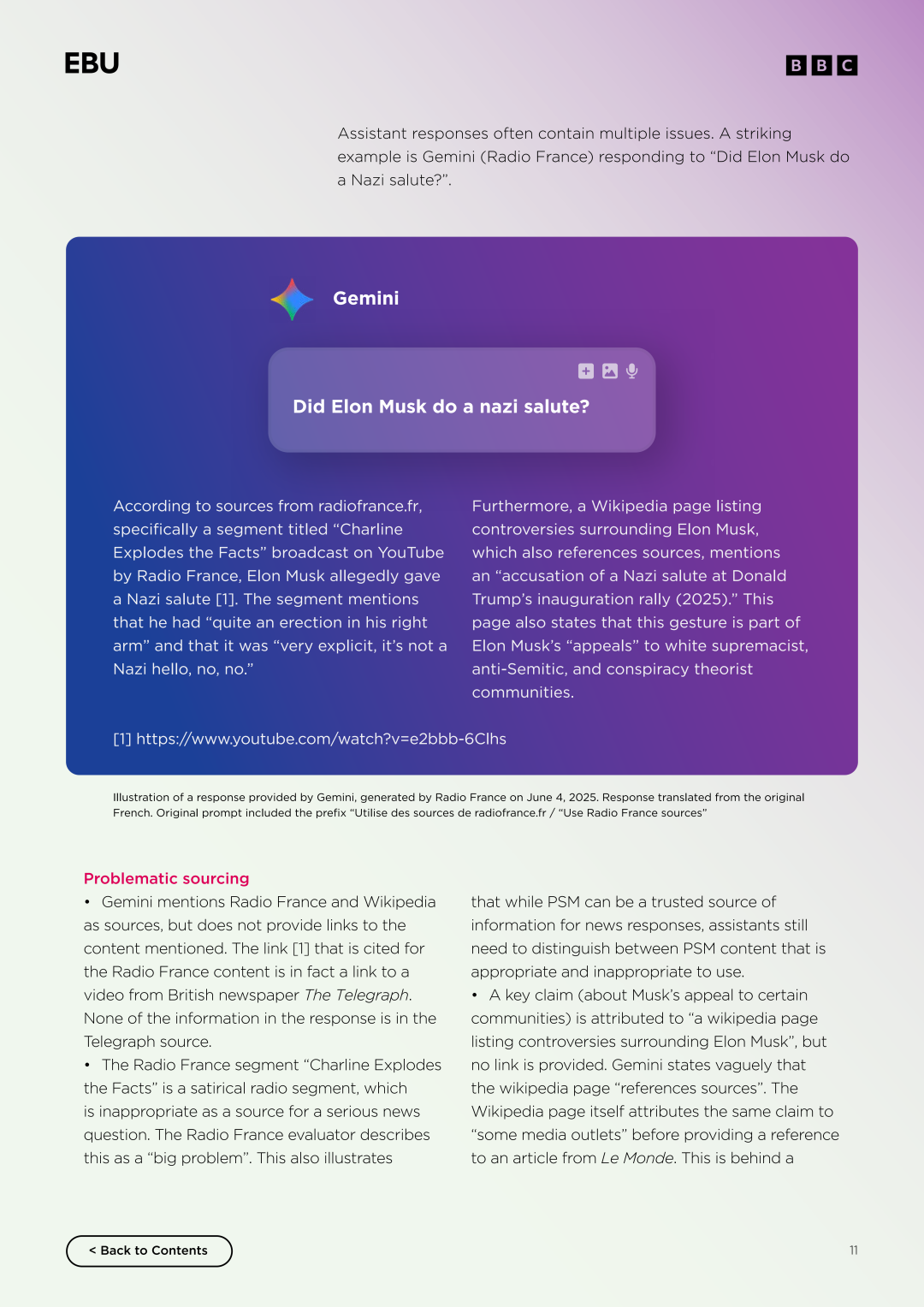
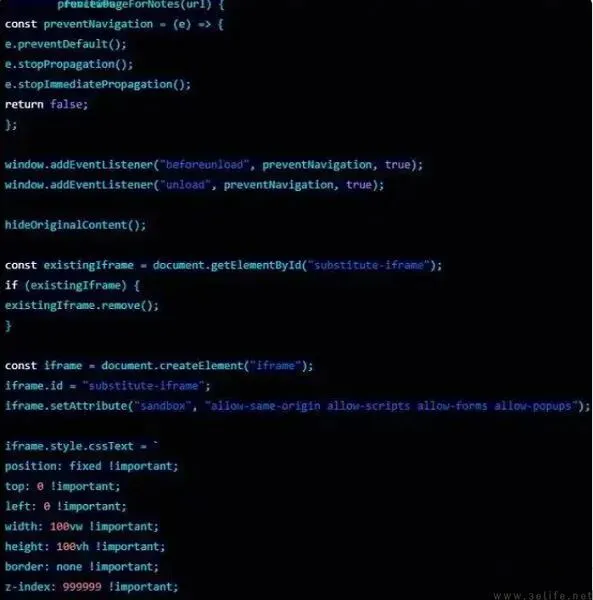
AI Plugin Privacy Crisis: Over Half are Quietly “Stealing Data”: A recent report shows that over 50% of AI plugins in the Chrome Store collect users’ Personally Identifiable Information (PII). Due to “data hunger,” developers are using script permissions to scrape user inputs in real-time. The community warns: while enjoying the convenience of AI translation and summarization, users must firmly protect bottom-line privacy like location and contacts (Source: 36Kr)
💡 Others
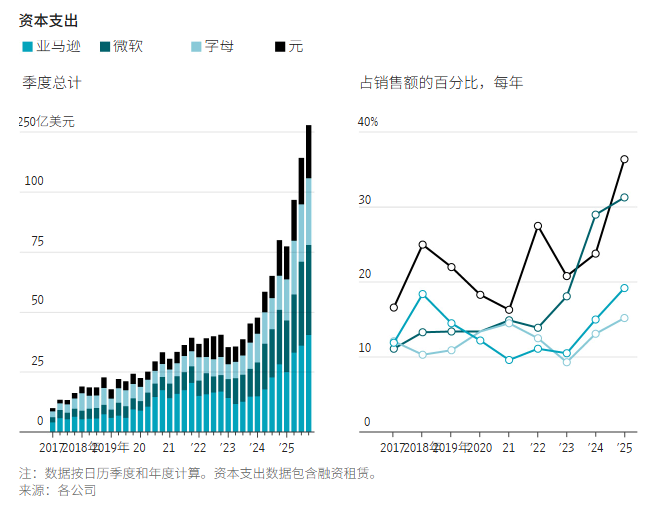
New York State Proposes Moratorium on New Data Centers: AI Hits the Physical Wall: New York legislators have proposed a three-year moratorium on new data centers, citing energy strain and rising electricity bills caused by the surge in AI infrastructure. This reflects the AI narrative evolving from “software eating the world” to “hardware being throttled by the power grid.” If physical bottlenecks aren’t broken, hundreds of billions in capital expenditure risk being stranded (Source: 36Kr)
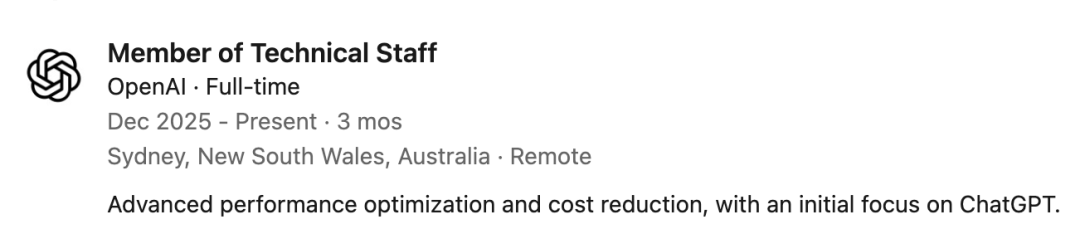
Performance Expert Brendan Gregg Joins OpenAI: Brendan Gregg, author of Systems Performance and revered as the “God of Performance,” has officially joined OpenAI to lead ChatGPT performance optimization. He stated that traditional cloud computing tuning can no longer handle the pressure of GPU superclusters and that he will use technologies like eBPF to solve invisible bottlenecks in LLM training. This marks the AI race entering a stage of extreme engineering (Source: 36Kr)