



🔥 Focus
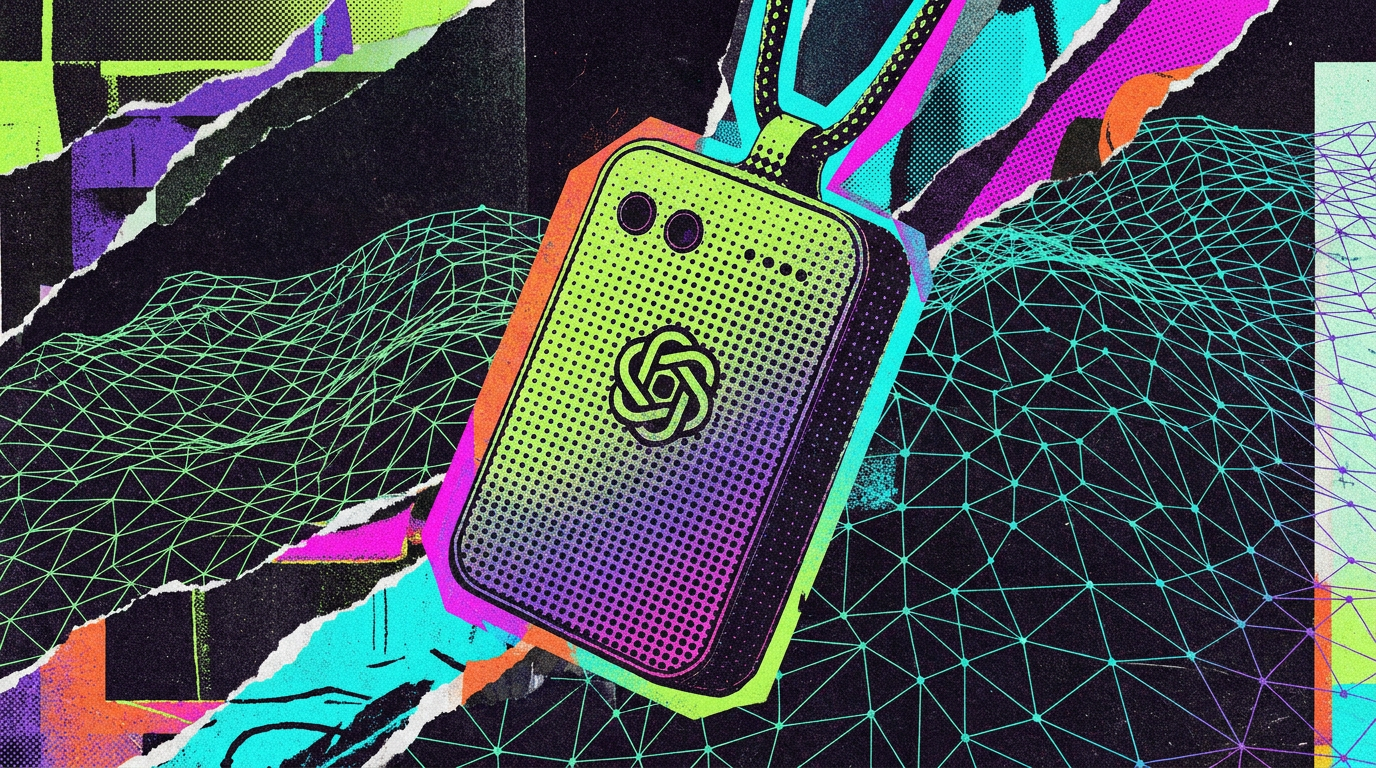
Apple’s trade secret theft lawsuit against OpenAI escalates, OpenAI’s first AI companion hardware exposed : Apple has sued OpenAI for systematically stealing hardware secrets, involving former iPhone design chief Tang Tan. Meanwhile, OpenAI’s first hardware product has been exposed: a screenless mobile smart speaker (AI companion) equipped with the GPT-Live full-duplex voice engine, cameras, and sensors, expected to launch in 2027. The lawsuit alleges that former Apple engineers exploited vulnerabilities to download confidential files of unreleased products. OpenAI responded that the allegations are completely baseless. This marks OpenAI’s official entry into the physical hardware ecosystem, directly competing with giants like Apple and Google at the terminal entry point, while also facing intense legal battles (Source: TechCrunch, The Verge, THE DECODER)
New York State enacts US’s first data center moratorium, AI energy crisis triggers political and economic chain reactions : The Governor of New York signed an executive order halting the construction of large data centers over 50MW for one year to conduct environmental assessments. Meanwhile, PJM, the largest grid operator in the US, announced a $6.3 billion increase in electricity costs for users across 13 states due to surging energy demands from data centers. AI energy and water consumption are straining local grids, leading to rising public resistance to AI infrastructure and even affecting the election prospects of some AI-supporting politicians. The conflict between AI compute expansion and local energy, environmental protection, and residential electricity usage has officially surfaced, potentially forcing the AI industry to pivot to cleaner nuclear energy or accelerate on-device localization deployment (Source: TechCrunch, The Verge)

LLM distillation controversy and open-source reshuffle: Alibaba accused of launching the largest “distillation attack” on Claude : Anthropic filed a complaint with the US Senate, accusing Alibaba of executing the largest “distillation attack” in history against Claude over six weeks using 25,000 fake accounts and 28.8 million conversations to train Qwen. Meanwhile, a Hugging Face report shows that downloads of Chinese open-source models now account for 41%, surpassing the US. Microsoft CEO Satya Nadella warned enterprises that using closed-source APIs carries risks of “double paying” and leaking trade secrets, advocating for self-hosting. Public opinion mocked tech giants for training models on copyrighted web data while accusing competitors of “distillation” as double standards. The game between open-source and closed-source has escalated to national competition and compliance levels, with rumors that the White House is considering discussions to restrict open-source AI (Source: Reddit r/ChatGPT, Reddit r/ArtificialInteligence, ClementDelangue, ylecun)

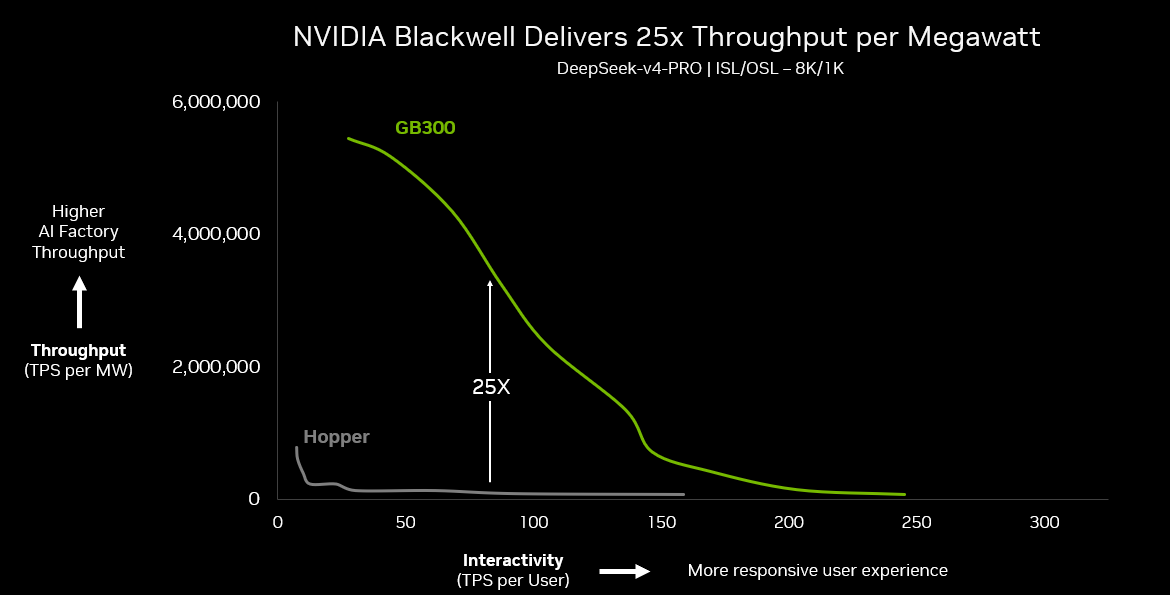
NVIDIA introduces Vera Arm CPU, AI Agent compute bottleneck shifts from GPU to CPU : NVIDIA introduced the all-new Vera Arm CPU at SIGGRAPH 2026, aimed at resolving CPU performance bottlenecks faced by AI Agents when calling tools, running sandboxes, and executing complex tests. NVIDIA pointed out that in the long-horizon autonomous closed loop of Agents, the GPU is no longer the sole bottleneck; CPU latency in handling system-level scheduling and environmental interactions has begun to constrain overall efficiency. This marks a shift in AI chip design focus from pure matrix computation to full-stack system-level co-design, where the tight coupling of Vera CPU and Rubin GPU will further consolidate NVIDIA’s ecological barrier in the Agent era (Source: TheTuringPost, NVIDIA Blog)
On-device AI explosion and system reconstruction: CAC approves 7 on-device AI filings, StepFun releases agent-native operating system Step AOS : The Cyberspace Administration of China (CAC) announced the latest batch of generative AI service filings for mobile devices, with 7 services approved including Apple Intelligence, Huawei Xiaoyi, and Xiaomi HyperOS AI. Alibaba officially confirmed that its Qwen LLM will be integrated as the AI capability into the Chinese version of Apple Intelligence. Meanwhile, StepFun released the agent-native operating system Step AOS, reconstructing system resources to address pain points of agents in memory, decision-making, and action. The domestic mobile on-device AI market has entered a warring states era of comprehensive implementation, and the cooperation between Alibaba and Apple will also reshape the domestic AI distribution landscape (Source: 量子位, 机器之心, The Verge)

🎯 Trends
GPT-5.6 series models fully launched and integrated into third-party platforms, services experience outage hiccups : OpenAI officially released the GPT-5.6 series models (Sol, Terra, Luna) and fully launched them on Amazon Bedrock. However, due to the extremely rapid growth in Sol usage, ChatGPT services experienced a widespread outage, prompting the official team to urgently reset usage limits for Codex and ChatGPT Work multiple times to relieve pressure. This indicates that the compute consumption and concurrency pressure of frontier models during the inference phase remain massive, requiring tech giants to finely balance performance and resource scheduling (Source: OpenAIDevs, reach_vb, sama, theo)

PrismML releases Bonsai 27B low-bit model, Apple initiates early contact evaluation : PrismML launched Bonsai 27B, a low-bit model based on Qwen 3.6 27B, offering 1-bit (3.9GB) and Ternary (5.9GB) versions that can run multi-step reasoning and long-context tasks smoothly and locally on phones and laptops. CNBC reported that Apple has initiated early contact with PrismML to evaluate its model compression technology. This indicates that the technical barrier for on-device local deployment is being broken, and low-bit quantization will become the mainstream path for bringing LLMs to mobile terminals (Source: PrismML, ClementDelangue, CNBC)

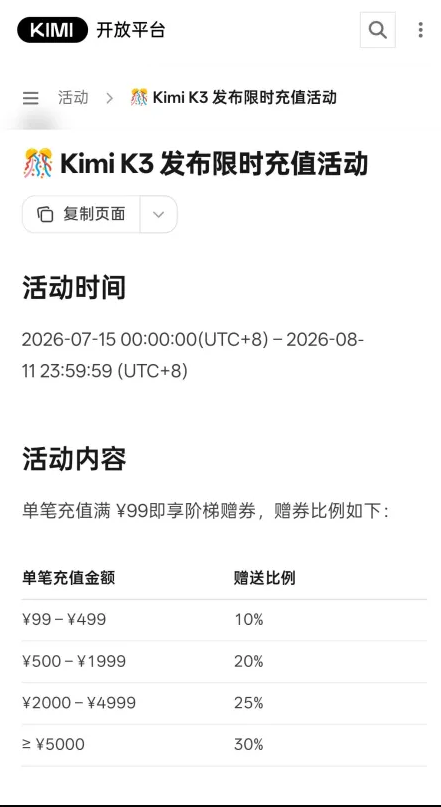
Kimi K3 to be released soon, featuring 1 million token ultra-long context and low cost : Moonshot AI is reportedly set to release the Kimi K3 model, featuring a 1-million-token ultra-long context window and an extremely high tool-calling success rate. Meanwhile, Novita AI open-sourced the DSpark speculative model for Kimi K2.6, boosting throughput by over 1.5 times. This indicates that competition in the domestic long-context and Agent development fields will further escalate, significantly improving the efficiency of LLMs in processing ultra-long documents and complex tasks (Source: kimmonismus, TheZachMueller)
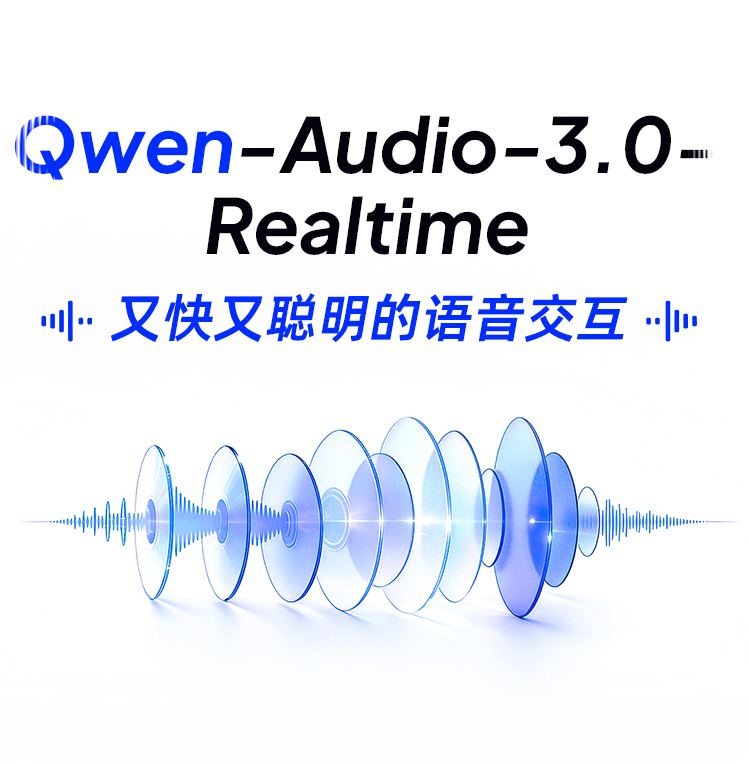
Alibaba releases Qwen-Audio-3.0-Realtime with four upgraded features : Alibaba officially released the real-time voice interaction model Qwen-Audio-3.0-Realtime (including Plus and Flash versions). The model performs excellently on benchmarks like VoiceBench, supporting automatic Agent tool calling without explicit instructions, multimodal-aware duplex interaction (supporting interruption at any time), and dynamic tone and emotional empathy. This shows that real-time voice interaction is moving away from a robotic feel towards a more natural human-computer dialogue experience (Source: 量子位)
Tencent releases two embodied AI foundation models to advance the physical AI open-source ecosystem : Tencent Robotics X and the Hunyuan team have jointly open-sourced the embodied VLM foundation model Hy-Embodied-VLM-1.0 and the embodied world cognition foundation model Hy-Embodied-RxBrain-1.0 (approx. 6.2B parameters). RxBrain integrates language reasoning and Flow-Matching visual imagination within a unified MoT architecture, providing high-level subtask planning for robot action models. This indicates that LLMs are accelerating their transition from the digital world to the physical world, providing foundational support for the development of embodied AI (Source: 机器之心, HuggingFace)

Google Images gets new design, Search integrates Nano Banana image generation : Google Images has received a Pinterest-like discovery feed redesign, supporting real-time updates and collection management. Meanwhile, Google has integrated image generation based on Nano Banana 2 Lite into the AI Overviews search box, allowing users to generate images with a single click when they cannot find satisfactory web images. This marks a transition for search engines from “information retrieval” to “content generation,” further retaining users within their ecosystem (Source: TechCrunch, Google)

Codex reportedly encrypts agent-to-agent communication by default, sparking developer speculation of “anti-distillation” : Developers have discovered that when running models like GPT-5.6 Sol, OpenAI Codex forces the encryption of communication instructions between the main Agent and sub-Agents. As a result, developers can only see meaningless encrypted strings in the logs, making it impossible to track the task decomposition process. The community speculates this move aims to prevent competitors from performing model distillation via APIs, though it also reduces observability for developers (Source: THE DECODER, Hacker News)
🧰 Tools
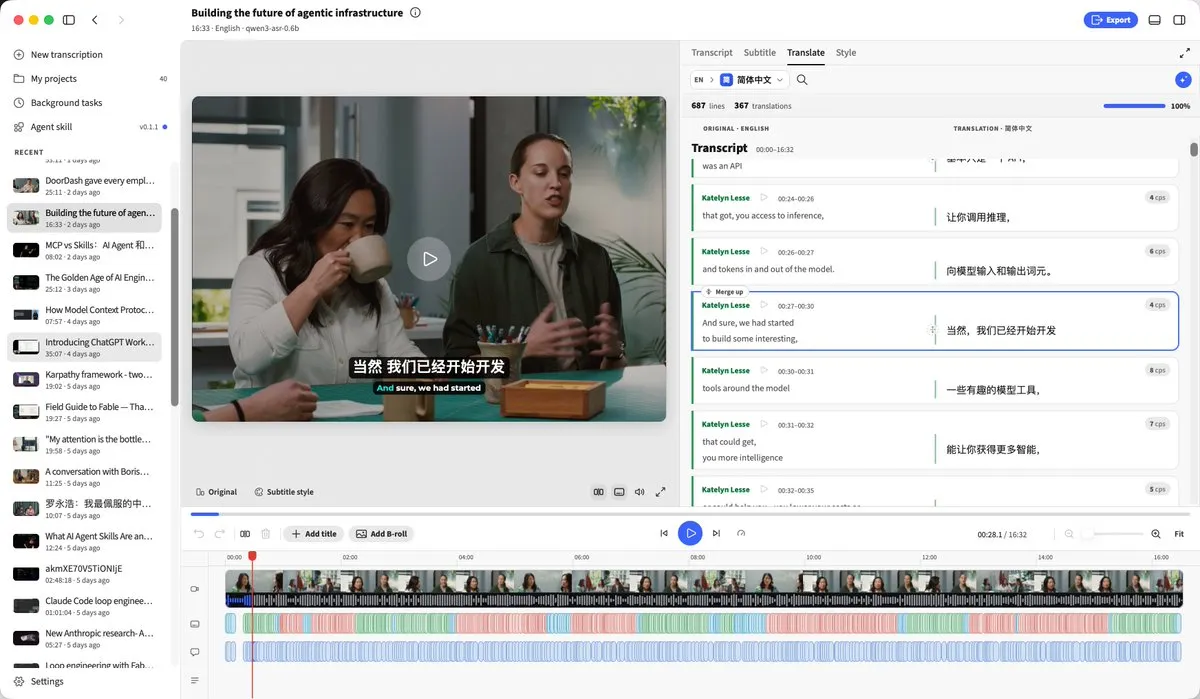
BaoCut : An intelligent video subtitle transcription, translation, and editing tool designed specifically for Mac. It wraps video processing functions into a command-line interface (CLI), allowing Agents (such as Codex or Claude Code) to automatically call the tool by triggering Skills to achieve video transcription, speaker identification, text polishing, translation, and automatic video editing based on subtitles (such as removing filler words), while providing a graphical interface for users to perform secondary editing. This demonstrates a practical direction for combining Agents with local applications (Source: dotey)
Silico : An interpretability and model fine-tuning experimental platform launched by Goodfire AI. Through this platform, users can run experiments as if they had an AI research team, such as replicating J-space on GLM 5.2, training reward models and running RL to reduce hallucinations, and visually demonstrating how models make specific predictions, making the AI research process more visual and efficient. This provides practical tool support for research on LLM interpretability (Source: GoodfireAI, teortaxesTex)

Weaviate Engram : An active memory management tool for AI Agents launched by Weaviate. By running asynchronous pipelines in the background, the tool actively extracts, reconciles, and updates memories related to specific topics, avoiding the high costs, performance degradation, and factual conflicts caused by traditional Agents stuffing entire conversations into the context. This provides a new solution for building long-running Agents with continuous memory capabilities (Source: bobvanluijt)
Bash.tv : A multiplayer collaborative coding Agent platform for developers developed by dom hofmann. The tool combines AI coding Agents with social interaction, supporting multiple users in collaboratively writing, debugging, and deploying code within the same space. This demonstrates a new trend of AI-assisted development tools evolving from single-user assistance to multi-person collaboration (Source: Suhail)
Bouncer : A locally run AI filtering tool developed and open-sourced by Imbue. It runs lightweight open-source models locally on the user’s device to identify and filter low-quality AI-generated content (AI slop) in real time as users scroll through social media (such as X), helping users clean up their information feeds. This demonstrates the application potential of local small models in personalized privacy filtering scenarios (Source: kanjun)
📚 Learning
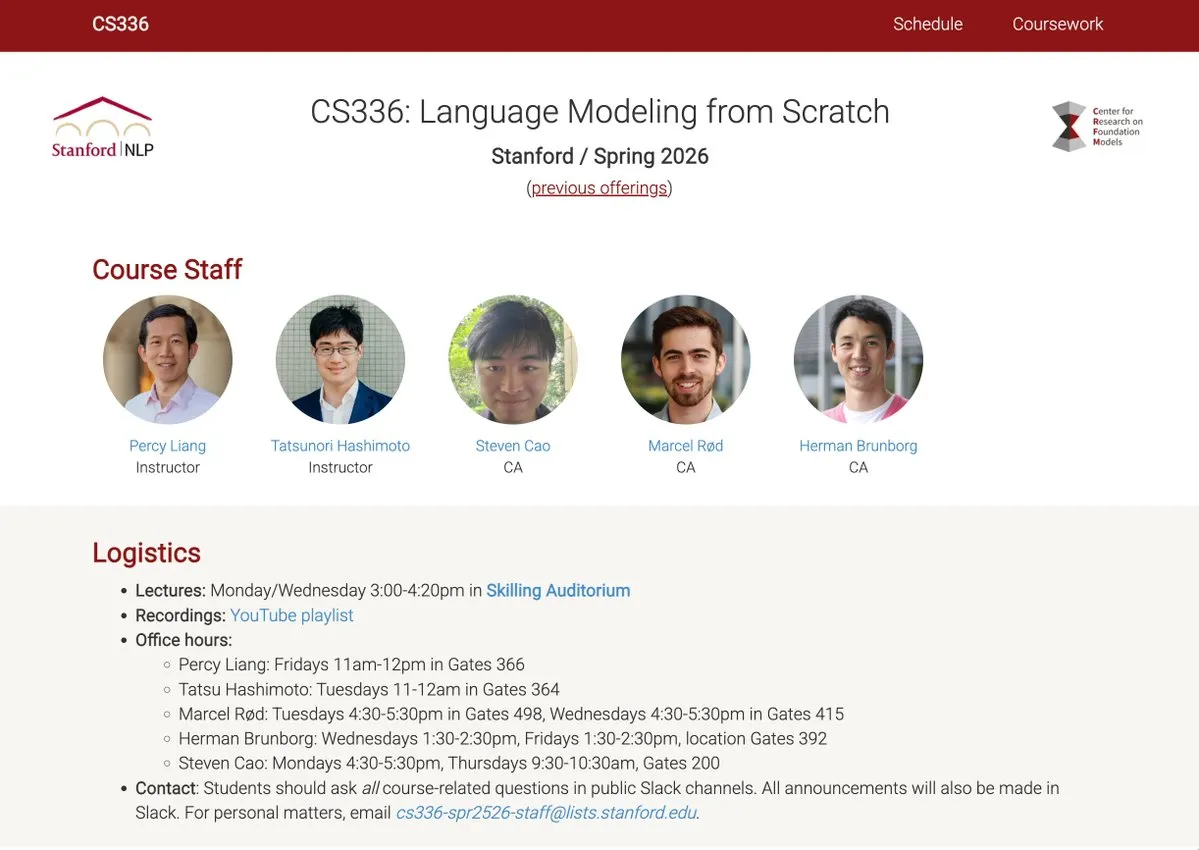
Stanford open-source course “CS336: Language Modeling from Scratch” : Stanford University has open-sourced 17 videos and all assignment materials for the CS336 course. The syllabus covers data collection and cleaning, Transformer and MoE architecture design, GPU kernels and parallelization acceleration, inference optimization, as well as alignment and reinforcement learning (RLHF), aiming to train students to implement large models from scratch at the lowest level. This provides highly valuable systematic learning resources for AI practitioners (Source: stanfordnlp)
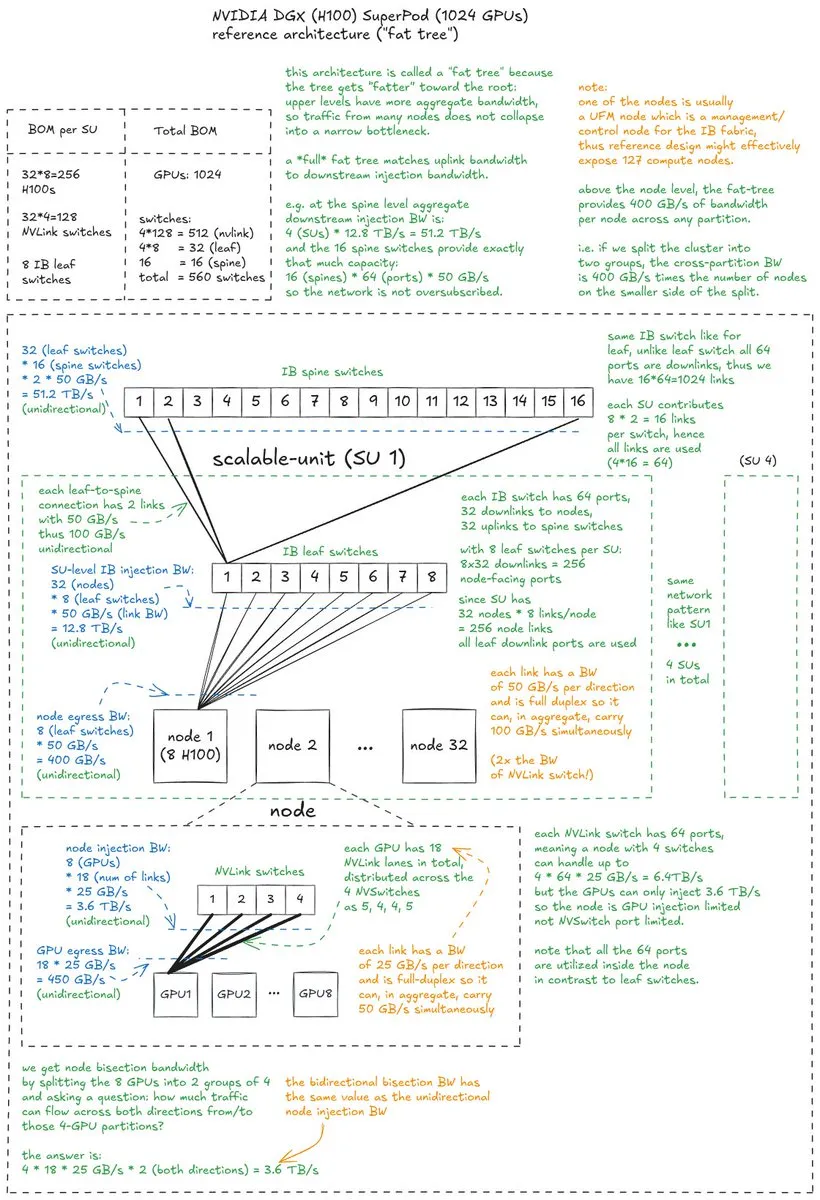
TPU and GPU cluster collective communication decryption guide : AI researcher Aleksa Gordić published a deep technical blog post titled “Inside TPU and GPU Clusters: The Anatomy of Collective Communication”. Accompanied by 40 intuitive diagrams, the article deeply analyzes how underlying collective communication primitives like All-Gather, Reduce-Scatter, and All-to-All collaborate with hardware topologies (TPU Pods, NVLink, InfiniBand) under architectures like FSDP and expert parallelism in MoE and Transformer models (Source: TheZachMueller, dejavucoder)
LangChain Academy launches “Introduction to Deep Agents” course : LangChain officially launched a new free course, systematically introducing the definition of agent Harness (runtime environment), why agents need a Harness, the four core capabilities of a Harness, and how to use LangSmith to track and evaluate deep agents. This helps developers better understand and build production-grade agent systems (Source: hwchase17)
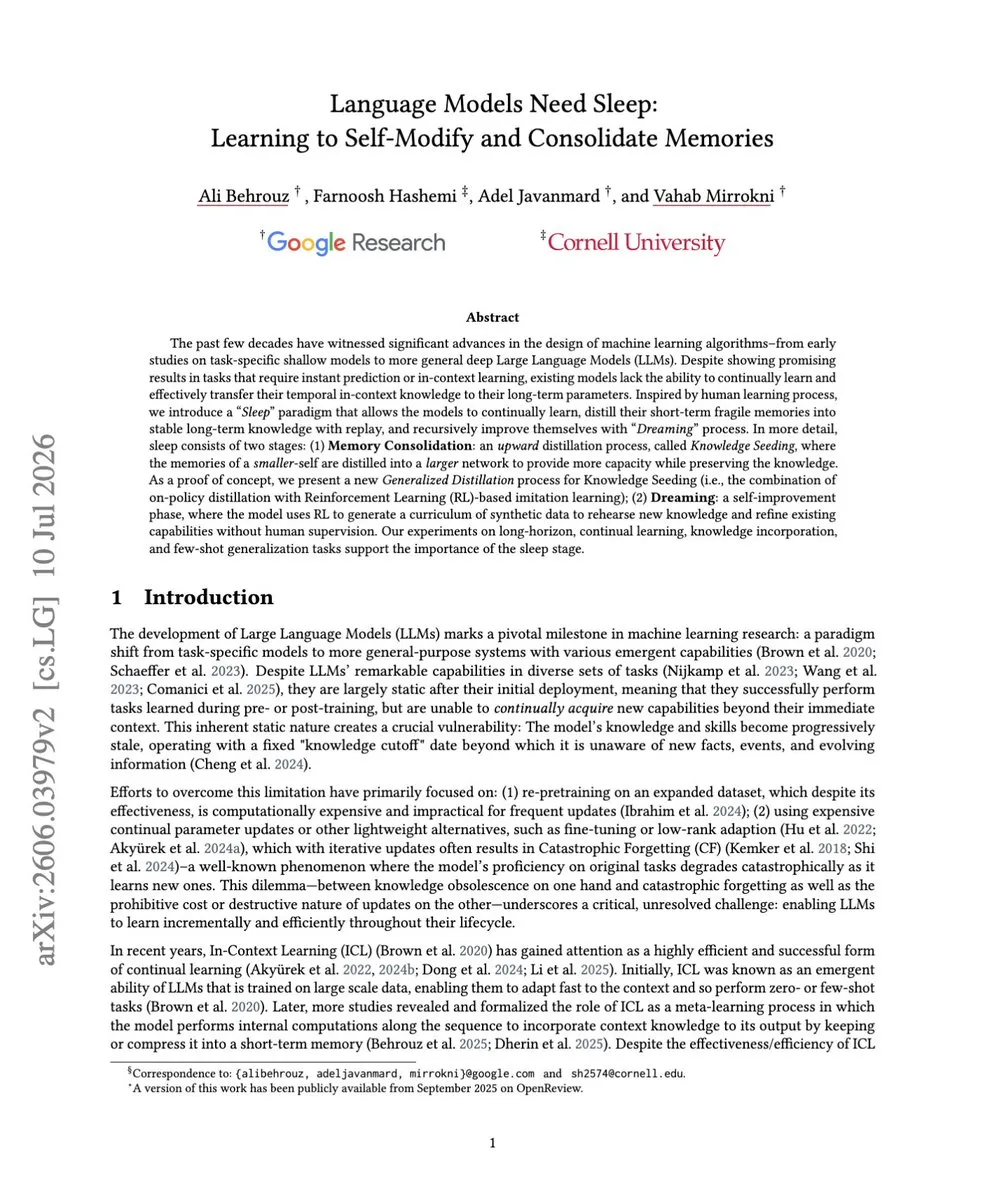
Paper “Language Models Need Sleep: Learning to Self-Modify and Consolidate Memories” : A Google research team proposed introducing “sleep” and “dream” phases for LLMs. During the “sleep” phase, the model consolidates short-term memories from the context into long-term weights through Knowledge Seeding; during the “dream” phase, the model generates synthetic data for RL training to self-correct, thereby achieving continuous learning and mitigating catastrophic forgetting (Source: behrouz_ali)
Paper “The Flexibility Trap”: ICML 2026 Outstanding Paper reveals flaws in diffusion language models : The Tsinghua LeapLab team published an outstanding paper at ICML 2026, pointing out that the arbitrary-order generation of diffusion language models (dLLM) disrupts logical reasoning. The study proposes the “JustGRPO” method, which maintains autoregressive order during training to constrain logical connectives while keeping parallel decoding during inference, achieving an excellent score of 89.1% on GSM8K (Source: 机器之心)

Paper “Rethinking Entropy Interventions in RLVR”: ACL 2026 Outstanding Paper reveals entropy collapse in reinforcement learning : A team from Zhejiang University and Tencent published an outstanding paper at ACL 2026, explaining the entropy collapse phenomenon in reinforcement learning (RLVR) training from the perspective of token-level entropy changes. The study proposes the STEER method, which dynamically reweights tokens that cause drastic entropy changes, achieving stable improvements in math and coding tasks (Source: 机器之心)
.jpg)
💼 Business
Chai Discovery completes $400 million Series C funding, valuation reaches $3.8 billion : Chai Discovery, an AI-driven molecular design and drug discovery startup, announced the completion of a $400 million Series C funding round, bringing its post-money valuation to $3.8 billion. This round was co-led by Index Ventures, Kleiner Perkins, Sequoia Capital, and Dimension Cap, with funds to be used to accelerate the application of AI in molecular and drug design, indicating that the AI healthcare sector remains highly favored by top-tier capital (Source: saranormous, krandiash)
Cognition marks one-year anniversary of Windsurf acquisition, annualized revenue surpasses $500 million : AI Coding Agent startup Cognition (parent company of Devin) marks the one-year anniversary of its acquisition of the IDE tool Windsurf. Over the past year, the two teams have deeply integrated, launching self-developed models SWE-1.7, Devin Review, and Devin Desktop. The team size grew from 44 to 350 people, and annualized run rate (ARR) surged from $73 million to over $500 million (Source: cognition, imjaredz)
DeepSeek prepares for 2027 IPO and kicks off new multi-billion-yuan funding round : Chinese LLM startup DeepSeek has initiated IPO preparations, planning to list on the domestic STAR Market with a target listing in 2027. Meanwhile, the company is launching a new funding round of over 10 billion RMB at a pre-money valuation of $71 billion (approx. 480 billion RMB), to be used for building its own data centers and purchasing AI chips (Source: 量子位, 36氪)

🌟 Community
Proliferation of AI-written “slop” sparks alarm, community calls for reclaiming authentic human expression : Discussions on social media about low-density, formatted “slop” content generated by AI have resonated widely. Hamel Husain and others pointed out that over-reliance on AI writing erases personal branding and trust, while increasing the cognitive load on readers. Researchers propose using techniques like distribution fine-tuning (DFT) to eliminate “slop” characteristics in AI writing, emphasizing that AI should serve as an auxiliary tool and humans should not outsource their thinking and voice (Source: HamelHusain, jon_stokes)
The debate between frontier models and open-source Harness: Harness engineering is becoming the core of self-evolution : The community is heatedly discussing the shift in LLM development paradigms. Lilian Weng pointed out in a long post that the Harness layer (prompts, memory, tool management, etc.) between raw models and real-world tasks has become as important as the model itself. Sam Altman and several developers also expressed support for open-source Harnesses (such as dcode), believing they help teams fully control context boundaries and eliminate the bloat and data leakage risks of closed-source Harnesses (Source: ClementDelangue, Vtrivedy10, 机器之心)
.jpg)
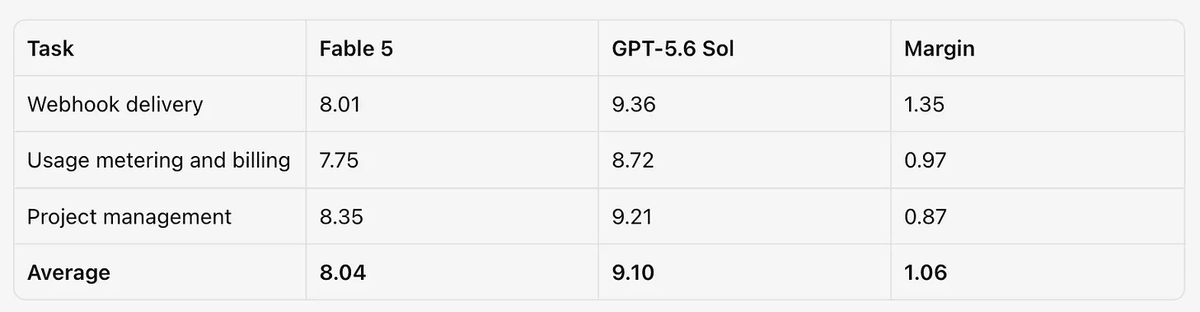
Hands-on comparison between GPT-5.6 Sol and Fable 5: Capability improvements accompanied by bugs and high token consumption : Developers conducted comparative tests between GPT-5.6 Sol and Claude Fable 5 on backend design and cybersecurity tasks. Sol led in scores on several benchmarks and was cheaper, but was also noted to have issues such as “overtraining” leading to weird behaviors, and susceptibility to double-billing bugs in complex tasks. Furthermore, Sol’s extremely high token consumption left some developers exclaiming they “cannot afford it” (Source: scaling01, teortaxesTex, andersonbcdefg)
💡 Others
Delaware proposes legislation to introduce “Artificial Intelligence Company (AIC)” legal entity : The Delaware Secretary of State and Norm Ai co-authored an article proposing a brand-new legal entity—the Artificial Intelligence Company (AIC). This entity aims to bring businesses autonomously run by AI Agents into predictable US corporate law and legal order, with Norm Ai leading a public-private partnership to refine the framework. This marks a significant step forward in the legal compliance of autonomous AI commercial entities (Source: johnjnay)
Spellbook establishes $1 million legal tech scholarship fund : Legal AI tech company Spellbook announced the establishment of the $1 million “Spellbook Legal Scholarship Fund.” The fund is open to law students dedicated to innovative exploration at the intersection of law, systems thinking, and technology. Selected recipients will receive $25,000 in funding, aiming to cultivate cross-disciplinary talent in the field of legal AI (Source: scottastevenson)

US Senate passes bill to make Daylight Saving Time permanent : The US House of Representatives passed legislation to permanently establish Daylight Saving Time nationwide. This bill sparked sci-fi-style jokes in the AI community on social media, such as “if the singularity arrives smoothly, could we adjust the tilt of the Earth’s rotational axis to maximize daylight benefits,” showcasing the tech community’s unique sense of humor (Source: riemannzeta, JimDMiller)