
🔥 Spotlight
Moonshot AI Releases Open-Source 3T-Scale Large Model Kimi K3: Featuring a 2.8-trillion-parameter MoE architecture, 1M context window, and native multimodality. Utilizing KDA linear attention and AttnRes deep residuals, inference costs are significantly reduced, though a slight gap remains on highly challenging tasks compared to Fable 5 and GPT-5.6. It secured first place on the Arena.ai front-end code leaderboard, surpassing Fable 5. Weights are planned to be open-sourced by July 27, sparking industry discussions about Chinese models catching up with US closed-source flagships. (Sources: QbitAI, Synced, THE DECODER)
Alibaba DAMO Academy Releases 4D Embodied World Model RynnWorld-4D: DAMO Academy proposes the first 4D embodied world model that simultaneously generates RGB, depth, and optical flow (RGB-DF). It adopts a three-branch Transformer architecture with joint cross-modal attention, trained in stages on 254 million frames of 4D data. The model can directly extract geometric and motion trends from intermediate layer features to achieve high-frequency closed-loop control, significantly outperforming traditional 2D strategies in success rates during real-machine tests of dual-arm dexterous manipulation. (Source: Synced)
.jpg)
Thinking Machines Launches Highly Efficient Open-Source Large Model Inkling: The AI startup founded by Mira Murati has released a 975B-parameter open-source multimodal MoE model. The biggest highlight is the introduction of a “controllable thinking” mechanism, allowing enterprises to control costs by adjusting the penalty coefficient of reasoning tokens. The model natively supports text, images, and audio, aiming to address high costs and hallucination issues in enterprise AI deployment by compressing the thinking process and focusing on practical tasks like tool calling. (Source: AI Business)

OpenAI Discloses Automated Red Teaming Model GPT-Red: Trained via self-reinforcement learning adversarial training, this model specifically searches for prompt injections and security vulnerabilities. In tests, GPT-Red achieved an 84% attack success rate against GPT-5.1, far exceeding the human red team’s 13%, and discovered “fake chain-of-thought” injection attacks for the first time. OpenAI used the attack samples it generated to train GPT-5.6 Sol, reducing its security vulnerability rate to 0.05% and significantly enhancing the security of production-grade agents. (Sources: MarkTechPost, AI Business)

China Advocates for an Open and Win-Win New AI Order at WAIC 2026: At the World Artificial Intelligence Conference held in Shanghai, the Chinese side delivered a keynote speech, reiterating support for open-source AI, opposing the creation of “new historical injustices” in the AI field, and warning against generalizing the concept of national security to restrict AI development. This reflects China’s attempt to break the US technological monopoly through open-source ecosystems and low-cost models, promoting the popularization of AI infrastructure and agents in Global South countries. (Sources: Reuters, SCMP)

🎯 Dynamics
Google Gemini 3.5 Pro Delayed Due to Substandard Coding Capabilities: The highly anticipated Gemini 3.5 Pro (codename “Cappuccino”) has had its release postponed by several months because it failed to meet internal standards in core capabilities such as code generation. Despite Google’s massive investments in computing power and data centers, internal bureaucracy, team infighting, and engineers’ trust issues with AI code have once again put the company on the defensive in its competition with OpenAI and Anthropic. (Source: The Verge)
Google Restructures AI Apps: NotebookLM Rebranded and Search App Integration Opened: Google has rebranded its popular AI note-taking tool NotebookLM as “Gemini Notebook” and added a cloud computer feature capable of writing and running code for Workspace users. Meanwhile, Google Search’s AI Mode now officially supports direct connections with third-party apps like Instacart, Canva, and YouTube Music, allowing users to complete shopping orders or template designs directly within the search interface. (Sources: THE DECODER, The Verge)
EU and German Regulators Crack Down on AI Antitrust and Compliance: The German media authority (ZAK) has for the first time designated Google AI Overviews and Perplexity as content providers, ruling that they are not protected by the DSA liability exemption clauses and must be held responsible for false content, while accusing Google of using AI summaries to suppress links to news websites. Meanwhile, under the DMA, the EU is forcing Google to open up its AI assistant interface on Android to competitors, breaking Gemini’s default monopoly. (Sources: THE DECODER, Ars Technica)
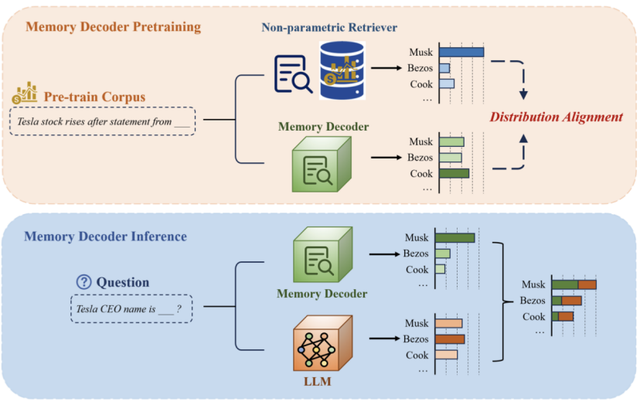
Shanghai AI Laboratory Releases 397B Non-Transformer Scientific Large Model: The laboratory released Intern-S2-Preview-397B at WAIC 2026. The model adopts a non-Transformer architecture named “Mobius” and pioneers a dual-engine design that separates “knowledge and reasoning.” It absorbs professional knowledge through pluggable external memory modules to avoid disrupting general capabilities. The model performs exceptionally well on AI4S tasks such as molecular design and material structure generation, improving end-to-end inference efficiency by nearly 4 times. (Source: QbitAI)
Li Auto Launches New-Generation L6: Starting at 249,800 RMB, Equipped with Self-Developed Smart Driving Chip Across All Trims: The new L6 returns to a “single-version” strategy, priced at 249,800 RMB. The new vehicle features flagship-level technology trickle-down in its electrical system, chassis, and smart cockpit: it comes standard with a 51kWh large battery (300km pure electric range), 12-minute fast charging, and is equipped with Li Auto’s self-developed Mach M100 smart driving chip (1280 TOPS computing power) and a 29-inch 6K ultra-wide panoramic screen, achieving a “same-generation, same-chip” intelligent experience as the flagship L9. (Source: QbitAI)

Apple Issues Legal Warnings to Former Employees at OpenAI, Alleging Leak of Trade Secrets: The competition for top AI talent and trade secrets has reached a fever pitch, with about 40 former employees who joined OpenAI receiving lawyer letters from Apple demanding they preserve all communication records and prepare for investigation. This move follows a lawsuit filed by Apple last week, accusing its former employees of helping OpenAI steal its hardware and chip design secrets. (Source: The Verge)
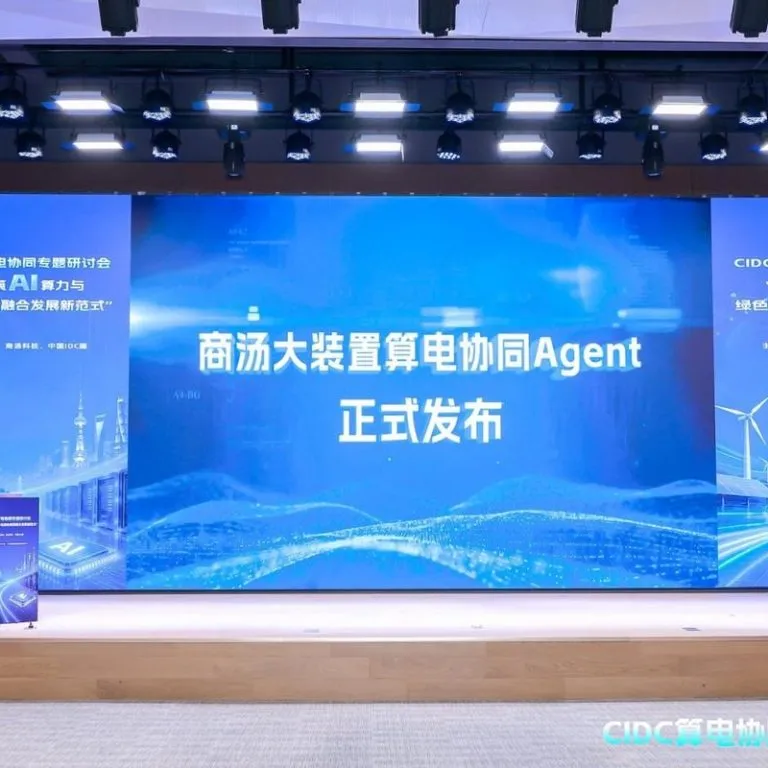
SenseTime Infrastructure Launches “Computing-Power and Electricity Collaborative Agent” to Optimize Token Production Energy Efficiency: SenseTime released the first “Computing-Power and Electricity Collaborative Agent” to pass the CAICT test at WAIC. The system intelligently schedules computing power and energy storage by sensing computing loads and predicting electricity prices. SenseTime pioneered replacing the traditional PUE metric with TPW (Tokens Per Watt). Following its deployment at the Lin-gang AIDC, it achieved an 80% increase in token output per unit of electricity cost and an annual carbon reduction of 24,000 tons. (Source: QbitAI)
Yuanli Lingji Challenges 15-Hour Continuous Operation, Building an 80,000-Part Great Wall Model with AI: Yuanli Lingji, in collaboration with StepFun, challenged 6 robots to continuously assemble a complex Great Wall model of over 80,000 parts for 15 hours at the WAIC site. Supporting this sub-millimeter fine operation are its general foundation model DM0.5 and world model DW0.5. Through a post-training reinforcement learning closed loop, the robots learned human-like “snapping force” and autonomous error-correction capabilities. (Source: Synced)
.jpg)
Roblox Launches Mobile AI Game Generation Tool “Build”: The gaming platform Roblox has released the mobile version of its AI-assisted creation tool “Build.” With just a single descriptive prompt, the AI can automatically generate a 3D game complete with gameplay mechanics, environments, and sound effects. To address the potential proliferation of low-quality “AI shovelware,” Roblox will automatically filter and rank generated games using player retention algorithms. (Source: TechCrunch)
🧰 Tools
code-review-graph: A Local-First Intelligent Code Graph Tool: This is an open-source local code analysis tool with nearly 20,000 stars on GitHub. It parses code using Tree-sitter to generate an AST, builds a local SQLite graph containing function, class, and test dependencies, and supports the MCP protocol. In tests on large projects like FastAPI, it achieved up to a 528x compression of context tokens, allowing the AI to read only the affected code files during reviews. (Source: GitHub)
LM Studio Bionic: A Local AI Agent for Open-Source Models: The local LLM execution platform LM Studio has launched the agent “Bionic.” Specially optimized for open-source models like Kimi K2.6 and GLM 5.2, this tool supports local document processing, code writing, and table generation. Additionally, it integrates Mistral AI’s Voxtral model to achieve low-latency, privacy-preserving real-time voice transcription locally. (Source: Hacker News)
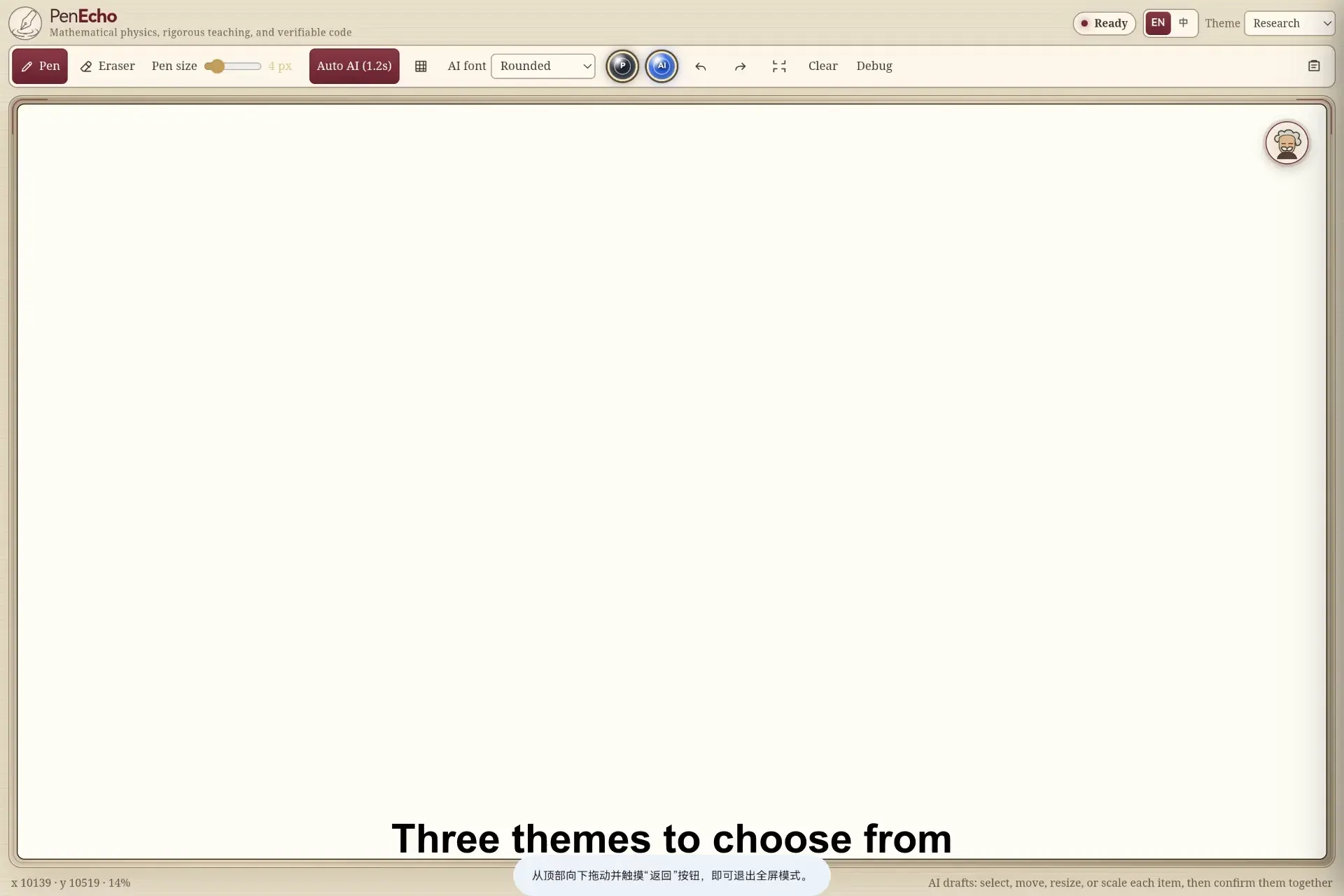
PenEcho: A Real-Time AI Interactive Canvas for Handwritten Formulas and Diagrams: Developers have open-sourced the PenEcho canvas tool. Users can write physics formulas or draw sketches directly on a tablet, and PenEcho will automatically send local image slices to large models like Claude, generating editable derivations or error-correction suggestions in real-time next to the handwritten content. This tool significantly optimizes the smoothness of human-computer collaboration in academic research. (Source: Reddit)
Chiron: An Exact Code Verification System Based on Minimum Description Length: Addressing the “hallucinations” and “overconfidence” that often occur when large models generate code, the open-source project Chiron provides a verification mechanism based on Minimum Description Length (MDL). After the model generates rules, Chiron strictly verifies them on a held-out test set. For outputs that cannot be 100% confirmed, the system directly triggers a refusal response, ensuring the absolute safety of the output code. (Source: Reddit)
📚 Learning
cwc-workshops: Anthropic’s Official Claude Code Hands-on Workshop: Anthropic has open-sourced all teaching materials from its official “Code with Claude” workshop. The content covers how to use Claude for LLM evaluation and tuning, multi-agent system decomposition, runtime validation of React components, and how to build cross-session long-term memory for agents using Memory Store and Dreaming Service. (Source: GitHub)
Transformer By Hand: A Guide to Calculating Transformer Network Architectures by Hand: Addressing the complex Transformer architecture, Professor Tom Yeh has released hand-calculation educational diagrams. He simplifies the complex components into core “attention weights” and “feed-forward networks (FFN).” Through the forward propagation calculation of 5 input features in a single-layer network, he visually demonstrates the feature-mixing principles of the attention mechanism in the spatial dimension and the FFN in the channel dimension. (Source: Twitter)
Academic Paper: Length Penalties Reduce the Monitorability of Chain-of-Thought (CoT): The paper (arxiv:2607.09786) points out that while adding length penalties in reinforcement learning can shorten CoT and reduce token costs, it selectively hides the true basis of the model’s reasoning. Experiments show that when compressed CoT is disturbed by prompt bias, its probability of exposing bias is 7-35% lower than that of randomly cropped text, making it harder for external monitors to detect the model’s latent errors. (Source: HuggingFace)
💼 Business
Toyota Research Institute Spin-off Walden Robotics Secures $300 Million in Funding: Walden Robotics, spun off from the Toyota Research Institute, has announced the completion of a $300 million seed round at a valuation of $1.1 billion. Investors include Toyota, Nvidia, CoreWeave, and others. Instead of pursuing a bipedal humanoid route, the company adopts a practical design of a “wheeled chassis + humanoid upper body,” focusing on manufacturing and logistics scenarios, and has already entered actual production in Toyota factories. (Source: AI Business)

Inference Neocloud Platform General Compute Secures $400 Million in Debt Financing: General Compute has secured a $400 million loan from Upper90, marking the industry’s first large-scale financing to use non-Nvidia inference chips (SambaNova SN50) as collateral. As the performance of open-source models surges, market demand for low-cost inference compute has grown significantly. This deal signals that capital is beginning to flow toward dedicated inference infrastructure beyond GPUs. (Source: TechCrunch)
Databricks Plans New Funding Round, Valuation Climbs to $188 Billion: Data lakehouse giant Databricks is raising a new round of strategic funding at a valuation of $188 billion. The company’s annualized revenue has reached $6.9 billion (up 80% year-over-year), with AI products like Unity AI Gateway and Genie (AI coworker) contributing $1.7 billion. The new funds will be used to accelerate enterprise multi-model governance and data retrieval layouts. (Sources: Podcast, Reddit)
🌟 Community
Kimi K3 Release Ignites Debate on Open-Source vs. Closed-Source Large Model Paths Between China and the US: The community has engaged in a heated debate over Kimi K3’s performance. Supporters argue that K3’s victory in the front-end code arena proves the gap between open-source models and top Western closed-source models has narrowed to just days, shattering the prejudice that “China can only rely on distillation.” Skeptics, however, point out that K3’s high pricing ($3/$15) signals the end of the cheap open-source era, and that its long inference latency, persistent hallucinations, and “over-embellishment” issues on complex tasks mean its actual performance still needs further validation on contamination-free test sets. (Sources: THE DECODER, Reddit, 36Kr)
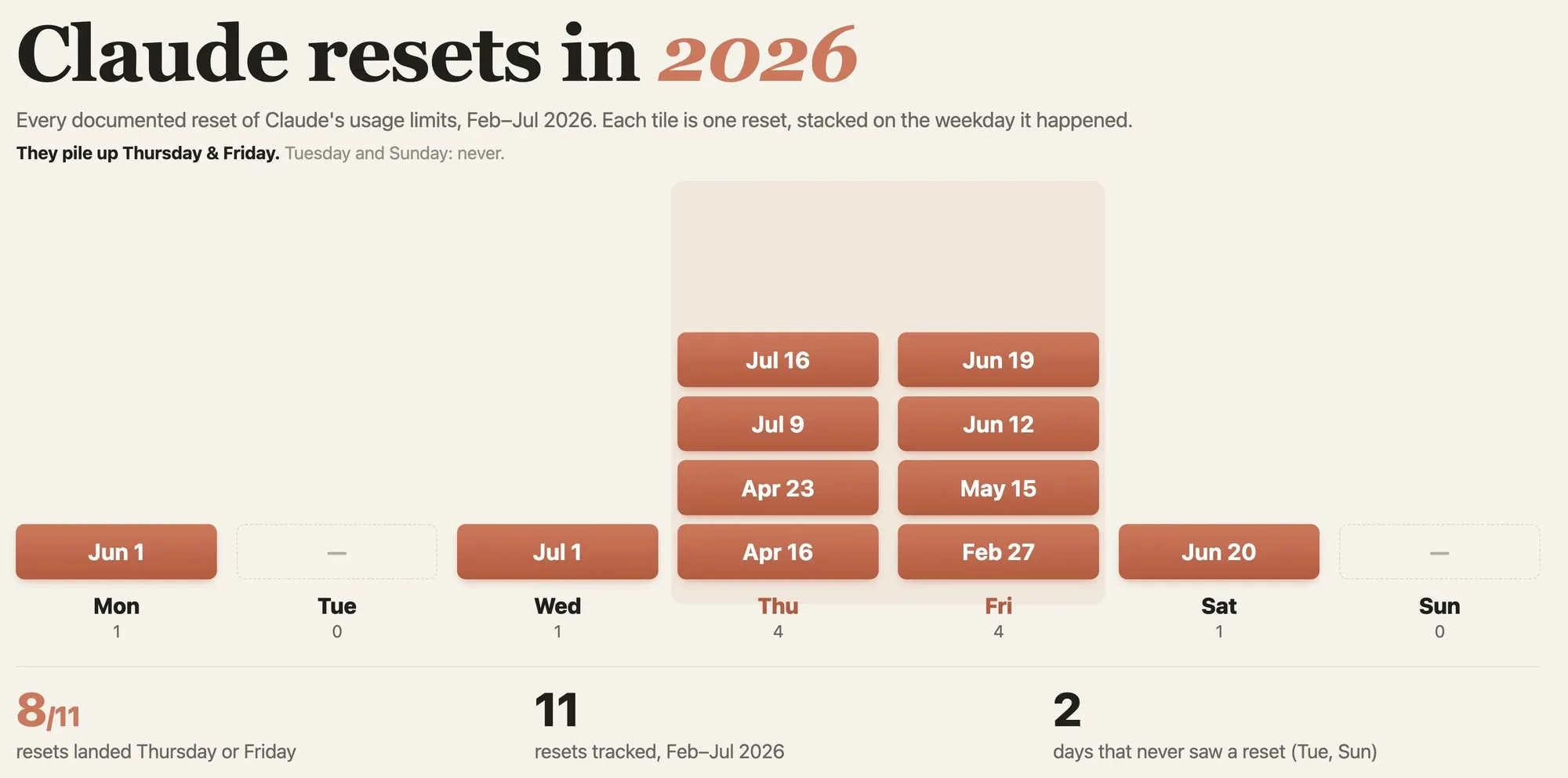
Claude’s Random Reset Mechanism Triggers Unsubscription Wave, Users Switch to OpenAI: The ClaudeAI community on Reddit has erupted in strong protests against Anthropic’s usage limit reset mechanism. Users complain that random and opaque reset times (especially for users with Thursday resets) lead to a massive waste of quotas. Many highly upvoted comments stated this was “the straw that broke the camel’s back,” and they have canceled their $200/month subscriptions to switch to OpenAI/Codex platforms, which support quota carryovers and offer a more stable experience. (Source: Reddit)
“Agentwashing” and Token Waste Trigger Enterprise Anxiety Over AI ROI: The latest surveys from a16z and VentureBeat have sparked heated discussions in the community. Data shows that 71% of the so-called “agents” deployed by enterprises are merely “wrapped versions” of single-turn conversations, rather than true multi-step workflows. Due to the lack of clear task definitions and evaluation systems, 80% of AI budgets are wasted in ineffective loops. This is prompting enterprises to shift from blind “tokenmaxxing” to building AI management systems centered on evaluation (Eval) and gateways. (Sources: 36Kr, Reddit)
💡 Others
AWS Billing System Suffers Severe Glitch, Users Billed Billions of Dollars: Multiple Hacker News users reported that the AWS billing forecasting system experienced a severe error, issuing massive bills ranging from $1.7 billion to $3.0 billion to personal test accounts that normally cost less than $5 per month. The official AWS support bot responded that this might be a metering or billing error, and the support team has urgently created tickets to investigate. (Source: Hacker News)
Hackers Exploit Worm Virus to Breach Suno, Leaking Entire Training Dataset Sources: The music generation platform Suno was breached by hackers using the Shai-Hulud worm virus, exposing part of its source code and training dataset composition. Leaked data reveals that Suno’s training data includes 113,000 hours of YouTube music, 62,000 hours of licensed Pond5 audio, and 12,000 hours of Deezer music. This has sparked intense debate in the community regarding copyright and fair use of data. (Source: Twitter)

AI Helps Decipher Herculaneum Scrolls, Solving the Mystery of Plato’s Burial Site: Scientists have successfully read the contents of ancient scrolls charred by the eruption of Mount Vesuvius without touching the carbonized rolls, using short-wave infrared, 3D scanning, and AI image enhancement technologies. The newly deciphered 1,000+ words record the history of Plato’s Academy in detail and, for the first time, pinpoint Plato’s burial site in a private garden near the temple of the Muses within the Academy. (Source: Twitter)