



🔥 Highlights
Hugging Face Reportedly Explores Sale at Over $13 Billion Valuation : Hugging Face, the world’s largest open-source AI model and dataset hosting platform, is reportedly working with investment banks to evaluate acquisition interest from potential buyers, with a valuation that could exceed $13 billion—a substantial jump from its $4.5 billion valuation in 2023. Community members and analysts point out that as model-layer competition intensifies, the strategic value of infrastructure assets controlling developer gateways and model distribution hubs has surged. However, if acquired by a single tech giant, the platform’s neutrality and open-source ecosystem independence could face severe tests (Source: TechCrunch, 36Kr)
Alibaba Officially Releases Wan 3.0 Video Generation Model for Public Beta : Alibaba’s large video generation model Wan 3.0 has officially launched and opened for public beta simultaneously across Alibaba Cloud Model Studio (Bailian), Tongyi Qianwen, and multiple ecosystem platforms. The model supports native generation of coherent videos up to 30 seconds in a single pass, introduces multimodal reference inputs such as PDFs, PPTs, tables, and web pages for the first time, and significantly reduces the “AI plastic look” in long-duration camera movements, lighting physics, and realistic human textures. It is now fully integrated into commercial workflows including mini-dramas, advertising, and e-commerce production (Source: QbitAI, The Verge)

IBM Unveils First Mainframe Chip Supporting Dual Arm and Z Architectures Alongside Spyre AI Accelerator : At the Hot Chips conference, IBM announced its next-generation mainframe processor architecture, where each core can dynamically switch between IBM’s native Z instruction set and the Arm64 architecture at nanosecond speed, enabling enterprises to run the vast modern Arm and Linux AI ecosystem alongside core transaction systems with zero overhead. IBM also previewed its next-generation Spyre AI coprocessor, equipped with high-bandwidth memory to support enterprise-scale LLM inference and agentic workflows (Source: VentureBeat)
OpenAI Acquires Instant Team and Issues Full Quota Reset for Codex Glitch : OpenAI announced the full acquisition of the team behind YC star startup Instant (known as the “Firebase for AI”) to address critical gaps in multi-threaded collaboration, offline caching, and persistent state management for Agents. On the same day, addressing user reports of rapid quota consumption, the head of Codex confirmed an excessive consumption bug involving long-session image compression, Computer History, and automated chat naming, executing a complete quota reset for all paid subscribers (Source: 36Kr, WeChat)
Harvard and Anthropic Scholars Solve 78-Year-Old Math Problem with Claude: Proving the Existence of a Complex Structure on the 6-Sphere : In collaboration with Claude, Harvard University researcher Levent Alpöge explicitly constructed a compact complex manifold structure on the 6-sphere ($S^6$) for the first time in a 108-page paper, completing a comprehensive set of topological and differential geometry verifications. This problem had baffled mathematicians for nearly 80 years since it was posed in 1948. This breakthrough demonstrates the deep reasoning potential of large models in constructing complex mathematical objects from scratch and synthesizing cross-domain tools (Source: 36Kr, X @teortaxesTex)
🎯 Trends
Anthropic Internal Test Codenames Leaked as Flagship Fable 5 Sees Cool Enterprise Adoption : Developers discovered two new closed-beta model codenames in the Anthropic API, “claude-marshmallow-eap” and “claude-melon-eap”, speculated to be Opus 5.1 or a next-generation Sonnet branch. Meanwhile, data from spend management platform Ramp shows that due to its high unit price, flagship Fable 5 accounts for only 11.4% of enterprise spend on Anthropic, while the more cost-effective Opus 5 rapidly overtook its flagship sibling in both actual API call volume and total spend after launch (Source: Synced, Financial Times)
Xiaomi Unveils Three Self-Developed AI Chips: Xuanjie O3, O100, and D100 : At a technical briefing, Xiaomi launched three chips: the flagship smartphone SoC Xuanjie O3, built on TSMC’s 3nm process with fully integrated AI units; the on-device AI accelerator chip Xuanjie O100, featuring 3D wafer-level hybrid bonding and 1.22 TB/s memory bandwidth; and China’s first 3nm high-compute autonomous driving chip, Xuanjie D100. Xiaomi also showcased the AI Cube prototype, which integrates all three chips to run 10B+ models locally and offline (Source: Synced)
.jpg)
Tencent ARC Lab Open-Sources SCoPE: Ray-Space Positional Encoding for Video DiT : To address geometric representation chaos during camera movements caused by grid coordinates in traditional video DiTs, Tencent, in collaboration with HKU and HKUST, introduced SCoPE. By directly injecting camera Plücker ray coordinates into the attention mechanism, SCoPE achieves single-image free-viewpoint navigation, precise camera trajectory control, and loop-closure viewpoint consistency recovery with minimal parameter overhead (Source: Synced)
.jpg)
Alibaba DAMO Academy’s Liver Cancer Diagnostic Model DAMO LiON Featured in Nature Medicine : Developed by DAMO Academy in collaboration with Shengjing Hospital, the liver cancer diagnostic AI model DAMO LiON iteratively fuses multiphase CT images to capture subtle pixel-level differences, accurately detecting primary and metastatic micro-lesions around 1 cm amidst complex tissue interference. In a prospective clinical trial involving 10,000 patients, it successfully helped identify 15 missed diagnoses while reducing physician reading time by 27% (Source: QbitAI)
Cerebras Announces Next-Gen CS-4 Rack-Scale AI Accelerator System : Cerebras unveiled the CS-4 rack-scale system based on the 5nm WSE-3 wafer-scale engine at Hot Chips. By upgrading power delivery and cooling to boost clock frequencies, a single rack houses 3 full wafers and delivers single-user inference throughput up to 4,400 tokens/s, which the company claims reaches up to 30x the performance of traditional GPU solutions on specific LLM inference tasks (Source: THE DECODER)
Ant Group and Xiamen University Propose MedGuard Medical Fact-Checking System : Published in npj Digital Medicine, this research addresses factual risks in online consultations. MedGuard deconstructs complex multi-turn doctor-patient dialogues into independently verifiable atomic medical claims and introduces an uncertainty-driven closed-loop verification against external guidelines, improving fine-grained dialogue risk detection F1 scores by 22.1% over general LLM baselines (Source: Synced)
HiDream.ai Releases Native Omni-Modal Interactive World Model HiDream-O1-World : HiDream.ai introduced an interactive world model based on its self-developed UiT architecture. Supporting text, image, and real-time control command inputs, the model features long-horizon spatiotemporal consistency and physical rule reasoning, topping the WBench Navi leaderboard. It provides foundational infrastructure for interactive AI games/films, embodied AI simulation training, and high-fidelity 3D spatial generation (Source: QbitAI)
🧰 Tools
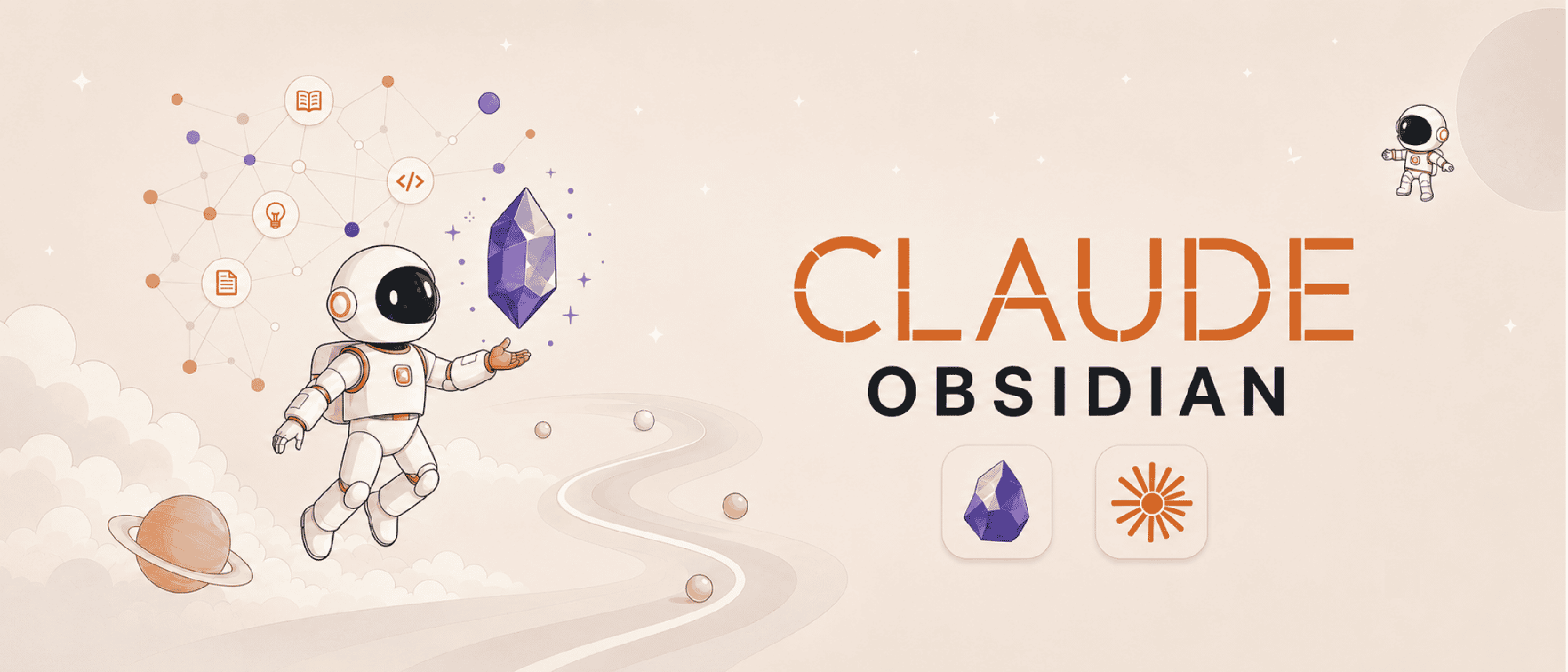
claude-obsidian: A Local Automated Knowledge Base System Powered by Claude Code : Drawing inspiration from Andrej Karpathy’s LLM Wiki paradigm, this open-source project embeds Claude Code deeply into local Obsidian knowledge bases. It features 15 Agent Skills covering data scraping, claim fact-checking, automated cross-referencing, and bidirectional link generation, constructing a self-iterating personal knowledge graph completely locally without data leakage (Source: GitHub Trending)
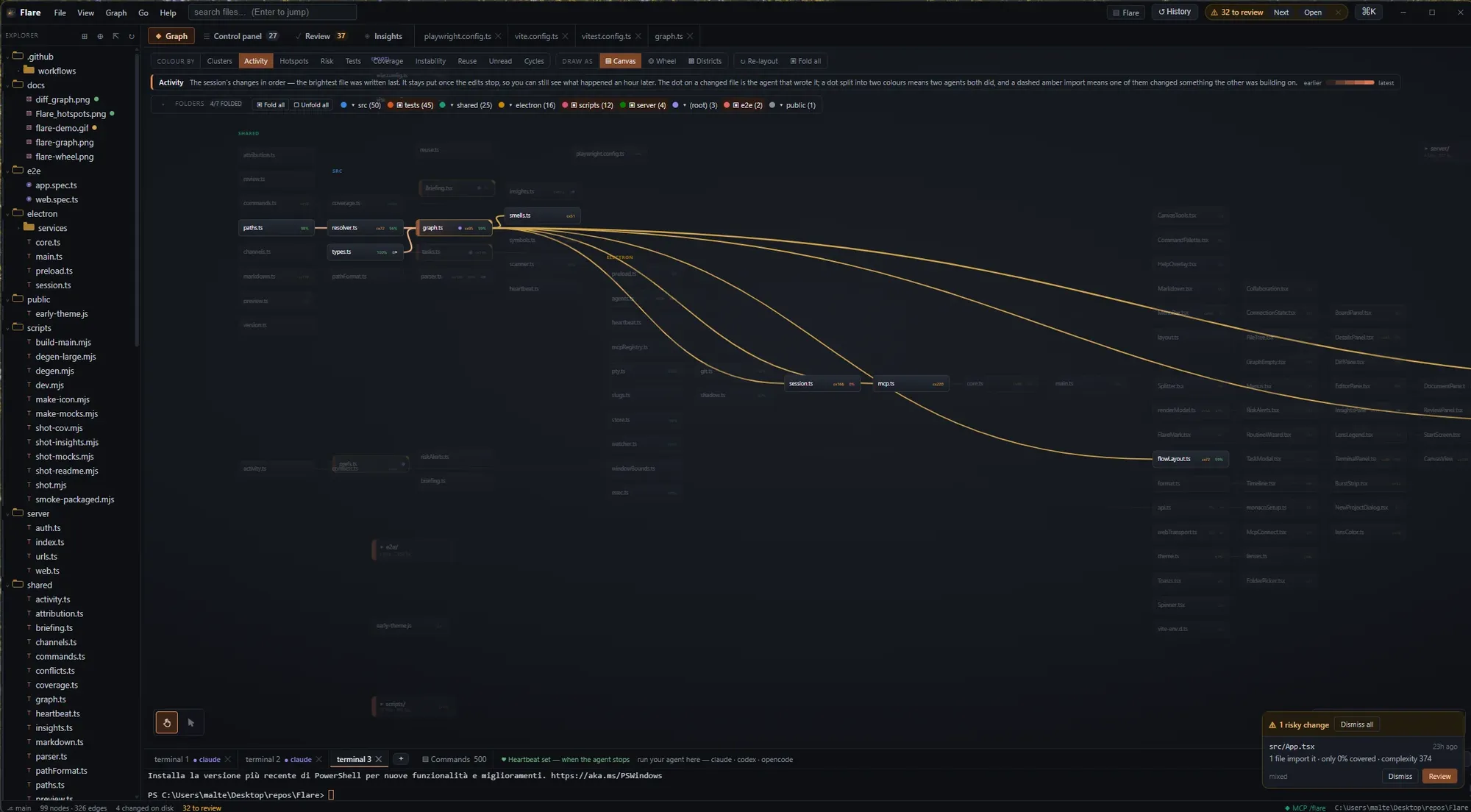
Flare: An Agentic Desktop IDE Built Around Code Dependency Topology Graphs : An open-source desktop IDE (built on Electron) designed specifically for coding agent collaboration. The primary interface renders real-time codebase call graphs; when agents like Claude or Codex edit code or run tests, corresponding file nodes dynamically highlight blast radius and change propagation. It also features a Git-decoupled real-time change rollback and task board mechanism (Source: Reddit r/ArtificialInteligence)
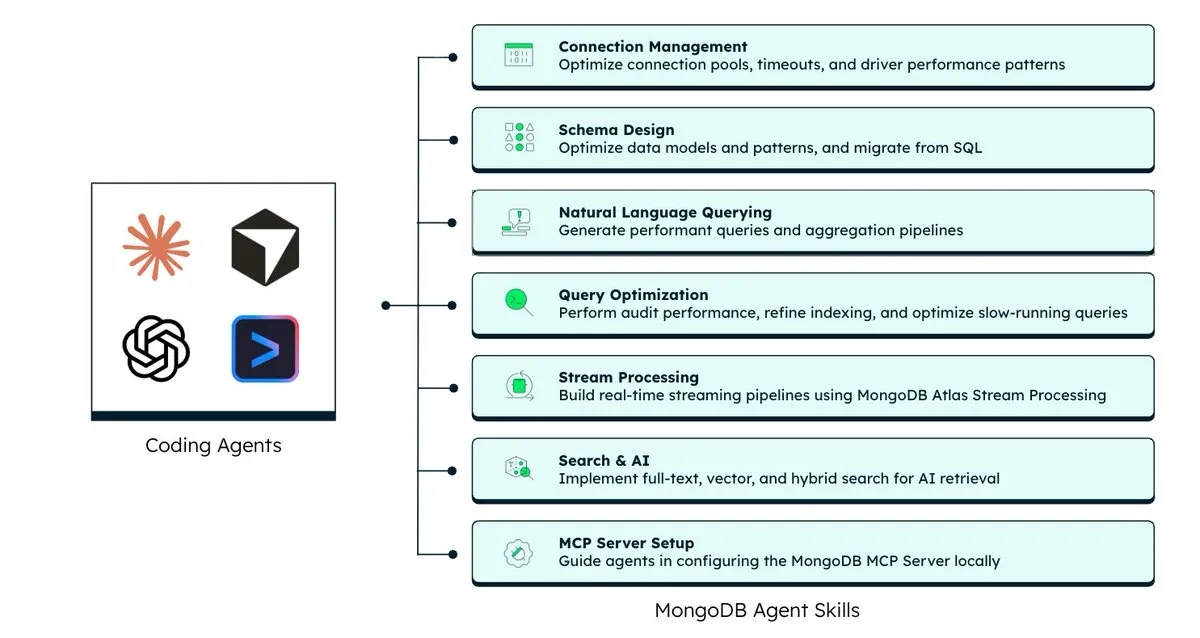
MongoDB Releases Official Agent Skills for Claude Code and Cursor : MongoDB officially launched a dedicated toolset for agents, packaging schema design, index optimization recommendations, complex query authoring, and connection pooling best practices. Developers can inject these skills via MCP or plugins into mainstream coding agents, ensuring generated database code and architectural refactoring strictly follow official production standards (Source: TheTuringPost)
Anthropic Upgrades Claude Tag: Enabling Slack Agents to Proactively Read and Intervene in Chats : Anthropic updated its enterprise collaboration app Claude Tag, removing isolated single-message classifiers to allow Claude to read full channel context and historical memory. The system autonomously decides whether to reply directly in the channel, start an independent troubleshooting thread, or observe silently, improving the effectiveness of unprompted proactive intervention by 30% in multi-person collaborative debugging scenarios (Source: VentureBeat)
📚 Research & Tutorials
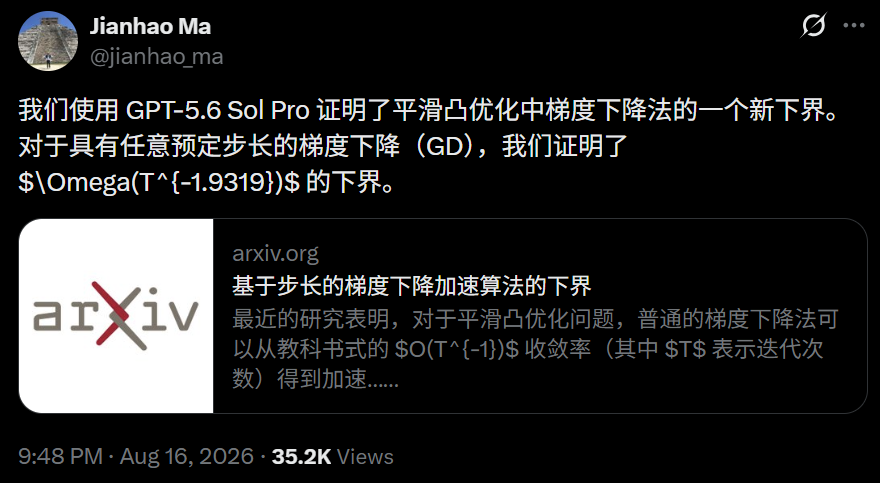
Tsinghua and Wharton Scholars Prove 40-Year-Old Gradient Descent Convergence Limit Conjecture with GPT-5.6 : Jianhao Ma from Tsinghua University and Yuxin Chen from the Wharton School of the University of Pennsylvania, using GPT-5.6 Sol Pro to propose an adversarial oracle geometric construction, proved for the first time that gradient descent with pure stepsize scheduling faces an insurmountable convergence lower bound of $\Omega(T^{-1.9319})$. This permanently settles the long-standing conjecture on whether stepsize scheduling alone can match the theoretical limit of Nesterov’s accelerated gradient descent. The proof was subsequently transcribed entirely into Lean 4 code by Codex and passed flawless formal verification (Source: 36Kr)
Jilin University and Xiamen University Propose “Graph Engineering” Paradigm for Systemic Intelligence : Addressing the organizational bottlenecks of single agents in complex, long-horizon tasks, 15 research institutions systematically reviewed an agent engineering framework centered on dynamically evolving graphs. The paper unifies task decomposition, heterogeneous agent collaboration, and runtime state management into graph structures, establishing a methodological framework for large model systems transitioning from “individual intelligence” to auditable, self-evolving “systemic intelligence” (Source: HuggingFace Daily Papers, 36Kr)
Tsinghua University Team Led by Zhao Mingguo Publishes Vision-Driven Bipedal Robot Soccer Control Framework in Science Robotics : The team proposed a unified end-to-end perception-action reinforcement learning framework that compresses historical temporal observations with an encoder-decoder and incorporates adversarial motion priors. On physical hardware (Booster platform by Booster Robotics), the system achieves dynamic ball-finding, adaptive gait fine-tuning, and 50Hz continuous shooting responses relying solely on onboard cameras, maintaining high success rates even against moving targets (Source: Synced)
.jpg)
DAIR.AI Releases Empirical Study on Coding Agent Developer Behaviors and Context Consumption Preferences : Tracking 33,000 agent-generated pull requests and 557 long-task development sessions, the research team found that instruction files (AGENTS.md / CLAUDE.md) and scratchpads account for 60.5% of total agent reading volume, compared to just 1.3% for traditional API documentation. Furthermore, prompting agents to retrieve documentation prematurely and frequently significantly decreases the frequency of real-time test verifications (Source: dair_ai)
Comprehensive Reinforcement Learning Guide: From Policy Gradients to Cutting-Edge LLM Post-Training : Machine learning researcher Cameron Wolfe published an in-depth guide to reinforcement learning for LLMs. Starting from Markov Decision Process derivations, it systematically dissects technical details of Vanilla Policy Gradient, PPO, GRPO, and recent variants (Dr. GRPO, DAPO), with particular emphasis on the memory and computational benefits of critic-free architectures in LLM alignment (Source: cwolferesearch)
💼 Business
Anthropic Enterprise Joint Venture Ode Acquires Casper Studios : Ode, the enterprise AI services entity formed by Anthropic alongside Blackstone and Hellman & Friedman, announced its first acquisition, bringing on board the team from San Francisco AI integrator Casper Studios to accelerate embedding Claude Code and custom agent solutions into complex IT and compliance workflows of large legacy enterprises (Source: AI Business)

Unitree Robotics Market Cap Plunges Over 40% in First Week Post-IPO : As the “first humanoid robot stock” on the STAR Market, Unitree Robotics saw its market valuation pull back consecutively after an opening-day surge past 440 billion RMB, with its latest market cap falling to around 240 billion RMB. Market analysts note that an extremely small initial float drove the valuation premium, while its high P/E ratio and reliance on university research procurement for over 70% of revenue have prompted secondary markets to rationally re-evaluate the company based on mass-production delivery quality and real industrial reorder rates (Source: 36Kr)
On-Device AI Infrastructure Startup Silicon Token Raises Hundreds of Millions of RMB Across Multiple Rounds : Silicon Token announced the completion of multiple funding rounds led by Zhenzhi Capital, bringing its valuation close to 2 billion RMB. Focusing on desktop-grade on-device AI workstations and heterogeneous scheduling systems, the company leverages memory-to-stream pipeline technology to allow a single 16GB consumer GPU to run dense video generation models requiring 120GB weights at full capability, targeting low-cost local content creation (Source: 36Kr)
🌟 Community
OpenAI Reports Threatening ChatGPT Conversation Leading to User Arrest, Sparking Debate on AI Privacy Boundaries : A former analyst in Florida entered premeditated murder plans against an ex-girlfriend into ChatGPT, triggering platform safety filters; OpenAI handed the data over to the FBI, leading to the user’s arrest. The incident sparked intense community debate: supporters argue the prompt intervention prevented a violent crime, while many developers and legal scholars worry that proactive platform monitoring without a judicial warrant could erode user privacy and introduce a novel “Tarasoff duty to protect” dilemma (Source: 36Kr)
Open-Source Model Token Share on Vercel AI Gateway Surges to 62%, Surpassing Closed-Source : Data revealed by Vercel founder Guillermo Rauch and investment firms indicates that token consumption for open-weight models on the Vercel AI Gateway jumped from 28.4% to 62% over the past two months, taking the majority market share for the first time. The community notes that in multi-agent architectures, sub-agents executing routine tasks are extremely cost-sensitive, driving massive token volume from expensive closed-source flagships to cost-effective open-source alternatives (Source: X @GavinSBaker, 36Kr)
Developers Discuss On-Device Ultra-Low-Bit Quantization and Deployment of 450M Specialized Vision Models : The LocalLLaMA community shared experiments on domain-specific supervised fine-tuning of a 450M vision-language model (LFM2.5-VL) across 50,000 browser screenshots, achieving structured web-state extraction accuracy rivaling 4B general-purpose models. Concurrently, a 2.7-bit ARM CPU ultra-low-bit quantization framework for Llama 3.2 garnered attention, underscoring the engineering potential of “task-specific lightweight models” on edge devices (Source: Reddit r/LocalLLaMA, HuggingFace Daily Papers)
💡 Other News
2026 Xplorer Prize Winners Announced: Gao Huang, Xuanzhe Liu, and Others Selected in Information Electronics : The 2026 Xplorer Prize winners were officially announced. Young scientists including Gao Huang of Tsinghua University (fundamental neural network architectures and diffusion language models), Xuanzhe Liu of Peking University (distributed LLM and intelligent computing system software), and Xuehai Qian of Tsinghua University were selected in the Information Electronics category, showcasing robust domestic depth across frontier AI algorithms, efficient inference frameworks, and computing hardware-software co-design (Source: Synced)
.jpg)
Nonprofit Investigation Criticizes Major AI Chatbots for Lack of Stance Disclosure in Sensitive Consultations : A cross-border investigation by AlgorithmWatch on ChatGPT, Gemini, Claude, and Grok revealed that when handling sensitive inquiries such as underage or unplanned pregnancy, models had an over 25% chance of directing users to ideological, non-official counseling organizations without disclosing their stance, raising legal and compliance concerns regarding factual transparency when generative AI acts as an information gatekeeper (Source: THE DECODER)

Pew Survey Shows Over One-Third of New Web Pages Contain AI-Generated Content Post-ChatGPT Launch : Latest data from the Pew Research Center reveals that since the popularization of large models in late 2022, over one-third of new English web pages across the open web are AI-generated or heavily AI-edited. The massive devaluation of content generation is compelling search engines, data cleaning pipelines, and evaluation benchmarks to establish stricter anti-synthetic-text filtering and provenance tracking mechanisms (Source: The Verge)