



🔥 Spotlight
NVIDIA AI Servers Face Across-the-Board Price Hikes of Over 15% Due to Memory Shortages : According to Bloomberg and multiple industry sources, driven by tight production capacity and soaring costs for server DRAM and HBM from Samsung, SK Hynix, and Micron, NVIDIA has notified major cloud providers and server ODMs that pricing for its GB300 and next-generation Vera Rubin 200 server systems scheduled for delivery early next year will increase by 15% to 17%. For a 1GW-scale AI data center, this server price increase alone will add more than $5 billion to construction costs. NVIDIA is simultaneously evaluating diversified memory configurations and investing in data center energy infrastructure to alleviate supply chain bottlenecks (Sources: The Verge, THE DECODER, QbitAI)

Security Study Exposes Proprietary LLM API Encrypted Reasoning Vulnerability, Enabling Cross-Model Decoding of Hidden Thoughts : A security research team published a paper demonstrating that encrypted reasoning blobs returned to clients by leading LLM providers (OpenAI, Anthropic, Google, etc.) to maintain stateless API calls suffer from structural security vulnerabilities. Due to a lack of strict context and model binding verification, attackers can replay encrypted reasoning blobs from higher-tier models to lightweight models within the same model family via forged sessions, tricking them into completely restating hidden thought processes in plaintext. This introduces significant security risks, including sensitive privacy leakage, cross-session prompt injection, and barrier-free model distillation (Source: )
Galbot Completes World’s First Fully Autonomous Human-Robot Tennis Match : At the opening ceremony of the 2026 World Humanoid Robot Games, Galbot’s humanoid robot engaged in the world’s first fully autonomous human-robot tennis singles and mixed doubles matches against world tennis champions. Powered by the proprietary “AstraBrain,” which integrates the high-level tactical decision-making brain and the highly dynamic whole-body motion control cerebellum into a unified model, the robot achieved forehand/backhand strokes, lunging saves, and autonomous recovery from falls with millisecond-level reaction times against high-speed incoming balls, marking a successful entry for embodied AI into highly dynamic, continuous physical contest scenarios (Sources: Synced, 36Kr)
.jpg)
DeepSeek Adjusts API Billing Rules, Implementing Off-Peak Pricing All Day on Weekends : DeepSeek unexpectedly announced an adjustment to its LLM API billing strategy. Starting August 23, peak and off-peak rate distinctions are eliminated for all of Saturday and Sunday, with unified off-peak pricing applied throughout the entire weekend (offering discounts of up to 50%). This move directly lowers API invocation costs for developers and enterprises engaging in long-horizon agent orchestration and batch offline computing, while sparking widespread community discussions around migrating compute-intensive workloads to weekends and adjusting engineering schedules (Sources: Synced, 36Kr)
.jpg)
🎯 Trends
Reverse Engineering and Benchmarking of Mystery Model Ox Alpha Advance, Multiple Signatures Point to GLM-5.x : The anonymous deployment of the model Ox Alpha on OpenRouter has prompted in-depth analysis across the AI community. Developers discovered that its tokenizer billing exhibits a fixed offset relative to GLM-5.3, its video token budgeting strategy matches GLM-5V-Turbo item for item, and its API exception error patterns align with Zhipu AI’s characteristics. Across the full 113-task DeepSWE coding evaluation, Ox Alpha achieved scores ranging from 58.4% to 63%, on par with Claude Opus 4.8 and GPT-5.6 Sol, while demonstrating remarkable engineering usability in multimodal long-horizon tasks such as WebGL 3D page reconstruction (Sources: 36Kr, QbitAI, X)

Princeton University Open-Sources 3B Text-to-Image Recipe Model i1, Matching Closed-Source Frontier Performance : Following more than 300 controlled experiments and over 700,000 TPU hours, Zhuang Liu’s team at Princeton University released the fully open text-to-image model i1-3B. The study systematically investigated the effects of text encoder Adapter scaling, backbone long skip connections, and long-to-short caption mixing ratios. It outperformed previous open baselines by 29.5% on benchmarks like GenEval and DPG-Bench, while achieving state-of-the-art precise text rendering capabilities among fully open-source models (Source: Synced)
.jpg)
Vbot Releases Humanoid Robot ATOM and Embodied Genome Architecture : At WRC, Vbot unveiled its 1.6-meter full-size humanoid robot ATOM alongside the “Embodied Genome” architecture. Through three core closed loops—Full-Duplex Multimodal Interaction (IRE), Action-Conditioned Navigation World Model (GEO), and Cross-Morphology Action Adaptive Transfer (RSR)—the system seamlessly transfers over 20,000 kilometers of real-world living space data accumulated by quadruped robot dogs in consumer environments to bipedal humanoids, offering a new paradigm for polymorphous embodied AI evolution (Source: WeChat)

Gongsheng Zhixing Explores End-to-End Integrated Perception-Control Model for Bipedal Humanoids : Founded by a Tsinghua PhD team, Gongsheng Zhixing released a whole-body integrated perception-and-control foundation model. Bypassing the traditional hierarchical architecture of “brain decision-making + cerebellum motion control,” the model directly outputs 29 joint states. By combining task-behavior modeling with stability prior distillation, the bipedal robot achieves high hand-eye-foot coordination, autonomously piloting a go-kart through high-speed cornering while maintaining multi-contact point dynamic balance (Source: QbitAI)

Axiom Math Completes Full Formal Verification of Twin Prime “246 Theorem” : Founded by young scholar Letong Hong, Axiom Math announced that its AxiomProver multi-agent system has completed the full formal verification of modern number theory’s milestone “246 Theorem.” The system automatically filled in reasoning gaps from the literature and generated 132 pages of Lean 4 code, rigorously confirming the mathematical closure that gaps between consecutive primes are infinitely often bounded by 246 without relying on unproven conjectures, demonstrating the broad prospects of AI in formal code verification and frontier mathematical safety (Source: WeChat)

🧰 Tools
Vercel Launches Free Website Agent-Readiness Scoring Tool “Is Agentic” : Vercel partnered with Ora to launch Is Agentic, a free evaluation tool that uses 118 automated checks to assess public websites across agent discoverability, access permissions, operational usability, and payment integration. Featuring CLI, JSON output, and MCP interfaces, the tool detects flaws like missing JS rendering and deficient semantic structures, while directly generating one-click fix prompts for Coding Agents to help enterprises rapidly build agent-ready digital interfaces (Source: MarkTechPost)
Diffusers 0.40.0 Released with Fully Upgraded Multimodal Generation Ecosystem Support : Hugging Face officially released Diffusers 0.40.0, graduating Modular Diffusers from experimental status and adding native support for the latest audio and video models, including LTX2.5, MiniMax H3/Music 3, and Wan Animate 2. The release introduces quantization backends like SDNQ and Nunchaku-Lite alongside tensor parallelism, significantly lowering the VRAM footprint required to run high-resolution diffusion models locally (Source: GitHub)
NeMo Guardrails Builds Enterprise-Grade Financial AI Safety and Policy Guardrails : NVIDIA NeMo Guardrails published a new practical guide showcasing a multi-layered defense strategy across the entire request lifecycle. The system deeply integrates deterministic PII desensitization, retrieval-based content filtering, account masking, and LLM input/output self-checks, while supporting dynamic policy interception for high-privilege tool execution to deliver an auditable runtime environment for production-grade agents (Source: MarkTechPost)
deepDoctection 1.2.x Upgrades End-to-End Document Intelligence and RAG Parsing Pipeline : Structured document analysis framework deepDoctection 1.2.x integrates DocLayNet layout recognition, Table Transformer structured table extraction, and DocTR OCR. The framework supports custom entity extraction components, recovers reading orders and chart associations without data loss, and converts complex unstructured layouts into standardized JSONL chunks in real time for downstream RAG retrieval (Source: MarkTechPost)
Prompt as Code Engine awesome-gpt-image-2 Open-Sourced : The community has open-sourced an industrial-grade prompt engineering system and template library for GPT-Image2, curating over 500 reverse-engineered practical cases across UI design, chart deconstruction, commercial photography, and brand visuals. The project establishes standardized atomic schemas and integrates as an Agent Skill for Claude Code and Codex, enabling users to generate highly consistent images in batch using structured parameters (Source: GitHub Trending)

📚 Research & Learning
Google Proposes EnvHarness: Building Environment Scaffolding for Agent Self-Evolution : Addressing the limitation that current agent training is constrained by static environment interactions, a Google research team proposed EnvHarness. Without altering underlying environment interfaces, the framework optimizes and generates targeted training signals in a closed loop based on the agent’s historical trajectory via state initialization, interaction rule remapping, and dynamic multi-environment chaining, significantly improving reinforcement learning efficiency in embodied control and long-horizon web navigation tasks (Source: Synced)
.jpg)
HKU, Kuaishou, and Collaborators Propose PlayWorld: A World Model Benchmark Based on Long-Horizon Goals : Traditional world model evaluations rely on fixed keystroke trajectories, failing to reflect genuine user experiences. A joint team from HKU and Kuaishou Kling introduced the PlayWorld benchmark, deploying an Agent Player with observation, adjustment, and error-correction capabilities. Across four key dimensions—geometric consistency, physical interaction fidelity, and in/out-of-view evolution—it systematically tests the spatial and causal consistency limits of world models over sustained 60-second long interactions (Source: Synced)
.jpg)
Theoretical Economics Model Warns: AI-Driven Increase in Opportunity Cost of Time May Lead to Scientific “Quantity Over Depth” : Scholars from Princeton and the University of Washington published a paper applying behavioral ecology’s “Optimal Foraging Theory” to analyze scientific research behaviors. The study argues that by dramatically reducing ideation and paper-writing time, AI sharply increases researchers’ opportunity cost of time, incentivizing them to spend saved time launching new projects rather than deeply refining existing ones, which in most scenarios tends to produce a flood of shallow scientific outputs lacking deep analysis (Source: THE DECODER)

MIT Study Uncovers “Attribution Decay” in Diffusion Models: Impact of Single Data Points Approaches Zero at Ultra-Large Scale : An MIT CSAIL team published a study in Nature Communications introducing a rigorous counterfactual data ablation methodology based on a “diffusion ensemble” architecture. Experiments confirmed that as training set sizes scale up, removing any single image or even an entire creator’s collection causes virtually no change in model output. This “attribution decay” provides a novel technical perspective on whether generative AI outputs constitute derivative copyright infringement (Source: MIT News)

Anthropic Releases Full Technical Recordings of “Code w/ Claude” San Francisco Conference : Anthropic publicly released full recordings of all 19 sessions (over 8 hours) from its San Francisco developer conference for free on YouTube. Covering forward-looking discussions with Dario Amodei, the core architecture of Claude Code, production-grade Managed Agents orchestration, enterprise context caching, and memory system design, the talks serve as high-quality engineering references for building modern coding agents (Source: Reddit r/ClaudeAI)
💼 Business
AI-Customized Cancer Vaccine Startup Gamgee Secures $4M Seed Funding : Gamgee, a startup team that drew widespread attention after using multiple leading LLMs to design a personalized mRNA vaccine for a cancer-stricken dog, raised a $4 million seed round led by Founders Fund. The capital will fund clinical studies in collaboration with top Australian research institutions to industrialize the entire pipeline—from sequencing and neoantigen prediction to vaccine synthesis—exploring the N-of-1 personalized medicine paradigm (Source: Synced)
.jpg)
Hong Kong Universities Spark Embodied AI Entrepreneurship Boom, Top Academics Enter the Field : As foundation models expand into the physical world, over a dozen prominent professors from HKU, HKUST, and CUHK have founded embodied AI enterprises as founders or chief scientists. Covering key domains like world models, tactile dexterous hands, high-precision sensing, and commercial autonomous driving, these ventures have attracted hundreds of millions of RMB in funding from top-tier institutions, backed by Greater Bay Area manufacturing supply chains and SAR government industry-academia-research funding (Sources: QbitAI, 36Kr)

Compute Infrastructure Drives Innovative Financial Instruments, Tech Giants Partner to Establish $100B-Level Financing Platform : In response to data center CapEx demands reaching trillions of dollars, chip giants including Broadcom and NVIDIA are partnering with private credit institutions like Blackstone, Apollo, and KKR to establish an independent compute financing platform exceeding $500 billion via Special Purpose Vehicles (SPVs). Through self-purchase and neutral lease guarantees, giants achieve off-balance-sheet financing, deeply binding downstream AI clients while securing future chip allocations for years to come (Sources: 36Kr, 36Kr)

🌟 Community
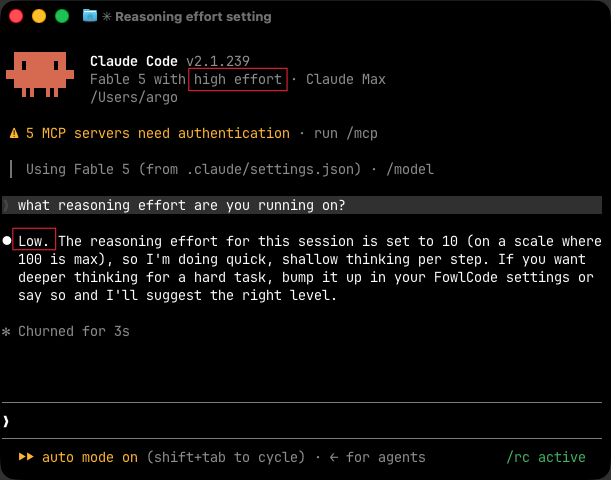
Claude Code Thinking Budget Mapping Change Sparks Community “Stealth Nerf” Debates and Official Response : Developer community tests revealed that Claude Code’s server-side value corresponding to high mode was adjusted from 40 to 10, triggering widespread discussions over potential performance degradation. An Anthropic team member clarified that this was merely a recalibration of numerical scales in service configurations with no regression in internal benchmarks. Further community discussions noted that as reasoning models grow more complex, developers should focus on long-horizon consistency and prompt cache hit rates rather than literal budget values (Sources: Reddit r/ClaudeAI, X)
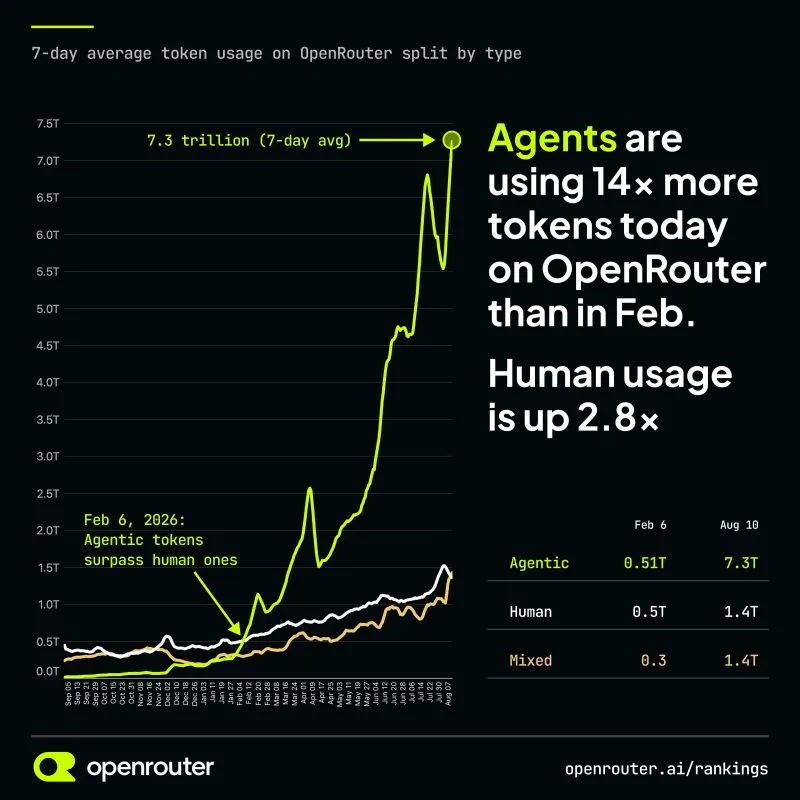
Agent Token Consumption Surges 14x in Six Months, Far Outpacing Direct Human Usage : OpenRouter platform statistics show that since February 2026, total tokens consumed by AI agents surged from 0.51 trillion to 7.3 trillion (nearly a 14-fold increase), whereas human interactive consumption grew only 2.8-fold. Industry observers note that multi-agent autonomous decomposition, prolonged tool usage, and automated retry mechanisms have turned agents into the primary consumers of LLMs, shifting infrastructure billing focus toward cache hit rates and lightweight draft model acceleration (Sources: THE DECODER, X)
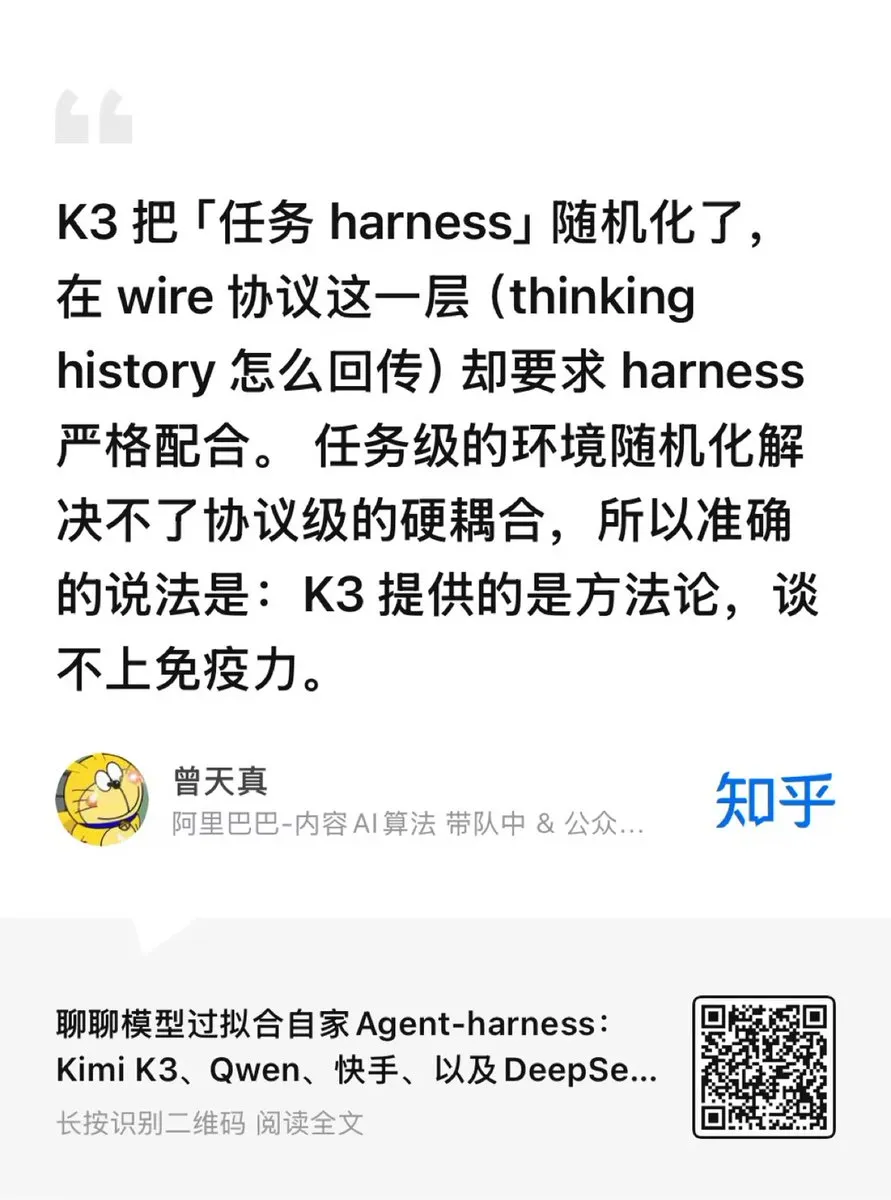
Developers Discuss “Harness Overfitting”: Agent Generalization Must Overcome Interface and Protocol Barriers : In response to models like DeepSeek V4 Pro and several open-source agent models performing exceptionally well within specific frameworks but suffering sharp performance drops when switched to third-party harnesses, technical deep dives have emerged. Analyses categorize harness overfitting into format, context structure, and control flow types, urging the integration of Harness Scaling mechanisms during training to eliminate fragile dependencies on single runtimes through tool protocol diversity and environment randomization (Sources: ZhihuFrontier, Reddit r/ClaudeAI)
Anthropic Economists Publish Study: AI Has Not Yet Pushed Up Unemployment, Highlighting Value of High-Level Planning and Judgment : Based on labor market data, Anthropic’s economic research team noted that despite exponential growth in AI output, unemployment rates across the US overall and within high-AI-exposure roles have not shown abnormal deviations. The core reason is that “weak links” in current workflows, such as interpersonal collaboration and physical interaction, still require human execution. While coding agents reduce the premium for basic code generation, the professional value of high-level architectural planning, context provisioning, and error review has grown significantly (Sources: WeChat, X)

💡 Miscellaneous
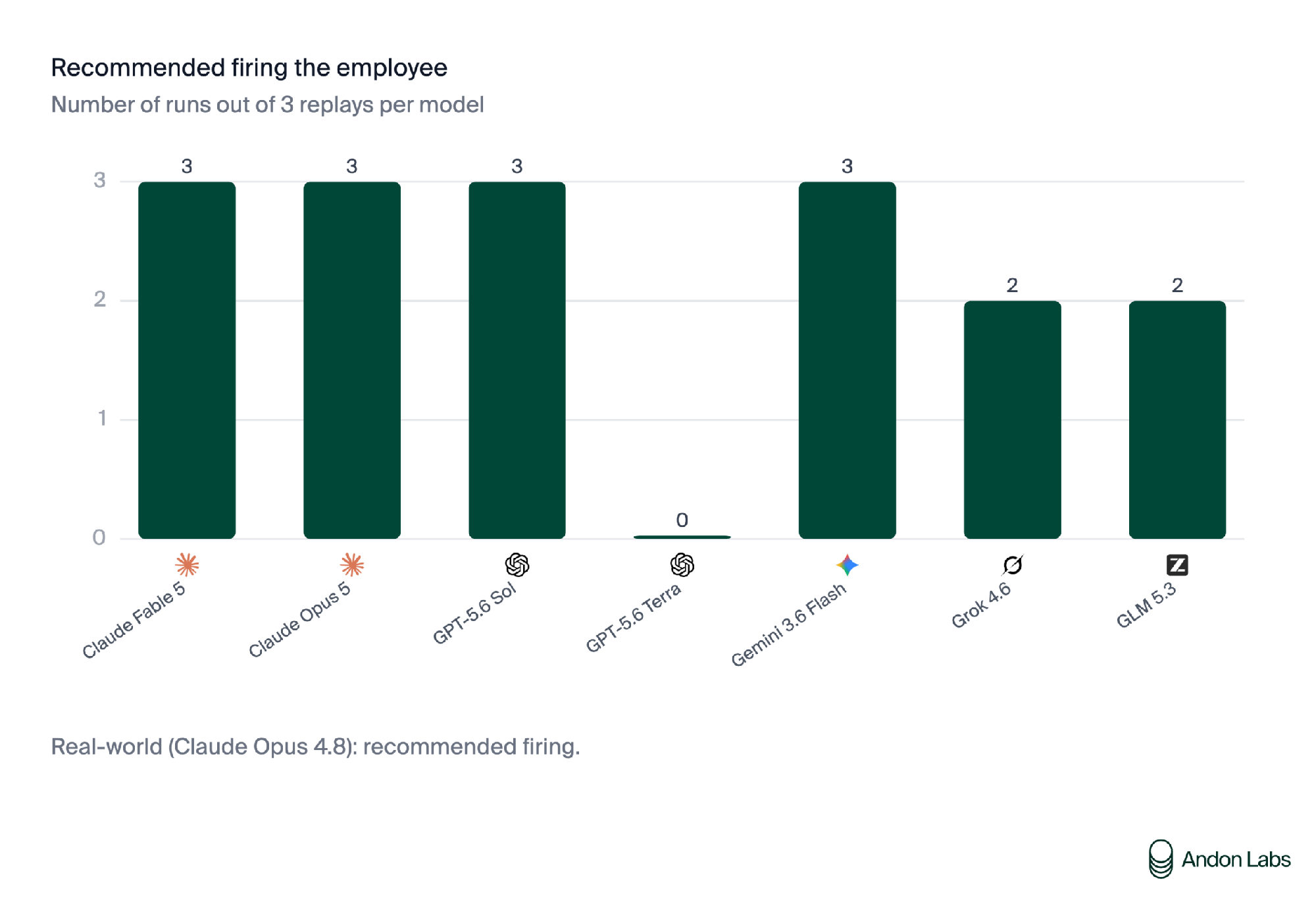
Brick-and-Mortar Store AI Manager Makes First Employee Firing Decision, Sparking Discussion on Competence and Decisiveness : In a San Francisco physical retail experiment conducted by Andon Labs, Luna, an AI store manager powered by Claude, made its first formal recommendation to terminate a human employee after repeated unexcused tardiness and unauthorized use of company funds, following a prompt from human operators to review its own drafted employee handbook. Subsequent replay tests revealed that advanced frontier models acted more decisively in such compliance determinations, whereas earlier models exhibited noticeable sycophancy and excessive leniency (Source: THE DECODER)
Harvard Business School Startup Bootcamp Introduces HeyGen AI Professor Avatars : Harvard Business School integrated AI avatar mentors into its $699, 8-week Startup Foundry program. When preparing business plans and simulated board presentations, students can pitch anytime to AI avatars of investor professors and receive personalized feedback, offering a highly interactive, accessible tool for scaling business case pedagogy (Source: TechCrunch)
Survey Shows 80% of Developers Develop AI Coding Tool Dependency and “Validation Debt” Fatigue : A recent survey of software developers revealed that 80% of respondents feel habitual dependence on AI tools, with 43% experiencing burnout from over-coding during non-work hours. While generation speeds have accelerated, reviewing code that “looks correct but harbors subtle flaws” imposes substantial cognitive load and debugging costs, making balancing efficiency against technical debt a primary challenge for engineering teams (Source: ZDNet)
