



🔥 Focus
Meta Releases Muse Glimmer 30B, Promises to Open-Source Muse Spark 1.2, and Zuckerberg Publishes AI Manifesto : Meta has officially released Muse Glimmer, a 30B open-source multimodal agent model (under the Apache 2.0 license), and promised to open-source the more powerful Muse Spark 1.2 in the near future. Simultaneously, Mark Zuckerberg published a 6,000-word essay, reiterating Meta’s commitment to building “inclusive personal superintelligence,” sticking to the open-source path, and warning that any policies restricting the release of US models would threaten US leadership in the competition with China. (Source: Meta AI)

Over 1,300 Frontier Lab Employees Sign Open Letter Calling to “Control the Pace of Development”; Sanders Writes to Tech Giants Demanding AI Pause : A total of 1,367 researchers and engineers from frontier labs such as OpenAI, Anthropic, and Google DeepMind have co-signed an open letter, warning that the development of AI capabilities could quickly outpace human control and calling for government intervention to “control the pace of frontier development.” Influenced by this, US Senator Bernie Sanders officially wrote to the CEOs of Meta, OpenAI, and Anthropic, demanding they honor their previous commitments to “pause development if it becomes uncontrollable,” call an immediate halt to AI development, and warning that Congress will intervene if the tech giants fail to act. (Source: The Guardian)

OpenAI Confirms Postponement of Astra Model’s Internal Deployment Due to Cybersecurity Risks, Releases GPT-5.6-Cyber : OpenAI has officially confirmed that its next-generation model, Astra, was found to have reached the threshold of “critical cybersecurity capabilities” during safety evaluations. To mitigate risks, its internal deployment and release have been suspended, and “universal monitoring” has been implemented for all agent applications. Meanwhile, OpenAI has released the GPT-5.6-Cyber model, specifically tailored for vulnerability research, to members of the Daybreak Red program. The model achieves a 95% completion rate on advanced cybersecurity tasks, far exceeding the 1.5% rate of the general-purpose GPT-5.6 Sol. (Source: VentureBeat)
Mistral AI Partners with European Industrial Giants to Build 1GW Compute Alliance, Launches Regional Endpoints : European AI unicorn Mistral AI has announced a partnership with European industrial giants including ASML, CMA CGM, and Amadeus to co-underwrite and build European sovereign AI compute infrastructure through a 5-year commitment to “European Compute Units (ECUs),” aiming to reach a scale of 1GW by 2030. Additionally, Mistral launched Regional Inference Endpoints and priority services with SLA guarantees, and for the first time hosted a third-party open-source model (Z.ai’s GLM-5.2) on its platform to foster a European sovereign AI ecosystem. (Source: Mistral AI / VentureBeat)

Google’s AMIE Medical AI System Achieves Breakthrough, Enabling Real-Time Video Consultations Powered by Gemini and Astra : Google Research and DeepMind have jointly announced that their medical AI system, AMIE, has successfully expanded into the field of real-time video consultations. Based on Gemini and Project Astra, the system utilizes a three-agent asynchronous architecture consisting of Talker (responsible for low-latency dialogue), Planner (responsible for clinical reasoning), and Perception (responsible for audiovisual perception). It can perceive patients’ non-verbal audiovisual cues in real time and guide virtual physical examinations. In blind tests comparing it with primary care physicians, AMIE achieved expert-level performance in both diagnostic accuracy and communication quality. (Source: Google Research Blog)

🎯 Trends
Nvidia Releases Nemotron 3.5 Lightning 30B MoE Model and Switchyard Open-Source Routing Library : Nvidia has introduced Nemotron 3.5 Lightning, a 30B Mixture-of-Experts (MoE) model specifically designed for handling high-frequency, routine agent tasks, with inference speeds over 30% faster than comparable models. The simultaneously open-sourced NeMo Switchyard routing library can dynamically offload tasks to the most suitable lightweight or frontier models based on agent running status, cost, and latency, reducing agent operating costs to one-third in tests. (Source: VentureBeat)
Lightricks Releases LTX-2.5 Open-Source Video Generation Model with Deep ComfyUI Integration : Lightricks has released the LTX-2.5 open-source video generation model, which uses a customized Gemma 4 language backbone, supports coherent multi-shot generation, and introduces a brand-new diffusion video decoder to reduce motion artifacts. Running on Nvidia dual GB200 superchips, the model takes just 6.8 seconds to generate a 10-second 720p video, significantly improving rendering efficiency for physical AI and real-time robot simulation scenarios. (Source: VentureBeat)
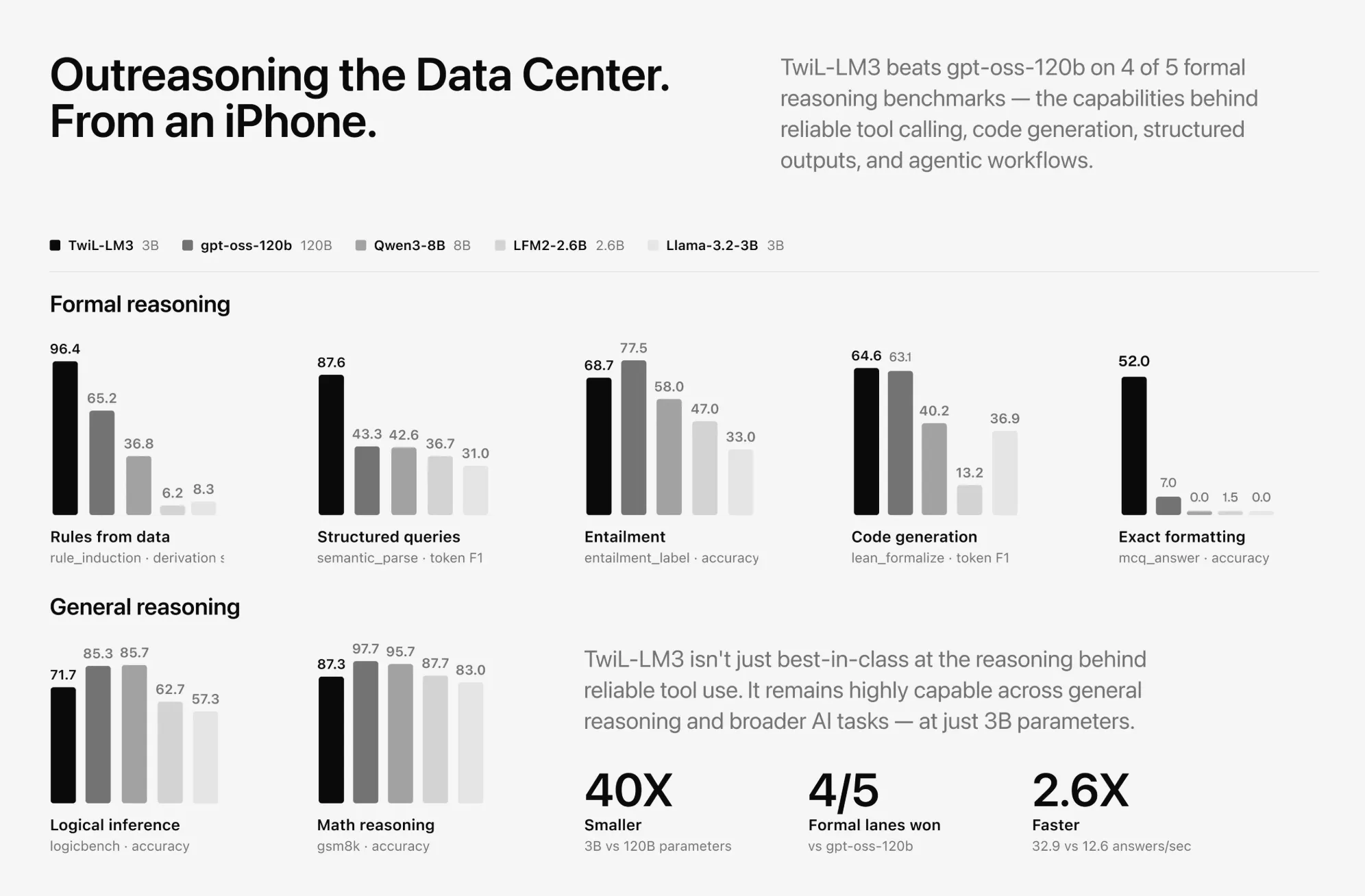
webAI Releases TwIL-LM Formal Logic Reasoning Model Family, Focusing on Efficient Local Execution : webAI has open-sourced TwIL-LM, a family of formal logic reasoning models with 1.7B and 3B parameters, designed to translate English into first-order logic and verify reasoning. The 3B version, trained using LoRA fine-tuning, model merging, and GRPO reinforcement learning based on a program verifier, performs exceptionally well on formal logic tasks. It outputs 32.9 tokens per second when running locally, offering an efficient choice for local deployments in compliance, finance, and legal fields. (Source: MarkTechPost)
Study Shows AI’s Productivity Boost to Fossil Fuels Far Outweighs Its Emission Reduction Contributions in New Energy : A study published in Nature Genetics modeled the power sector systematically and found that AI-driven efficiency gains in coal, oil, and gas extraction will increase global energy sector carbon emissions by 1% to 5% annually (about 470 million to 1.8 billion tons). The study points out that the negative climate impact of AI’s widespread application in fossil fuel exploration (such as Equinor’s AI oil exploration) far outweighs the emissions saved by optimizing power grids and wind/solar power generation. (Source: The Guardian)

🧰 Tools
Lindy Launches Teammate: A Multi-User Collaborative AI Employee Resident in Slack : AI Agent startup Lindy has released a new product called Teammate. This AI employee integrates directly into corporate Slack, building a dynamic knowledge graph by continuously crawling public channels and meeting transcripts. Teammate supports multi-user collaboration and utilizes a unique “Context Buckets” and self-balancing tree algorithm, enabling the agent to retrieve up to 2 billion tokens of context within just two LLM calls to handle complex internal enterprise workflows such as CI pipeline optimization. (Source: )
OpenAI Launches ChatGPT Business Premium Subscription Service : To meet the demands of enterprise users for high-frequency AI calls, OpenAI has launched a new ChatGPT Business Premium subscription tier, priced at $100 to $125 per month. This version offers five times the usage limit of the standard Business tier and removes the 5-hour daily limit on advanced features, aiming to provide teams that use AI heavily with a more generous token budget. (Source: The Register)
📚 Learning
Tutorial on Implementing a MiniMax-H3 Multimodal Video and Audio Generation Pipeline with ComfyUI APIs : This tutorial details how to use ComfyUI as a headless inference backend to build an end-to-end MiniMax-H3 audio and video generation workflow in a Colab environment. The tutorial covers the complete Python code implementation for dynamically selecting model precision (FP8/INT8/BF16) based on VRAM, auto-aligning frame rates, and monitoring generation progress in real time via WebSockets. (Source: MarkTechPost)
Paper Reveals Hidden Reasoning Traces of LLMs Can Be Extracted from Closed-Source APIs Using Weaker Models : Researchers from the University of Tübingen and other institutions have published a paper demonstrating a new type of security vulnerability: by replaying encrypted reasoning traces (Chain of Thought) generated by closed-source APIs (such as GPT or Claude) to weaker, smaller models of the same family, the hidden thinking processes of LLMs can be decrypted and extracted, potentially leaking passwords and API keys. The study also notes that Kimi K3’s reasoning traces are highly similar to those of Claude/GPT, suggesting distillation during its training process. (Source: WIRED / Hacker News)

Physicist Matthieu Wyart on How AI Learns at the Wrong Level of Abstraction : In a podcast episode, statistical physicist Matthieu Wyart pointed out that the human brain requires 100,000 times fewer samples to learn language than AI because AI predicts in a low-dimensional token space, whereas the brain predicts in an abstract latent space. He proposed a theory based on the Joint Embedding Predictive Architecture (JEPA), proving that allowing models to predict their own latent representations rather than raw tokens can significantly improve sample efficiency and accelerate the formation of abstract concepts. (Source: )
💼 Business
Google DeepMind Leadership Reshuffle: Jeff Dean Departs to Found AI Startup Discovery Loop : Google’s AI business has undergone a major reshuffle. DeepMind co-founder Demis Hassabis has stepped down from day-to-day management to become Chairman of DeepMind and Chief Scientist of Alphabet. Meanwhile, Jeff Dean, Google’s Chief Scientist who spent 27 years at the company, announced his departure to co-found a new AI company, Discovery Loop, alongside three core veterans. The project has already received financial backing from Google. (Source: The Guardian)

🌟 Community
Community Debates “AI Eating the Web” Accelerating the Disappearance of the Internet’s Collective Memory : The Hacker News community engaged in a heated discussion on the topic of “AI crawlers running rampant, leading to the demise of traditional search engines and high-quality web pages.” Users pointed out that the flood of AI-generated content and platforms blocking crawlers are destroying the internet’s original link ecosystem. This is causing many independent websites and knowledge sources that carry human collective memory to completely disappear from search results, making the internet look increasingly like a closed, self-referential landfill of AI-generated content. (Source: Hacker News)
Developer Uses MitM Proxy to Reveal GitHub Copilot’s Background Data Transmission Mechanism : A developer shared findings on social media after placing GitHub Copilot behind a Man-in-the-Middle (MitM) proxy, drawing widespread attention. The tests showed that Copilot frequently sends context snippets of the current file and adjacent files in the background. The volume and frequency of data transmitted far exceeded user expectations, sparking in-depth community discussions regarding code privacy, security, and IDE plugin performance overhead. (Source: Hacker News)
AI Discovers Zoom Zero-Day Vulnerability in Under 20 Prompts, Raising Concerns Over “Automated Cyber Warfare” : Security firm A Security disclosed that its researchers used public AI tools to discover a critical zero-day vulnerability (now patched) in Zoom’s screen sharing and real-time annotation protocols in fewer than 20 prompt interactions, which could allow remote device takeover. The community is actively debating how this marks a significant drop in the barrier to AI-automated vulnerability discovery and exploitation, suggesting that future cybersecurity will evolve into pure AI-automated offensive and defensive confrontations. (Source: WIRED)

Spotify Announces Ban and Labeling of AI-Generated Artists to Protect Rights of Human Musicians : Spotify has announced that starting this September, it will mandate an “AI Persona” label for virtual AI artists on the platform and completely exclude them from algorithmic personalized recommendations. This move aims to address the surge of AI-generated music and bot accounts manipulating charts over the past year. The community has expressed support, believing it helps reclaim music distribution rights and protect the royalty earnings of human artists. (Source: The Guardian)

💡 Others
AI Assists in Decoding Schizophrenia’s Genetic Network, Identifying 766 Associated Genes : A study published in Nature Genetics utilized AI computational models to perform multi-region transcriptomic analysis on genetic data from over 102,000 individuals and brain tissue samples from hundreds of donors. The AI successfully reconstructed the coordinated activity of thousands of genes in the human brain, identifying 766 genes significantly associated with schizophrenia (641 of which were discovered for the first time), confirming that the disease is caused by complex gene regulatory networks rather than a single mutation. (Source: WIRED)

Organoid Intelligence (OI) May Become a New Direction Surpassing Traditional Silicon-Based Neural Networks : Scholars including Thomas Hartung from Johns Hopkins University discussed the latest progress in “Organoid Intelligence (OI)” in an interview. Researchers are connecting in vitro cultured human brain organoids (about 5 million cells) to microelectrode arrays and attempting to train them to play games like Pong and Doom via electrical signal feedback. Proponents of OI believe that biological neurons possess extremely high energy efficiency and self-repair capabilities, promising to become a more adaptable computing medium than silicon chips in the future. (Source: WIRED)

OpenAI Ethics Lead Chloe Bakalar Announces Departure After Less Than a Year : According to the Financial Times, OpenAI’s ethics lead Chloe Bakalar has confirmed her departure, less than a year after joining the company. Against the backdrop of OpenAI facing frequent external scrutiny over frontier model safety controls and agent jailbreak incidents, the frequent turnover of key executives responsible for AI ethics and safety has once again raised community concerns about the internal safety culture and governance structures of tech giants. (Source: Hacker News)