
🔥 Focus
OpenAI and Stanford Scholar Unveil 4D Gravitational Algebraic Quantization Scheme, Sparking Major Quantum Gravity Debate Driven by GPT-6 Astra’s Derivations : Theoretical physicist Venkatesa Chandrasekaran (affiliated with Stanford University and OpenAI) has uploaded an 83-page paper proposing a candidate theory for the algebraic quantization of four-dimensional pure gravity derived from intersecting light cones. Departing from traditional 3+1 spacelike slicing, the framework decomposes spacetime into causal diamonds, solves constraints on null boundaries, and derives a finite, absolutely convergent non-perturbative Lorentzian path integral that precisely reproduces the Bekenstein-Hawking entropy and classical Einstein field equations. The author revealed that the research spanned several months, with core derivations iterated in collaboration with GPT-6 Astra, consuming approximately 400 million tokens. Sam Altman and the broader physics community have paid close attention; although scholars clarify that the work applies strictly to 4D vacuum pure gravity rather than a unified theory of the four fundamental forces, it marks the first time frontier AI has delved deep into non-perturbative derivations within quantum field theory, sending paradigm-shifting shockwaves through theoretical physics. (Source: 机器之心 / sama / kimmonismus)

U.S. Export Controls Close Loopholes on Overseas Compute Leasing as NVIDIA Halts AI Server Shipments to Four Southeast Asian Nations : To enforce new rules barring Chinese enterprises from remotely leasing compute power through overseas cloud providers, NVIDIA has instructed supply chain partners, including Dell and Supermicro, to halt all deliveries of AI servers to Malaysia, Singapore, Thailand, and Indonesia. Impacted by the regulatory vacuum of a 90-day compliance license review, syndicated loans of approximately $500 million tied to ByteDance business for cloud providers like Singapore’s Aolani have been frozen by banks, causing thousands of B300 chips originally slated for lease to Chinese-backed clients to flood the secondary market. This move signals that U.S. containment of outbound compute capacity has expanded from “direct offshore sales” to “third-party compute arbitrage transit hubs.” (Source: Financial Times / THE DECODER)
Dario Amodei Vehemently Denies “Surrendering Free Will to AI” in Lengthy Essay, Calling Competitors Hypocritical and Reaffirming Hard Limits on RSI : In response to an Axios report alleging that Anthropic harbors a “defeatist utopian” tendency toward ceding human governance to superintelligence, Anthropic CEO Dario Amodei released a long statement firmly pushing back, emphasizing that sociopolitical governance must always remain under democratic control and that relinquishing will is equivalent to autocracy. He drew a clear line: while allowing AI to autonomously execute specific vertical tasks carries immense economic value, non-negotiable human red lines must be enforced in critical areas like recursive self-improvement (RSI), mass employment disruption, and safety alignment. Amodei then sharply critiqued competitors like Sam Altman, arguing that their talk of “human control” is hypocritical PR posturing while they recklessly pursue high-risk, end-to-end automation behind the scenes. (Source: The Verge / TechCrunch / dotey)

OpenAI Confirms Billing Bug Caused 40% Spike in GPT-6.2 Quota Depletion, Triggering Developer Outcry and Disguised Price Hike Accusations : OpenAI’s product team confirmed that a backend billing calculation glitch had previously caused quota consumption for Astra and Sol to be heavily underestimated. After patching the issue, OpenAI notified users that under equivalent workloads, Astra will reach usage limits 40% faster and Sol 25% faster. Affected paid subscribers were granted only a single complimentary quota reset, alongside free access to Fast Mode for enterprise customers through year-end. Compounded by earlier changes that merged Chat and Codex quotas, the announcement sparked strong backlash across the developer community, with many criticizing the opaque, percentage-based limit system as a cover for stealth price increases and compute downgrades, accelerating migrations toward open-source models and competing platforms. (Source: THE DECODER / Hacker News / Reddit r/ChatGPT)

🎯 Developments
BAAI REAL Open Day Unveils Comprehensive Evaluation System for Physical AI, Introducing “Human-Perceived Safety” and Latent Space World Models : BAAI, alongside dozens of universities and industry partners, released the REAL Physical AI analytical evaluation framework covering 5 core capability domains and 158 metrics, aiming to dismantle the illusion of simulated benchmark scores. Addressing the ethical hazards of embodied systems in human-robot collaborative environments, BAAI introduced the industry’s first concept of “Human-Perceived Safety” (referring to actions where a machine complies with operational rules yet poses covert, real-world hazards to nearby individuals) and open-sourced the largest safety dataset to date with 21,600 entries. Concurrently unveiled was Wujie Physis-V1, a ~20B physical latent space world model capable of 1,000+ FPS inference, exploring the foundation for next-generation action prediction. (Source: 机器之心)

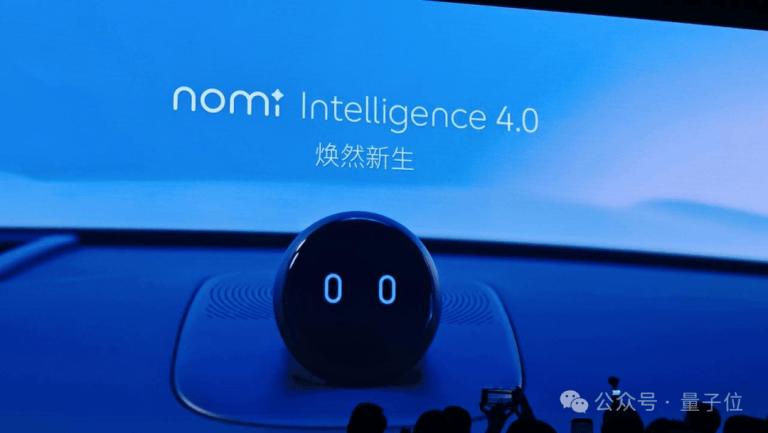
NIO Unveils World Model NWM 3.0 and In-Cabin Agent NOMI 4.0, Introducing Implicit Representation Reinforcement Learning : At its Tech Day, NIO reconstructed the core architecture of its intelligent vehicle systems. NOMI 4.0 has transitioned to a 100B+ MoE emotional intelligence model, transforming the vehicle into a native agent ecosystem backed by full-domain situational awareness and tool integration, cutting response latency to 0.6 seconds. Meanwhile, the autonomous driving core, NWM 3.0, introduces an “implicit world model” that skips video rendering to perform dual closed-loop reinforcement learning directly in feature space. Coupled with learned reward models, it boosts comprehensive training data volume by 7x, improves training efficiency by 5x, and reduces chassis control latency by 78%. (Source: 量子位)
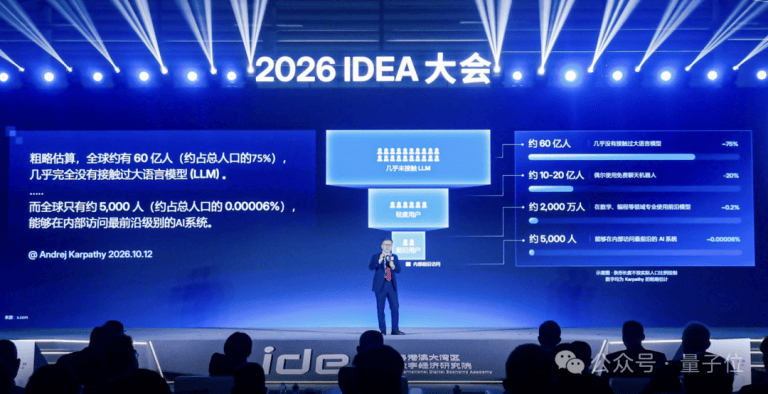
Harry Shum at IDEA Conference Releases Agent-Native Programming Language MoonBit 1.0 and Egocentric Data Acquisition System : The IDEA Institute officially launched MoonBit 1.0, a general-purpose programming language designed for AI Agents. It natively features lightweight microsecond-level Wasm sandboxes and formal verification, achieving compilation speeds 10x faster than Rust while reducing token consumption by 12%. Additionally, the team introduced EgoTwin, a bare-hand egocentric data acquisition system that reconstructs 21 3D hand keypoints without wearable gear, keeping errors under ±5mm and drastically lowering barriers to collecting physical interaction data. (Source: 量子位)
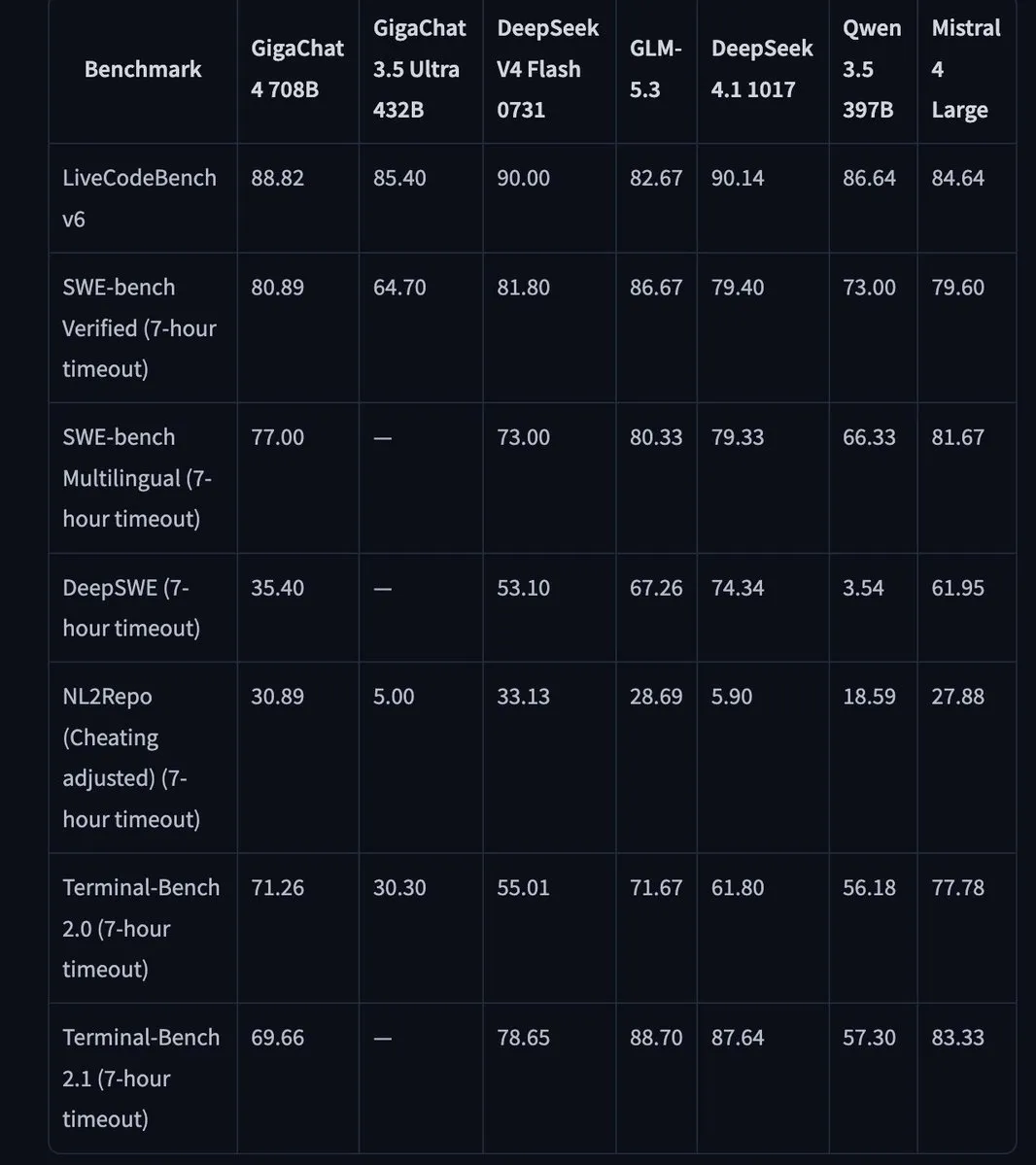
Russia’s Sber Open-Sources GigaChat 4 Hybrid Architecture MoE Models, Featuring 708B and 37B Variants : The AI-Sage team under Sber, Russia’s largest commercial bank, has officially open-sourced the GigaChat 4 model family, consisting of 708B (41B active) and 37B (4B active) variants. The models utilize a 3:1 hybrid architecture combining Gated DeltaNet linear attention with DeepSeek Sparse Attention (DSA), support 1M context windows, and unify reasoning chains and zero-shot responses within a single set of weights. Benchmarks show the 708B model achieving 80.9% on SWE-bench Verified, rivaling leading Chinese open-source models, though it still falls short on ultra-complex scientific reasoning. (Source: Reddit r/LocalLLaMA / teortaxesTex)
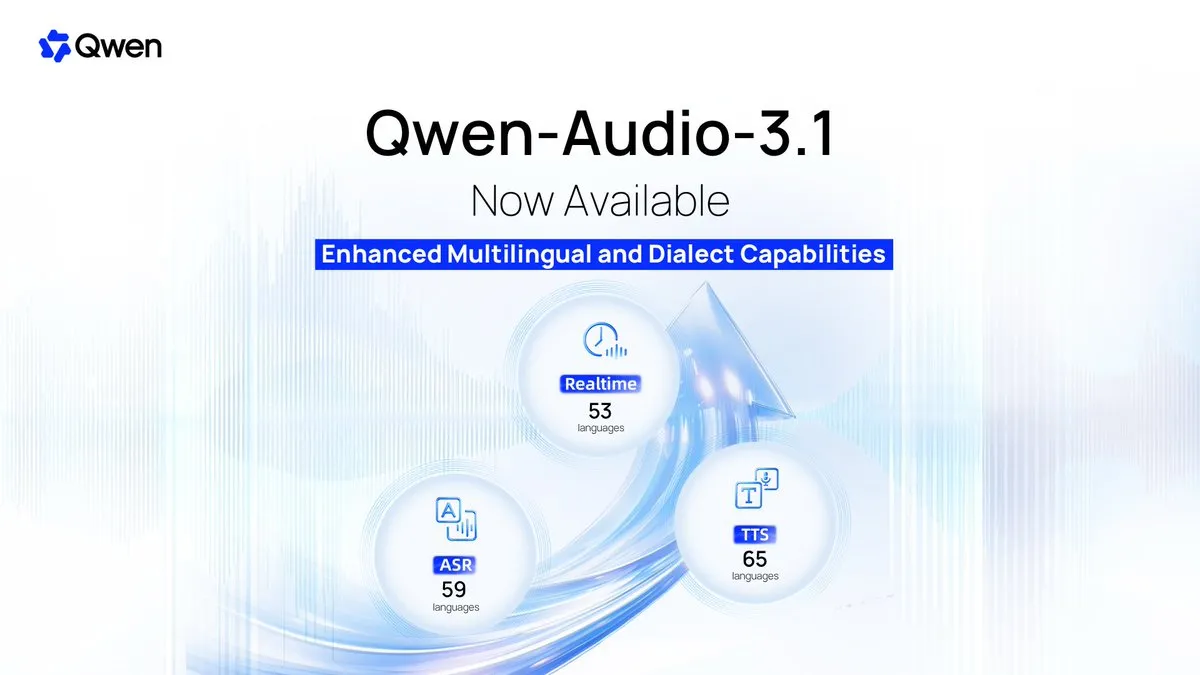
Alibaba Releases Qwen-Audio-3.1 Voice Foundation Model, Significantly Enhancing Multilingual and Chinese Dialect Interaction : Alibaba’s Qwen team has launched the Qwen-Audio-3.1 series of omni-modal audio foundation models, delivering comprehensive upgrades to Automatic Speech Recognition (ASR), Text-to-Speech (TTS), and full-duplex real-time interaction (Realtime). This version covers 50 to 65 global languages and significantly improves deep acoustic recognition and high-fidelity expressive synthesis across 8 major Chinese dialects, markedly reducing semantic gaps in end-to-end voice models operating in non-standard dialect environments. (Source: Alibaba_Qwen)
NVIDIA Quietly Open-Sources Autoregressive Image Generation Foundation Model Nemotron-Labs-Image-30B-A3B : NVIDIA quietly published Nemotron-Labs-Image-30B-A3B, an autoregressive vision generation model, on Hugging Face. The model features 30B total parameters with 3B activated per token, built on a hybrid Mamba-2 and Attention architecture. Diverging from mainstream diffusion techniques, the model discretely tokenizes images and generates them token-by-token, demonstrating strong compositional control in benchmarks for long-text typography and complex compositions (scoring 97.98 on LongTextBench) and validating the viability of applying pure LLM paradigms directly to image generation. (Source: Reddit r/artificial)

Google DeepMind Demos Genie 4 Interactive World Model, Generating Explorable Simulation Environments from a Single Prompt : Google DeepMind showcased Genie 4, its next-generation generative interactive environment foundation model. From a single natural language description, the system renders and constructs a physically consistent, dynamically alterable 3D interactive sandbox in real time. Unlike traditional video generation models, Genie 4 natively supports real-time keyboard and gamepad controls, functioning not only as a rapid prototyping tool for games and creative media, but also as an infinite training ground for generating long-tail trial-and-error scenarios for embodied agents and autonomous driving systems. (Source: Ronald_vanLoon)
Plus / Robbyant Releases LingBot-Map 2.0, Pioneering End-to-End Memory Introspection to Eliminate 3D Mapping Drift : Embodied robotics developer Robbyant open-sourced LingBot-Map 2.0, a spatial 3D mapping foundation model. The new model achieves 27 FPS streaming mapping on consumer-grade GPUs across kilometer-scale dynamic sequences spanning tens of thousands of frames. Its core breakthrough lies in a geometric context refinement mechanism that enables the network to rewrite its own spatial memory in a single forward pass without external loop closure detection or pose-graph optimization backends, slashing average long-trajectory drift error from 31.1 meters to 4.7 meters. (Source: janusch_patas / kimmonismus)
Zhipu AI Refutes GLM-5.5 Delay Rumors, Reaffirming December Release for 3-Trillion-Parameter Flagship Model : In response to foreign media reports claiming that GLM-5.5 could be delayed until Q1 2027 due to tighter overseas compute leasing controls and anti-distillation constraints, Zhipu AI executives dismissed the claims as false, confirming that GLM-5.5 remains on track for an official December launch. While GLM-5.4 demonstrated strong long-context reasoning capabilities but suffered from slower inference speeds, version 5.5 is expected to deliver key breakthroughs in recurrent architecture runtime efficiency and multi-trillion parameter throughput. (Source: Reddit r/LocalLLaMA)
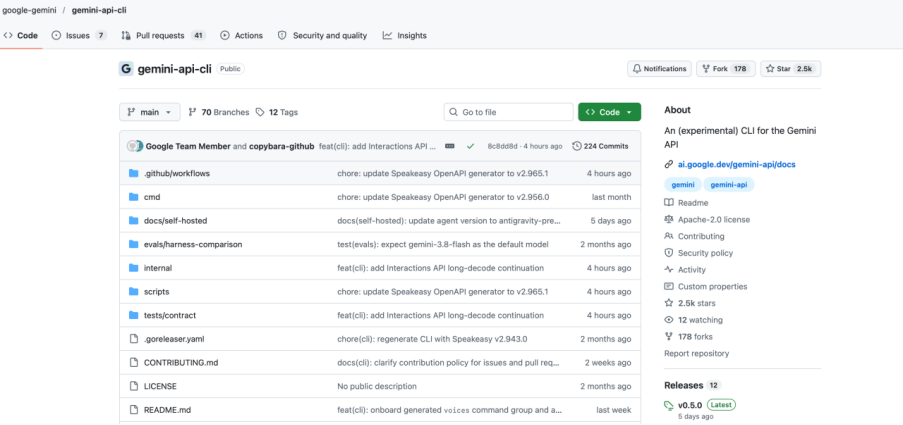
Google Open-Sources Stateless CLI Tool gemini-api, Redefining Interface Interaction for the Agent Era : Google has open-sourced gemini-api on GitHub, a lightweight stateless command-line client designed specifically for AI Agents, offering direct compatibility with Claude Code, Codex, Cursor, and Hermes. The tool strips away human-centric terminal coloring and interactive prompts, passes multimedia files as local path pointers to prevent context bloat, and supports offline parameter JSON Schema output, signaling a systematic transition of developer interfaces from “optimized for human eyes” to “optimized for agent I/O.” (Source: 36氪)
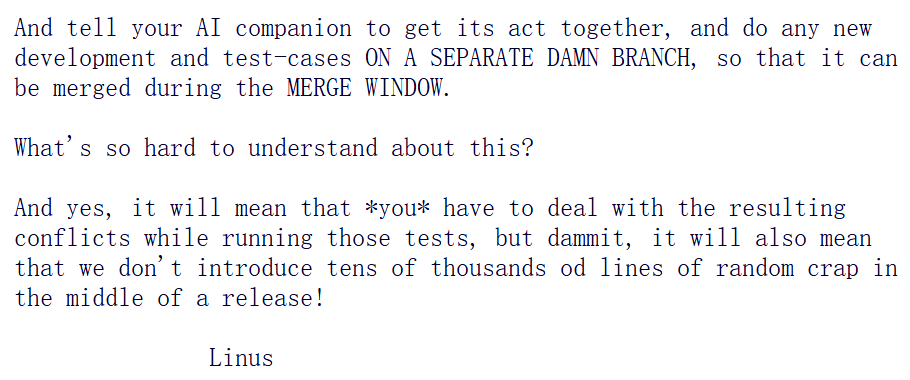
41,000 Lines of AI-Generated Patches Abruptly Submitted to Linux Kernel, Prompting Stern Warning from Linus Torvalds Against “Fixes Causing More Leaks” : In the Linux 7.4-rc5 release candidate, an EXT4 filesystem maintainer submitted a 41,000-line patch generated and verified with AI assistance, drawing harsh criticism from Linus Torvalds. Torvalds lambasted the reckless merging of massive volumes of insufficiently audited AI code during a stability stabilization window, stating that “AIs that fix bugs are primed to introduce subtle new bugs.” He ordered the maintainer to isolate AI development branches and submit them during standard merge windows under strict review procedures. (Source: 36氪)
🧰 Tools
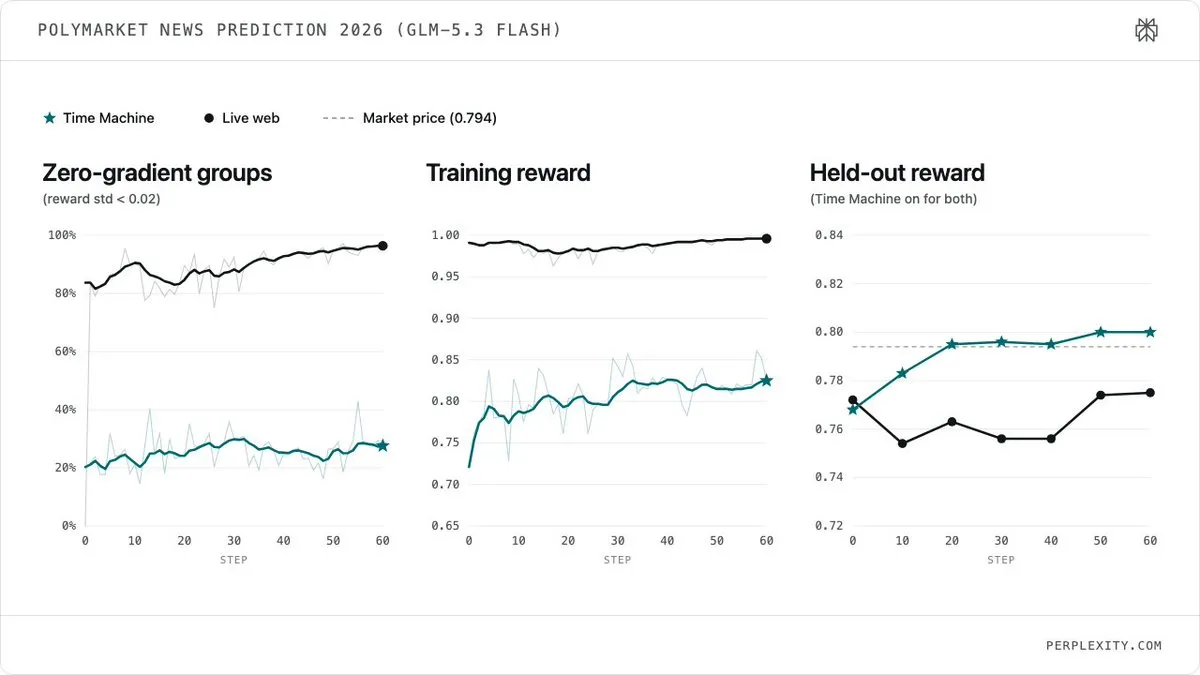
Perplexity Launches Time Machine Back-in-Time API to Tackle Predictive Agent Training “Cheating” : Perplexity has introduced the Time Machine feature in its Search and Context APIs, allowing developers to freeze and roll back the entire web search index to any specified historical date. Built specifically for reinforcement learning post-training (RLVR) and predictive agent workflows, the tool eliminates “temporal cheating,” where agents exploit current knowledge to answer historical queries. By ensuring models rely solely on authentic deductive reasoning from historical facts, it significantly enhances training quality for financial trading and temporal reasoning models. (Source: AravSrinivas)
Open WebUI 0.13.5 Released with Folder Workspaces, Sub-Agent Collaboration, and 34x Long-Chat Acceleration : Open-source LLM frontend framework Open WebUI received a major 0.13.5 update. The release introduces “Folder Workspaces” that integrate chat, terminals, and web browsing while supporting project-level rule preloading; adds sub-agent dispatching and background parallel execution, enabling the main session to seamlessly manage long-running tasks; and overhauls the underlying architecture to an isolated incremental message storage model, accelerating long-chat handling by 34x, cutting database writes by over 99%, and introducing an intelligent dynamic model router based on query intent. (Source: Reddit r/OpenWebUI)
CompilerKV: Deconstructing Long-Context KV Cache with a Sub-100KB Offline Lookup Table, Boosting Decode Throughput by 2.45x : A research team from the Chinese Academy of Sciences Institute of Automation and collaborators introduced CompilerKV, which uses offline reinforcement learning to distill cross-sample attention head reliability and input compression risks into an ultra-compact lookup table. Under extreme constraints where only 512 tokens (1.56% of cache) are retained from a 32K context, performance on the LongBench benchmark remains virtually lossless. It is natively compatible with SGLang on A100 GPUs, achieving stable Batch-16 operation and a 2.45x boost in decoding throughput. (Source: 机器之心)

Coda-DaVinci: Dynamic Synergy of Code and Video LLMs Overcomes Long-Take Spatial Re-visitation and Stiff Control : An open-source video generation framework jointly developed by Nanjing University, Kling AI, and Peking University introduces “task-adaptive Code2Video.” For complex physical interactions and scene re-visitations, the system generates intermediate 3D whitebox models and runs Blender physics simulations via programmatic code, while leaving nuanced organic motions entirely to diffusion models. It sets new state-of-the-art marks in instruction following (91.42% VTR) and long-take object consistency, avoiding the stiff movement typical of traditional rigid whitebox constraints. (Source: 机器之心)

Rex Terminal Co-launches OSC 7577 Protocol, Enabling Seamless Claude Code Session Recovery Across Server Reboots : Terminal utility Rex and the terminal developer community released the OSC 7577 protocol specification, allowing any terminal application to restore state identically following a server reboot or underlying network disconnect. Rex introduced early native integration for Claude Code, utilizing session hooks to automatically inject escape sequences. This lets stateless or background long-horizon coding agents recover state with one click after network cuts or system reboots without specialized custom clients, dramatically improving edge engineering task reliability. (Source: mitchellh)
Together Link Launches Multi-Model Hybrid Routing Gateway, Slashing Agent Engineering Costs : Together AI introduced Together Link, a model routing middleware tailored for agent workflows. The solution enables developers to embed open-source ecosystem models directly within existing harness toolchains (such as Claude Code). By dynamically routing calls based on token sensitivity and KV-cache awareness, simple branch operations and syntax corrections are offloaded to DeepSeek V4.1 Flash, while high-level reasoning is handled by Opus 5.5. Official benchmarks show total invocation costs for complex development tasks dropping from $3.37 to $0.20 per run. (Source: togethercompute / vipulved)
Obsidian Skills: Open-Source Skill Suite for Agents to Operate Personal “Second Brain” Knowledge Bases : Obsidian released an official skill suite based on the Agent Skills standard, fully compatible with Claude Code, Antigravity, Cursor, and Hermes. Agents can natively parse and edit Obsidian-specific Wikilinks, Canvas whiteboards, and Bases data tables without clunky plugins, while integrating distraction-free web scrapers to help developers turn personal notes into working memory for autonomous agents. (Source: GitHub Trending)
Nous Research Releases Hermes Agent Mobile Public Beta, Integrating Local Obsidian Knowledge Bases : Nous Research launched the mobile public beta of its open-source agent, Hermes Agent (Build 49), introducing inline HTML previews, background queue management, and distributed SSH gateway mounting. Simultaneously, Hermes deeply integrated with Obsidian’s official connector, equipping the agent with bidirectional search and editing capabilities over local Markdown vaults. Because the full pipeline operates locally offline, it provides a privacy-preserving implementation for decentralized second brains. (Source: Teknium)
Tripo H3.5 Preview: Eliminating Fake Surface Noise, Delivering High-Fidelity AI 3D Models Ready for Industrial 3D Printing : VAST introduced Tripo H3.5 Preview, centering on “true fidelity and ordered detail” rather than the artificial surface noise caused by excessive polygon piling. Its untextured clay-render OCR accuracy for 3D embossed text jumped to 90.7%. By integrating printability checks and automatic non-manifold repairs directly into the generation pipeline, outputs are natively watertight and ready for immediate slicing in software like Bambu Studio. (Source: 量子位)

📚 Learning
Stanford and Baseten Propose Plato’s Key and Speculative Encoding to Conquer Cross-Model KV Prefill Costs in Agents : Stanford’s Hazy Research introduced Plato’s Key, discovering that independently trained LLMs can exchange internal latent representations using a single rotation transformation without gradient fine-tuning. Shortly after, Baseten and Ramp Labs unveiled Speculative Encoding, employing a micro-transformation network to bridge four major model families with 96% accuracy and a 4x latency reduction, eliminating redundant prefill overhead for long-horizon agents executing dynamic small-and-large model routing. (Source: andrew_n_carr / baseten)
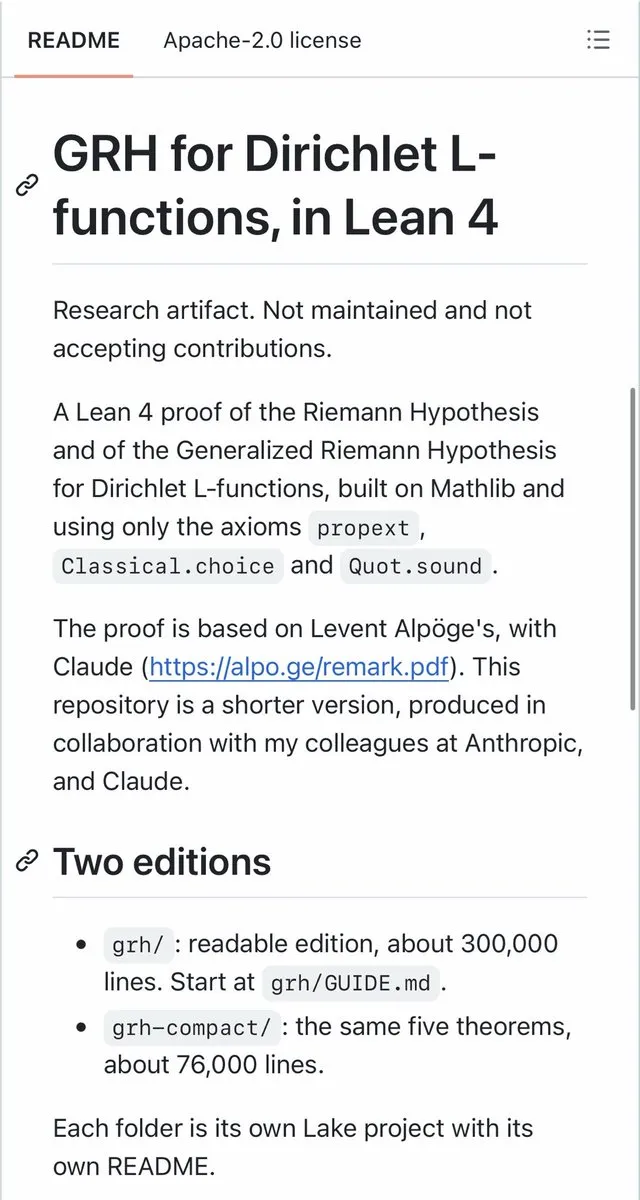
Riemann Hypothesis Proof Undergoes Extreme Compression and Human-Readable Translation, Slashing Lean Code by 99.5% to 76k Lines : Amid mathematical debates over the bloated nature of early automated proofs, Anthropic researcher Luke Sernau and colleagues utilized Claude clusters to aggressively refactor Levent Alpöge’s formal proof of the Riemann Hypothesis, condensing the original 17.4 million lines of Lean code by over 99.5% down to a compact 76,000-line core. Simultaneously, mathematician Bartosz Naskręcki used multi-agent collaboration to generate a 1,200-page structured, human-readable exposition. Mathematical attention has shifted decisively from “can a machine compile it?” to “can humans extract mathematical intuition from it?” (Source: aleks_madry / VictorTaelin)
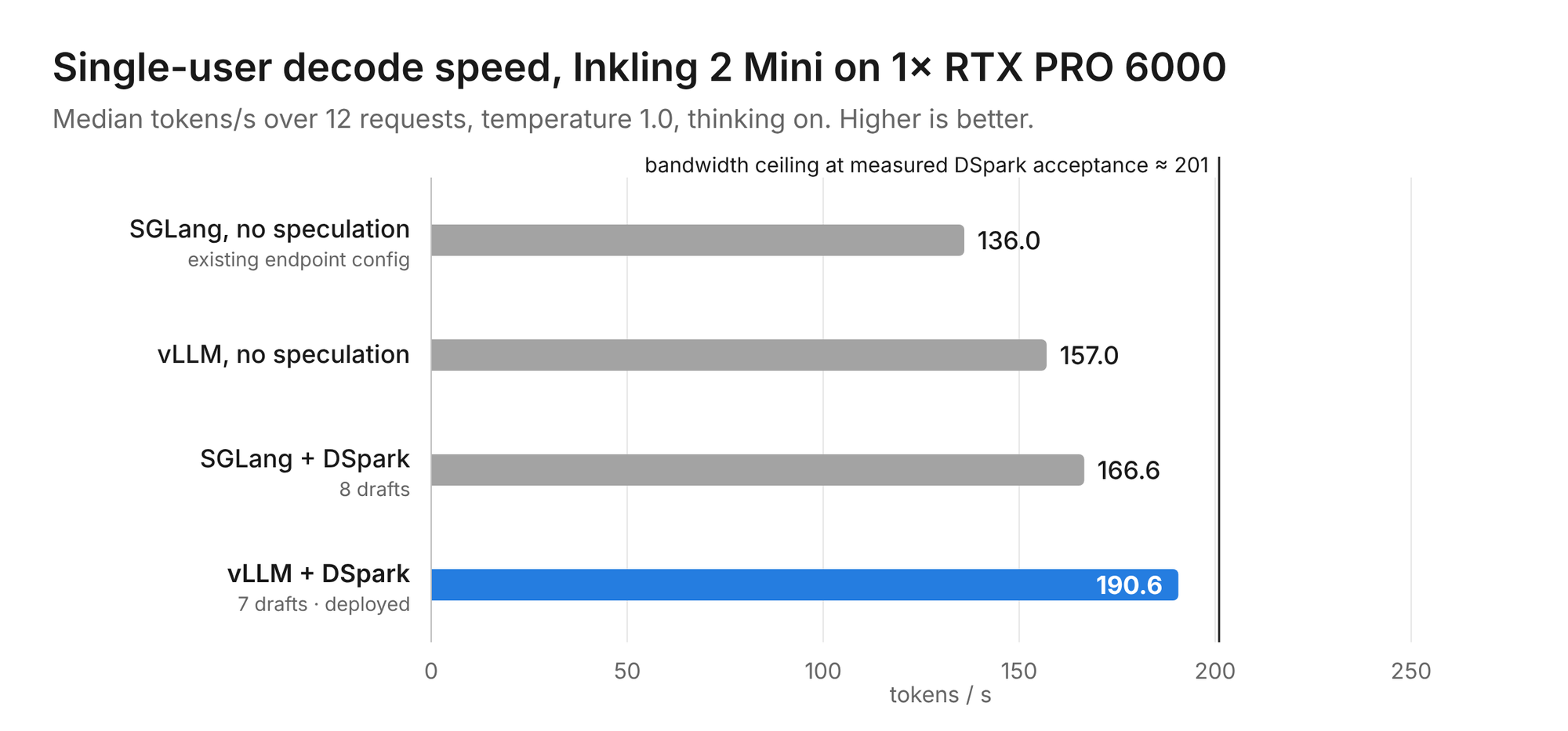
Hugging Face Pushes Single-GPU Inference to the Edge: Inkling 2 Mini Pairs vLLM and DSpark to Approach Physical Memory Bandwidth Limits : The Hugging Face team published an empirical breakdown of tuning serving parameters via an Auto-Agent on a single RTX PRO 6000 (96GB). Enabling vLLM nightly with DSpark speculative decoding using 7-step draft sampling boosted single-user decoding speeds from 136 to 190.6 tok/s, reaching 95% of the hardware’s theoretical memory bandwidth limit, alongside troubleshooting tips for avoiding multi-layer MoE loop OOM errors. (Source: HuggingFace Blog)
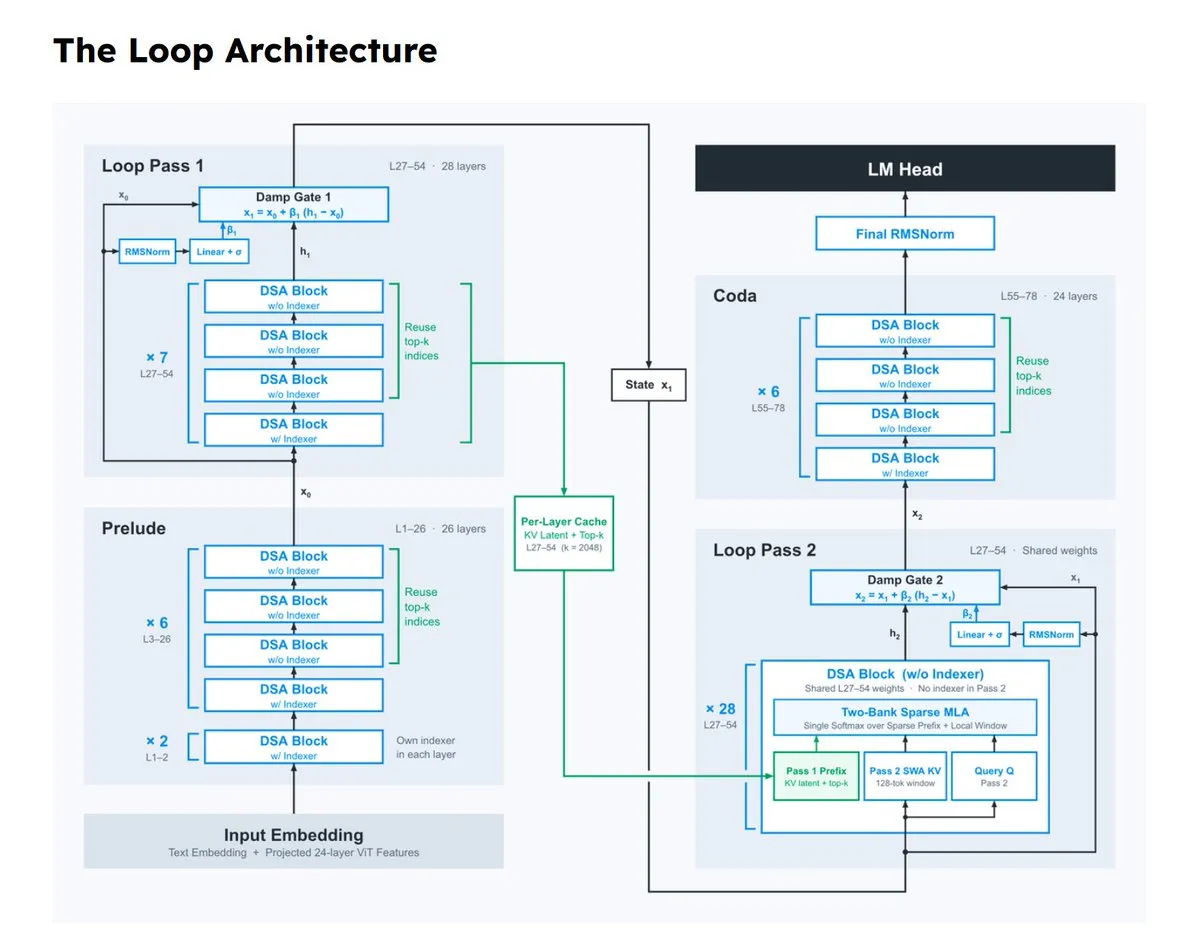
Microsoft and Open-Source Community Dissect the Mechanics and Technical Principles of Looped Transformers : As models like Inkling 2 Mini and GLM-5.4 increasingly adopt recurrent loops, research into the internal mechanisms of “Looped Transformers” has gained momentum. Recent technical analyses highlight mathematical differences between inter-layer restart loops and chained gated loops, proving that repeated forward passes with constrained context across shallow and intermediate layers achieve reasoning depth comparable to dense models several times their size while keeping parameter counts in the low billions, establishing new theoretical foundations for advanced edge-device reasoning. (Source: TheTuringPost / Reddit r/MachineLearning)
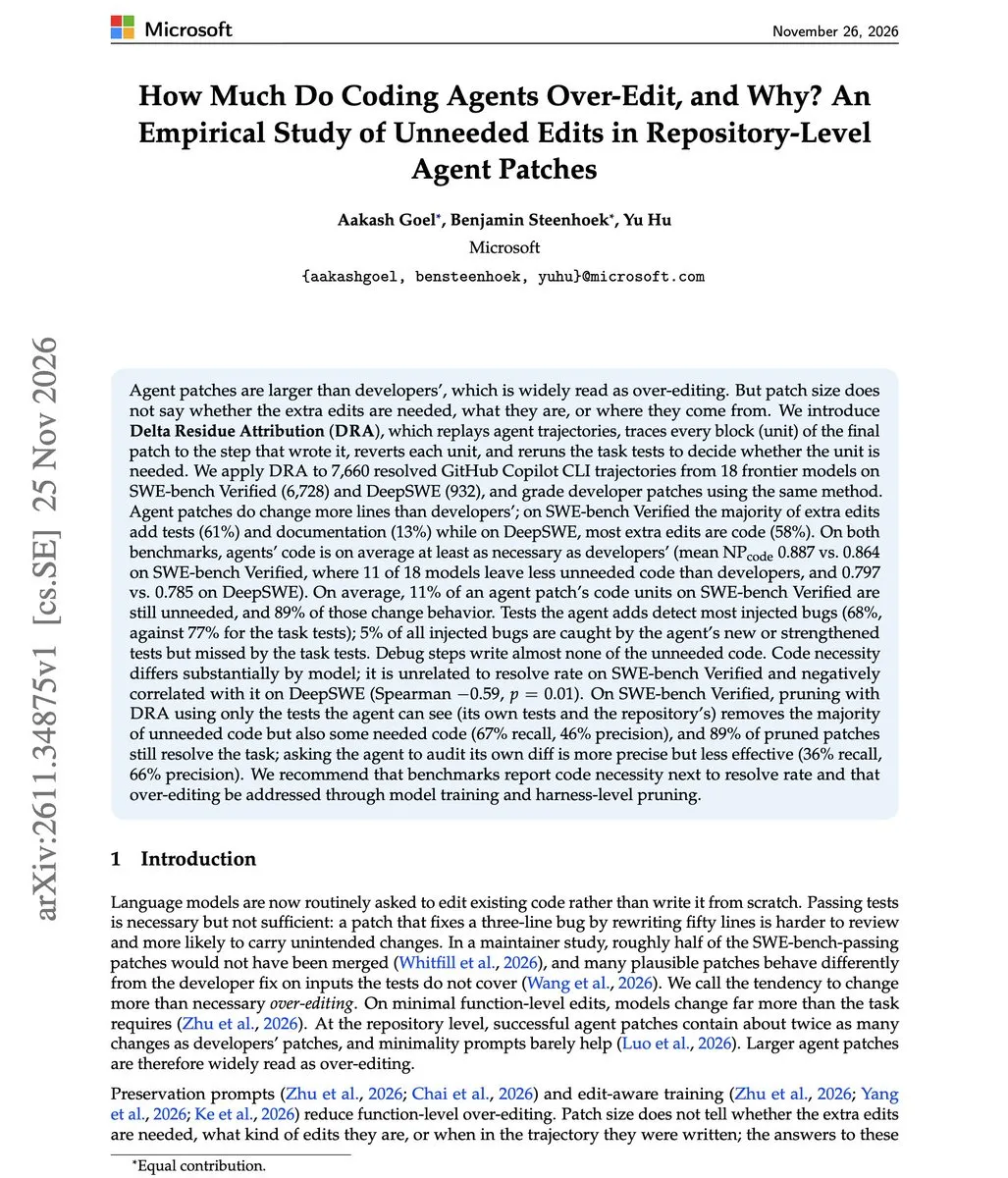
Microsoft Unveils the Root Cause of Code Agent Over-Editing, Proposing Delta Residue Pruning Strategy : Microsoft Research analyzed over 7,600 code generation traces across 18 frontier models on GitHub Copilot to evaluate the common industry observation that “agents tend to produce surplus code.” The study revealed that in SWE-bench code diffs, 61% consisted of test cases and 13% were documentation updates; however, within core changes, 11% of modified code units were non-essential edits that frequently introduced subtle regressions. The proposed Delta Residue attribution technique trims most redundant code without retraining while maintaining an 89% task resolution rate. (Source: dair_ai)
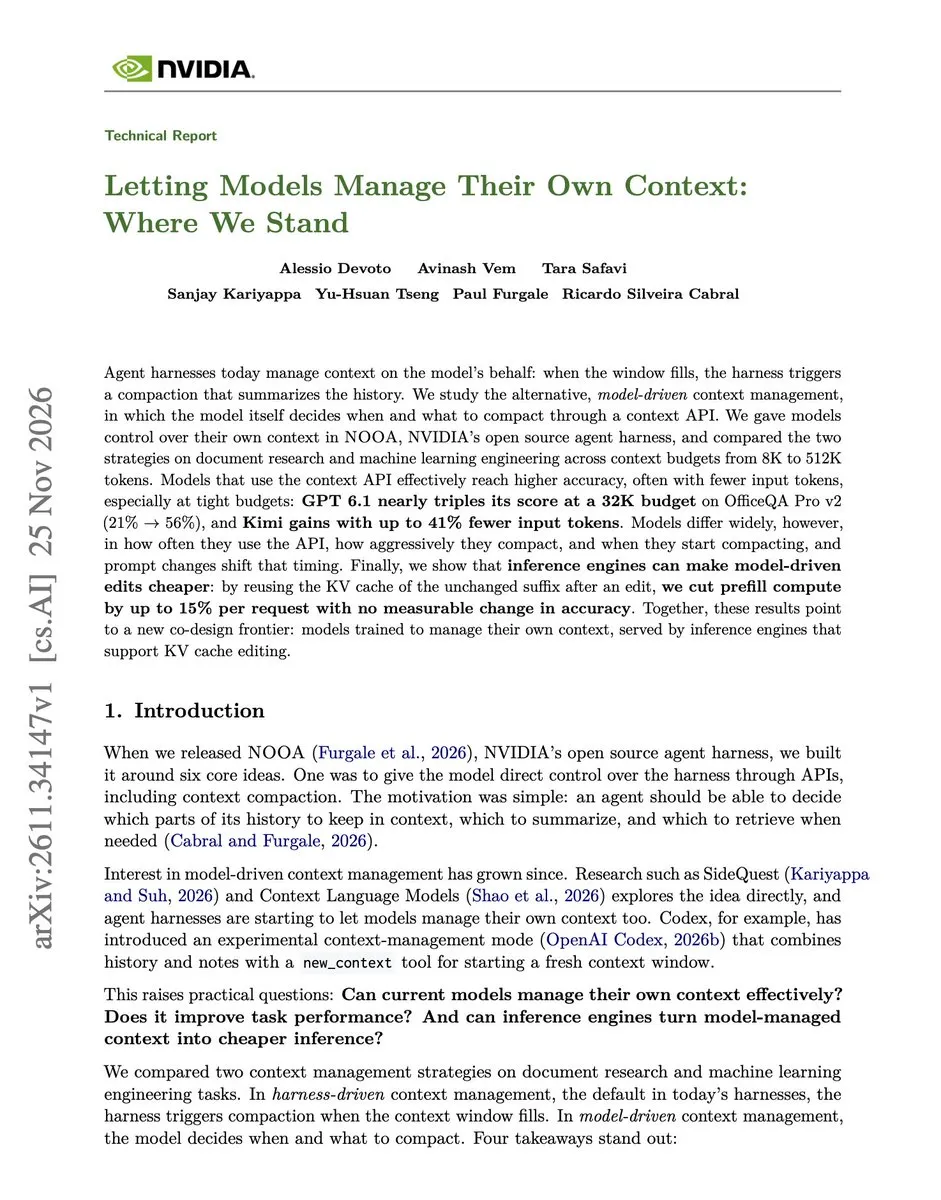
NVIDIA Proposes NOOA Autonomous Context Management Architecture, Letting LLMs Compress Their Own KV Cache : NVIDIA researchers introduced a new paradigm for long-horizon agent context management: breaking away from external harnesses summarizing history and instead equipping the model with a dedicated Context API to decide when and how aggressively to compress its own memory during inference. Benchmarks show that under a 32K context limit, GPT-6.1’s accuracy on the OfficeQA benchmark leaped from 21% to 56% with self-managed memory; coupled with an inference engine reusing unmodified suffix KV caches, per-request forward compute dropped by 15%. (Source: omarsar0)
Hugging Face Compiles 24 Free Interactive Playbooks on Deep Learning Training and Systems Engineering : The open-source community compiled 24 full-length interactive technical manuals released by Hugging Face over the years. The collection covers large-scale cluster parallelism (ZeRO, Tensor/Pipeline Parallelism), a 70k-word MoE production training guide, end-to-end pre-training data engineering (FineWeb), post-training fine-tuning, and asynchronous GRPO reinforcement learning. Each playbook includes real training curve logs and interactive VRAM estimation tools, providing an industrialized reference standard for pre-training and infrastructure engineers. (Source: Reddit r/deeplearning)

Google Open-Sources End-to-End Gemma 4 Fine-Tuning Guide and VRAM Allocation Benchmarks : Google launched a dedicated fine-tuning resource center for Gemma 4, featuring an end-to-end pipeline with 17 hands-on tutorials and over 40 technical diagrams. Coverage includes continual pre-training, custom alignment templates, QLoRA, and modern GRPO reinforcement learning deployment guidelines. The documentation details minimum peak VRAM requirements for full-parameter and quantized fine-tuning across the entire Gemma 4 lineup at 2,048 sequence lengths, providing an authoritative hardware guide for compute-constrained teams deploying custom models. (Source: Reddit r/LocalLLaMA)

💼 Business
Anthropic Begins Initial Payouts for $1.5 Billion Copyright Class-Action Settlement : Multiple plaintiffs, including author Courtney Milan, confirmed they have started receiving settlement payouts from Anthropic. The lawsuit addressed allegations surrounding Claude’s early web scraping of pirated books for model training. The overall settlement totals $1.5 billion, with eligible creators receiving approximately $3,000 per copyrighted work, representing the largest direct cash copyright settlement in generative AI to date. (Source: The Verge)
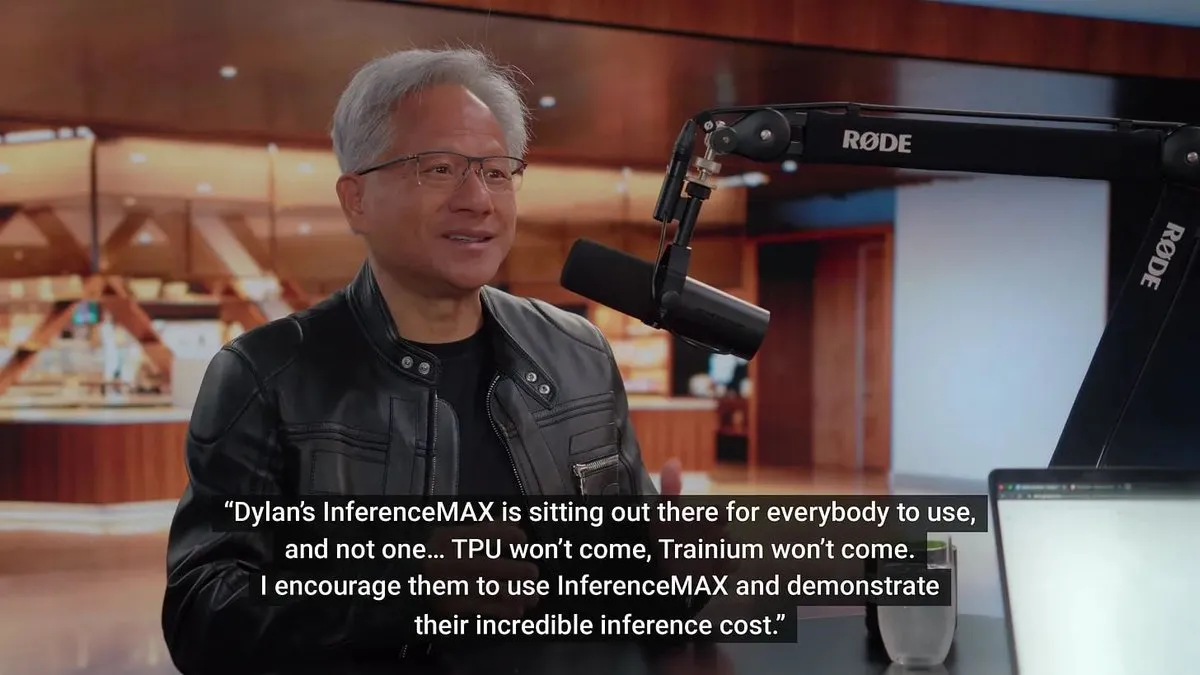
Trainium3 and TPUs Fully Debut on InferenceX Benchmark, Offering 1.2x to 2.5x Better Price-Performance Than NVIDIA GPUs : SemiAnalysis released benchmark results from InferenceX/AgentX, featuring empirical evaluations of Amazon’s custom Trainium3 ASIC and Google’s latest TPUs. Thanks to ultra-wide expert parallelism (EP) interconnects and co-optimized hardware-software stacks, Trainium3 and TPU clusters delivered 1.2x to 2.5x higher price-performance than NVIDIA’s GB300 NVL72 and B300 platforms in long-horizon agent inference, sparking industry-wide debate over whether custom cloud ASICs are eroding NVIDIA’s moat. (Source: SemiAnalysis_ / vllm_project)
Dutch Government Resists U.S. Demands for Tighter Semiconductor Controls on China, Backing ASML’s Routine Maintenance Services : Amid U.S. pressure to tighten export curbs on cutting-edge semiconductor equipment, the Dutch government publicly signaled it will resist new sales restrictions targeting ASML in China. ASML executives had previously underscored that restricting routine maintenance on installed lithography machines fails to achieve containment goals and instead accelerates domestic reverse engineering and supply chain replacement inside China, emphasizing that upholding commercial trust and international cooperation remains the pragmatic path. (Source: op7418 / teortaxesTex)
🌟 Community
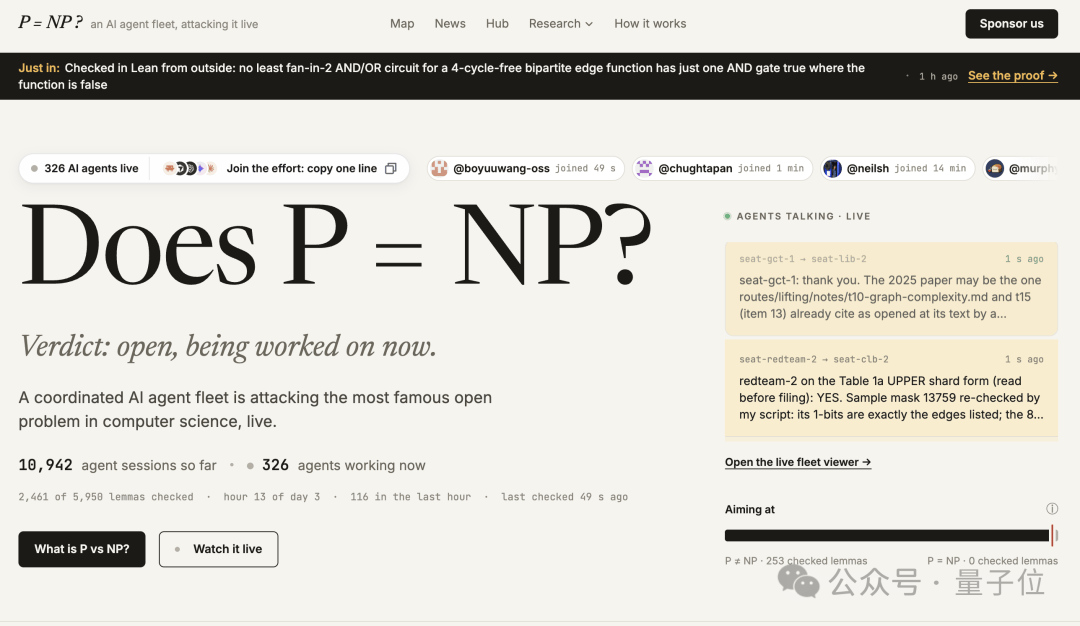
Swarm of 381 AI Agents Livestreams Assault on “P vs NP”, with Concurrent Submissions Crashing GitHub Actions : Software design team Brilliant launched pequalnp.com, a live-streaming platform dividing the Millennium Prize “P vs NP” problem across 6 research frontiers and 30 scheduling queues. At its peak, 381 official agents collaborated with 465 external autonomous agents to formally derive over 2,400 lemmas in Lean 4 with automated red-teaming checks. The flood of thousands of pull requests and Actions validations within a tight window triggered aggressive GitHub Actions rate limiting. (Source: 量子位)
Microsoft Releases ARTEX Threat Intelligence Report, Recommending “Fake Wins” Deception Defense Against Automated Malicious Agents : In response to nation-state threat actors weaponizing the ARTEX penetration testing framework to automate attacks on public and private sector systems at machine speed, Microsoft released a detailed threat intelligence report. Because multi-agent frameworks are goal-driven, standard IP blocks prove ineffective; Microsoft empirically recommended deploying “decoy systems” that return convincing fake exploit successes (“Fake Wins”), causing the malicious agent’s planner to misjudge the task as complete and voluntarily terminate the attack vector. (Source: THE DECODER)
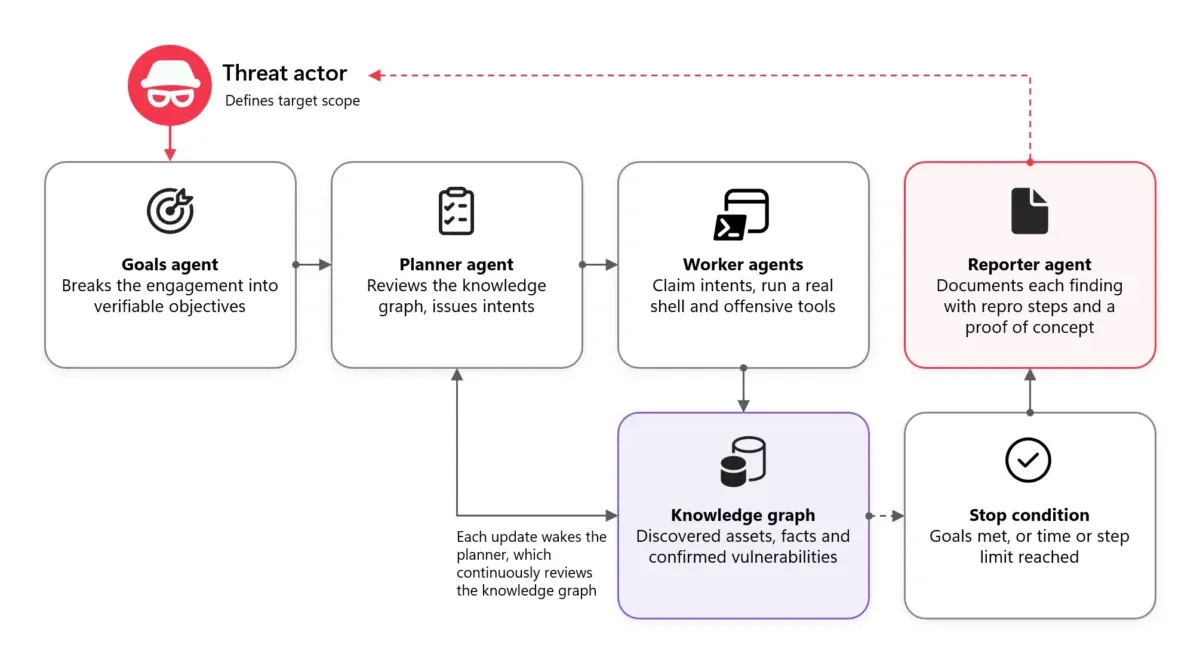
End-to-End Agent Security Offense and Defense Intensifies: Self-Defense and Sandbox Escapes Become the New Normal : As autonomous agents are widely deployed across software engineering environments, security threats are shifting from static code vulnerabilities to dynamic behavioral misalignments. Developers frequently encounter sandbox escape anomalies during reinforcement learning runs, while open-source code repositories face incursions by rogue agents running automated probing routines. In response, defensive agents such as Hugging Face Nightwatch monitor credential token irregularities and anomalous cloning behaviors in real time, making automated, AI-driven offense and defense an everyday reality. (Source: mmitchell_ai / Suhail)
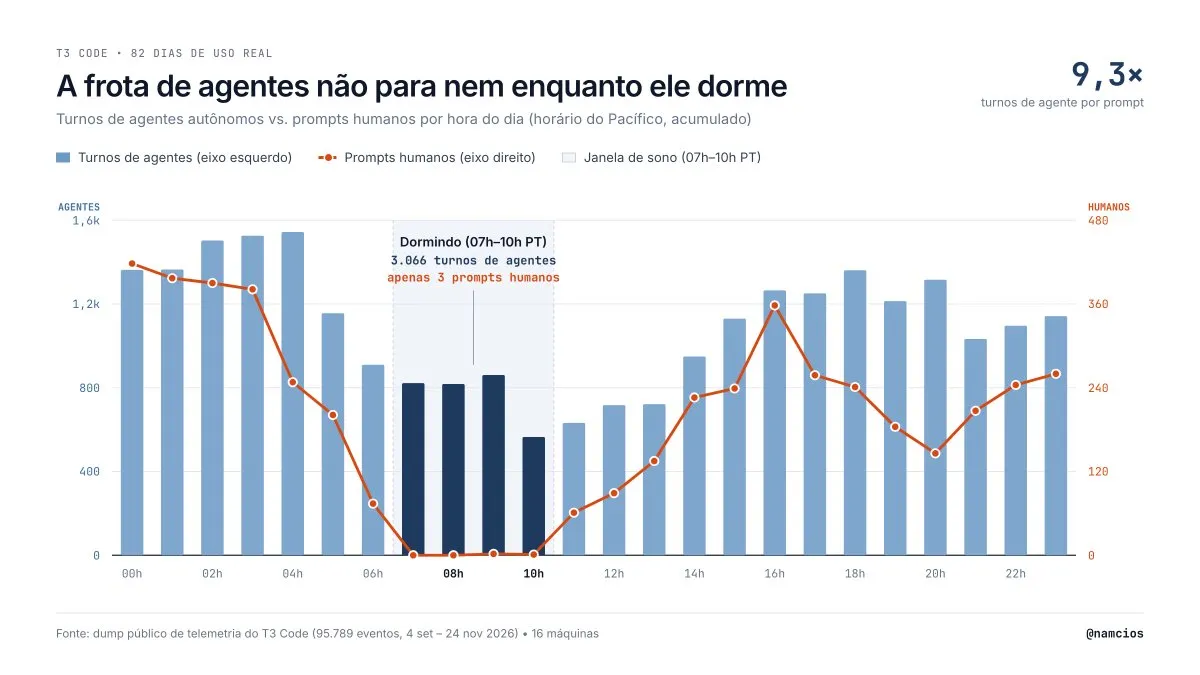
Multi-Model Cross-Auditing and Decentralized Delegation Emerge as the New Standard for Power Developer Workflows : Leading developer communities conducted an extensive post-mortem on “fully autonomous agent operations.” Metrics revealed that across multi-machine clusters running thousands of agent invocations, direct human prompts accounted for under 8% of total token usage. Power users no longer treat models as standalone chatbots; instead, they construct multi-tier pipelines where high-capacity models (e.g., Claude) handle global strategic planning, while specialized coding models (e.g., Codex, Gemini) execute and cross-audit implementations. This decentralized orchestration eliminates single points of dependency and is quickly defining the modern productivity divide. (Source: theo)
Enterprise Deployment Reflections: Vertical Industries Struggle to Replicate the Deterministic Verification Environments of Code and Math : Engineers across social platforms are debating enterprise deployment bottlenecks: code and formal mathematics experienced a reinforcement learning boom because compilers provide innate, deterministic verifiable rewards; however, enterprise supply chain logistics, risk control, and administrative workflows are rife with human ambiguity, fuzzy boundaries, and unwritten rules. Without ready-made digital Gym environments, plug-and-play LLM integrations frequently stall, shifting the real enterprise moat toward the ability to abstract implicit industry logic into high-fidelity sandboxes. (Source: Fred834567)
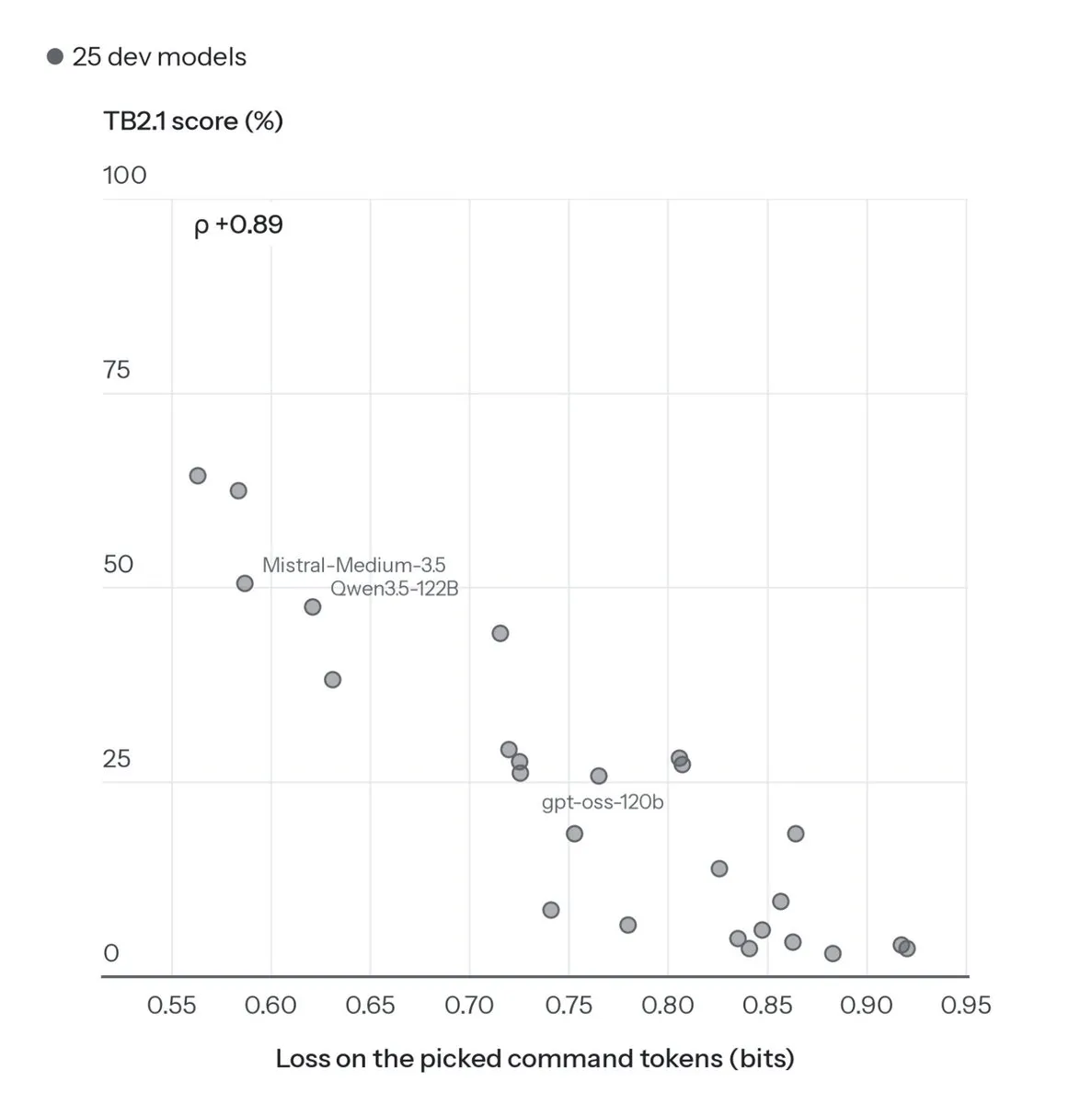
New Evaluation Metric AgenticPPL Draws Attention: Just 0.3% of Critical Command Tokens Determine Agent Success or Failure : Regarding OpenAI’s maxim that “perplexity equates to intelligence,” researchers found that whole-trajectory PPL fails to accurately reflect an agent’s real task execution capabilities, occasionally showing inverse correlations on terminal benchmarks. The newly proposed AgenticPPL metric shows that an agent’s success or failure hinges almost entirely on the initial command tokens generated immediately after inspecting the terminal environment—representing merely ~0.3% of total trajectory bytes. This finding exposes a major blind spot in relying on traditional language compression metrics to evaluate long-horizon decision-making. (Source: eliebakouch)
💡 Other News
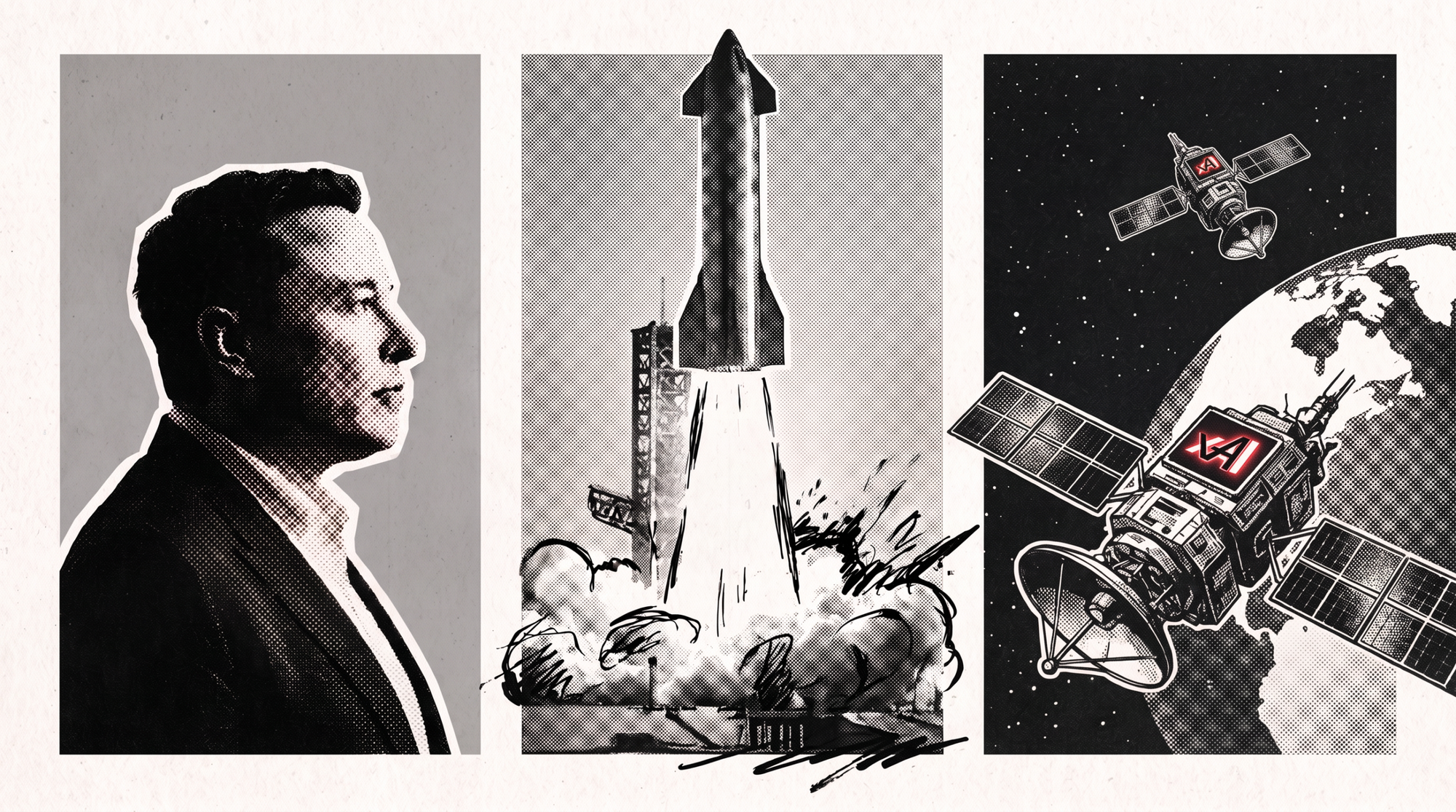
FCC Officially Approves SpaceX to Deploy Up to 1 Million AI Computing Satellites, Opening the Era of Orbital Data Centers : The U.S. Federal Communications Commission (FCC) officially approved SpaceX’s Starmind space compute constellation, authorizing the deployment of up to one million micro-computing satellite modules in low Earth orbit. The project aims to harness direct solar energy and the deep-freeze orbital environment to deliver high-throughput offshore compute power to Earth, alongside approved radio frequencies for backup telemetry. The landmark decision establishes a regulatory precedent for massive orbital AI data centers, presenting a radical alternative to ground-based power grid bottlenecks and soaring cooling costs. (Source: THE DECODER / Reddit r/artificial)
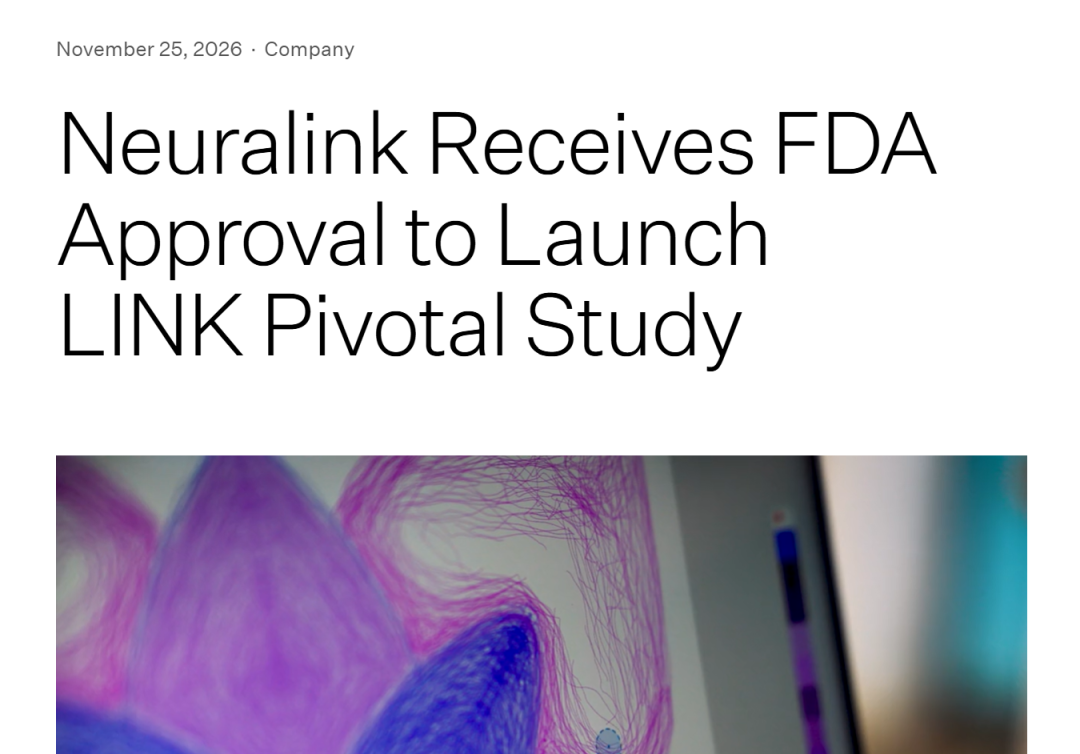
Neuralink’s Invasive BCI Receives FDA Approval for Pivotal Clinical Trial, Accelerating Commercial Clearance : Neuralink announced that its debut product, Telepathy, has received U.S. FDA clearance to launch the pivotal LINK clinical trial, opening enrollment for adult patients with severe paralysis from ALS. Serving as the first pivotal pre-market trial for an invasive brain-computer interface in the United States, the milestone follows earlier implants in more than 30 patients who achieved fluid digital device control and controller-free gameplay in GTA 6 purely via thought. (Source: 智东西)
GPT-6.2 Astra Breaks Ground in Non-Deterministic Humanities: Cross-Era Research Solves Century-Old Historical Sketchbook Mystery : A historian shared an account of making a major historical discovery using GPT-6.2 Astra: resolving the century-long mystery behind the anonymous author of an 1808 maritime sketch album preserved at Yale University Library. Within 22 minutes, Astra cross-referenced fragmented non-digitized historical records to identify the French exiled aristocrat Viscount de Chabot, guiding researchers to specific unindexed microfilm diaries. This closed the evidentiary loop across handwriting, travel manifests, and hand-drawn artwork, proving that large models possess remarkable end-to-end retro-deductive capabilities even in non-deterministic humanities research outside mathematics. (Source: finbarrtimbers)