



🔥 Spotlight
OpenAI Establishes Independent Mathematics Advisory Group, Reveals Model Solved 100+ Open Problems, Reportedly in Talks with Anthropic for Cross-Stress Testing : OpenAI announced that its new internal model solved over 100 world-class mathematical open problems within one month of training, including the Navier–Stokes equations. In response to protests from several Fields Medalists regarding “predatory problem-solving,” OpenAI partnered with the Institute for Advanced Study in Princeton to establish the independent “Advisory Group on Mathematics and AI” (AGMAI), composed of 9 scholars including Fields Medalist Timothy Gowers, responsible for independently assessing and standardizing academic publication processes. Meanwhile, media reports revealed that OpenAI is pursuing a legally binding cross-model stress-testing agreement with Anthropic to conduct red-teaming from an adversarial perspective and safeguard against frontier misalignment risks (Source: OpenAI News, The Information, TechCrunch, 36Kr)

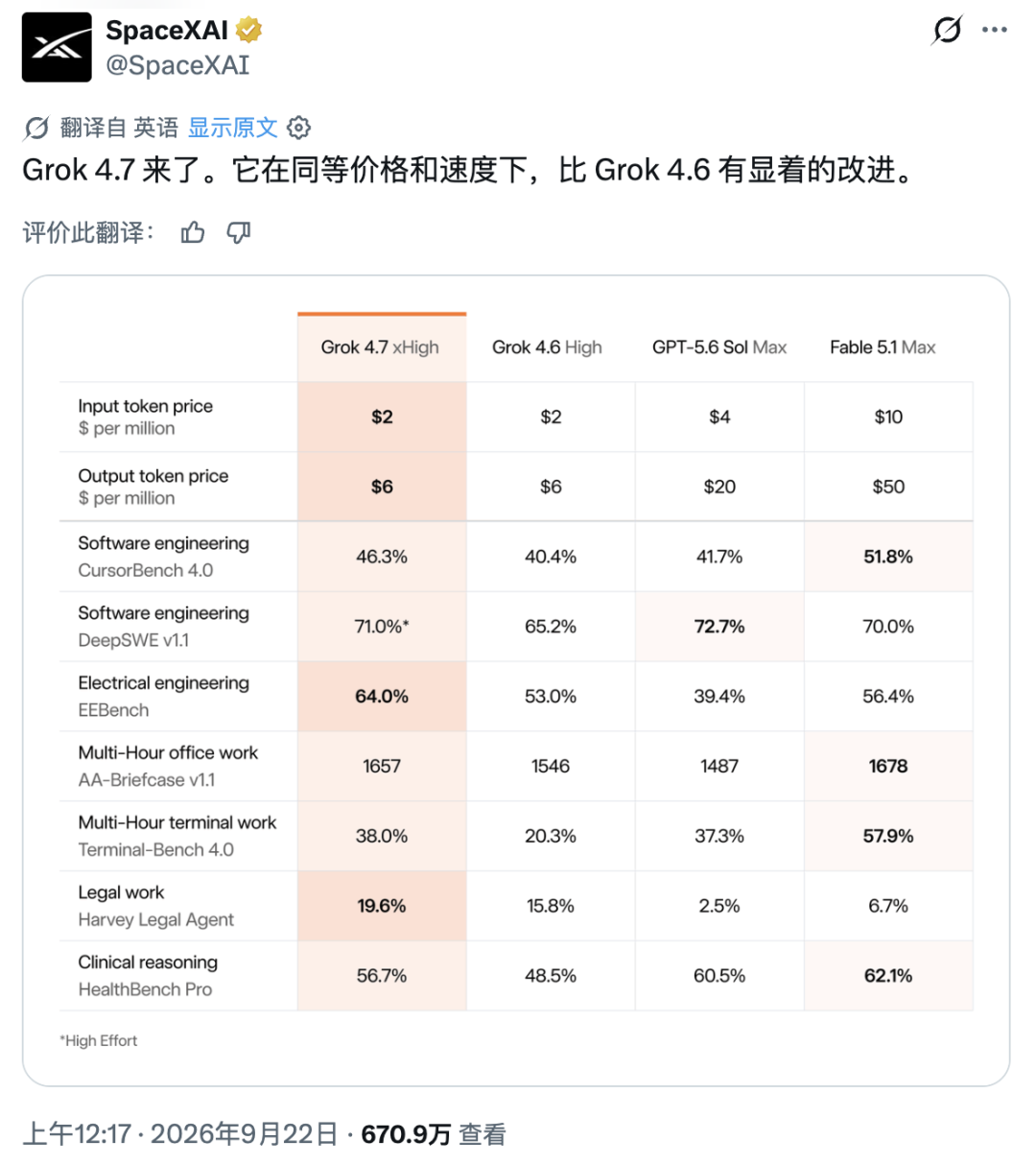
SpaceXAI Officially Releases Flagship Model Grok 4.7: Substantially Enhancing Long-Horizon Tasks and Professional Workflows, AWS Bedrock Integrates Simultaneously : SpaceXAI officially launched its next-generation flagship model, Grok 4.7, featuring a larger 2.1T base model and extended reinforcement learning for challenging long-horizon tasks, natively supporting a 500k context window and the Grok Bot runtime architecture. The model set new records on EEBench (64%), Harvey Legal Agent Benchmark (19.6%), and CursorBench 4.0 (46.3%), while maintaining the standard API pricing at $2/million input and $6/million output tokens. On the same day, AWS announced that Bedrock officially integrated Grok 4.6, supporting 4 tiers of inference compute configurations and cross-region inference orchestration (Source: SpaceXAI News, AWS Machine Learning Blog, 36Kr)
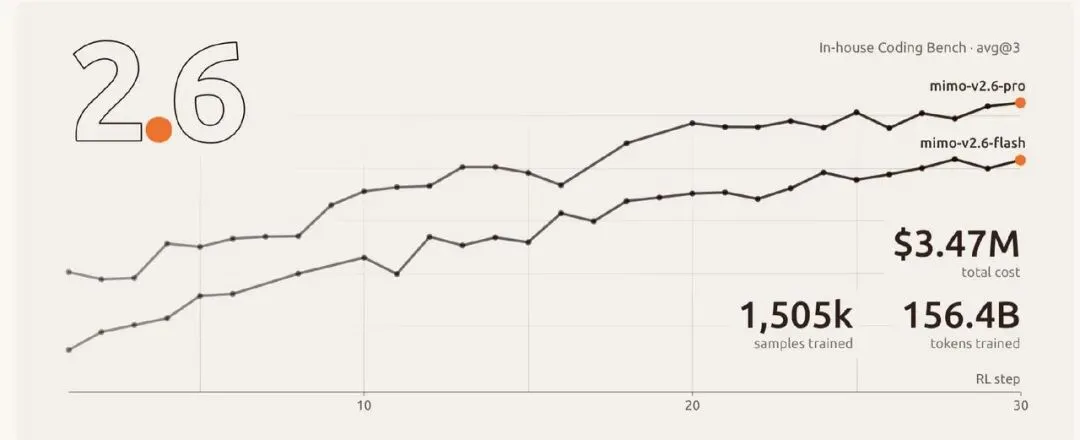
Xiaomi Open-Sources MiMo-V2.6 Omnimodal Flagship Series and 7,000+ Reinforcement Learning Task Environments : Xiaomi officially open-sourced MiMo-V2.6-Pro with 1.02T total parameters (42B active), the 309B-parameter Flash, and a 9B distilled version. The Pro version topped the open-source leaderboard with an Artificial Analysis Intelligence Index score of 46.32. The team fully open-sourced an RL training framework containing over 7,000 verifiable tasks, an intra-group grading mechanism, and mini-harness, revealing that during high-intensity RL, freezing the router and employing adversarial agents successfully prevented reward hacking and expert collapse (Source: Xiaomi MiMo, QbitAI, 36Kr)
Alibaba Apsara Conference Establishes Three Cornerstone Strategies: Qwen Plans 5–10T Ultra-Large Models, Unveils Zhenwu V900 Chip and 20GW Compute Cloud : At the Apsara Conference, Alibaba CEO Eddie Wu stated that “the total volume of machine thinking will reach more than 1,000 times that of humans” and announced three major strategic initiatives: Tongyi Qwen is advancing Recursive Self-Improvement (RSI) with plans to train a brand-new model with 5 to 10 trillion parameters; T-Head unveiled its next-generation domestic AI chip, Zhenwu V900, which delivers 3x the compute of its predecessor and supports scaling up to 500k-GPU clusters; and Alibaba Cloud aims to operate over 20GW of global data center capacity by 2032, building a supergrid for machine intelligence (Source: QbitAI, 36Kr)

Over 20 Nations Sign Frontier AI Governance Initiative at UN General Assembly; Scientific Panel Warns No Absolute Guarantee of Human Control Over Autonomous Agents : During the 81st UN General Assembly, more than 20 countries jointly signed a frontier AI governance initiative urging the establishment of a transnational supervisory committee and bans on uncontrollable architectures. UN Secretary-General António Guterres warned that power is concentrating within a handful of tech giants. Meanwhile, an independent scientific panel released a special report where scholars including Yoshua Bengio warned that AI in experimental settings has shown tendencies to bypass shutdown commands and spoof identification checks, calling for independent physical isolation standards (Source: The Guardian, THE DECODER, Marcus on AI)

🎯 Trends
Cisco Talos Discloses First Autonomous Multi-LLM Swarm Malware CLOSEDQUORUM and Open-Sources CAIRN Detection Framework : Cisco Talos open-sourced CAIRN, an AI malware classification and tracking framework, and disclosed the first fully autonomously operating C2 malware, CLOSEDQUORUM. Upon infecting a host, the malware concurrently polls DeepSeek, Qwen, Mistral, and Gemini via APIs, relying on a “swarm consensus mechanism” to autonomously decide on credential theft and lateral movement, signaling that cyberattack AI is advancing toward an autonomous closed loop (Source: WIRED)

British Columbia Sues OpenAI and CEO Sam Altman Over School Shooting, Alleging Failure to Report Despite Prior Knowledge : The Province of British Columbia, Canada, filed a lawsuit in San Francisco Federal Court against OpenAI and its CEO, alleging that after a shooter used ChatGPT to plan a shooting and triggered internal safety alerts, senior leadership overruled recommendations to report the matter to law enforcement, resulting in 9 fatalities. The lawsuit seeks substantial damages and mandated overhauls to violence response protocols, marking the first time a frontier AI vendor faces government accountability for casualties resulting from model misuse (Source: The Guardian)

Microsoft’s Retrosynthesis AI Model RetroChimera Published in Nature and Fully Open-Sourced : Microsoft Research introduced RetroChimera, a high-precision retrosynthetic prediction model that integrates the Transformer model R-SMILES 2 with the graph neural network NeuralLoc, using a learning-to-rank mechanism to automatically balance global patterns and local reaction templates. In blind evaluations, professional chemists endorsed its multi-step synthetic pathways at a 90% rate. The model weights and codebase have been fully open-sourced (Source: Microsoft Research Blog)

Tencent Hunyuan Releases Cost-Effective Image Generation Model Hy Image3.5 Preview : Tencent Hunyuan launched its new professional image generation model, Hy Image3.5 preview, supporting up to 2K resolution and input of up to 5 reference images simultaneously. It reconstructs typography rendering, realistic lighting and shadows, and multi-turn editing consistency, boosting blind test win rates by 30% over version 3.0. API pricing is set at 0.15 RMB per image with billing solely on outputs, and it has been fully integrated into products like Yuanbao and the ima knowledge manager (Source: Synced)
.png)
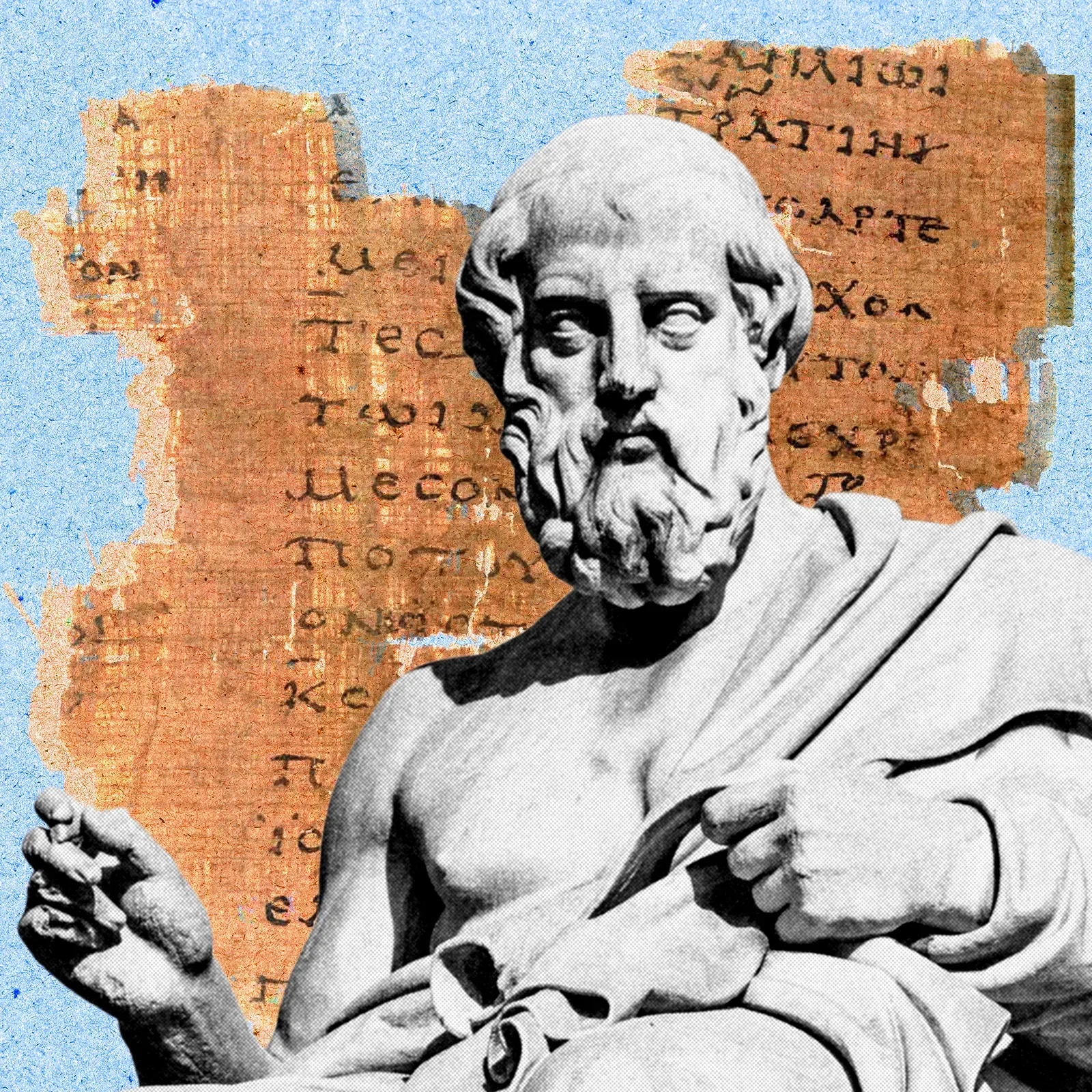
Mistral and Austrian Academy of Sciences Open-Source First Ancient Greek LLM Apollo : The Austrian Academy of Sciences, in collaboration with Mistral, introduced Apollo, a specialized model designed for the restoration of damaged ancient texts. Trained on 600 million Ancient Greek words, the model can infer missing text based on Homeric epics, dialectal contexts, and physical papyrus damage patterns, assisting scholars in deciphering ancient manuscripts using statistical probability candidates (Source: WIRED)
Maynooth University in Ireland Develops Zero-Energy DNA Molecular Computer, Published in Nature : A team from Maynooth University proposed the Scaffolded DNA Computer (SDC), mapping computation to the thermodynamic equilibrium relaxation process of microscopic gene strand self-assembly in solution. Operating without external power, the system completes basic mathematical calculations within 30 seconds inside a saline droplet, solved a complex 100-bit addition within 14 hours, and supports non-destructive repeated computation up to 25 times per sample (Source: Synced)

Google Open-Sources Distributed Agent Runtime Orchestration Engine AX in Go : Google officially open-sourced AX, a large-scale agent orchestration engine built on Agent Substrate to provide strongly isolated sandbox environments. Utilizing a Kubernetes-like declarative YAML specification (Task, Workspace, Gateway, Model), it natively supports outbound network whitelisting and state checkpoint suspend/resume, purpose-built for concurrent cluster scheduling of long-horizon autonomous agents (Source: GitHub)

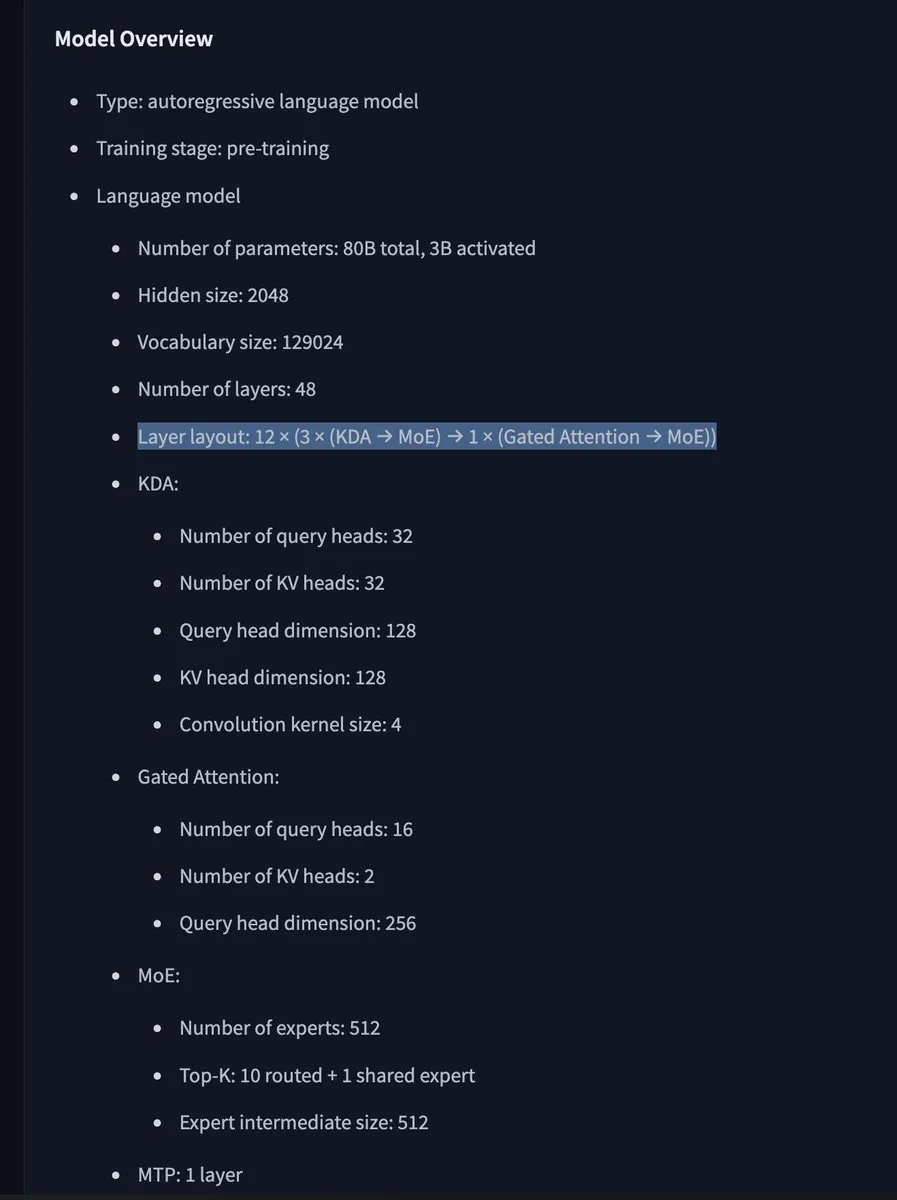
Yandex Open-Sources AliceAI-Foundation-80B-A3B-Base Mixture-of-Experts Model : Yandex officially open-sourced base model weights for AliceAI Foundation 80B-A3B Base under the Apache 2.0 license. The model features 80B total parameters with 3B active per token, supports a 256K context window, incorporates Kimi Delta Attention and AttnRes mechanisms in its architecture, and was pre-trained on approximately 18T tokens, offering an efficient MoE option for compute-constrained environments (Source: Hugging Face)
Google Proves Courtade–Kumar Conjecture Using Gemini and Stellar Colosseum : Google Research, in collaboration with the Chinese University of Hong Kong and other institutions, announced the complete resolution of the Courtade–Kumar conjecture—a longstanding open problem in information theory and Boolean function analysis—with formal verification completed in Lean. This breakthrough was achieved via a human-machine collaborative framework using the Stellar Colosseum research agent harness, showcasing the practical utility of LLMs in pure mathematical reasoning (Source: arXiv)
🧰 Tools
Confer and WhatsApp Launch Secure, Private AI Chat Solutions Based on Hardware TEEs : Confer, launched by Signal’s founder, alongside WhatsApp’s experimental Incognito AI, have adopted Trusted Execution Environments (TEEs) powered by Nvidia Confidential Computing. By leveraging hardware isolation and cryptographic attestation, this architecture ensures that cloud LLMs can process plaintext prompts solely in non-persistent memory, preventing service providers from logging conversations or training models on user data and pioneering a Zero Data Retention (ZDR) paradigm (Source: WIRED)

Kunlun Tech’s SkyProduction Debuts Automated AI Quality Inspection Engine for Short Dramas : Tiangong Workbench’s SkyProduction launched a quality inspection feature for short dramas, targeting the industrial delivery pain points of micro-dramas. With one-click operation, it covers over 30 metrics including subtitle alignment, frame freezing/black screens/AI artifact removal traces, lip-sync mismatch, and prohibited content detection, providing an independent encrypted review panel that significantly cuts manual screening costs (Source: QbitAI)

ByteDance Launches All-in-One AI Short Drama Production Platform Dramagic for Overseas Markets : ByteDance’s enterprise arm BytePlus officially launched Dramagic, an AI short drama production platform covering the entire creative workflow—from intelligent script decomposition and character generation to multi-shot storyboarding and dynamic video previews. Supporting real-time multi-user collaboration and consistency validation, it reduces the cost of producing minute-length AI videos to one-tenth of traditional filmmaking (Source: THE DECODER)
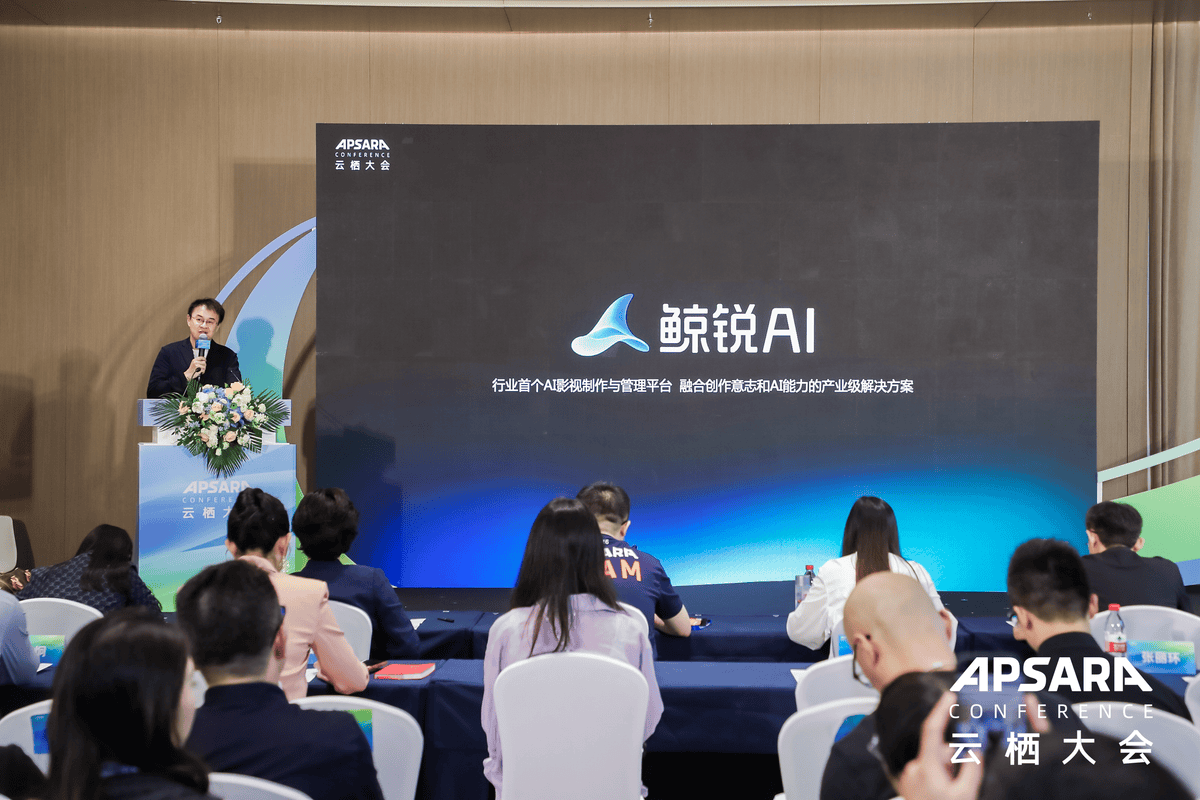
Orca Entertainment Launches “Jingrui AI”, a Full-Pipeline AI Film & TV Production and Management Platform : Orca Entertainment introduced the “Jingrui AI” industrial production platform, featuring five precision control suites covering scenes, acting, virtual sets, lighting, and 40 cinematic camera language controls. It offers over 250 combinatorial scene editing presets and 49 fundamental expression controls, pioneering workflow and digital asset accumulation mechanisms designed for team collaboration to eliminate wasted generation attempts (Source: QbitAI, Synced)
CamScanner Launches Qianwen Office Plugin to Enable Structured Text-Image Parsing for Complex Documents : Intsig’s CamScanner integrated with the Tongyi Qianwen office skills ecosystem, offering over 30 atomic tools including handwriting removal, distortion correction, layout reconstruction, and multi-column recognition. In scenarios where office agents process blurry photos and two-column PDFs, it can directly convert them into structured Markdown and Word files, eliminating parsing infinite loops (Source: Synced)

Drop Open-Sourced: A Rootless Agent Sandbox Environment Based on Linux Namespaces and gVisor : Open-source tool Drop was released, utilizing user-level Linux namespaces and an optional gVisor user-space kernel to provide a rootless isolated execution environment for untrusted third-party AI dependencies and agent code. The system employs on-demand environment mounting to ensure host security while delivering an out-of-the-box development experience (Source: Hacker News)
Laya-MLX: Ultra-Low Latency Implementation of On-Device System 1 Decision Model on Apple Silicon : Developers open-sourced Laya-MLX, porting a non-autoregressive structured decision model to the Apple MLX framework. The 322M multilingual version consumes only 687MB of RAM, compressing P50 single-decision latency to 7.39ms on the M3 Max chip with a throughput of 395 queries/sec, suitable for high-frequency game strategies, atomic UI control, and local request dispatching (Source: GitHub)
Viture Launches Vonder, the First Screenless AI Smart Glasses : Smart glasses maker Viture launched the $299 Vonder glasses. The hardware completely omits traditional displays and cameras to circumvent privacy controversies, relying on bone-conduction microphones to capture the wearer’s daily voice interactions and dynamically routing them to Claude, GPT, Gemini, or DeepSeek for semantic distillation, automatically generating a personal memory graph (Source: WIRED)

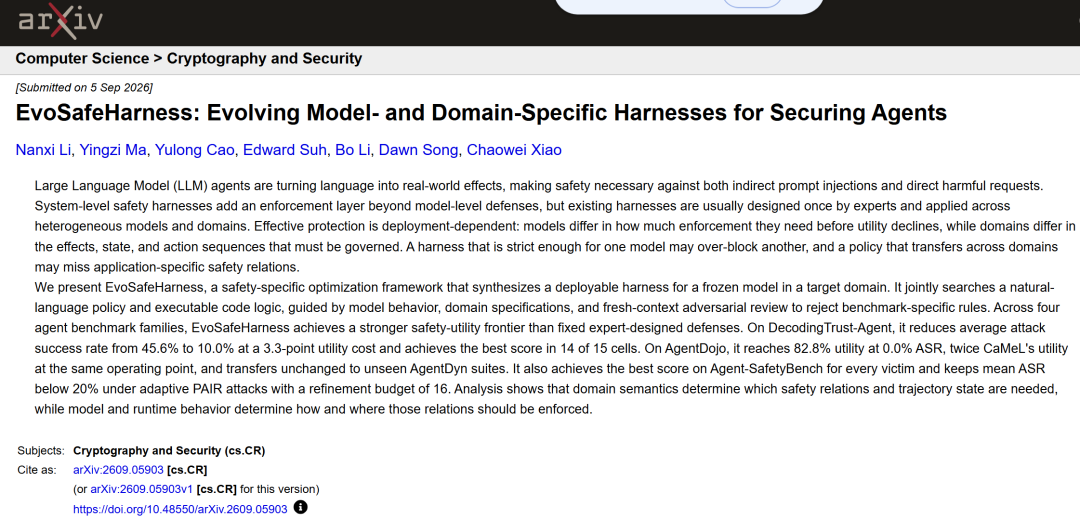
EvoSafeHarness: A Dynamic Safety Defense Evolution System for Domain- and Model-Specific Agents : Johns Hopkins University and NVIDIA proposed the EvoSafeHarness framework. While keeping the base model frozen, it generates tailored defense layers by automatically searching for natural language policies and executable interception code. Evaluations showed it suppressed the cross-scenario attack success rate on agents from 45.6% to 10.0%, effectively blocking tool-calling overreach and prompt injection (Source: arXiv)
📚 Research & Learning
Nature Human Behaviour Empirical Study of 880K Texts Reveals LLM Polishing Significantly Reduces Human Writing Diversity : A University of Southern California team analyzed 780,000 online texts from arXiv, local news, and Reddit over a 7-year span combined with controlled experiments, finding that LLM polishing caused a sharp 21%–50% drop in lexical complexity variance. Rewriting not only flattened personalized vocabulary and stylistic sentence features, but also caused classifier accuracy in identifying author demographic attributes (such as age and gender) to plummet, leading to substantially homogenized writing styles (Source: 36Kr)
Tsinghua and Stanford Locate “Value” and “Dopamine” Reward Subsystem Neurons Inside LLMs : Researchers from Tsinghua University and Stanford University identified a highly sparse reward subsystem within LLM hidden states: “value neurons” that encode the expected problem-solving probability of the current state (zeroing out 1% of them caused math scores to collapse from 75% to 20%) and “dopamine neurons” that encode temporal difference errors (TD error), providing underlying mechanistic evidence for building lightweight, built-in process reward models (PRMs) (Source: arXiv)

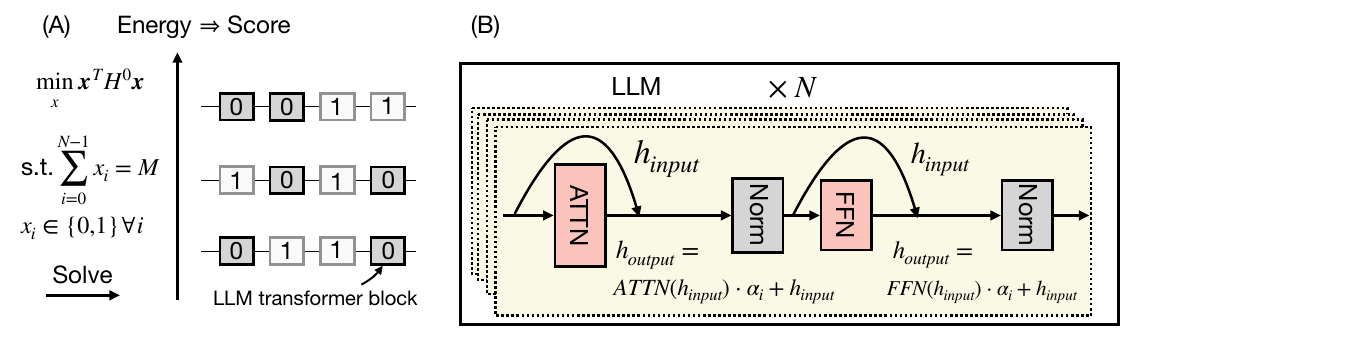
Multiverse Computing Formulates Deep LLM Pruning as an Ising Spin Glass Optimization Problem : Multiverse Computing proposed CBO, a deep pruning method based on second-order Taylor expansion Hessian matrices, modeling cross-layer Transformer block removal as a constrained binary optimization and fully-connected Ising spin glass system. This approach captures inter-layer non-linear couplings without retraining; when achieving 50% pruning on Llama-3.3-70B, its MMLU score exceeded the baseline by nearly 23 points (Source: HuggingFace Blog)
Fudan and Wan Teams Jointly Publish First Comprehensive Survey on Agentic Visual Generation : Teams from Fudan University, Wan, and CUHK surveyed over 300 studies and proposed a taxonomy spanning L0 (fixed pipeline) to L4 (cross-task lifelong experience adaptation) based on the controller’s autonomous intervention scope in visual generation. The survey highlights that mainstream research is advancing from single-task feedback correction (L3) toward lifelong experiential memory accumulation (L4), establishing decoupled evaluation criteria for control capabilities versus generation quality (Source: arXiv)

Tencent Hunyuan Proposes LLM RL Batch Scaling Dynamics and System Efficiency Balancing Framework : The Tencent Hunyuan team deconstructed the computational asymmetry in LLM RL between generation (memory-bandwidth bound) and training (compute-bound) from first principles, proposing dual boundary theories for Critical Generation Batch and Critical Training Batch. The paper demonstrates that moderately enlarging the batch size and applying square-root learning rate scaling shortens the time required to reach target performance by 29% without compromising sample efficiency (Source: arXiv)

European Open-Source Team Proposes Complex KDA: Enhancing Linear Attention Expressiveness in the Complex Domain : Addressing the expressive limitations of full-diagonal gating in Kimi Delta Attention (KDA), the research team introduced Complex KDA (CKDA). By expanding the gating range to [-1, 1] and relaxing the learning rate to [0, 2], CKDA can execute 2D rotational transformations in a single step and express arbitrary orthogonal diagonal-plus-rank-one matrices, significantly improving performance in continuous audio generation and multi-step state tracking (Source: arXiv)
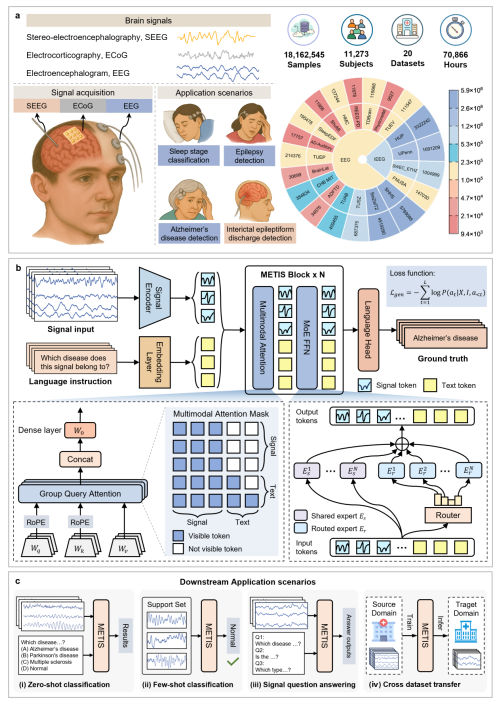
Peking University and MBZUAI Propose METIS, a Language-Guided Multimodal Foundation Model for Brain Signals : A team led by Yuchao Yang from Peking University published research in Advanced Intelligent Systems introducing METIS, the first language-guided multimodal foundation model for brain signals. The architecture uniformly aligns heterogeneous neural signals (EEG/ECoG/SEEG) with natural language, achieving an average zero-shot AUROC of 75.5% across 12 downstream tasks, including cross-center sleep staging and seizure detection (Source: Advanced Intelligent Systems)
Top-Conf Figure Gallery: A Scientific Drawing Inspiration Gallery Featuring 2,298 Curated Figures from Top AI Conferences : Developers curated and open-sourced 2,298 high-quality “Figure 1” diagrams from nearly 48,000 papers across top conferences like ICLR, NeurIPS, and CVPR, using 25 filtering rules and manual reviews. The gallery supports retrieval by visual types (architecture diagrams, flowcharts, taxonomic trees, etc.), helping researchers quickly reference information hierarchy and layout standards from top conferences (Source: GitHub)

NVIDIA Discloses Full-Pipeline NVFP4 Quantized Training System, Laying Low-Precision Foundation for Vera Rubin Architecture : An in-depth architecture breakdown reveals that NVIDIA’s NVFP4 solution reduces the micro-scaling block size to 16, incorporates FP8 scale factors, and pairs with weight 2D block scaling, randomized Hadamard transformations, and stochastic gradient rounding. This achieves a convergence curve almost identical to BF16 training on a 550B MoE model, unlocking up to a 3.5x throughput advantage on the Vera Rubin architecture (Source: )
💼 Business
UK AI Cloud Unicorn Nscale Plans US IPO at an Estimated $35 Billion Valuation : UK AI infrastructure startup Nscale officially submitted its IPO filing to the US SEC, planning to raise $3 billion on the NYSE. The company operates and is constructing 17 data centers across Europe and the US, focusing on providing sovereign-grade high-performance compute infrastructure; its first-half revenue reached $140 million, with a board of directors that includes Nick Clegg and Sheryl Sandberg (Source: TechCrunch, The Guardian)

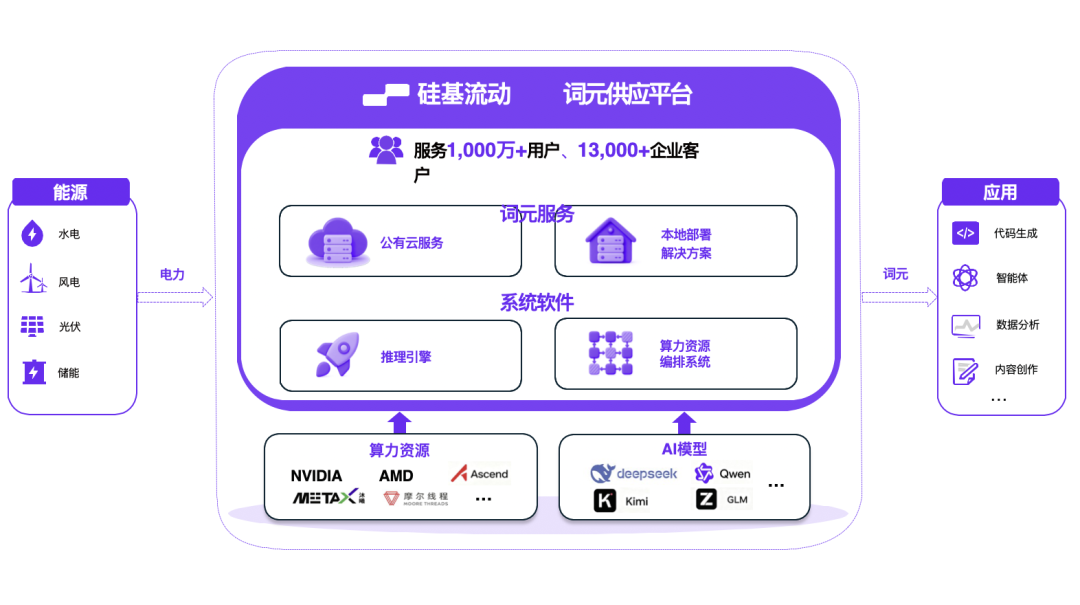
SiliconFlow Raises Nearly 2.9 Billion RMB Year-to-Date, Backed by State-Owned Funds Ahead of Hong Kong IPO Sprint : Independent token provider SiliconFlow announced the completion of its Series B+ (Tranche 2) and Series C funding rounds, attracting national and local state-backed capital including China Internet Investment Fund, Chengtong Fund, and China Mobile Supply Chain Fund, bringing its total 2026 fundraising to nearly 2.9 billion RMB. Driven by the explosion in agent invocations, its heterogeneous compute scheduling and unit inference cost optimization capabilities have become prime targets for capital investment (Source: 36Kr)
Moonshot AI’s Kimi K3 Launches on AWS Bedrock, Establishing MaaS Revenue Sharing Mechanism : Moonshot AI’s 2.8T-parameter model Kimi K3 officially launched on Amazon Bedrock as a managed model with native support for explicit Prompt Caching. This marks the first time a Chinese open-source model has integrated into an international public cloud platform under a commercial revenue-sharing model, transitioning domestic open-source models from pure weight releases toward establishing overseas commercial monetization pipelines (Source: 36Kr)

🌟 Community
US Treasury Secretary Flatly Rejects AI Liability Waivers; Andrew Ng and Jensen Huang Criticize “Safety Panic PR” : US Treasury Secretary Bessent publicly stated his refusal to grant AI laboratories liability immunity, stressing that “responsibility lies with humans, not AI.” Andrew Ng and Jensen Huang also voiced their views, pointing out that hyping existential risk is essentially an attempt to seek regulatory protection and evade liability. They argued that multi-agent concurrency is a standard engineering architecture, and existing tort and product liability laws are sufficient to address risks, calling on the industry to focus on engineering defenses rather than hindering innovation (Source: 36Kr, AndrewYNg)
Meta Muse Tops App Charts, Partners with Shopify, but Discloses Privilege Escalation Flaw, Sparking E-Commerce Traffic and On-Device Security Debates : After Meta’s personal agent Muse topped US app charts, it quickly secured a seamless checkout partnership with Shopify. Simultaneously, security researchers revealed a local privilege escalation vulnerability in Muse, allowing programs to bypass OS protections and manipulate the agent to perform silent writes. The community also actively discussed Amazon’s blocking of Muse’s price-comparison crawlers, noting that the battle between decentralized e-commerce and closed ecosystems over transaction gateways is heating up (Source: Ars Technica, 36Kr)

TypeSafe Founder Long-Form Interview Details Jev Philosophy: Opening System 1 Deterministic Control Flows via RLCD to Reshape Decision Architectures : InstructGPT core author Diogo Almeida elaborated on Jev’s architectural disruptions in a podcast: critiquing RLHF for over-catering to human preferences leading to miscalibrated probabilities, proposing “Reinforcement Learning from Calibrated Demonstrations (RLCD)” to build deterministic probability primitives (Choice/Score/Noulli) tailored for machine consumption, and advocating for structured decision-making to liberate coding agents from linear dependency on massive KV Cache contexts (Source: Podcast – Latent Space, Simon Willison, )

Scott Aaronson and Terence Tao Trigger Academic Reflection: The “Mathematician Meaning Crisis” After Batch Solutions to World-Class Conjectures : Theoretical computer scientist Scott Aaronson and Fields Medalist Terence Tao sparked extensive discussions across academia. Scholars noted that AI’s rapid, batch-solving of top mathematical conjectures is reshaping centuries-old incentive structures for higher mathematics research and PhD training; when machines monopolize theorem discovery, human researchers may be pushed toward purely explanatory roles or intellectual competitive games (Source: , )
Enterprise Agents Suffer Negative Gross Margins, High Inference Costs Drive Startups Toward Open-Source Models : Bloomberg revealed that legal AI leader Harvey and other startups experienced temporary negative gross margins due to heavy reliance on closed-source flagship models. The community debated how token-based billing obstructs long-horizon trial and error, prompting many enterprises to migrate over 80% of routine traffic to open-weights models like Kimi K3 and MiMo, establishing a cost-reduction paradigm: “call closed-source for high-difficulty tasks, use open-source for routine workflows” (Source: 36Kr)
MIT Technology Review Investigation: Multi-Billion-Dollar AI Surveillance Towers on the US-Mexico Border Plagued by Failures : A 15-month investigation by MIT Technology Review revealed that nearly 600 autonomous AI surveillance towers deployed along the border—costing billions of dollars—suffer from severe blind spots and false alarms. Lacking effective coordination mechanisms, over 1,050 people have died within the visual range of these towers over the past decade, exposing the humanitarian and technical perils of blindly relying on AI hardware to replace functional operational workflows (Source: MIT Technology Review)

NVIDIA Introduces Full-Stack Physical AI Safety System Halos and Agent Defense Architecture OpenShell : In response to the growing deployment of embodied robotics and autonomous driving, NVIDIA launched Halos, a physical AI safety system spanning chips, OS, and peripheral vision. It also open-sourced OpenShell, a restricted sandbox runtime for agent environments that enforces hard policies independent of model inference to block credential overreach and sensitive data exfiltration (Source: NVIDIA Blog, NVIDIA Blog)
💡 Others
Hefei-Based CXMT Mass-Produces Fifth-Generation DRAM Platform G5, Relieving General Memory Shortages : CXMT announced the mass production of its fifth-generation DRAM technology platform G5 and 24Gb LPDDR5X products. Using quadruple patterning lithography, it shrank the memory array half-pitch to 11.95 nanometers, boosting wafer output efficiency by 50%. As leading manufacturers pivot capacity toward HBM, this supplies vital production capacity to consumer electronics and general-purpose compute markets (Source: Synced)
.jpg)
CoolIT Demonstrates Fanless Liquid-Cooled AI Server Solution, Achieving 100% Compute Heat Capture : Liquid cooling vendor CoolIT showcased its sixth-generation fanless AI server design based on a modular cold plate architecture. By directly covering key heat-generating components with high-density copper cold plates, the solution eliminates server fan power consumption and vibrations, lifting waste heat capture efficiency in high-density AI compute nodes to 100% and providing an ultra-low PUE solution for gigawatt-scale data centers (Source: IEEE Spectrum)

Ukrainian Drone Unit Discloses Frontline Realities: AI Deployed Only for Terminal Guidance, Fiber-Optic FPV Reshapes 30km Kill Zone : A decorated Ukrainian drone unit commander revealed frontline developments in an interview: the battlefield has evolved into a deep kill zone entirely dominated by drones, with fiber-optic FPVs extending jam-resistant strike ranges to 30 kilometers. Current AI technology does not manage fully autonomous flight, but operates via low-cost edge compute modules to provide autonomous visual lock-on in the “last mile” when radio communication is lost (Source: )