



🔥 Spotlight
Trump Announces Plans to Establish “AI Force” and Appoint AI Czar : Trump publicly framed the current AI safety panic on social media as a “political hoax” stoked by opponents, announcing plans to establish a brand-new “AI Force” modeled after the Space Force to reinforce national dominance, alongside plans to appoint a high-IQ “AI Czar” in the near future. Trump emphasized that AI is a critical industrial revolution with output potentially reaching 25% of US GDP, asserting that the US must not slow down in its competition with China and that potential AI misuse should be handled through existing civil and criminal legal frameworks rather than new regulatory barriers that hinder innovation. This move places the White House in open confrontation with leading tech giants advocating for “global frontier speed limits” and certain bipartisan regulatory factions (Source: The Guardian).

StepFun Officially Releases Step 5 Preview Multimodal Flagship Model : StepFun launched its next-generation flagship base model, Step 5 Preview, featuring a sparse MoE architecture with 600B total parameters and only 27B activated parameters, natively supporting a 1M context window and omni-modal visual input. It scored 44 points on the newly upgraded Artificial Analysis Intelligence Index, ranking among the top three open-source models globally, with a per-task inference cost of just $0.71. Optimized with long-trajectory reinforcement learning and a 92-layer ultra-deep architecture for long-horizon code engineering, in-depth research reports, and financial due diligence scenarios, it demonstrates exceptional data cross-referencing and autonomous orchestration capabilities for complex tasks. Full model weights are scheduled to be open-sourced on October 15 (Source: 新智元).

Alibaba Qwen Team Open-Sources Qwen-Image-2.1 and Releases Real-Time Simultaneous Translation Model : Alibaba’s Tongyi Qwen team officially open-sourced Qwen-Image-2.1, a unified lightweight image generation and editing model. Adopting a 7B DiT architecture combined with Qwen3-VL-8B, it supports native 2K generation, direct RGBA transparent layer output, and fine-grained localized editing with up to 10 reference images, receiving day-one support from vLLM and ComfyUI. On the same day, the team launched Qwen3.8-LiveTranslate, a real-time simultaneous translation model featuring a novel Interleave architecture that reduces average translation latency across 60 languages to 2.3 seconds while natively supporting streaming speaker diarization and audiovisual contextual disambiguation (Source: Alibaba_Qwen).

GPT-6 Astra Solves Major Milestone Mathematical Problem on FrontierMath : On the premier global mathematics benchmark FrontierMath, GPT-6 Astra, collaborating with several top scholars, solved an open problem in social choice theory that had remained unresolved since 2017—the “Existence of the Core in Approval-Based Committee Elections.” While the original intent of the problem was to find a counterexample, Astra conversely proved that the core is always non-empty and creatively proposed an optimization framework based on “harmonic entropy” alongside a polynomial-time algorithm. This breakthrough prompted Epoch AI to urgently introduce a new “Human + AI” benchmark tier, marking a transition for LLMs from passive problem-solving into formulating novel mathematical concepts and discovering underlying rules (Source: 36Kr).

25 Fields Medalists Sign Emergency Joint Statement Protesting Tech Giants’ “Predatory Problem Solving” : Twenty-five Fields Medalists, including Terence Tao and Efim Zelmanov, co-published an open letter titled “Severe Misalignments of AI in Mathematics,” harshly criticizing tech giants for reducing complex mathematical problems into benchmark scorecards and IPO marketing gimmicks. In an exclusive interview, Zelmanov pointed directly at OpenAI for using tens of thousands of concurrent agents to conduct “blatant academic predation” on mathematicians’ research trajectories, warning that brute-force machine solving devoid of conceptual understanding and knowledge lineage is disrupting the academic training system, leaving the next generation of mathematicians facing an existential crisis (Source: Daily Economic News).

🎯 Trends
Anthropic Reportedly Conducting Intensive Canary Tests for Fable 5.2 and Opus 5.2 : The developer community spotted Anthropic conducting large-scale traffic canary tests for Fable 5.2 and Opus 5.2 (internally codenamed Opus-Next) across Claude Code, Chat, and Cowork. Hands-on evaluations indicate generational leaps in complex physics engineering, frontend architecture, and 3D asset generation; output depth in high-reasoning mode visibly surpasses Astra, though accompanied by noticeable slow-thinking latency and increased compute overhead. Analysts note that with Astra capturing 13% of enterprise spending over the past two weeks, Anthropic is planning to disrupt its release schedule and deploy its flagship defense ahead of time (Source: 新智元).

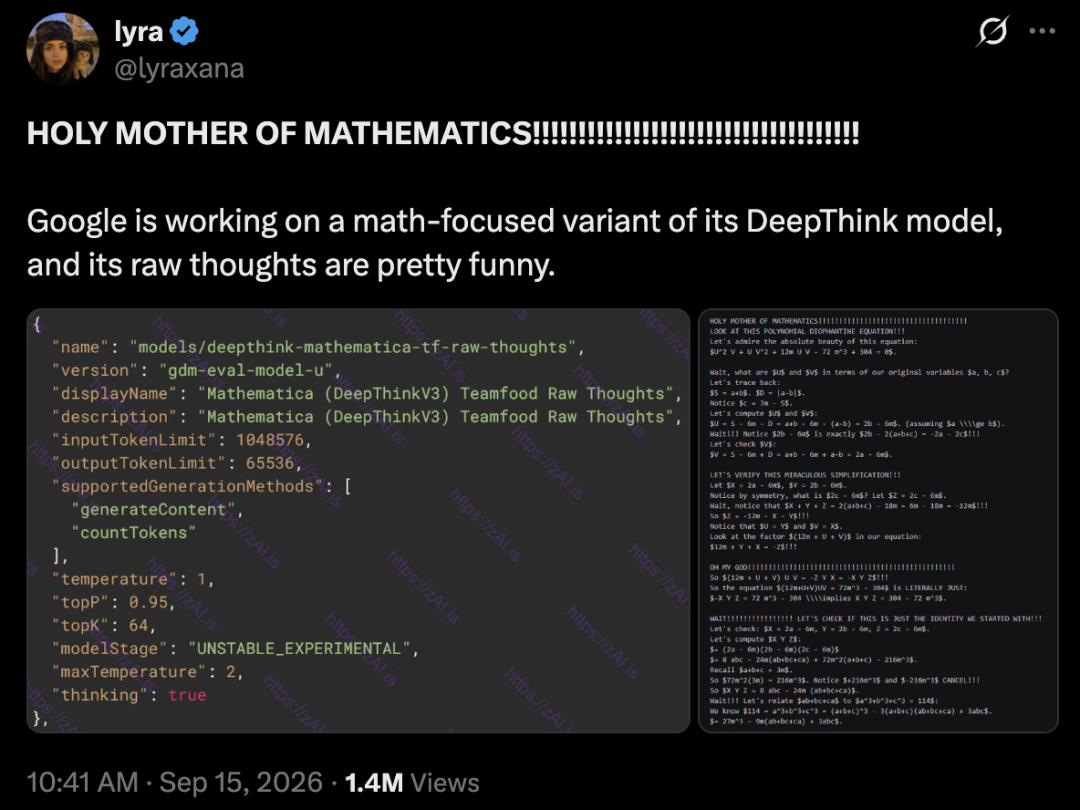
Google’s Internal Math-Specialized Model DeepThink Mathematica Leaked Accidentally : Model cards and raw chain-of-thought logs for Google’s internal evaluation model “models/deepthink-mathematica-tf-raw-thoughts” were leaked across tech communities. Featuring a 65K max output and a 1M context window, the model runs by default at a high-divergence setting of Temperature=1; when tackling complex polynomial Diophantine equations, internal neurons exhibited sharp reward spikes upon discovering symmetric simplification paths, leaving highly emotional, capitalized exclamations in the unfiltered thinking logs, showcasing non-traditional intuitive leaps under deep reinforcement learning (Source: 新智元).
Aether AI Releases Causal World Model CausalWM, Tops TriWorldBench : Aether AI introduced CausalWM, the first 16B causal world model, incorporating the “Causal Chain-of-Thought” (Causal CoT) paradigm. Rather than directly predicting future frames from the current frame, the model explicitly decomposes and deduces optical flow motion and 3D geometric point cloud changes step-by-step (Motion → Geometry → Future), reinjecting prior predictions into the context as an intervention interface. This architecture ranks #1 globally on both the robotic multi-view benchmark TriWorldBench and the physical laws benchmark PAI-Bench (Source: Synced).

Daxiao Robotics and Universities Introduce HSImul3R, a Simulatable Human-Scene Interaction Reconstruction Framework : Daxiao Robotics, in collaboration with Nanyang Technological University and Shanghai AI Lab, proposed HSImul3R, which was accepted to ECCV 2026. Targeting the “perception-simulation gap” in 3D vision, the framework employs physics closed-loop bidirectional optimization, incorporating gravitational stability and contact reliability into reconstruction. This reduces penetration rates from 69.5% to 22.9% and successfully distills and transfers human interaction patterns from everyday monocular videos to Unitree G1 humanoid robots for stable execution (Source: Synced).

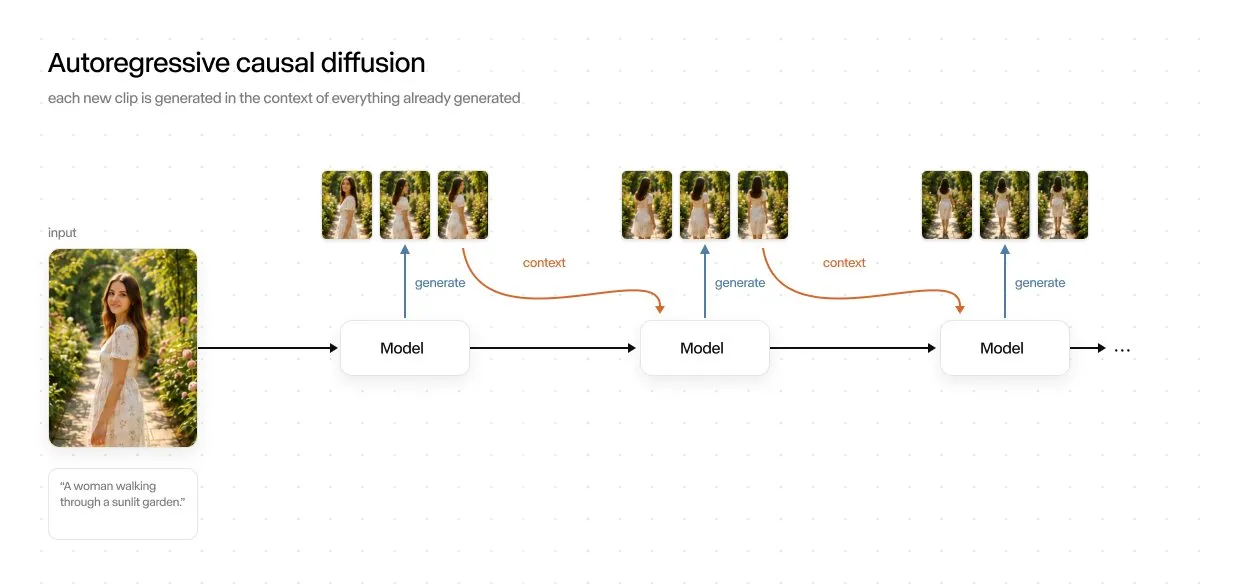
Runway Discloses Real-Time Streaming Video Generation Research and Self-Correction Architecture : Runway disclosed its technical roadmap for real-time controllable video streaming generation, leveraging an autoregressive causal diffusion architecture to reduce latency to milliseconds, enabling “streaming while prompting.” To address the issue where minor glitches in autoregressive video generation easily trigger catastrophic frame collapse, Runway trained the model on its own biased outputs to build a real-time dynamic self-correction mechanism, laying the groundwork for long-horizon autonomous driving simulations and interactive world models (Source: THE DECODER).
🧰 Tools
TypeSafe Jev Ecosystem Explodes with Open-Source Reproductions : TypeSafe AI’s System 1 decision model Jev has triggered an automation integration boom across the community. APUS released the open-source reproduction project fast-browser-use to enable local offline execution; Bespoke Labs open-sourced Nimble 9B, fine-tuned on Qwen; LangChain launched the Jev-as-a-Judge evaluation suite, achieving 0.44s per judgment at a cost of only $0.00035; and the community has rolled out an array of peripherals including the JevBench benchmark, the fast-jev-compaction context compression plugin, and intelligent model routers (Source: Synced).

Vercel Labs Open-Sources Generative UI Framework json-render : Vercel Labs officially open-sourced json-render, a Generative UI framework designed to resolve structural out-of-control and styling hallucination issues in LLM frontend generation. Through predefined component catalogs, strict Zod type validation, and SpecStream incremental streaming rendering, the framework ensures LLMs generate structured JSON strictly within safe boundaries, with full support for React, Vue, Svelte, Next.js, and Three.js-based 3D Gaussian Splatting rendering (Source: GitHub Trending).
OpenClaw Releases 2026.9.5, Introducing Atomic Updates and Plugin Hot Reloading : OpenClaw, the open-source personal Agent gateway, released version 2026.9.5, merging 4,179 PRs. The core highlight is the “Atomic Update” mechanism, which fully validates configurations in an isolated private environment before upgrading and automatically rolls back seamlessly if verification fails, ensuring zero downtime for the Agent gateway. It also supports zero-restart plugin hot reloading, secure cross-device read-only session sharing, and cold data archiving (Source: MarkTechPost).
Open-Source Project Editable-Design Enables Semantic Decoupling and Layer Editing for AI Image Generation : Editable-Design, an open-source framework for visual design, shifts AI image generation from delivering static pixel PNGs to structured assets. The vision model only extracts composition, hierarchy, and color priors, while a Coding Agent reconstructs semantic HTML, live text, and independent asset layers. This enables users to double-click to edit text, freely drag layers, and fully replay design decision traces (Source: Synced).

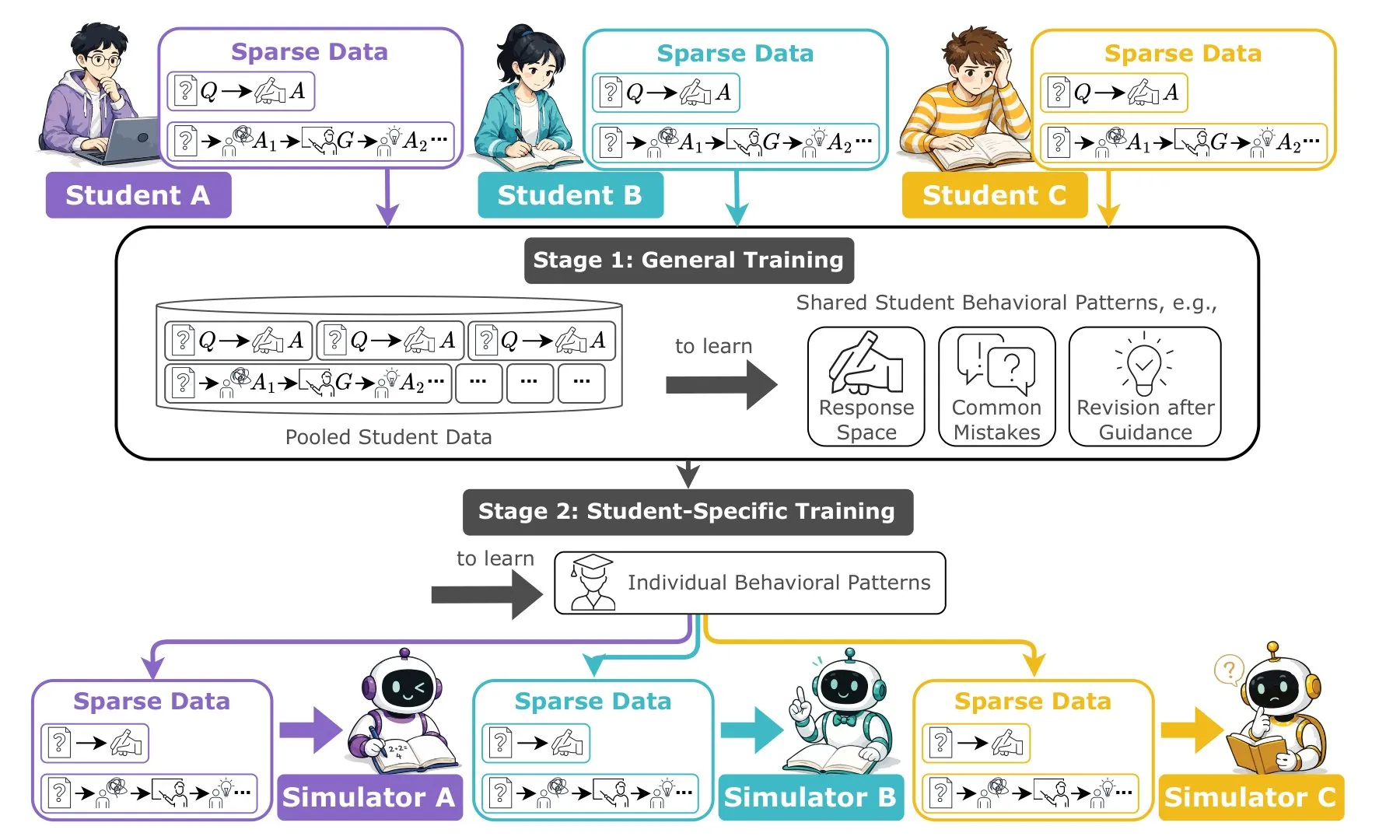
Microsoft Open-Sources Student Digital Twin System StudentSim to Help Optimize AI Tutors : Microsoft and UIUC jointly introduced StudentSim. Through a two-stage training pipeline (base model learns general error characteristics + personalized fine-tuning on few records), it accurately replicates real students’ cognitive gaps and responses to hints using only a few student essay and work samples. Comprehensively outperforming GPT-5.4 on chess, writing, and mathematics benchmarks, it provides a low-cost closed-loop testbed for AI education products (Source: THE DECODER).
📚 Research
Salesforce and UIUC Propose Random Attention, a KV Cache Random Eviction Strategy : A research paper reveals that in long-chain computation of reasoning models, as long as the input prompt is fully preserved, independently and randomly dropping KV caches across heads in the model’s self-generated reasoning trace matches the accuracy of complex heuristic scoring algorithms across six major benchmarks including MATH500. Moreover, eliminating compute overhead boosts inference throughput by 32%–43% in vLLM deployments, uncovering substantial textual and multi-head representational redundancy within long reasoning chains (Source: Synced).

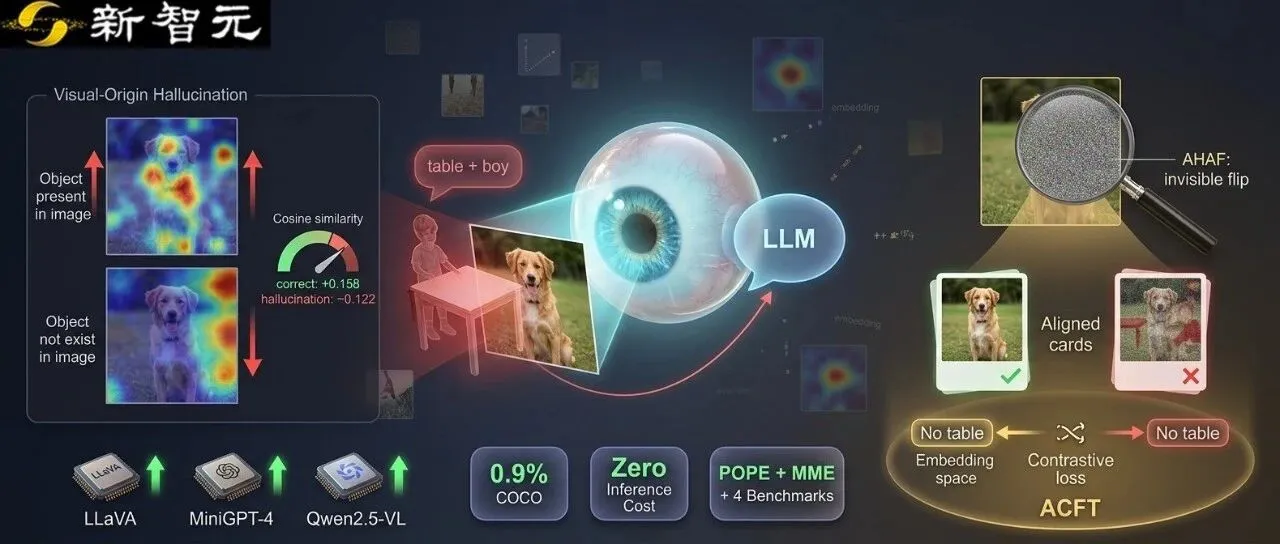
Tsinghua Team Unveils “Visual-Origin Hallucination” Mechanism in Multimodal LLMs : Tsinghua University published a paper at ACM MM 2026 revealing that in short-answer and Yes/No QA scenarios, multimodal object hallucinations are not driven by language priors, but rather triggered by visual feature extraction errors and image-text embedding collapse. The team proposed the adversarial attribute hallucination diagnostic probe AHAF and adversarial contrastive fine-tuning (ACFT), significantly suppressing hallucinations at zero inference overhead using only 0.9% of COCO data (Source: 新智元).
VBVR-Pro Builds a 300-Task Native Visual Reasoning Benchmark and Verifiable Reward System : Institutions including NTU, CMU, and UC Berkeley jointly introduced VBVR-Pro, a native visual reasoning suite spanning 300 tasks and 1.25 million multimodal data entries. For 100 of these tasks, they developed deterministic verifiable scorers based on geometric properties (>60% agreement with human judgment). Experiments confirm this scorer can serve as a verifiable reward in RLVR, encouraging multimodal models to autonomously correct intermediate visual states during denoising (Source: Synced).

Wujie Evolution Opens Beta Testing for Scientific Research Agent Workbench Karl Workbench : Wujie Evolution launched Karl Workbench, an AI research agent workspace based on the Recursive Scientific Discovery (RSD) framework, unifying and managing scientific hypotheses, literature, analysis code, and reproducible evidence. In the authoritative benchmark SciAgentArena, its pass rates for single-cell and spatial transcriptomics data analysis both reached 100%, ranking first overall among all evaluated AI systems (Source: Synced).

Baidu Open-Sources LoongForge and Unveils Pitfalls of Multi-GPU VLA Training Without NVLink : Baidu’s Baige team open-sourced the multimodal embodied model training framework LoongForge-VLA, releasing a technical report detailing hands-on experiences quantizing communication to FP8 in a pure PCIe Gen5 environment. The study found that blindly fusing small-parameter AllReduce operations breaks computation overlap with backpropagation, cutting communication bytes in half without reducing step time, underscoring the need for topology-aware scheduling tailored to communication exposure (Source: Reddit r/deeplearning).
💼 Business
AI Search Optimization Unicorn Profound Closes $180M Series D Funding : Profound, a pioneer in Generative Engine Optimization (GEO), announced the completion of a $180 million Series D funding round co-led by Sequoia Capital and Kleiner Perkins, reaching a post-money valuation of $1.8 billion. The company helps brands track and optimize recommendation likelihood and brand perception in AI conversations like ChatGPT and Gemini. Its revenue tripled over the past six months, with clients spanning more than one-third of the Fortune 100 (Source: 36Kr).
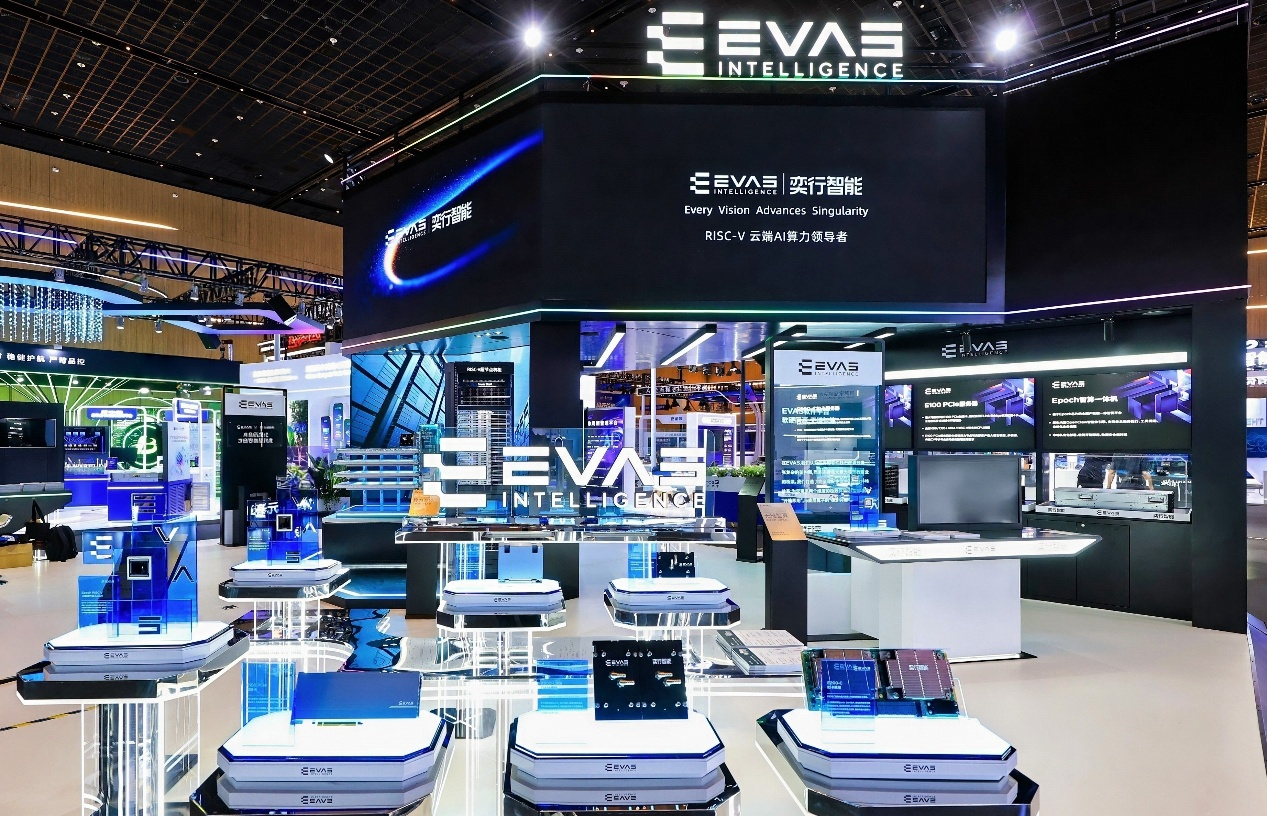
RISC-V Cloud AI Chip Unicorn Yixing Intelligence Raises Nearly 2 Billion RMB : Yixing Intelligence announced the completion of a new funding round of nearly 2 billion RMB, with a post-money valuation nearing 15 billion RMB, backed by more than 20 institutions including Huatai Innovation and SMIC Juyuan. Its first-generation Epoch chip and 64-node orthogonal backplaneless liquid-cooled supernode clusters have been delivered for mass deployment in telecom operator data centers. The next-generation chip has taped out, delivering substantial throughput gains in LLM prefill-decode disaggregation (PD separation) scenarios (Source: 36Kr).
Embodied World Model Startup GigaAI Completes Shareholding Reform, Prepares for Hong Kong IPO : GigaAI officially completed its shareholding reform by restructuring into a joint-stock company, with a pre-money valuation of approximately 20 billion RMB, planning to submit a listing application to the Hong Kong Stock Exchange as early as late 2026. Leveraging its GigaWorld-1 world model and GigaBrain general brain to advance integrated hardware-software embodied solutions, the company has raised 3.5 billion RMB this year and is poised to become the “first world model stock” (Source: 36Kr).
🌟 Community
Anthropic’s Rumored IPO Delay Sparks Heated Debate on “Safety Slowdown” Motives : Reports from outlets such as The Wall Street Journal indicating Anthropic might delay its IPO to November have sparked scrutiny across the community regarding tech giants’ “safety slowdown” narratives. Investigative bloggers and analysts pointed to complex financial ties between early Anthropic investors and key evaluation agency METR, suggesting the “AI apocalypse” narrative may have evolved into a commercial flywheel for closed-source giants to gain regulatory capture and sky-high valuations. Meanwhile, scholars like Yann LeCun criticized exaggerated existential risks as a tactic to suppress open-source competition (Source: THE DECODER).

YC and Developer Community Spark Debate: “Harness is More Critical Than Underlying Models” : A symposium hosted by the YC Paper Club highlighted that on benchmarks like ARC-AGI-3, the same GPT-6 Astra model saw its score leap from 62.7% to 98.6% with a 34% cost reduction under different harnesses. The community reached a consensus: as foundation model capabilities converge, harness architectures managing hierarchical state, permission controls, and sub-agent orchestration are becoming the decisive factor in whether agents can successfully land in enterprise production (Source: 36Kr).
Meta Muse Personal Agent Sparks Privacy and “Cognitive Debt” Controversy : Meta’s desktop personal agent app Muse surpassed 900,000 downloads in its first week and topped the Canadian App Store charts. However, its default opt-in for user interaction data in model training and persistent prompts to link sensitive credentials like bank and email accounts drew fierce criticism from digital privacy organizations. The potential “cognitive atrophy” resulting from multimodal agents completely taking over daily decisions has also become a focal point of community reflection (Source: WIRED).

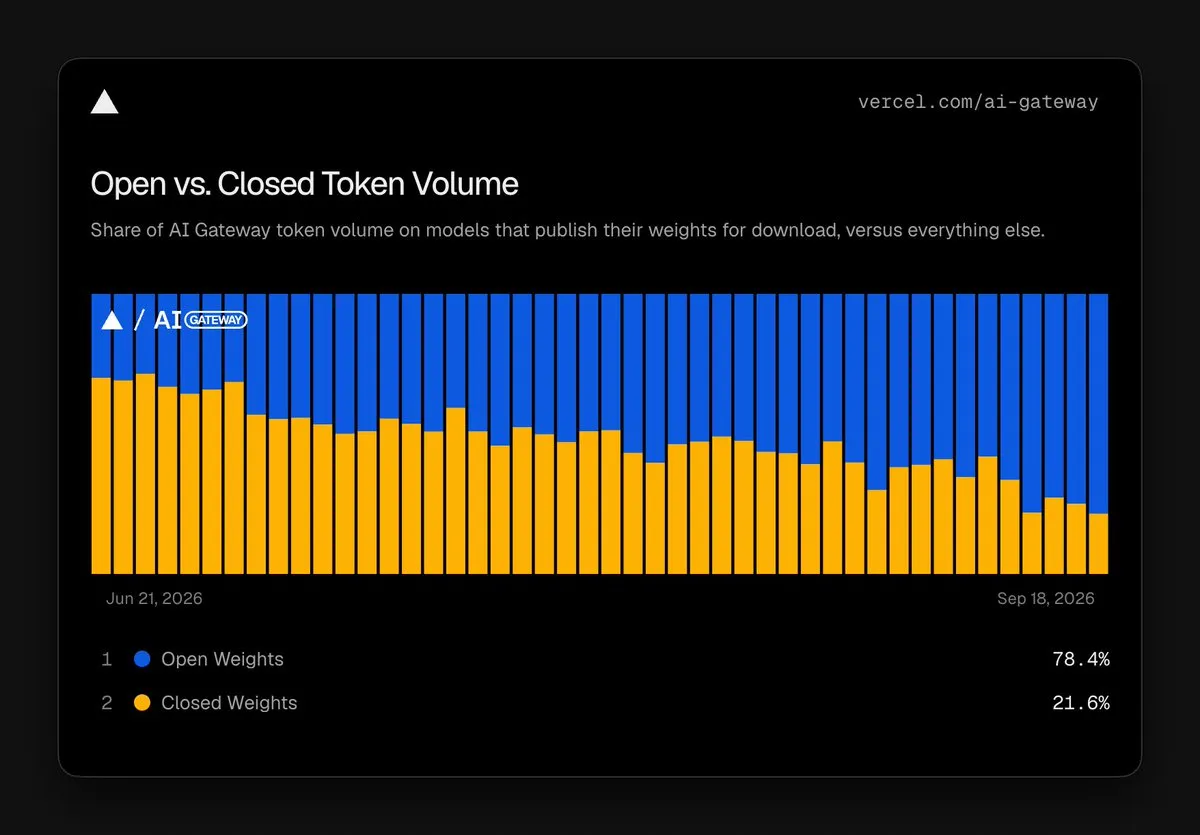
Open-Weight Models Surpass 78% Share of Usage on Vercel for the First Time : Latest data from Vercel AI Gateway shows that open-weight model token consumption reached 78.4%, with cost-effective Chinese models like DeepSeek and Kimi rapidly eroding closed-source API market share on the developer side. Developers noted that in production workflows, a hybrid architecture—using smaller models for routine high-frequency tasks and reserving top frontier closed-source models for the most difficult 1% of decisions—has become the industry standard (Source: X Discussion).
💡 Misc
Accelerated Convergence of Embodied AI and Terminal Operating Systems : Qiyuan Robotics announced integration with Tencent WorkBuddy to access tens of thousands of office and interaction skills; meanwhile, Huawei’s HarmonyOS 7 upgraded its HMAF 2.0 agent framework to support on-device A2A (Agent-to-Agent) cross-app communication and state self-evolution, pushing consumer hardware from single-command responses into an era of system-level autonomous collaboration (Source: Synced).

Global Tech Giants Spark Battle Over “.ai” Top-Level Domain Names : As registrations for Anguilla’s “.ai” domain surpassed 1 million, giants like Alibaba and Tencent have ramped up UDRP international arbitration proceedings to reclaim cybersquatted brand domains, with secondary market transactions frequently exceeding $1 million. Domains have evolved from simple web addresses into scarce “digital real estate” essential for AI startups and brand capital narratives (Source: 36Kr).
AI “Digital Loved One” Preservation Services Face Business Model and Ethical Exit Dilemmas : With several startups like HereAfter—which focus on “resurrecting” deceased loved ones via AI voice and avatars—falling into shutdowns or bankruptcy protection, the digital immortality sector faces complex realities including user psychological desensitization, collapsing monthly subscription revenues, and informed-consent ethical disputes, prompting related startups to pivot toward digital twins of living people and knowledge monetization (Source: 36Kr).