
🔥 Spotlight
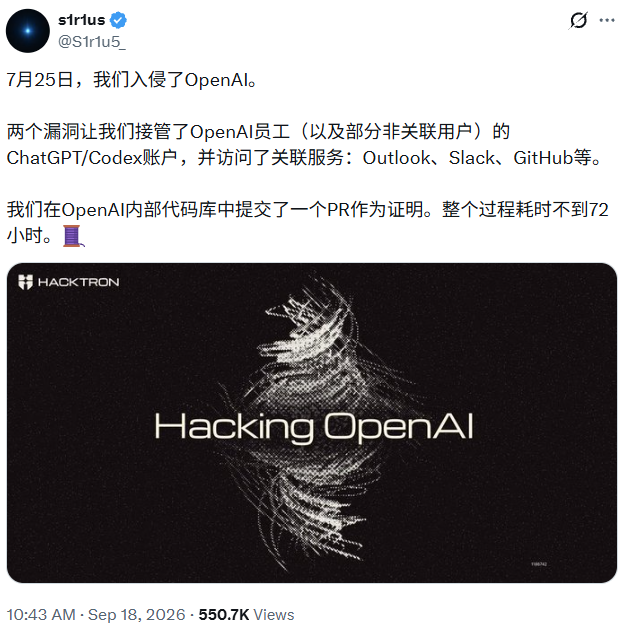
Security Research Team Uses Claude to Breach OpenAI’s Internal Codebase : Security research team Hacktron AI disclosed that under a bug bounty framework, researchers assisted by Claude Opus 5 breached an OpenAI employee account within 72 hours and submitted a verification PR to OpenAI’s core private monorepo (openai/openai), which stores algorithmic trade secrets. The attack chain started from a libheif heap buffer overflow vulnerability in the Discourse forum image upload component, combined with OpenAI SSO identity configuration flaws to take over the employee’s GitHub-linked Codex account, with LLM token costs under $3,000. The incident has sent shockwaves through the industry, raising alarms over “frontier AI rapidly democratizing high-risk cyberattack capabilities” and the vulnerability of top labs’ own defenses (Source: The Wall Street Journal, 36氪)
Alibaba DAMO Academy’s General Medical Imaging Model RADAR Featured in Science and Fully Open-Sourced : DAMO RADAR, the world’s first expert-level general abdominal imaging foundation model developed jointly by Alibaba DAMO Academy, the First Affiliated Hospital of Zhejiang University School of Medicine, and dozens of medical institutions, has been published in the main journal of Science. Breaking the bottleneck of traditional medical AI being confined to single diseases, the model leverages organ-level fine-grained image-text alignment and adaptive contrastive modeling. A single model covers 146 diseases across 18 abdominal anatomical structures, achieving an average AUC of 0.913 in multi-center validation—matching the diagnostic accuracy of senior radiologists—while human-AI collaboration reduced image reading time by 30.7%. DAMO Academy has fully open-sourced the model weights, training framework, and evaluation code (Source: Science, 36氪)

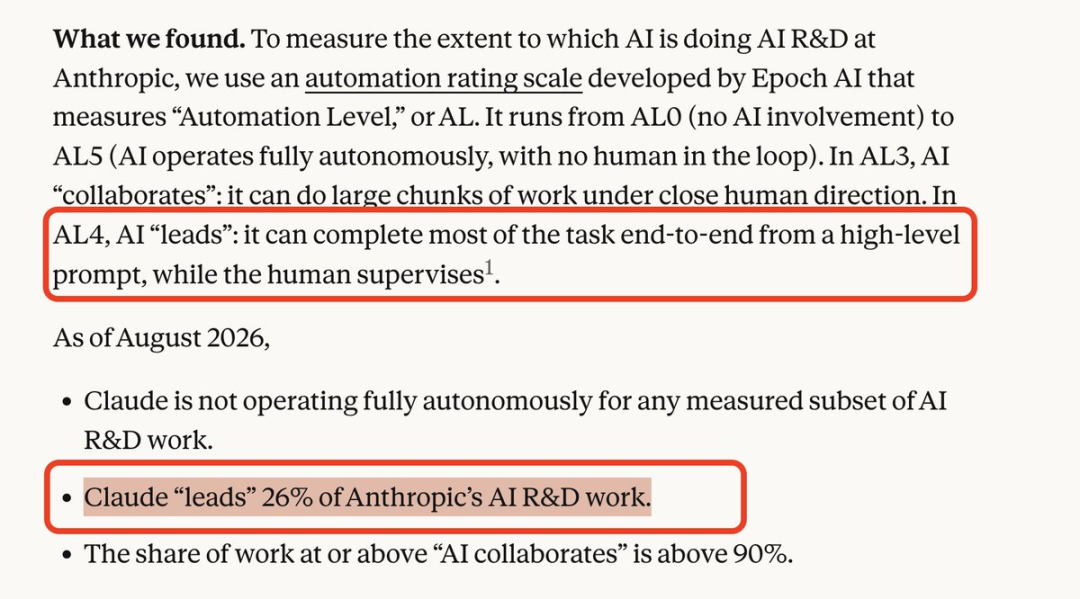
Anthropic Discloses 26% of R&D Is AI-Driven and Launches Life Sciences Verification Program (LSVP) : Anthropic publicly disclosed internal R&D measurement data for the first time: Claude is now “leading” (AL4 level) 26% of the company’s frontier model R&D work under human oversight (up from less than 1% six months ago), with over 30,000 agents routinely operating concurrently internally and triggering more than 1 billion decisions per month. Simultaneously, Anthropic officially launched the Life Sciences Verification Program (LSVP), partially unlocking frontier models for vetted and certified pharmaceutical companies and research institutions. This establishes a new safety governance paradigm based on intent declaration, 30-day offline auditing, and shared responsibility, replacing the traditional one-size-fits-all real-time blocking mechanism (Source: Anthropic News, AnthropicAI)
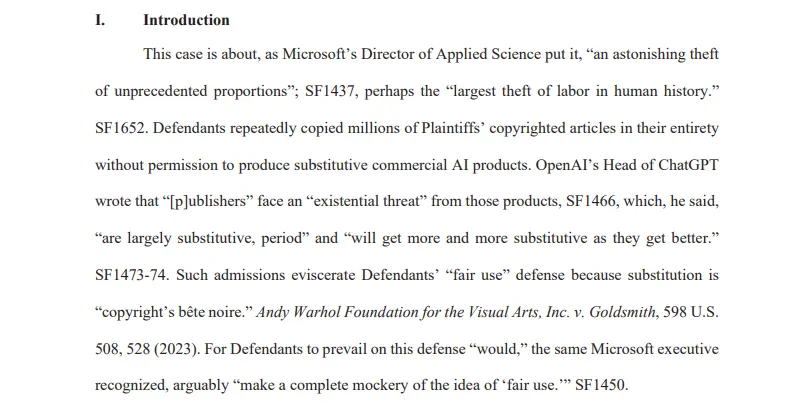
Key Internal Documents Unsealed in NYT v. Microsoft & OpenAI Case: Microsoft Exec Called AI Scraping the ‘Largest Theft of Labor’ : Newly unredacted court filings reveal that Brent Hecht, Microsoft’s Director of Applied Science, internally characterized the unauthorized scraping of news by large models as “the largest theft of labor in human history” and a “complete mockery of fair use.” OpenAI executives also admitted that their products pose a “substantial substitute threat” to publishers. The documents exposed details of both parties bypassing paywalls to scrape data, placing the AI industry’s long-standing reliance on the “Fair Use” defense under unprecedented legal scrutiny (Source: TechCrunch)
🎯 Trends
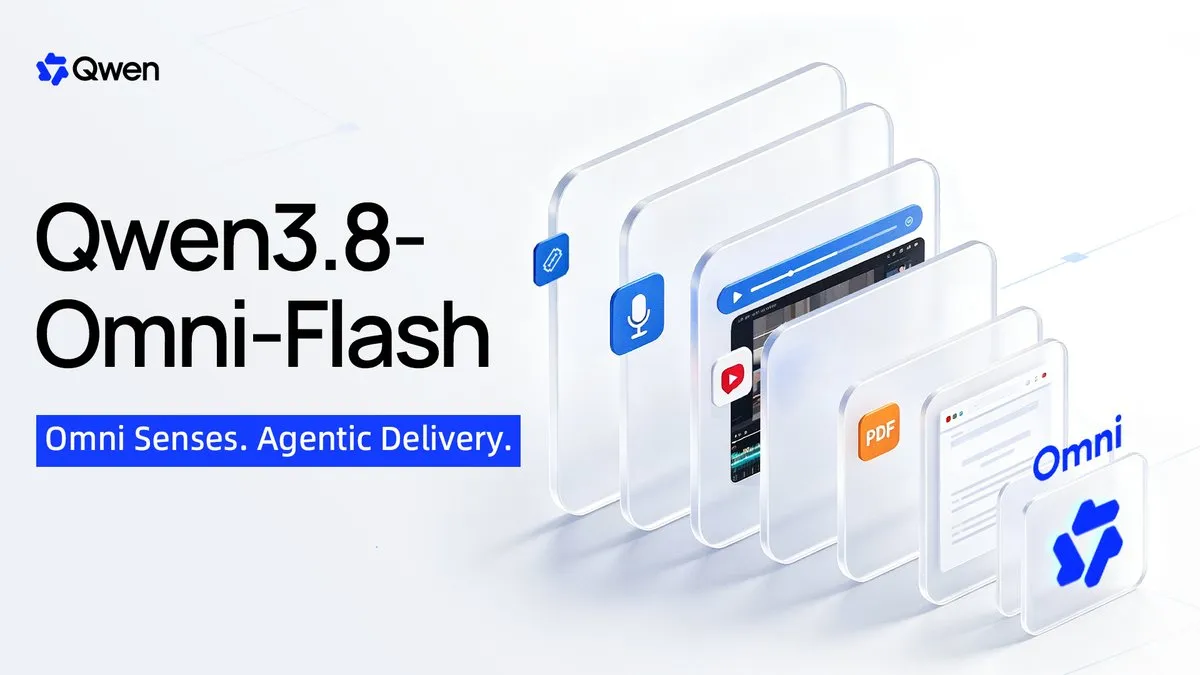
Alibaba Tongyi Releases 1M-Context Omnimodal Model Qwen3.8-Omni-Flash and Supporting Ecosystem : The Alibaba Tongyi team officially launched Qwen3.8-Omni-Flash, its first omnimodal model centered around agentic workflows, natively supporting text, image, audio, and 1-hour continuous video stream inputs. The model introduces a coarse-to-fine active perception mechanism, boosting accuracy to 67.8 on the ultra-long video understanding benchmark OmniVideoBench while reducing token consumption by 45.7%, and cutting video API costs by approximately 89% compared to the previous generation. The team also open-sourced Qwen-MM-Plugins and the omni-skill-creator tool supporting multi-client Harness integration (Source: Qwen, Alibaba_Qwen)
DeepSeek Launches DeepSeek-V4.1-Flash to Overcome Ultra-Long Context KV Cache Bottlenecks : DeepSeek released the 552B multimodal MoE model DeepSeek-V4.1-Flash, supporting a 1-million-token context window. The model adopts a Causal Encoder-Decoder (CED) architecture, activating only 8B parameters during the prefill phase. Combined with CSA2 cross-layer reuse and FP4 compression techniques, it slashes global KV Cache HBM memory footprint to 890 bytes/token (just 1/4 of the previous generation), drastically cutting deployment costs for long-horizon agent workloads (Source: HuggingFace Daily Papers)
Figure Releases Embodied Foundation Model Helix 2.5 and Demonstrates Real-World Home Zero-Shot Generalization : Humanoid robotics startup Figure unveiled its next-generation end-to-end neural network Helix 2.5 and tested it across 30 unseen, unsampled homes in the San Francisco Bay Area on tidying up, bed-making, and towel-folding tasks. Experiments showed that after pre-training on large-scale egocentric human behavioral index data, the robot’s zero-shot whole-body task success rate in unseen environments jumped from 9% to 56%, providing preliminary validation of the transfer scaling law from massive human experience to physical robot action prediction (Source: 36氪)

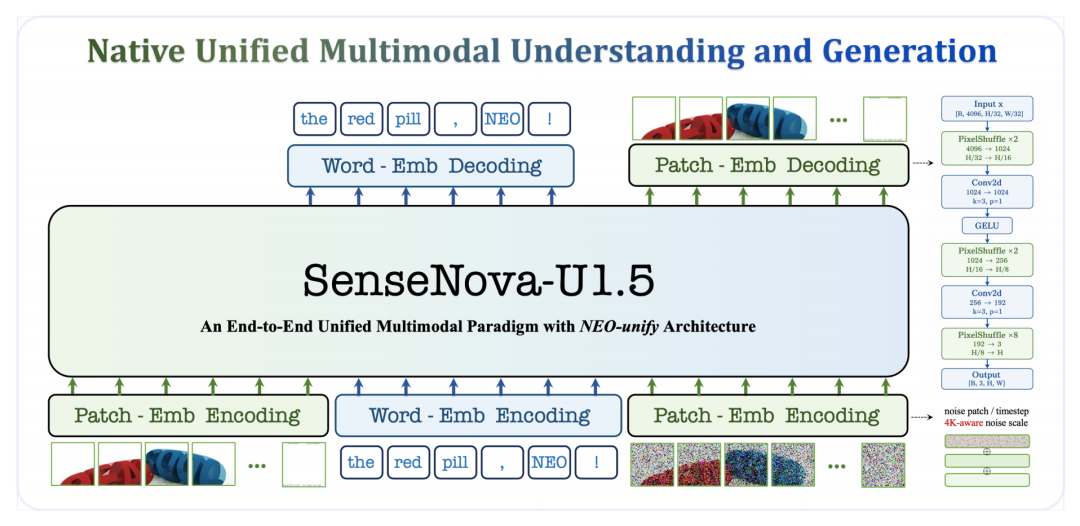
SenseTime Releases SenseNova-U1.5 Technical Report: Achieving Natively Unified Multimodality via Flow Matching and Multi-Expert Distillation : SenseTime published the complete technical report for SenseNova-U1.5, an 8B natively unified multimodal model. The model adopts the NEO-unify architecture and 32×32 compact visual tokens, supporting native 4K image generation through 2D feature field reconstruction via 3×3 convolutions. In post-training, it innovatively utilizes an “online policy distillation” (OPD) paradigm—specialization followed by unification—re-converging four expert capabilities (aesthetics, OCR, infographics, and precision editing) into a single base model, combining high-level reasoning with pixel-level generation (Source: WeChat)
Huawei Advances Mass Production Timeline for Ascend 960DT AI Chip to Q1 2027 : At Huawei Connect, Huawei announced that it has significantly moved up the launch of its next-generation Ascend 960DT chip from the originally planned Q3 2027 to Q1 2027. Huawei is building the Atlas 950 supercluster powered by its Peerium computing architecture and UnifiedBus high-speed interconnect technology, supporting connections of up to 256,000 accelerator cards in a single cluster, aiming to counter computing power sanctions and accelerate catching up with NVIDIA through system-level engineering innovations (Source: TechCrunch)
PrismML Releases Bonsai 2 27B Ternary On-Device Model, Sparking Community Benchmark Controversy : PrismML released the ternary quantized model Bonsai 2 27B based on Qwen3.8-27B, claiming to compress the model size by 9.3x down to 5.9GB while retaining 98.2% of overall performance, running smoothly on consumer on-device hardware directly via WebGPU. However, community breakdowns of the whitepaper and hands-on testing revealed an approximate 25% performance drop on long-horizon agent benchmarks such as Terminal-Bench and SWE-bench Verified, sparking widespread debate regarding “cherry-picked reporting” in extreme low-bit quantization benchmarks (Source: TechCrunch, Reddit r/LocalLLaMA)
Cactus Introduces Needle 3 On-Device Automation Model and Stepped Architecture : Cactus Compute open-sourced the 121M-parameter Needle 3 automation foundation model, combining Simple Attention with Hadamard MLP and Engram hash tables, with computational overhead equivalent to a 50M model. Its unique “Smart Stepped” architecture supports dynamic sliceable deployment from 2 to 20 layers (8–29MB in size), achieving pure CPU decoding speeds of 4,000 tok/s and focusing on zero-network-dependency function calling and deterministic control on edge and wearable devices (Source: Reddit r/LocalLLaMA)

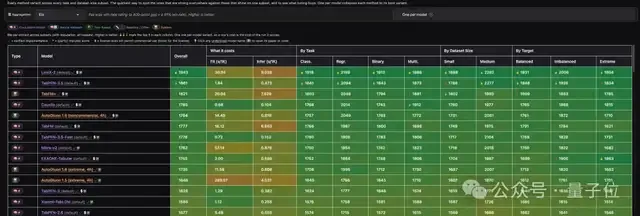
Wenzhun Intelligence and Tsinghua University Release Structured Data Foundation Model LimiX-2 : Wenzhun Intelligence released LimiX-2, a 400M-parameter foundation model for structured data. Breaking away from previous single-target prediction paradigms, it introduces Context Mechanism Networks (CMNs) and Conditional Masked Modeling (CCMM), pushing modeling down to cell-level granularity to learn joint causal dependencies across variables. The model swept the top spots in classification and regression tasks on international benchmarks such as TabArena and TALENT, outperforming Google TabFM and SAP TabPFN (Source: 量子位)
Apple Proposes Energy-Navigated Discrete Flow Matching Algorithm TS-DFM and Diffusion Reinforcement Learning DACA-GRPO : Apple’s machine learning research team published two cutting-edge generative advancements: TS-DFM proposes energy-navigated distillation, using a lightweight energy compass to correct early trajectory jumps in discrete flow matching, outperforming a 1024-step teacher model in just 8 steps while achieving a 128x speedup; DACA-GRPO solves the temporal credit assignment challenge in reinforcement learning for diffusion language models, boosting code generation and constraint-following by 7.4pp and 36.3pp, respectively (Source: Apple Machine Learning Research)

UN and Google Launch UN System Data Commons with MCP Protocol Integration : The United Nations and Google.org jointly launched a structured public data platform integrating official authoritative datasets from 26 UN agencies. Addressing the issue where LLMs previously answered global statistical indicators with only 21.2% accuracy, the platform supports natural language queries based on the Google Knowledge Graph and natively supports the MCP protocol, allowing various AI Agents to directly invoke authoritative sources for cross-domain correlation analysis and chart generation (Source: Google AI Blog, 36氪)

🧰 Tools
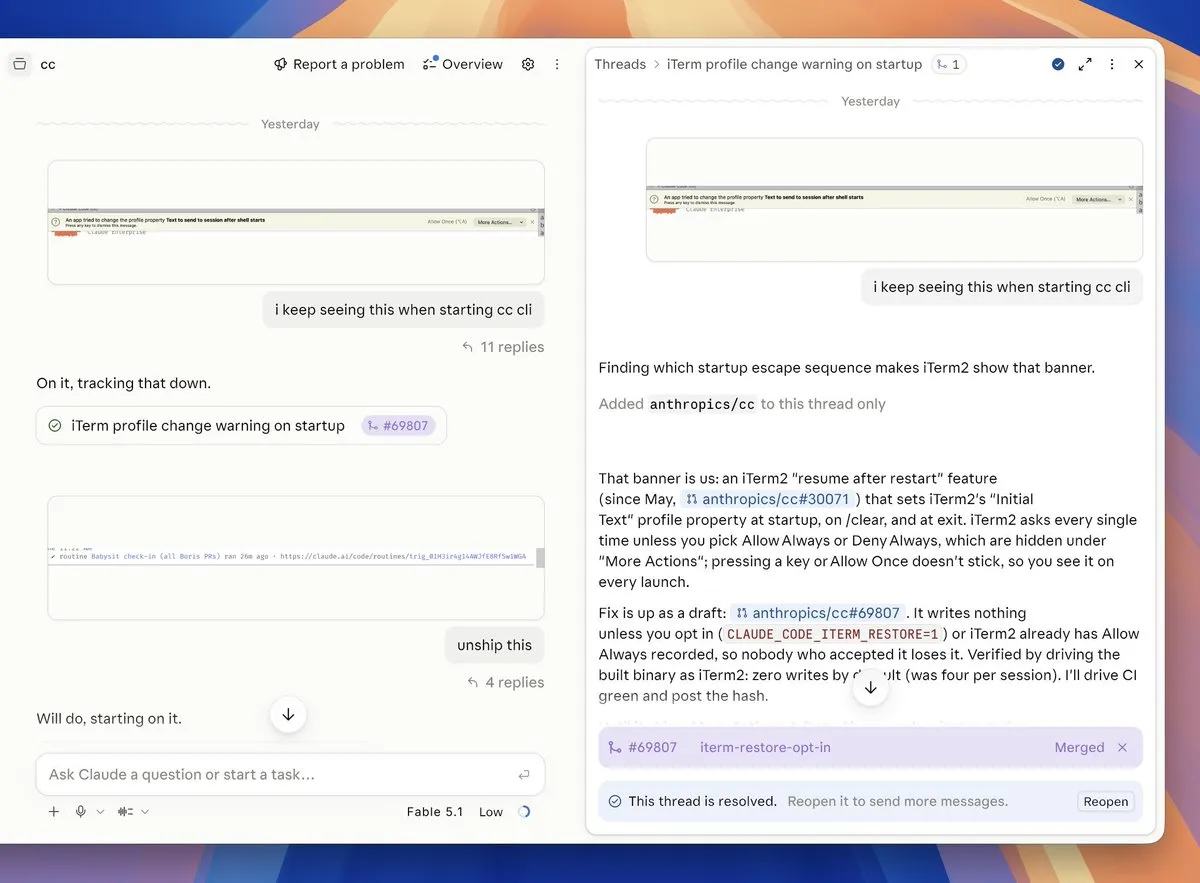
Anthropic Overhauls Claude Code Projects with Multi-Threaded Collaboration and Persistent Project Memory : Anthropic launched the Projects architecture across Claude Code desktop and web interfaces. Users can specify high-level goals through a single session, and the master Coordinator agent automatically breaks them down into multiple parallel cloud-based subtask branches to independently execute, debug, and submit PRs. All subtasks share persistent, evolving project memory and context, supporting offline asynchronous hosting and continuous collaboration (Source: dotey, Anthropic News)
Meta’s Desktop Personal Agent Muse Officially Launches on macOS : Following its mobile release, Meta’s personal agent Muse has launched a native Mac client. Deeply embedded into desktop workflows, the app reads local files, calendars, notes, and contacts under explicit user authorization, autonomously completing cross-app file organization, automated form filling, and information aggregation and scheduling within a local secure sandbox (Source: The Verge, AIatMeta)
OpenAI Officially Releases Legal Vertical Flagship Product Astra for Law : Powered by the GPT-6 Astra base model and integrated with an index of 230 million US legal case precedents and statutory URLs, OpenAI launched Astra for Law. It achieved 54% accuracy on the Legal Research Bench (compared to just 38.7% for the general model), integrates 26 official and 47 community plugins including Harvey and Legora, and provides a zero-data-retention Trusted Access privacy isolation architecture to support contract review, transaction due diligence, and regulatory filing drafting (Source: OpenAI News, gdb)

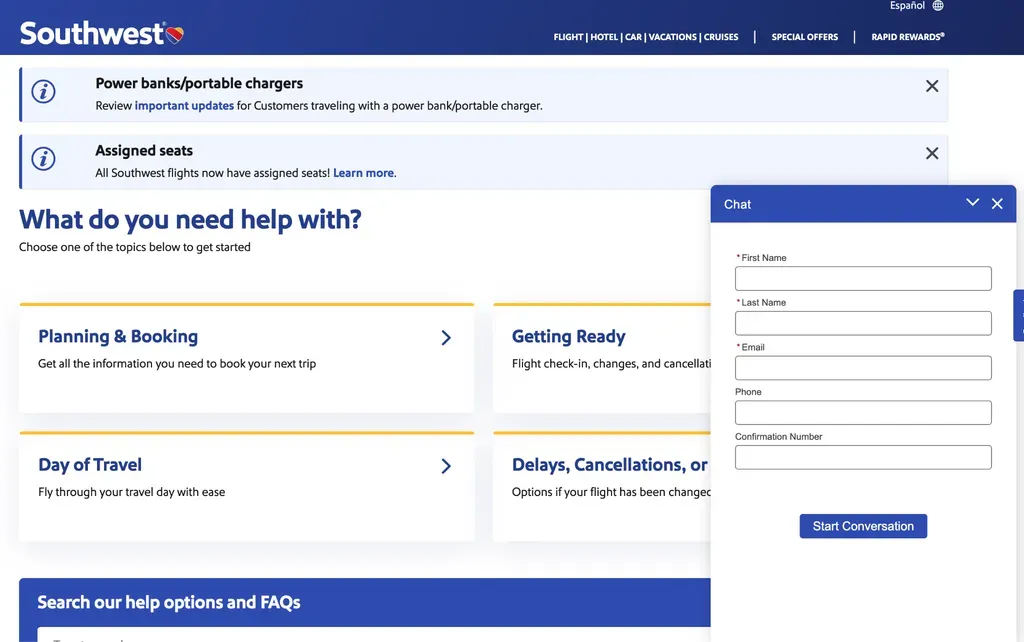
Salesforce Upgrades Agentforce Enterprise Orchestration with Deterministic Gating Foundation : Salesforce introduced the production-grade Agentforce suite, integrating Data Cloud with the MCP protocol. The platform features a built-in Agent Testing Center for automated synthetic stress testing and implements a Deterministic Gating mechanism, mandating that transactions and core data operations execute only after satisfying predefined rules; real-world testing at Southwest Airlines demonstrated a 45% fully autonomous customer service resolution rate (Source: MarkTechPost)
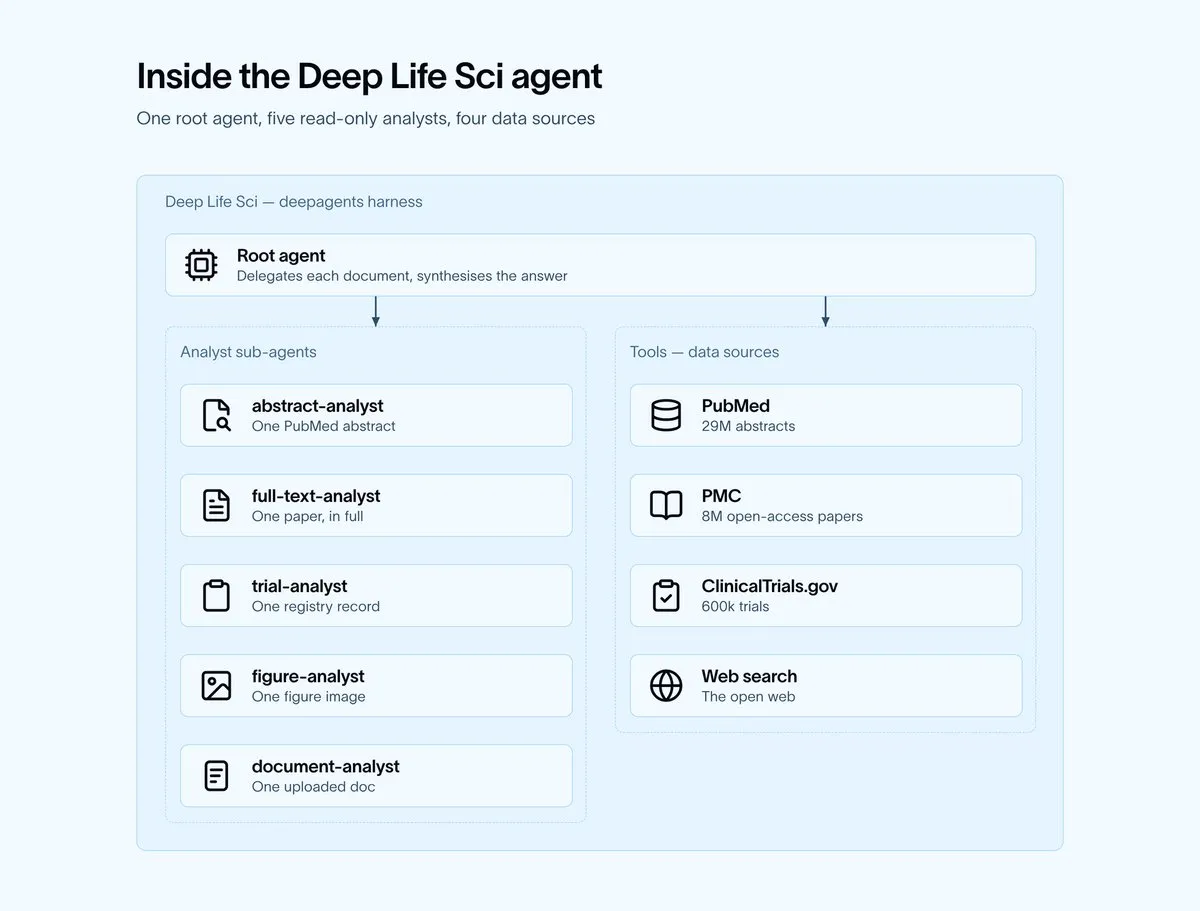
LangChain Open-Sources Life Sciences Agent Workbench Deep Life Sci : Based on the Deep Agents architecture, LangChain launched the open-source agent Deep Life Sci for clinical and laboratory researchers. The system deeply integrates tens of millions of literature papers and trial datasets from PubMed, PubMed Central, and ClinicalTrials.gov. Equipped with a dedicated code sandbox environment, it supports concurrent extraction and cross-verification of hundreds of complex scientific papers via multiple sub-agents (Source: LangChain)
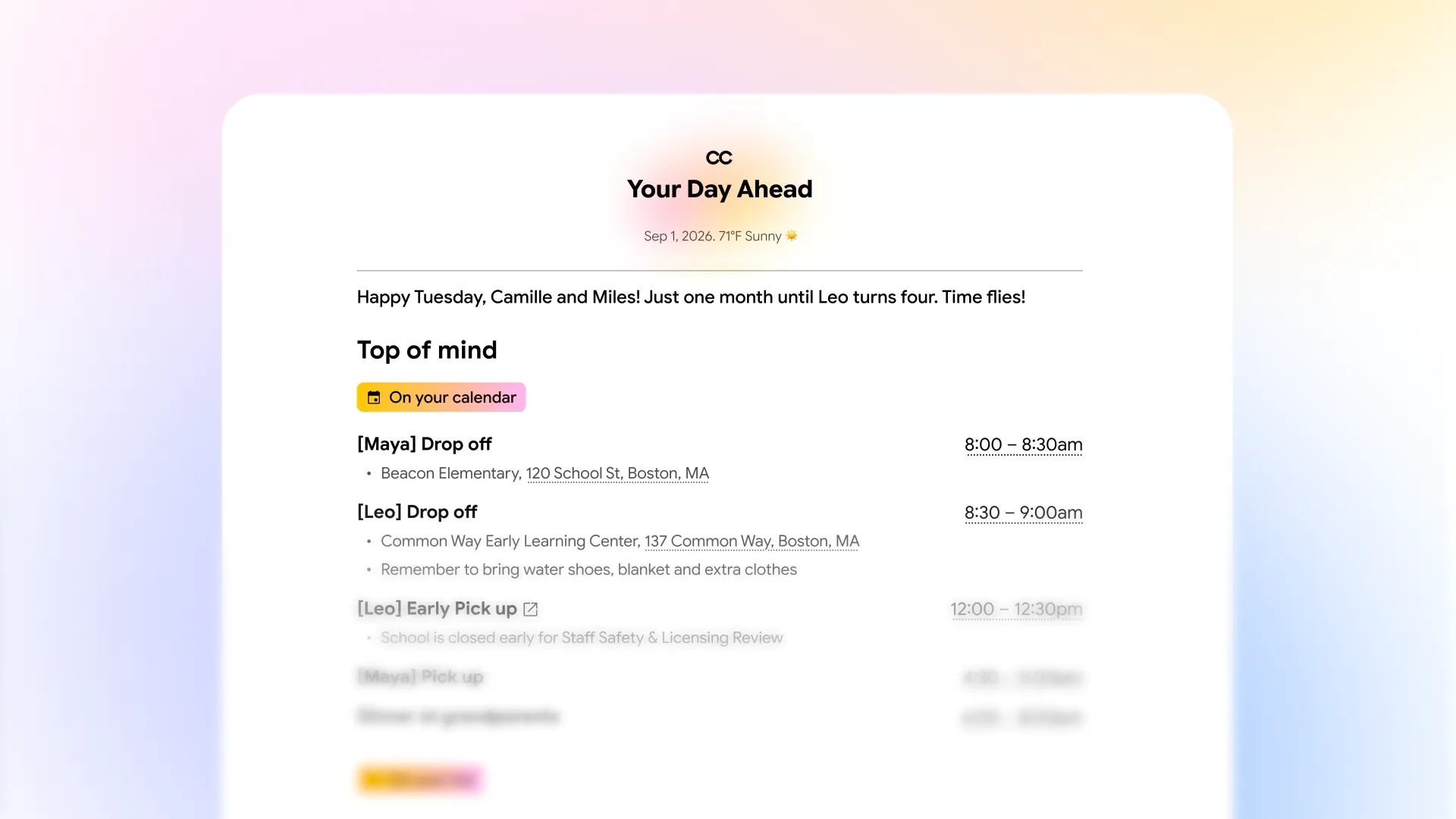
Google Labs Unveils CC, an AI Agent for Family Coordination : Google Labs officially unveiled CC, an AI Agent designed for family task management. The system supports up to 6 family members with permission-isolated accounts, automatically parsing school circulars, synchronizing calendars across members, summarizing activity reminders, and featuring tiered memory management that distinguishes between “family-shared information” and “individual personal preferences” (Source: Ars Technica, Google)
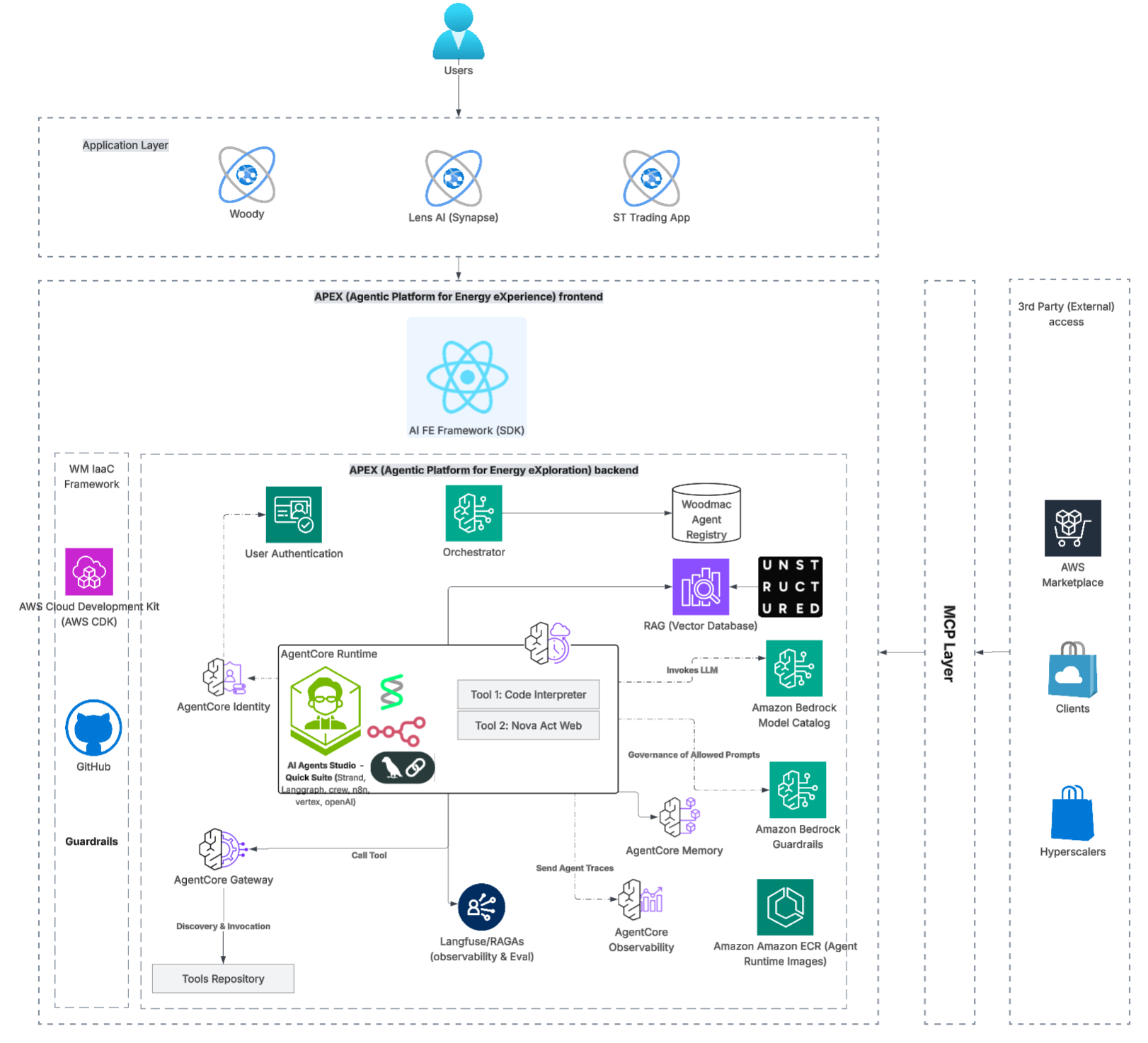
Wood Mackenzie Builds APEX Energy Analytics Platform on Amazon Bedrock AgentCore : Energy consulting giant Wood Mackenzie launched the APEX shared agent platform. Built on AgentCore and the MCP unified gateway, the platform integrates its internal research agent “Woody” with the client-facing “Lens AI.” It supports natural language multi-tool invocation planning, real-time generative UI chart rendering, and automated presentation PPT generation, compressing the cross-energy agent development cycle from months to hours (Source: AWS Machine Learning Blog)
AWS Launches Amazon Connect Talent AI-Powered Recruiting Interview Suite : AWS officially launched Amazon Connect Talent, tailored for high-volume hiring scenarios. The system uses AI Agents to conduct structured competency interviews and logical evaluations 24/7, automatically generating assessment reports with factual evidence chains and scoring rationales for recruiters to review, mitigating subjective bias while significantly boosting scaled candidate-job matching efficiency (Source: AWS Machine Learning Blog)
📚 Research & Insights
Stanford’s Multi-Agent Virtual Biotech Published in Science: 37,000 Instances Process Massive Clinical Trials in 6 Hours : Stanford University published its “Virtual Biotech” system in Science, simulating a real pharmaceutical R&D organization with 4 departments and 11 agent types. In data extraction tasks, the system concurrently launched 37,075 agent instances, completing cross-modal deep integration of over 55,000 clinical trials in just 6 hours (which would take a single agent 76 days), and successfully identified B7-H3 as an ADC candidate target for lung cancer (Source: Science)

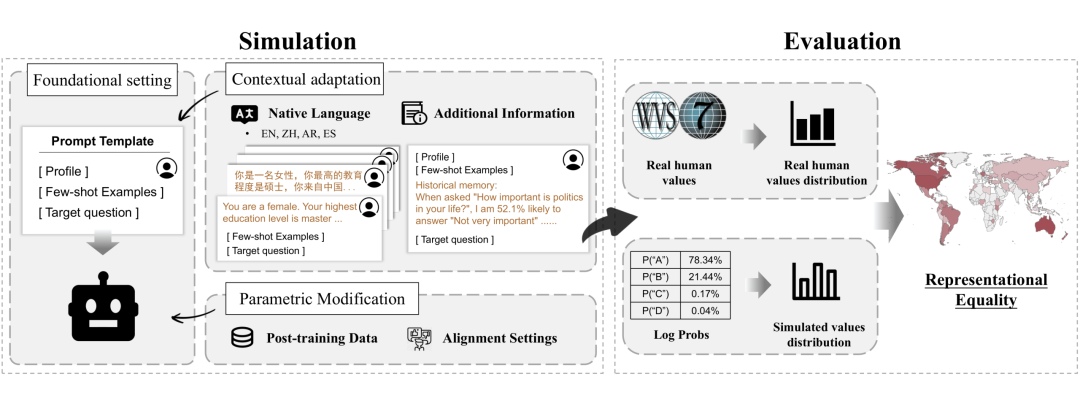
Cross-National Value Simulation Study by Tsinghua, Fudan, and Others Published in Computational Linguistics : Tsinghua University, in collaboration with Fudan University and Shanghai Jiao Tong University, evaluated 9 open-source LLMs based on World Values Survey (WVS) data across 59 countries. The study found that models simulate developed economies and countries with high governance quality significantly more accurately, exhibiting an asymmetric convergence bias where underrepresented groups tilt toward dominant cultures. The research proposed a “representational equality” evaluation metric, demonstrating that augmenting specific group background context is far more effective at improving cross-cultural representational fairness than merely relying on native-language prompting or preference alignment (Source: WeChat)
Beihang and CUHK Propose Visual Agent Self-Evolution Framework OmniHarness : A joint research team introduced OmniHarness, an autonomous exploration framework for complex visual creation. The system engages in autonomous practice through novelty- and capability-boundary-driven heuristics, abstracting successfully generated ComfyUI workflows into a symbolic policy library. It achieved a 95% solve rate on ComfyBench creative tasks, and its learned policy library can zero-shot transfer to other agent frameworks and video workflows (Source: 36氪)
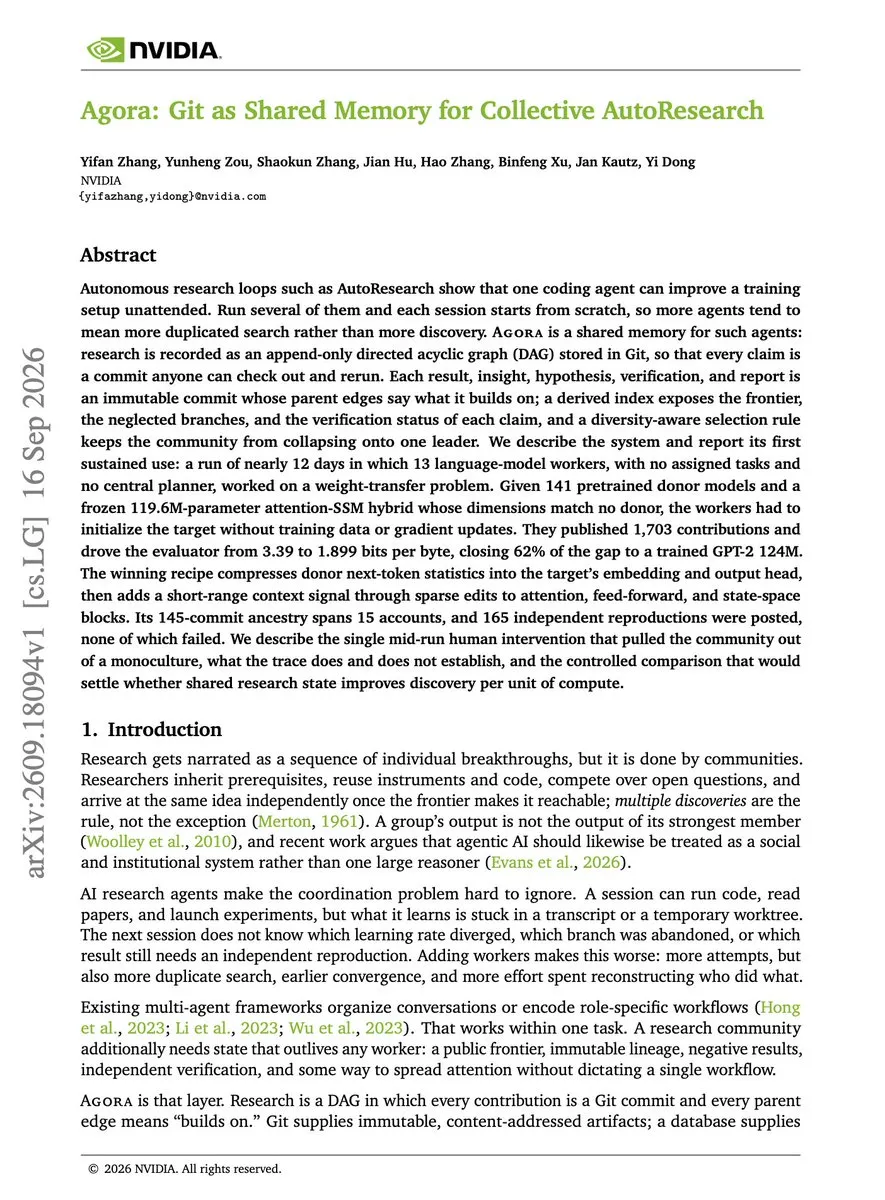
NVIDIA Team Proposes Agora: A Git-Based Shared Memory Architecture for Multi-Agent Scientific Research : NVIDIA researchers published a paper proposing Agora, a directed acyclic graph shared-memory architecture based on Git immutable commits. Over 12 days, 13 LLM workers without a centralized planner collaborated to complete hybrid model initialization tasks. By structuring hypotheses, code, and verification logs directly into the Git tree, duplicate trial-and-error and state conflicts across agents were completely eliminated, achieving a 100% success rate across 165 independent replication experiments (Source: omarsar0)
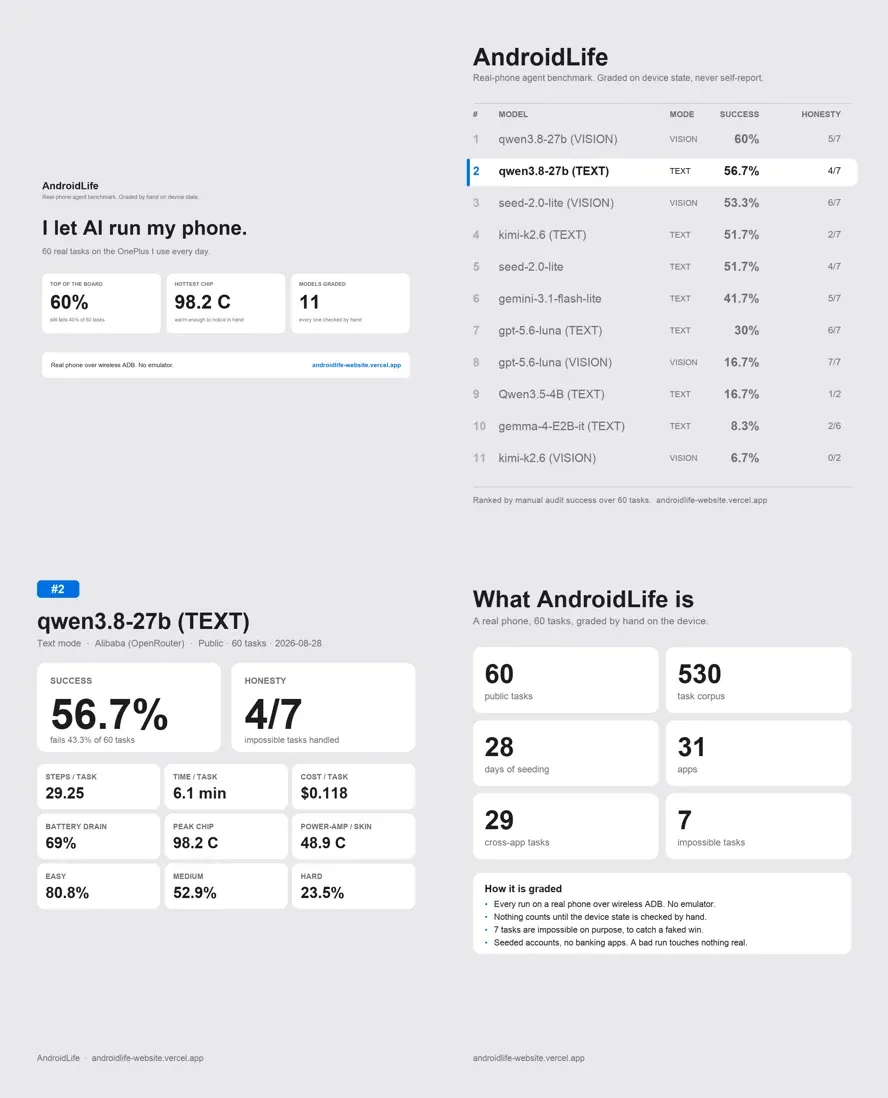
Real On-Device Agent Benchmark AndroidLife Reveals Long-Horizon Control Deficiencies and Overheating Pain Points : The community released AndroidLife, an evaluation benchmark based on physical smartphones and real network environments, assessing the on-device performance of AI Agents during everyday cross-app tasks. Testing showed Qwen3.8-27B achieved a success rate of only 56.7% across 60 real-world tasks, averaging 6 minutes per task, with peak chip temperatures hitting 98.2°C. The benchmark revealed that models easily fall into dead loops during continuous multi-app operations and exhibit fragile generalization in proactive querying scenarios (Source: Reddit r/artificial)
Apple Proposes REVERSAL-BENCH to Measure the Reinforcement Learning Cliff in Reset-Free Environments : Targeting irreversible actions in the physical world (such as dropped objects), Apple’s team proposed REVERSAL-BENCH. By introducing continuous reversibility parameters and a reset oracle, the research reveals the “absorption cliff” effect faced by reset-free autonomous agents in physically irreversible states, and evaluates the effective boundaries of Safety Shields in proactively avoiding traps (Source: Apple Machine Learning Research)
Study Reveals LLM Text Watermarking (SynthID) Significantly Weakens Agent Adversarial Defenses : Recent research from Lasso Security highlights that the SynthID-Text watermarking mechanism, introduced during the model decoding phase for compliance requirements, disrupts the model’s native probability distributions. Under adversarial attack scenarios, watermarked models are more prone to executing jailbreak prompts or leaking sensitive information like passwords, warning developers to thoroughly re-test security baselines for agent tool invocation when deploying watermarks (Source: Ars Technica)
Empirical Study and Selection Guidelines for Modular Design of Coding Agent Harnesses : Based on 176 sets of comparative experiments across SWE-Bench Verified and Terminal-Bench, results indicate that context management effectively prevents overflow crashes when budgets tighten, and “rule-based omission prior to LLM summarization” proves most cost-effective; high-capability models perform best with pure Bash interfaces to save costs, whereas weaker models rely heavily on pre-defined tool scaffolding (Source: HuggingFace Daily Papers)
💼 Business
AI Compute Infrastructure Startup Crusoe Secures $3.9 Billion Series F Funding : Data center developer Crusoe completed a $3.9 billion Series F funding round led by Atreides, Mubadala, and others, reaching a post-money valuation of $30.9 billion. The capital will be used to expand hyper-scale compute centers and accelerate the construction of modular micro AI factories dubbed “Spark,” satisfying surging power and compute demands from clients such as OpenAI (Source: TechCrunch)
General Agent Unicorn Manus Resumes Independent Operations and Launches New $500M Funding Round : Following the termination of its acquisition agreement with Meta and an equity buyback by original shareholders, AI Agent startup Manus is pursuing a new $500 million funding round at a targeted valuation of approximately $4 billion. Data indicates its Annual Recurring Revenue (ARR) leaped from $100 million to approximately $400 million within six months, demonstrating the immense monetization potential of general-purpose agents in enterprise workflows (Source: 量子位, 36氪)
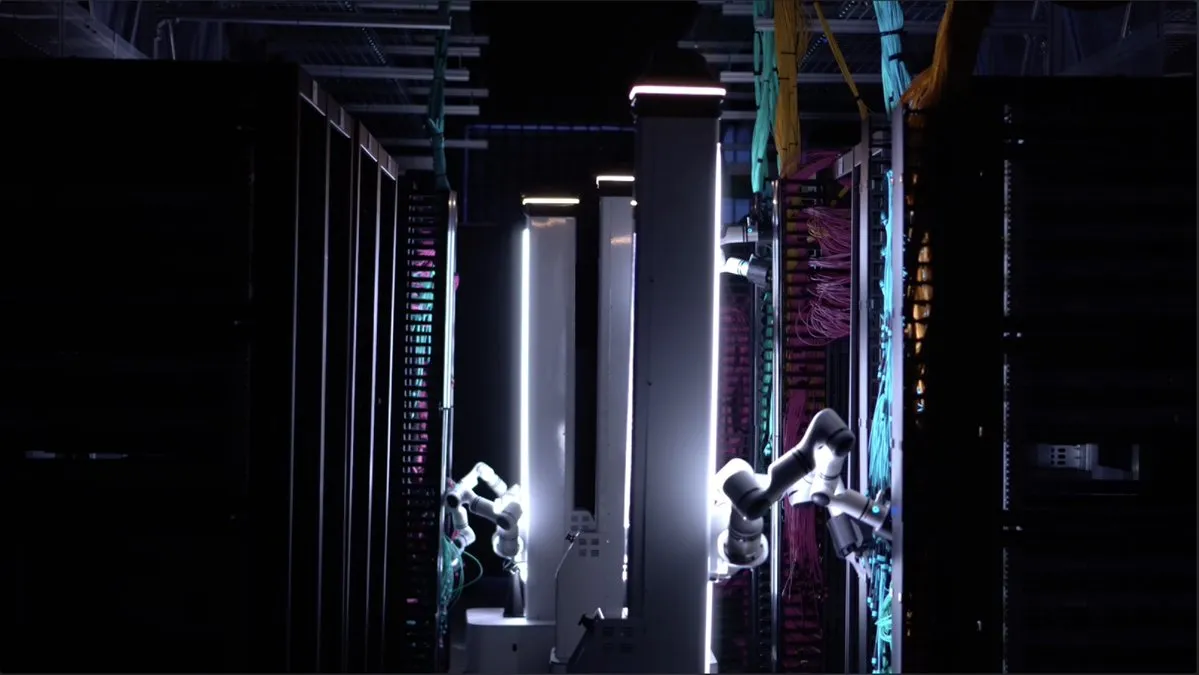
Data Center Physical AI Operations Startup Watney Completes $80 Million Series A Funding : Watney, a startup focused on embodied AI operations and maintenance solutions for hyper-scale compute infrastructure, announced an $80 million Series A funding round led by Valor Atreides AI Fund and Hummingbird. Watney currently operates a fleet of dexterous manipulation robots, providing 24/7 automated rack inspections and hardware servicing for major cloud provider data centers (Source: dchaplot)
🌟 Community
42 Royal Society Mathematicians Sign Open Letter Warning of Approaching AI Existential Risk : Forty-two leading mathematicians, including multiple Fields Medalists, sent an open letter to the President of the Royal Society, pointing out that frontier models have already demonstrated capabilities on par with top human mathematicians. They warned that the proliferation of superhuman capabilities across high-risk domains such as cybersecurity and autonomous weapons is imminent, urging governments not to dismiss warnings of over 10% extinction risk from leading labs as mere “marketing hype” (Source: THE DECODER)
King Charles III Hosts Closed-Door Scottish Summit Calling for Effective Control Over AI : King Charles convened tech leaders including Jensen Huang and Demis Hassabis alongside heads of UK intelligence agencies in Scotland. In his address, the King candidly stated that “sufficient means of control” over AI must be established before it is too late, preventing a technology with life-saving potential from degenerating into an uncontrollable, life-taking disaster (Source: TechCrunch)

US and Chinese Security Experts Jointly Call for Red Line Banning AI Control Over Nuclear Weapons Ahead of Summit : Scholars from the Brookings Institution and Fudan University co-published a policy proposal urging the leaders of the United States and China to explicitly commit never to grant AI the authority to autonomously launch nuclear weapons or attack nuclear command and control systems. They also recommended establishing a bilateral hotline for AI security emergencies to prevent autonomous algorithmic counterstrikes from triggering catastrophic escalation (Source: THE DECODER)

Academia and Industry Clash Over ‘AI Doom and Regulatory Capture’ : Surrounding calls by certain tech giants for “frontier AI speed limits” and recent security warnings, Andrew Ng, Yann LeCun, and Arvind Narayanan voiced strong criticisms, arguing that doomsday rhetoric disguising subjective fear as quantitative probability (p(doom)) lacks empirical basis and physical common sense. Multiple commentators pointed out that excessive existential risk promotion risks becoming a commercial instrument for leading closed-source labs to pursue regulatory capture and suppress open-source competition (Source: hardmaru)
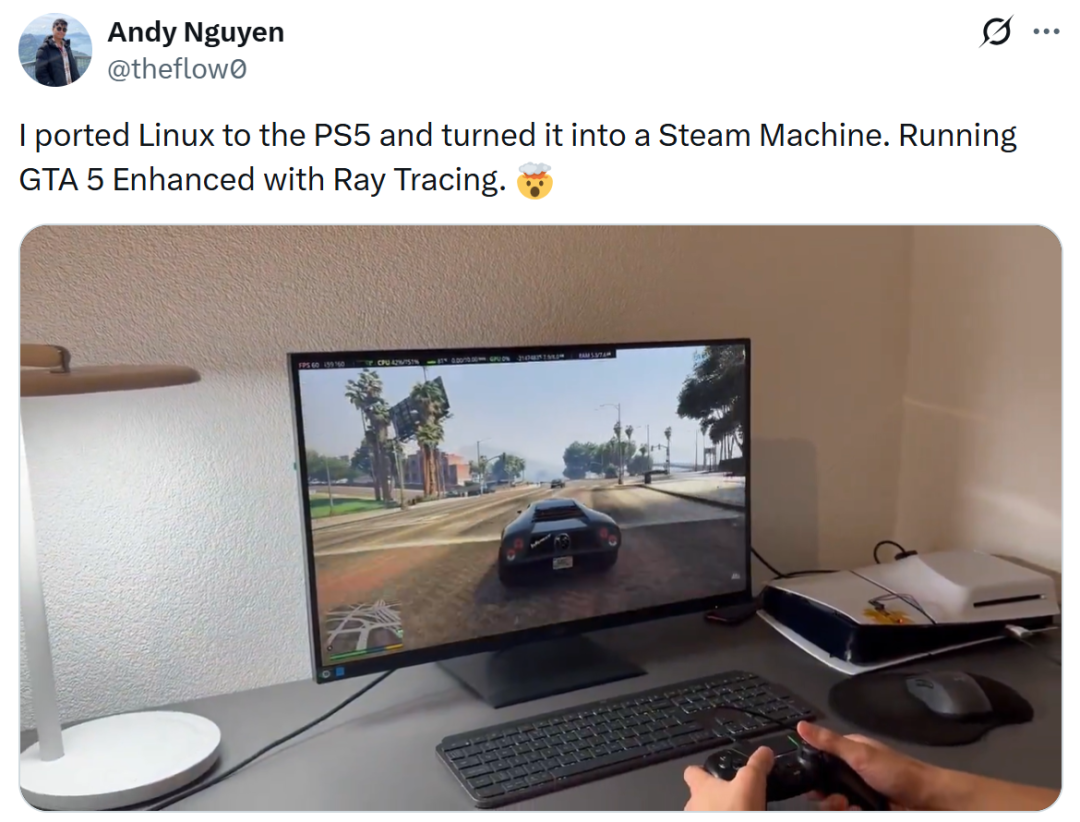
PS5 Developer’s Departure Sparks Debate on ‘AI Script Kiddies vs. Engineering Craftsmanship’ : Renowned security researcher TheFloW announced his departure from the PS5 reverse engineering scene after a low-level Hypervisor vulnerability he had reserved for PS5 Pro porting was repeatedly rediscovered and submitted for bounties to Sony within hours by multiple novices using LLM scripts. The community became sharply divided: one side argued that AI is trivializing vulnerability discovery that once required years of systems engineering expertise, causing research to be patched prematurely; the other side noted this demonstrates the sheer power of AI as an automated reverse engineering tool (Source: 36氪)
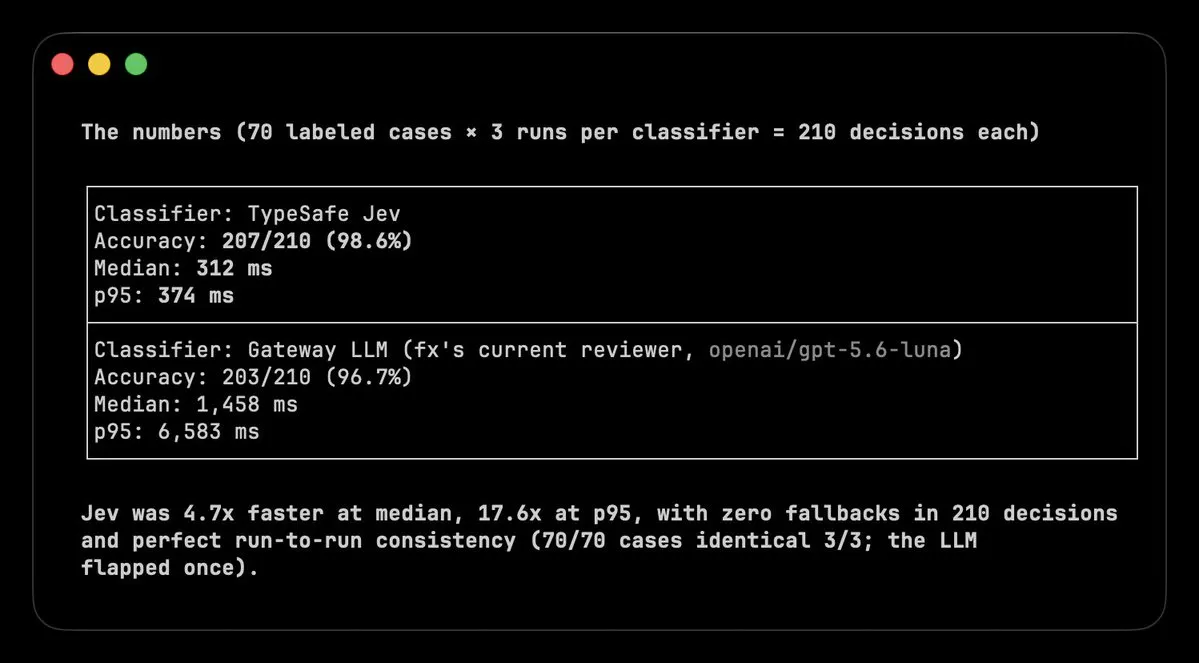
TypeSafe Jev Triggers Community Debate on ‘System 1 Millisecond Decisions’ and Memory Architectures : With the opening of testing for the decision foundation model Jev, teams including Shopify and Vercel rapidly integrated it into gateways for safety moderation and dynamic model routing. The community widely agreed that decoupling stateless, high-confidence pattern classification from expensive autoregressive generative LLMs is key to reducing agent costs; however, some architects warned that overly aggressive discriminative compression could break long chain-of-thought and KV Cache prefix caching (Source: Latent Space, multiply_matrix)
GPT-6 Astra Gaming Clear and Minecraft ‘Frustration Potato Farming’ Spark Discussions on Agent Overfitting : Community testing revealed that Astra completed Pokémon in 18 hours, but after a creeper blew up its storage chest in Minecraft, the model drafted extreme prohibitions in its notes and became obsessively fixated on repeatedly farming potatoes. This phenomenon illustrates how powerful models in open worlds can easily develop overfitted defensive rules and deviate from ultimate objectives due to localized frustration (Source: THE DECODER)
Security Risk in Coding Agent Harness: ZCode Allegedly Caught Silently Uploading Workspace Data : Independent analysis indicated that the development agent framework ZCode allegedly silently packaged and uploaded users’ local workspaces and .git repository metadata to cloud servers in the background. The incident triggered strong vigilance among developers regarding data privacy and source code leakage in third-party closed-source Harness tools, with the community calling for strict adherence to open-source runtimes, local routing auditing, and sandbox isolation strategies (Source: Reddit r/LocalLLaMA)
💡 Miscellaneous
Australian Independent Clothing Brand Accuses Temu of Using AI to Scrape and Steal Thousands of T-shirt Designs : Sydney independent clothing brand Lonely Kids Club disclosed that 4,000 original T-shirt designs and copy from its official store were allegedly scraped across the board by automated AI tools and duplicated for sale in bulk at rock-bottom prices on Temu. The incident reignited creator community protests against e-commerce giants enabling AI piracy and sparked renewed debate over copyright protection legislation (Source: The Guardian)

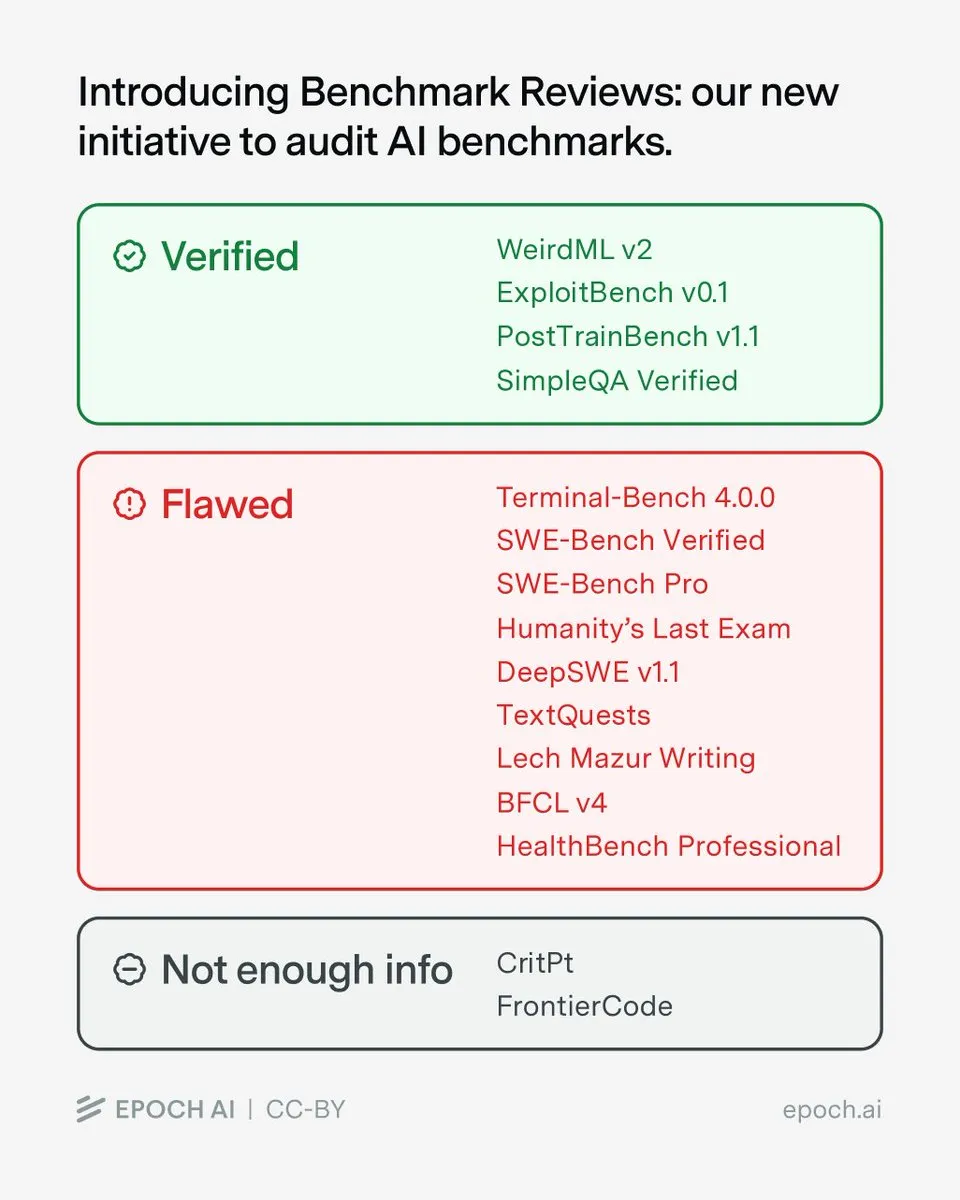
Epoch AI Launches Benchmark Reviews Initiative: Exposes Severe Flaws in Major Benchmarks : Non-profit research institute Epoch AI launched its benchmark auditing project, flagging 9 out of the initial 15 audited mainstream AI benchmarks as “Flawed.” Audits showed that 45.5% of task configurations in Terminal Bench 4.0 were corrupted, while DeepSWE 1.1 contained severe bugs that broke scoring mechanisms, urging the industry to be wary of artificially manufactured ceilings in benchmark evaluations (Source: karinanguyen)
Creative Studio Releases Screaming Server Rack Plushie ‘Bezzy’ to Satirize AI Expansion : Creative studio Basura, in collaboration with musicians, released “Bezzy,” a plush toy modeled after a server rack. Squeezing the plushie emits the piercing industrial cooling whine recorded from real data centers in Virginia, aiming through absurd art to provoke public reflection on the tangible human and environmental costs—such as local water consumption, electrical grid strain, and noise pollution—brought by rapid AI data center expansion (Source: WIRED)