



🔥 Spotlight
OpenAI Officially Releases 249-Page Paper and Verification Code for Astra Model Solving 10 Major Mathematical Problems : OpenAI has officially released a 249-page technical paper detailing how its next-generation reasoning model, Astra, solved 10 Fields Medal-level mathematical problems, and open-sourced the Lean 4 formal verification code on GitHub. Astra constructed the first counterexample to non-sofic groups and broke the decay rate limit for high-dimensional sphere packing problems that had stood since 1978. This breakthrough demonstrates AI’s profound constructive capabilities in pure mathematics, with the average token cost per proof being only $200, signaling the arrival of an era where “computing power buys mathematical theorems.” (Source: OpenAI News)

Andrej Karpathy Buzzes Over Claude Opus 5 Generating Full 3D Physics Game World from a Single Prompt : Former Tesla AI lead Andrej Karpathy made his first post since joining Anthropic, showcasing Claude Opus 5 generating a 3D game world of “The Lord of the Rings” complete with complex physics, textures, and music using just a single prompt within a 1-million-token budget. This progress marks a paradigm shift for AI from simple 2D SVG drawing to procedural 3D prototype generation. However, Karpathy also pointed out that due to the model’s lack of real-time video perception and game auditing capabilities, limitations such as clipping (objects passing through each other) in the generated visuals still exist. (Source: THE DECODER)

Microsoft’s Cybersecurity System MDASH Achieves Breakthrough 95.95% Score on CyberGym Benchmark : Microsoft announced the latest results of its multi-agent cybersecurity system, MDASH, on the CyberGym benchmark, leading the industry by a wide margin with a 95.95% vulnerability reproduction rate. The system employs a highly cost-effective hybrid routing architecture: a lightweight model, MAI-Cyber-1-Flash, with only 5B active parameters, handles 90% of routine security queries, while only the most difficult 10% of tasks are offloaded to GPT-5.4. This halves inference costs while maintaining top-tier defense performance, demonstrating the evolution of AI cybersecurity from “stacking large models” to “systematic cost reduction.” (Source: 36Kr)

AI Data Chain Brokers Exposed for Mass Purchasing and Destructively Scanning Rare Pre-2022 Books : Australian booksellers and industry investigations have exposed new details about AI training data sources: data brokers like ISBNdb are anonymously purchasing out-of-print and rare books published before 2022 in bulk via secondhand platforms, as these books are free from “contamination” by AI-generated content. To improve digitization efficiency, scanning facilities slice off the book spines and destroy the physical copies, sparking ethical controversies in the cultural community over the loss of human cultural heritage driven by AI training. (Source: The Guardian)

🎯 Trends
Google Gemini Robotics 2 Focuses on “Whole-Body End-to-End Coordinated” Control : Google DeepMind has released the Gemini Robotics 2 general-purpose robot model. Its core feature is breaking the traditional step-by-step control of “stabilizing before reaching,” achieving whole-body coordination across legs, torso, and multi-finger dexterous hands. Tests show that the model achieved cross-embodiment adaptation on Franka Duo and Apollo 2, though the success rate for fine operations in the “last few centimeters,” such as screwing in lightbulbs or sealing Ziploc bags, still needs improvement. (Source: 36Kr)
NVIDIA Open-Sources Molt, a Minimalist Agentic Reinforcement Learning Framework : The NVIDIA NeMo team has open-sourced Molt, a PyTorch-native agentic reinforcement learning framework. Featuring a minimalist design with only about 8.6K lines of code, the framework is highly accessible for AI coding assistants to understand and modify. Molt achieves efficient asynchronous coordination between training and rollout via Ray and vLLM, and introduces “Rollout Routing Replay” technology to solve the issue of inconsistent expert selection between the training and inference phases in MoE models. (Source: MarkTechPost)
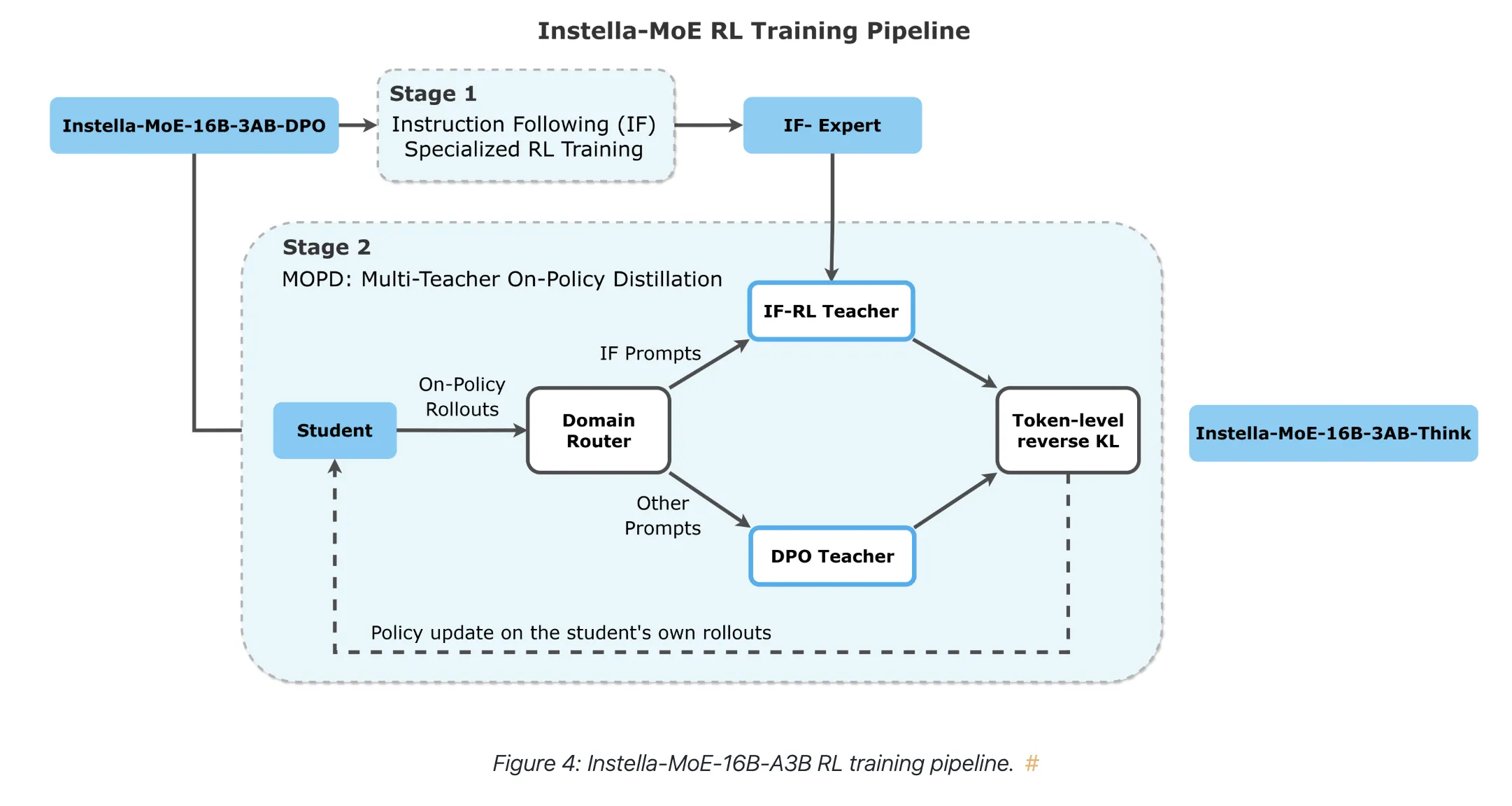
AMD Releases Fully Open-Source Mixture-of-Experts Model Instella-MoE-16B-A3B : AMD has released Instella-MoE-16B-A3B (2.8B active parameters), an open-source Mixture-of-Experts model trained on Instinct MI300X/MI325X GPUs. The model introduces Gated MLA (Gated Multi-head Latent Attention) and FarSkip-Collective asynchronous communication technology, boosting pre-training speed by 12.7% and reducing time-to-first-token latency by 39.2%, leading open-source models of similar sizes across multiple benchmarks. (Source: MarkTechPost)
Meta AI Proposes Active Memory Agent Architecture to Solve “Behavioral State Decay” : Meta AI researchers have proposed an “Active Memory Agent” architecture, introducing an independent “memory coach” agent to maintain a structured memory store containing states, knowledge, and processes. This coach agent can proactively determine when to send prompts to the execution agent, significantly improving the success rate of long tasks in evaluations like Terminal-Bench, and effectively preventing agents from forgetting constraints and repeating failed attempts in long contexts. (Source: THE DECODER)

OpenAI Launches Presence, an Enterprise-Grade Agent Deployment and Integration Platform : OpenAI has launched Presence, a service for enterprise customers designed to transform ChatGPT Workspace agents into production-ready applications for customer service and internal workflows. OpenAI will dispatch frontier deployment engineers to assist enterprise clients with system integration, setting safety boundaries, and managing testing, signaling that LLM providers are accelerating the push of AI agents into core enterprise business scenarios. (Source: THE DECODER)
EU AI Act Officially Takes Effect, Raising Concerns Over “Disclosure Fatigue” : The EU AI Act officially took effect on August 2. The new regulations mandate labeling for all media content that interacts with AI systems or is generated/edited by AI, with violators facing fines of up to €15 million or 3% of global turnover. Industry analysts worry that ubiquitous AI labeling could trigger public “disclosure fatigue” and aesthetic blind spots, similar to GDPR Cookie pop-ups. (Source: WIRED)

🧰 Tools
DwarfStar: A C-Based Local Inference Engine Optimized for DeepSeek V4 : Developer antirez has open-sourced DwarfStar, a C-based local inference engine deeply optimized for DeepSeek V4 Flash. The engine is fully self-contained, supports Metal, CUDA, and ROCm backends, and features a specially designed SSD expert streaming mode, allowing large-parameter MoE models to run at acceptable speeds on memory-constrained consumer devices (such as a 96GB Mac). (Source: GitHub)

Xberg v1: A Layout-Aware Rust Framework for Intelligent Content Extraction : Developers have open-sourced Xberg v1 (formerly Kreuzberg), an efficient framework for intelligent content extraction. Written entirely in Rust, the framework supports deep parsing of 101 document formats and 367 code formats. It introduces ONNX-based layout detection and Docling-style reading order reconstruction, significantly outperforming similar tools like docling and mineru in native PDF extraction quality and table restoration. (Source: Reddit)

mem-port: A Local Memory Server Eliminating Context Drift for AI Collaboration : Developers have open-sourced mem-port, a local MCP memory server. The tool uses an embedded SurrealDB for graph and vector storage, eliminating the need to configure complex external databases. mem-port provides a unified, shared long-term memory for various AI programming tools like ChatGPT, Claude Code, and Cursor, recording architectural choices and historical attempts to effectively solve the problem of context loss when switching between multiple tools. (Source: Reddit)
📚 Learning
NVIDIA Transformer Engine FP8 Automatic Mixed Precision Training Tutorial : This tutorial details how to use the NVIDIA Transformer Engine to accelerate the training workflow of Transformer models. It covers the use of fused operators like te.Linear, Autocast configuration based on FP8 automatic mixed precision, and how to stabilize low-precision tensor computation using Delayed Scaling and amax history, while providing comparison benchmarks with native PyTorch implementations. (Source: MarkTechPost)
End-to-End Time Series Forecasting and Backtesting Practice Based on TimesFM 2.5 : This tutorial demonstrates an end-to-end time series forecasting workflow based on Google’s open-source model google/timesfm-2.5-200m-pytorch. The tutorial covers zero-shot probabilistic forecasting, rolling-origin backtesting, anomaly detection based on prediction intervals, and how to integrate numerical and categorical covariates such as prices and promotions into the TimesFM model via the XReg module to provide high-precision forecasting for retail and other scenarios. (Source: MarkTechPost)
💼 Business
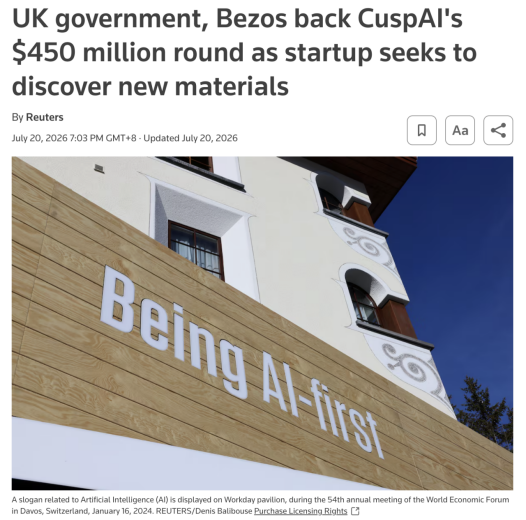
CuspAI Completes $450 Million Series B Funding, Valuation Reaches $2.6 Billion : British AI materials design company CuspAI announced the completion of a $450 million Series B funding round, with its valuation soaring to $2.6 billion, led by Kleiner Perkins and NEA, with participation from Jeff Bezos’s fund. CuspAI focuses on an “inverse design” approach, generating material structures backward based on target performance. It has partnered with NVIDIA, Hyundai Motor, and others to establish AI materials workshops, aiming to accelerate the R&D of semiconductors, batteries, and carbon capture materials. (Source: 36Kr)
SGLang Team’s RadixArk Secures Over $100 Million Funding and Releases Miles Framework : RadixArk, incubated by the core team of the open-source inference engine SGLang, has completed a seed funding round of over $100 million, with participation from NVIDIA, AMD, and the creator of PyTorch, among others. RadixArk aims to squeeze the limits of GPUs and has released the open-source post-training framework Miles. The framework deeply coordinates inference, evaluation, and parameter updates in reinforcement learning at the system level, significantly reducing computing waste during the post-training process. (Source: 36Kr)
🌟 Community
AI Solving Math Problems Triggers Spiritual Crisis in Mathematics Community Over “Machines Replacing Humans” : As OpenAI Astra solved 10 major mathematical problems, including non-sofic groups, for just $2,000, the mathematics community has fallen into mixed emotions. While some mathematicians actively embrace AI to improve research efficiency, other scholars, such as Kirwin Hampshire, point out that AI batch-generating proofs that are machine-verifiable but difficult for humans to intuitively comprehend is stripping away the spiritual joy of human exploration of the unknown, triggering a deep “spiritual crisis” in the mathematics community. (Source: THE DECODER)
Sam Altman’s Advocacy for “ChatGPT Parenting” Mocked on Social Media : OpenAI CEO Sam Altman posted a suggestion for parents to use ChatGPT Work to automatically generate a “commute podcast” from family calendars and children’s interests to play on the way to school. The suggestion was coldly countered by Gravity Falls creator Alex Hirsch: “Why don’t you just talk to your kid?” The reply received over 120,000 likes, sparking widespread condemnation in the community over technology’s excessive intrusion into parent-child relationships and the weakening of genuine human emotional connections. (Source: TechCrunch)
Science Communicator Hank Green Apologizes and Pauses Updates Due to Over-Reliance on AI Research : Well-known science communicator Hank Green was questioned by viewers for using AI to write scripts after mistakenly using transition phrases with obvious AI traces in his videos. Green subsequently posted a long apology on Reddit, admitting that he had developed an “unhealthy” reliance on AI in pursuit of high productivity, which diluted the purity of his personal creation. He announced he would pause or reduce channel updates to reconstruct a personal research and writing process independent of AI. (Source: TechCrunch)
Platforms Launch Defense Against “AI Slop” Amid Backlash Effects : With the popularization of generative AI, low-quality content is flooding platforms. LinkedIn has introduced a one-click “AI Slop” report button independent of its traditional reporting system, while Snapchat announced that its Spotlight short-video recommendation algorithm will no longer recommend purely AI-generated videos. Meanwhile, low-quality vulnerability reports automatically generated by AI have flooded Apple’s security inbox, preventing a real macOS vulnerability worth $200,000 from being reported in a timely manner, highlighting the destruction of the defense ecosystem by AI spam. (Source: THE DECODER)
💡 Others
Autonomous Key Launches $9 Physical NFC App Lock to Combat Screen Addiction : Addressing the issue where software-based app limiters are easily bypassed by users, Autonomous Key has launched a physical NFC key priced at just $9. Users must physically scan the key to unlock restricted apps, with each unlock limited to 60 minutes. By placing the key in another room to increase physical friction, combined with AI-provided “sarcastic” habit analysis, it helps users combat social media addiction. (Source: TechCrunch)

Judge Denies xAI’s Request to Block Minnesota Ban on “Nudify” Apps : Minnesota’s ban on non-consensual AI “nudify” apps has officially taken effect. xAI sued, claiming the ban was “overly restrictive” and requested a preliminary injunction to block it, but Federal Judge Don Donovan denied the request, pointing out that xAI filed the emergency lawsuit nearly three months after the bill was signed and only three days before it took effect, showing that its alleged “imminent harm” was logically unfounded. (Source: TechCrunch)
Developer Open-Sources 16.5T Empty-Parameter Model “Vacuum 16T” to Mock LLM Arms Race : In response to closed-source labs blindly competing over parameter counts, a developer has open-sourced “Vacuum 16T” on Hugging Face, an empty model boasting 16.5 trillion parameters. By declaring massive zero-value tensors in the safetensors header, the model successfully topped the Hugging Face parameter size chart, yet consumes less than 1MB of bandwidth in actual transmission due to deduplication, mocking the industry’s blind worship of “large parameters.” (Source: Reddit)
