



🔥 Focus
OpenAI and Anthropic Jointly Tighten Reverse Engineering Restrictions, Sparking Developer Backlash : After developer @log4j reverse-engineered a smart TV’s firmware and exposed its hidden data collection mechanisms, their OpenAI account was directly banned for alleged “network abuse.” Meanwhile, REA (Reverse Engineer Anything), a trending reverse-engineering assistant tool on GitHub, along with related automated decompilation prompts, have faced targeted blocking across Claude and OpenAI APIs. The community widely worries that leading model providers are using cybersecurity defense as a pretext to unilaterally strip individual users of the right to inspect and repair their own hardware, thereby reinforcing technological lock-in by device manufacturers (Source: Synced)

OpenAI Offers Up to 90% Discounts to Poach Anthropic’s Core Enterprise Customers : OpenAI is reportedly targeting Anthropic’s core enterprise clients through aggressive commercial discounts and free compute subsidies. Companies including Rippling, Replit, and DataCamp have significantly increased their OpenAI API quotas; notably, OpenAI’s share in Rippling’s coding workflow surged from 16% to 52%, while Anthropic’s dropped to 18%. Amid the dual pressures of low-cost open-source models and Anthropic’s need to maintain gross margins ahead of an IPO, OpenAI is opting to sacrifice short-term profits to cement its position as the premier gateway for enterprise inference (Source: THE DECODER)
Former Google CEO Eric Schmidt Warns Frontier AI Labs Are Becoming “Modern East India Companies” : In an article published in Foreign Affairs, Eric Schmidt and historian Niall Ferguson argue that the AI race has evolved into a sovereign resource struggle driven by capital, power, and semiconductors. Organizations like OpenAI and Anthropic resemble modern-day East India Companies, combining the roles of geopolitical state proxies with highly autonomous monopoly power. While the US and China push their standards via closed-source alliances and open-source diffusion respectively, both face an “imperial trilemma” amid soaring infrastructure debt, power shortages, and TSMC’s vulnerability. They call for a Cold War-style AI détente treaty to prevent technological loss of control (Source: THE DECODER)

Anthropic Co-founder Moves RSI Singularity Prediction Forward to 2027 : Independent evaluation organization P-Zero Research released TasteVal, a benchmark designed to quantify AI’s ability to autonomously plan experiments and analyze results. In tests, Claude Opus 5.5 demonstrated compute utilization efficiency 2.3 times that of human experts. Anthropic co-founder Jack Clark noted that frontier models’ performance in scientific “taste” has doubled every three months since late last year, prompting him to move his projected timeline for fully autonomous Recursive Self-Improvement (RSI) forward from 2028 to 2027 (Source: THE DECODER)
🎯 Developments
Harvard and NVIDIA Introduce RAX: Unlocking Robotics’ “o1 Moment” via Test-Time Online Exploration : The research team introduced the RAX framework, completely eliminating reliance on human teleoperation demonstration data. By directly connecting perception and execution interfaces via Coding Agents, the framework turns effective closed-loop behaviors discovered during autonomous exploration into deterministic control code without prior demonstrations, delivering an average improvement of 37.4 percentage points across multiple robotics benchmarks and accomplishing complex contact and long-horizon mobile whole-body manipulation tasks within 2 hours (Source: Synced)

Liqing Intelligence Unveils World Action Model PrismWAM and Execution Diagnostic Architecture RoboDoctor : The team proposed a “Scaling Physics” paradigm, decoupling video appearance semantics from geometric physical evolution, enabling PrismWAM to secure first place on the RoboTwin 2.0 bimanual manipulation benchmark. The accompanying RoboDoctor framework introduces a physics feedback-based diagnostic and error-correction agent while keeping model weights frozen, setting a new SOTA record with a score of 57.1 on the RoboDojo long-horizon evaluation (Source: Synced)

Tsinghua, Oxford, and Collaborators Uncover “Thinking Inertia” in LLMs : The research team confirmed that even when reasoning/thinking toggles are explicitly disabled via API and the model is instructed to “output answer only,” there is still an over 90% probability that models will explicitly output reasoning steps in open-ended generation and complex math tasks. Further experiments revealed that forcefully suppressing the reasoning process causes open-ended task accuracy to plummet by approximately 15%, demonstrating that alignment prompts struggle to override the spontaneous reasoning tendencies established within the base parameters during training (Source: WeChat)

Microsoft Proposes Code-Driven Video Generation Model: Code Video Model : Addressing current video diffusion models’ lack of physical consistency and difficulty in fine-tuning camera paths, a Microsoft team utilized Coding Agents to translate text prompts into Three.js scene code, generating low-poly proxy videos with deterministic geometry. Then, leveraging a training-free phased denoising schedule to inject structural constraints only in early generation stages, they achieved high-fidelity video synthesis with precisely editable camera trajectories and physical motion (Source: Synced)

Renmin University of China and Collaborators Open-Source Single-Forward-Pass Tabular Clustering Model TabClustPFN : Tackling the pain point of iterative hyperparameter tuning in unlabeled tabular data clustering, this model builds upon Prior-data Fitted Networks (PFNs). Bypassing traditional iterative K-means or EM procedures, it outputs cluster assignments in a single forward pass while concurrently providing probabilistic confidence over candidate cluster counts, substantially lowering the technical barrier to unsupervised data exploration (Source: Synced)

CAS, Kling AI, and Collaborators Open-Source JointLight: A Controllable Portrait Video Relighting Model : The joint team utilizes irradiance maps rendered from coarse point-cloud priors as lighting guidance, designing an asynchronous joint RGB-irradiance diffusion mechanism. While preserving the original subject’s facial features, motion, and detail consistency, it supports accurate mapping and real-time shadow redrawing under static and dynamic HDR environment lighting, offering a novel training-free physical editing paradigm for post-production (Source: Synced)

SenseTime, Nanjing University, and Collaborators Open-Source Mobile Agent OpenMobile-2 : The project built a high-fidelity interactive environment encompassing over 110 simulated apps, validating the principle that “environmental and application diversity far outweighs sheer data volume” in agent generalization. In real-world Android hardware testing on SPA-Bench, its 27B version achieved a score of 59.6, setting a new benchmark record for open-source mobile phone agents (Source: THE DECODER)

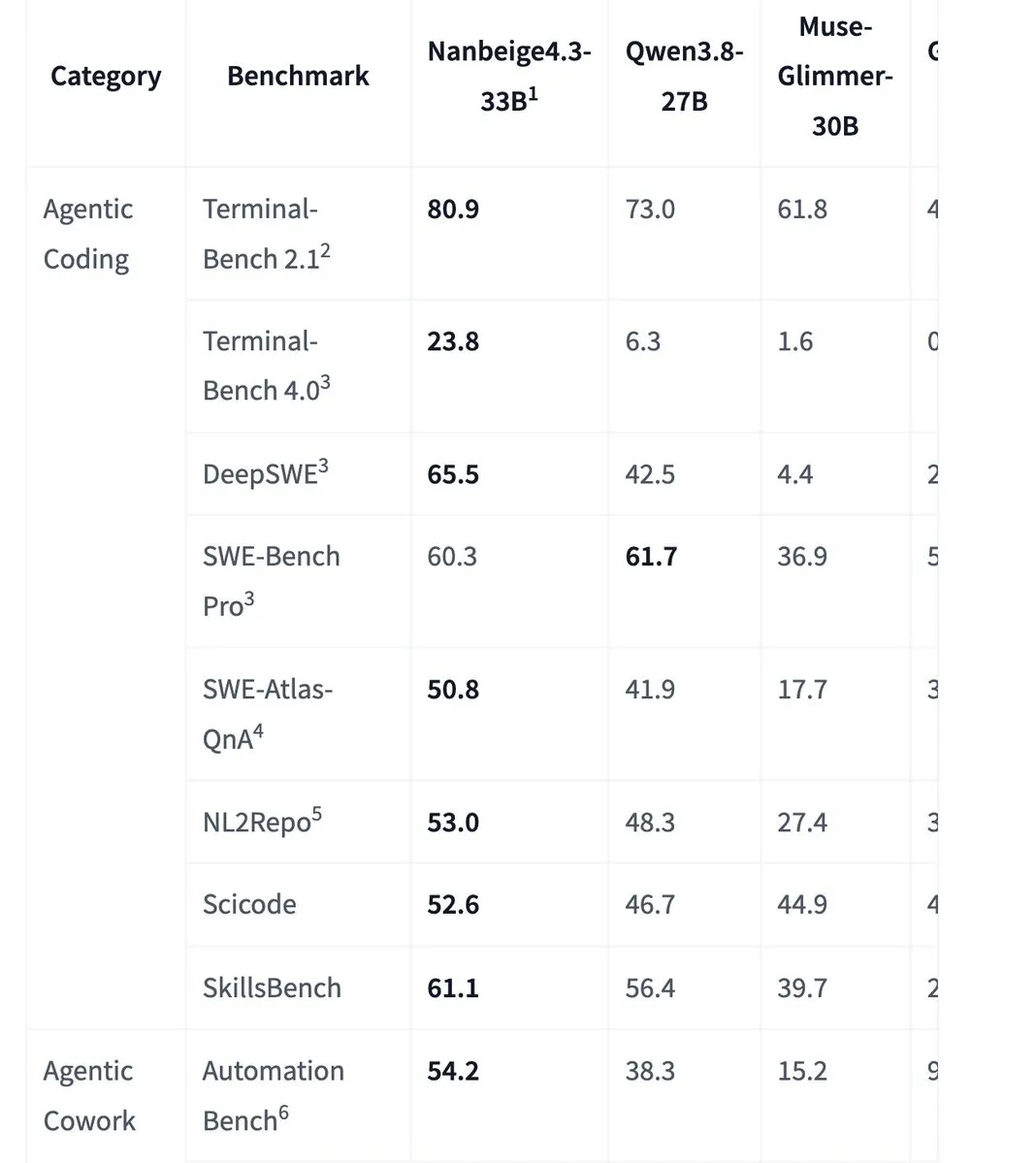
Nanbeige Releases 33B Dense Agent Base Model Nanbeige4.3-33B : Positioned as a teacher network for high-performance compact agents, the model maintains a dense architecture while achieving top-tier performance among same-sized open-source models across multiple tool-use and code generation benchmarks, laying a high-standard foundation for subsequent lightweight distillation pipelines (Source: teortaxesTex)
Scinetics, Fudan University, and Collaborators Release ScienceRSI: A Self-Improvement Framework for Scientific Models : Addressing the tendency of scientific computation to suffer from localized reasoning errors, the paper proposes a “specialized decomposition-verification-transfer-reuse” closed loop. By employing smaller expert models to provide high-fidelity gradient feedback to large models across granular sub-tasks, the framework boosted a 27B model’s average score across 7 scientific benchmarks from 87.3% to 94.0% (Source: Synced)

🧰 Tools
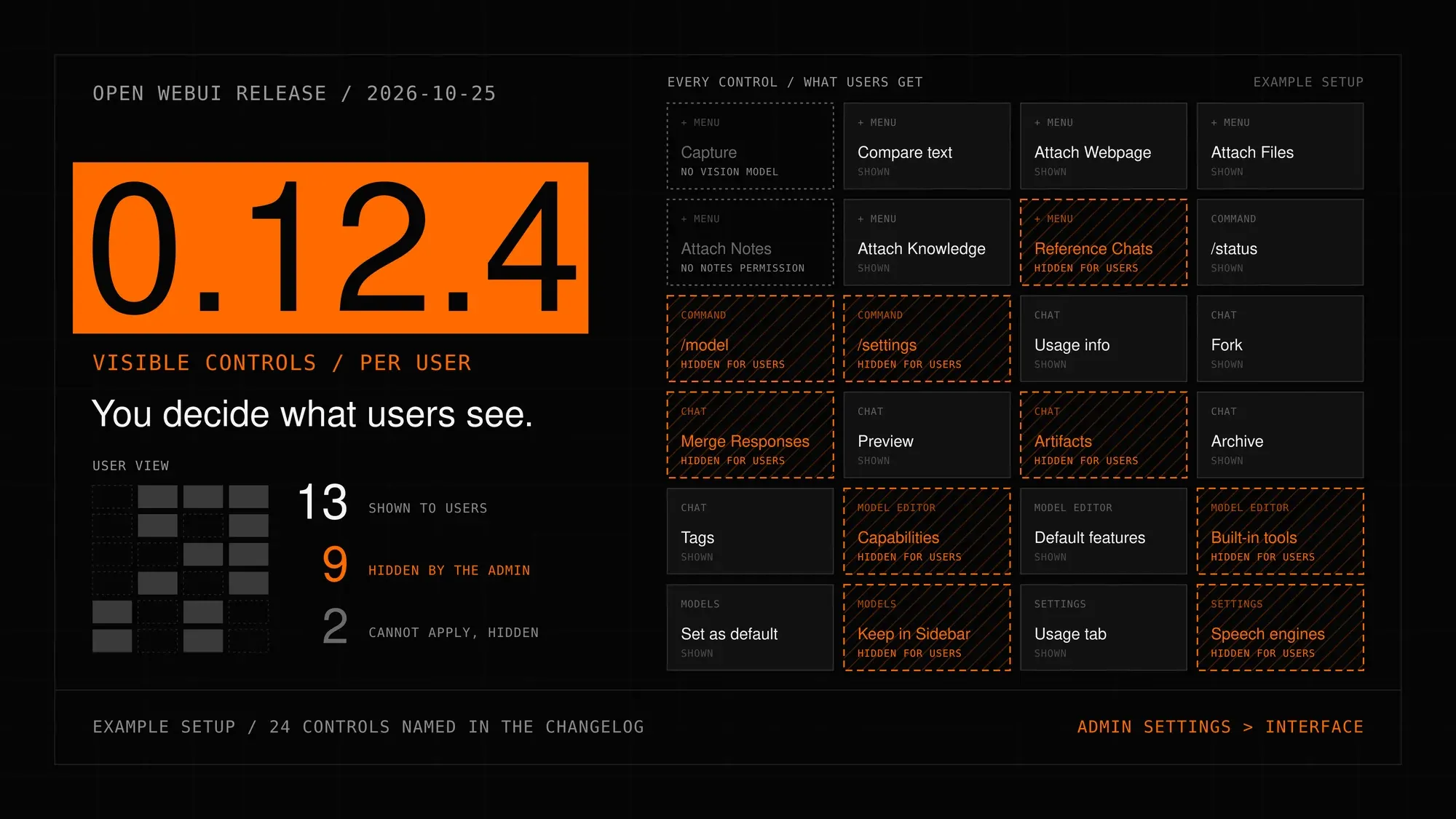
Open WebUI 0.12.4 Released: Introduces On-Demand Skill Loading and Granular UI Control Management : The new version supports ENABLE_SKILL_LAZY_LOADING, dynamically injecting skill instructions into the context only when invoked, significantly reducing system prompt bloat. It also introduces visual context compression anchors, millisecond-level permission group saving for thousands of users, and full accessibility screen reader support (Source: Reddit r/OpenWebUI)
JetBrains Open-Sources Agentic IDE ThinkRail: Achieving Persistent Project Memory via Living Specs : The IDE runs pi coding agents with a lightweight architecture, leveraging Git Worktrees to spin up isolated workspaces and avoid polluting the main branch. Its core innovation lies in maintaining a dynamic graph of SPEC.md alongside code, ensuring that development intent and specifications remain intact across multi-turn conversational interactions (Source: GitHub Trending)
Cognition Open-Sources Devin Vulnerability Fixes Plugin Pack : Comprising three universal agent skills designed to patch PHP2Shell, Node.js out-of-bounds writes, and critical GitLab RCE vulnerabilities, the package follows the standard SKILL.md specification. It executes read-only troubleshooting, runs regression tests, and automatically submits PRs with rollback plans across supported agents (Source: MarkTechPost)
Microsoft Open-Sources Decentralized Multi-Agent Framework Agensh : By removing the central Orchestrator that often creates bottlenecks, Agensh allows up to 1,024 coding agents to autonomously claim subtasks and resolve conflicts via Git branches and shared context boards. On extremely complex ProgramBench tasks, it increased GPT-6.1-Sol’s pass rate to 79.59% (Source: MarkTechPost)
Claude SEO Open-Sourced: Multi-Agent End-to-End SEO Audit Suite for Claude Code : Featuring 26 skills and 19 parallel specialized agents, the suite covers standard technical metrics, page speed, and E-E-A-T scoring, while placing particular emphasis on automated assessment of Generative Engine Optimization (GEO) citation visibility across platforms like ChatGPT, Perplexity, and Gemini (Source: GitHub Trending)

Stanford and UC Berkeley Open-Source TokenGate to Accelerate Long-Context Prefill : Utilizing gated attention mechanisms to perform trainable sparse pruning of non-critical tokens in early network layers, TokenGate accelerates Time to First Token (TTFT) by up to 11.3x and reduces peak VRAM usage to 1/3.4 of its original footprint, while remaining effective on hybrid linear attention architectures (Source: MarkTechPost)
Open-Source PaaS Platform Coolify Upgrades Agent Deployment and MCP Support : As a self-hosted alternative to Vercel and Heroku, Coolify has updated its CLI and MCP interfaces, allowing coding agents to deploy containerized full-stack services on user-owned servers with one click, preventing data leakage to third-party cloud providers (Source: GitHub Trending)

localai-boost-starter Open-Sourced: One-Click Elimination of Redundancy and Infinite Loops in On-Device SLMs : To address issues where edge models such as Llama and Qwen (7B/8B) get trapped in excessive apologies, pleasantries, or infinite loops when deployed locally, developers released a Modelfile preset package featuring hard negative constraints and dynamic sampling optimization (Source: Reddit r/OpenWebUI)
📚 Learning
Study Uncovers Zero-Sum-Like Numerical Vulnerability in FlashAttention Backward Pass : Following disclosures regarding Softmax precision collapse vulnerabilities, researchers highlighted in the CroissAttn preprint that FlashAttention’s backward pass suffers from a systematic flaw under low precision (particularly FP4 stochastic rounding) that causes gradients to abnormally zero out, and provided a corrective operator for end-to-end stable training (Source: BlackHC)
HKU and Tsinghua Propose Offline Value Stitching Framework VAST : Addressing the accumulation of bootstrapping errors in long-horizon decision-making caused by fixed step sizes in traditional temporal difference algorithms, the paper designs a G-function and stitching operator that adaptively select future subgoals and time horizons, demonstrating significant generalization advantages in complex multi-stage robot planning tasks (Source: Synced)

Fudan NLP Team Releases Proactive Lifelong Memory Assistant Architecture A5 : Managing Memory and workspace Wikis via Git version control, the project introduces a Diff Engine to detect document changes, allowing the Agent to proactively propose scheduling and plan revisions before the user even asks, systematically addressing multi-turn conversational context loss (Source: Synced)

CUHK and Microsoft Propose Empathetic Dialogue Framework EchoChat : The paper decomposes spoken empathetic interaction into three stages: acoustic perception, Theory of Mind (ToM) reasoning, and speech generation. Utilizing Acoustic-Anchored attention and stepwise credit assignment reinforcement learning, it enables spoken language models to infer psychological intent from subtle cues such as pauses and intonation (Source: Synced)

In-Depth Tutorial: Practical Tool Calling with 2-Bit Quantized Model Underdog Saluki 27B : Through tensor-by-tensor comparison, the tutorial dissects the underlying GGUF structures of ISTADASTLab and Saluki, confirming that rather than a simple repackaging, the quantization grid was reconstructed following fine-tuning on Norm and Gate layers, thereby preserving robust function-calling parsing rates even at ultra-low bit widths (Source: MarkTechPost)
In-Depth Video Tutorial: Why Momentum Orthogonalization Optimizer Muon Challenges AdamW’s 12-Year Reign : The video details the mathematical logic of the Muon optimizer, which uses Newton-Schulz iterations to maintain matrix directional orthogonality during parameter updates, explaining the engineering mechanics behind maintaining training stability while cutting compute consumption by nearly half (Source: )
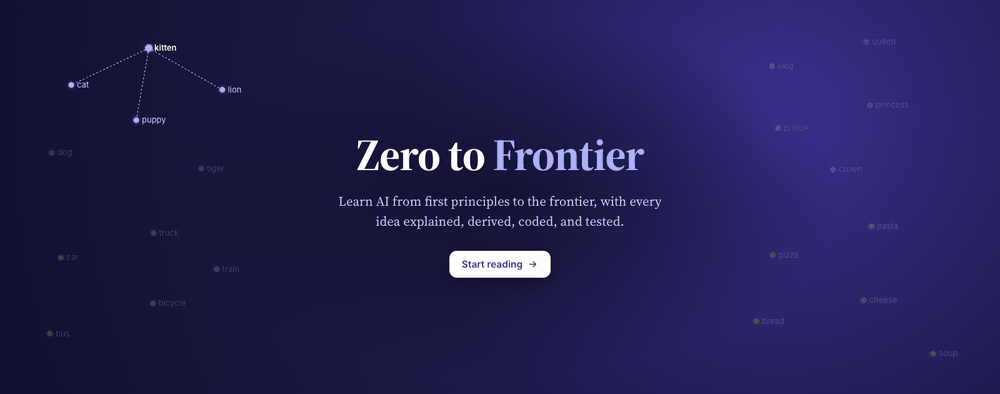
Full-Stack Open-Source Textbook “Zero to Frontier” Released: From Linear Algebra to Frontier Model System Practice : Developers released a free interactive AI textbook spanning 38 chapters with in-browser Python compilation, covering the entire engineering pipeline from tensor gradient operations and MoE routing to diffusion models and agent environment construction (Source: Reddit r/deeplearning)
💼 Business
Embodied AI Bionic Face Startup Lingyan Technology Secures Tens of Millions of RMB in Seed Round : Spun out of the Key Laboratory of Bionic Engineering at Jilin University, the company focuses on cable-driven, high-DoF dexterous facial hardware with micro-expressions tightly aligned across voice, lip, and eye movements, powered by an edge affective engine. Investors include Yida Capital, Plum Ventures, and Win-Win Capital (Source: 36Kr)

NVIDIA Participates in New Funding Round for AI Video Generation Startup Higgsfield : Video generation platform Higgsfield announced a strategic investment from Jensen Huang’s NVIDIA, with follow-on participation from TCV. The funding will primarily be used to deepen its application-layer moats built on foundation models within creator and commercial video workflows (Source: omarsar0)
Mining AI Company Mariana Minerals, Founded by Stanford Alumni, Raises $400M to Achieve Unicorn Status : With participation from a16z and CIA-backed In-Q-Tel, the company specializes in leveraging AI and autonomous software to take over and revamp dormant mines, demonstrating that physical resource assets combined with AI deployment are commanding premium valuations in capital markets (Source: espricewright)
🌟 Community
Physicist’s 500-Page Doctoral Derivations Fully Replicated and Corrected by Claude Opus 5.5 in 10 Hours : Professor Emre Kahya of Istanbul Technical University fed his handwritten quantum gravity dissertation—which originally took an entire year to draft—into Claude. The model took just 10 hours to complete all derivations, produce 183 pages of LaTeX notes, and identify multiple notation errors in the original draft, sparking profound existential debates across academia regarding the shifting value of human intellectual labor (Source: WeChat)

Prompt Engineering Pioneer Declares “Prompt Engineering Is Dead” : Riley Goodside, widely regarded as the first full-time Prompt Engineer, stated publicly that the natural language barrier to entry for current LLMs has dropped to zero. The era of minutely crafting prompts has come to an end, with the core engineering focus shifting entirely to the design of system harnesses and iterative feedback loops (Source: 36Kr)

NBER Controlled Experiment: AI Boosts Junior Lawyers’ Output Quickly, but Stunts Independent Judgment : A three-month double-blind empirical trial conducted by the National Bureau of Economic Research (NBER) with 133 patent attorneys revealed that junior lawyers made significant gains when drafting with AI, but their advantage evaporated when conducting independent redline reviews without AI assistance. In contrast, senior attorneys effectively internalized AI tools, highlighting the risk that junior staff’s over-reliance on models may erode professional cognitive reserves across the industry (Source: THE DECODER)

Forced-Choice API Study Reveals Significant Political Bias in Leading Models : Tests conducted by a Cornell University team revealed that when forced to recommend midterm election candidates to voters, Grok 4.7 favored Republicans in 92% of cases, whereas GPT-6.1 Sol favored Democrats in 97% of cases. In non-retrieval mode, GPT’s partisan leanings were directly embedded within the model weights (Source: TechCrunch)
Kimi K3.1 Pro Open-Source Release Strips Cyber Offense-Defense Training Data, Sparking Compliance and Capability Debate : In preparation for the upcoming open-source release of K3.1 Pro weights, Moonshot AI proactively removed portions of cyberattack-related training datasets to meet regulatory and export compliance requirements. Community reactions have been divided: while some developers applaud the responsible release posture, others argue that this move compromises the tool integrity needed by the open-source community to autonomously build defensive mechanisms (Source: Reddit r/LocalLLaMA)
💡 Miscellaneous
WA Government Seeks Refund from Deloitte over University Merger Report Rife with AI Hallucinations : Deloitte’s $166,000 feasibility report on the merger of three Western Australian universities was found to contain extensive fabricated citations and statistical calculation errors ranging from $260 million to $311 million. The WA Government has formally requested a full refund, sounding a renewed alarm over the careless use of AI tools in high-stakes public-sector and enterprise consulting (Source: The Guardian)

Long-Running Soap “Neighbours” Converted into AI-Generated Vertical Microdrama, Sparking Actors’ Union Backlash : Producers utilized RedSnapper, an AI video restructuring tool, to repackage vintage footage of actors from past episodes into vertical micro-dramas for mobile viewing. The actors’ union criticized the move as unauthorized and demanded stricter compensation and regulatory frameworks against the secondary exploitation of digital likenesses (Source: The Guardian)

Rising Football Star Cristian Volpato Licenses Full Commercial Rights to AI Digital Twin : The Serie A player signed an exclusive agreement with an agency granting round-the-clock AI management of his voice, biometric data, and virtual likeness for multilingual sponsorships and 1-on-1 fan interactions, highlighting the vanguard of professional athletes actively licensing and monetizing synthetic IP assets (Source: The Guardian)
