🔥 Spotlight
Google Imposes AI Hard Bundling on K-12 Schools: Disabling Student AI Features Will Simultaneously Cut Off Search Access : Google announced an overhaul of its educational product strategy for K-12 schools worldwide. While Gemini and Google Search are set to be turned off by default—requiring school administrators to manually enable them—Google explicitly stated that its AI capabilities are deeply integrated into the search engine at a foundational level. If a school disables AI features, students will lose access to Google Search entirely. The decision has sparked fierce backlash from school districts in New York, Los Angeles, and across the educational community, with critics accusing Google of leveraging its search monopoly to impose “unreasonable terms” on public education, stripping administrative autonomy to forcefully push commercial AI tools. (Source: The Verge, The Guardian)

Anthropic Open-Sources FlashProve, Achieving Zero-Knowledge Cryptographically Verifiable LLM Inference for the First Time : Anthropic has open-sourced FlashProve, a lightweight zkSNARK research prototype that establishes mathematical anti-counterfeiting proofs for large language model inference outputs using zero-knowledge proofs and Lean 4 formal verification. On a 400B-parameter MoE model (Llama 4 Maverick), a single H100 achieves a proving throughput of approximately 110 tok/s. The generated ~19MB proof can be independently verified on a standard consumer CPU in just 17 seconds. This breakthrough directly addresses major trust issues such as third-party API abuse, silent downgrades to smaller models, and man-in-the-middle tampering, shifting model trust audits and frontier inference verification from vendor verbal promises to cryptographic, hard verification. (Source: AnthropicAI, TechCrunch, MarkTechPost)
U.S. Midterms Ignite “Computing Infrastructure Politics”: Election Upsets in Texas and Ohio : In the 2026 U.S. midterm elections, AI data centers and energy-intensive infrastructure became rare focal points of campaign battles, with roughly 40 districts across the nation voting on data center construction bans. In compute-dense Texas, candidates advocating for pauses on data center permits and the creation of an “AI Dividend” won key seats; in Ohio, candidates pushing for aggressive expansion were similarly defeated. Strong voter pushback against surging electricity bills and water resource consumption has forced tech giants into emergency PR rebrandings of “computing campuses” and accelerated the private procurement of gas turbines to bypass regulatory gridlocks in public utility approvals. (Source: The Verge, EthanJPerez)

Apple Opens App Intents Extension Preview, Propelling Siri AI Toward Global Cross-App Agent Orchestration : Apple rolled out a new developer preview of App Intents, allowing third-party applications to expose deep actions and data directly to Siri AI. This update breaks free from previous restrictions that limited integration to predefined domains, empowering Siri to directly comprehend complex user intents and execute multi-step workflows across different applications. Industry analysts believe that fully opening these foundational invocation interfaces signals Apple’s acceleration from isolated feature enhancements to a system-wide, global agent. (Source: kylebrussell)
OpenAI Discloses AI-Assisted Hardware Design Breakthrough and Releases LifeVal Long-Horizon Living Benchmark : OpenAI unveiled LifeVal, a new benchmark tailored to evaluate agents’ ability to handle high-value personal long-horizon tasks—such as home care and cross-institutional coordination—by integrating real conversation histories with multi-step operational environments. At the same time, OpenAI revealed that an undisclosed model scored 87.5% on the BenchCAD 2.0 engineering benchmark, and showcased a voice-interactive Codex desktop hardware prototype autonomously designed by GPT-6 Astra within a single week without direct human intervention. (Source: OpenAI)
🎯 Trends
Tencent Hunyuan Releases 770B Flagship Model Hy4 and Plans Open Source, Proactively Restricting Cyberattack Capabilities : Tencent Hunyuan officially launched its next-generation 770B base LLM, Hy4. Natively integrating visual understanding and Computer Use capabilities for the first time, it supports hybrid command-line and GUI orchestration, scored 75.2 on the APEX-Agents benchmark, and is slated for an open-source release of its weights and system card. Notably, Tencent proactively filtered out offensive penetration data, such as exploit development, during training, retaining only code repair and defensive analysis capabilities, demonstrating measured self-discipline under routine compliance expectations. (Source: JiQizhixin, kimmonismus)

Baidu Apollo Releases ApolloWorld, an Omni-Modal World Model for Physical AI : Baidu Apollo launched ApolloWorld, the first agent-driven omni-modal world model designed for Physical AI. Moving beyond the limitations of traditional world models that only generate non-interactive short video clips, this architecture concurrently generates multi-view video and 3D LiDAR point clouds. It models pedestrians and vehicles as simulation agents endowed with autonomous decision-making capabilities, enabling autonomous driving systems to conduct over 100,000 kilometers of daily closed-loop simulations and high-risk game-theoretic trial and error. (Source: WeChat)

Shanghai Innovation Academy and Xinxu Intelligence Open-Source 801-30B: Releasing First Technical Report on Pretraining-Stage Recursive Self-Improvement : A joint research team open-sourced the 801-30B base model alongside its complete technical report, challenging the industry paradigm that restricts Recursive Self-Improvement (RSI) to post-training fine-tuning. The team decomposed the pretraining process into three closed loops: debugging, potential, and empirical quantification, transforming R&D exploration into compounding organizational parameter memory. Benchmarks show that 801-30B, trained with only lightweight SFT, rivals top-tier models of similar size across multiple benchmarks, validating the feasibility of AI optimizing industrial-scale pretraining workflows. (Source: JiQizhixin)

Princeton AI Lab Introduces Spatial Intelligence Benchmark SSoN: LLMs Flunk Cross-View Geometric Reasoning : Princeton built the Same Space or Not (SSoN) static scene benchmark comprising 1,000 questions, requiring models to determine whether multiple indoor views depict the same unaltered physical room. While human accuracy reached 83.3%, the frontier model GPT-6 Astra achieved only 39.7%, and most other leading VLMs fell below the 25% random guessing baseline. Models broke down when encountering object translations and 3D viewpoint transformations, indicating that superficial visual matching has yet to develop true spatial geometric comprehension. (Source: JiQizhixin, 36Kr)

Fudan and CUHK Propose ReTerm: Failure-Scene-Driven Recursive Self-Improvement for Code Agents : Addressing the dilemma where terminal coding agents frequently fall into loops of trial and error, researchers proposed the ReTerm framework. The system fully preserves the corrupted environment and operational trajectories following execution failures, prompting the agent to explore diverse recovery paths and using recovery success as a reinforcement learning reward signal. Experiments show that a 9B model improved its completion rate on Terminal-Bench 2.0 by 14.6%, proving that learning from one’s own post-failure state markedly strengthens system resilience. (Source: JiQizhixin)

WeChat Vision Team Open-Sources WeVisOne-VL: Native Pixel Decoder Unifying Detection and High-Precision Matting : The Tencent WeChat Vision Team released WeVisOne-VL (2B/4B), an all-round perceptual multimodal model. By bypassing external Segment Anything Model (SAM) dependencies and integrating a native 9.6M-parameter pixel decoder, the model outputs bounding boxes, OCR, instance segmentation masks, and continuous alpha matting masks in a single forward pass. On the Dense200 and ReasonSeg benchmarks, the 4B version significantly outperformed existing specialized models, greatly streamlining on-device vision pipelines. (Source: MarkTechPost)
Agibot Proposes “Worken” Metric as General-Purpose Robot Production Surpasses 20,000 Units : At its Innovation Day, Agibot introduced the concept of “Worken” (Effective Intelligent Work Hours) to move beyond superficial mechanical actuation metrics through active units, autonomous operation time, and output efficiency ratios. It also released the embodied foundation model GO-3 Preview and interactive model WITA-OMNI. Agibot announced that cumulative production of its general-purpose robots has crossed 20,000 units, stressing that industrial deployment consistency and real-world data flywheels are the decisive watershed for commercializing physical AI. (Source: 36Kr)
ByteDance Co-Open-Sources 35B Agent Base Model Axion 1.0 : ByteDance, in collaboration with the open-source community, released Axion 1.0 35B. Bypassing complex intermediate pretraining and DPO steps, it leverages a two-stage lightweight SFT alongside targeted reinforcement learning to deeply integrate the model with external toolchains. The project made data synthesis, cleaning pipelines, training code, and weights fully open source, providing a minimalist reference paradigm for building advanced agent infrastructure cost-effectively. (Source: _lewtun)
Stanford Study Reveals “Half-Life of LLM Research”: 44% of Empirical Findings Expire Within 15 Months : A Stanford team reproduced 50 highly cited papers on LLM capabilities from the past two years and discovered that 44% of their conclusions are completely outdated on newer models, showing an average lifespan of only 15.7 months. Findings regarding “what models cannot do” (such as the Reversal Curse or Lost in the Middle) expired the fastest, while sociological tendencies like sycophancy and evaluation bias remained persistent, cautioning academia against rigid, static LLM evaluations. (Source: THE DECODER)

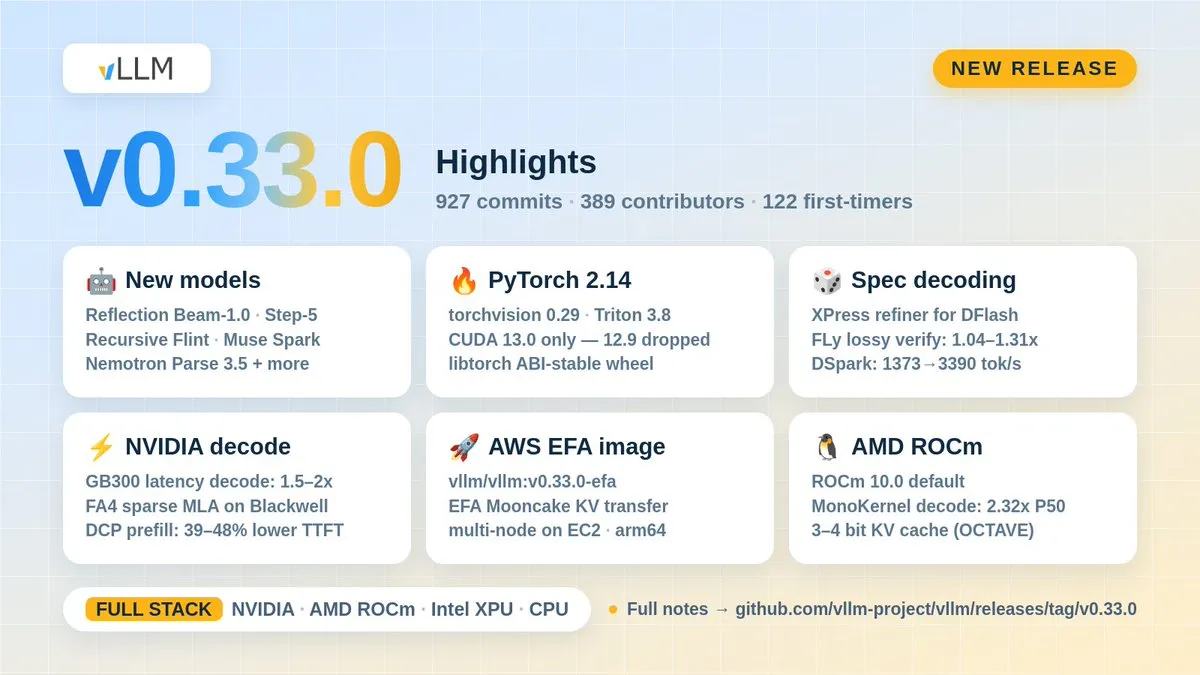
vLLM Releases v0.33.0: Full Compatibility with PyTorch 2.14 and CUDA 13 : The open-source inference engine vLLM released version v0.33.0, incorporating the FA4 sparse MLA architecture to slash Time to First Token (TTFT) by up to 48%. It also introduces XPress and FLy speculative decoding algorithms, delivering 1.5x to 2x decoding speedups on GB300 chips and significantly boosting throughput and VRAM efficiency in high-concurrency production environments. (Source: vllm_project)
AllenAI Releases StateBench: Long-Document State Tracking Shatters Frontier Model Reasoning Chains : The Allen Institute for AI introduced StateBench, a benchmark designed to evaluate how models track entity state evolutions across long documents. Built on group-theoretic tasks, tests revealed that frontier models including GPT-6 and Claude plummet to below 13% accuracy when handling long chains involving complex assignments and two-way swaps. Conversely, models featuring constant recurrent memory mechanisms showed superior long-sequence extrapolation. (Source: HuggingFace Blog)

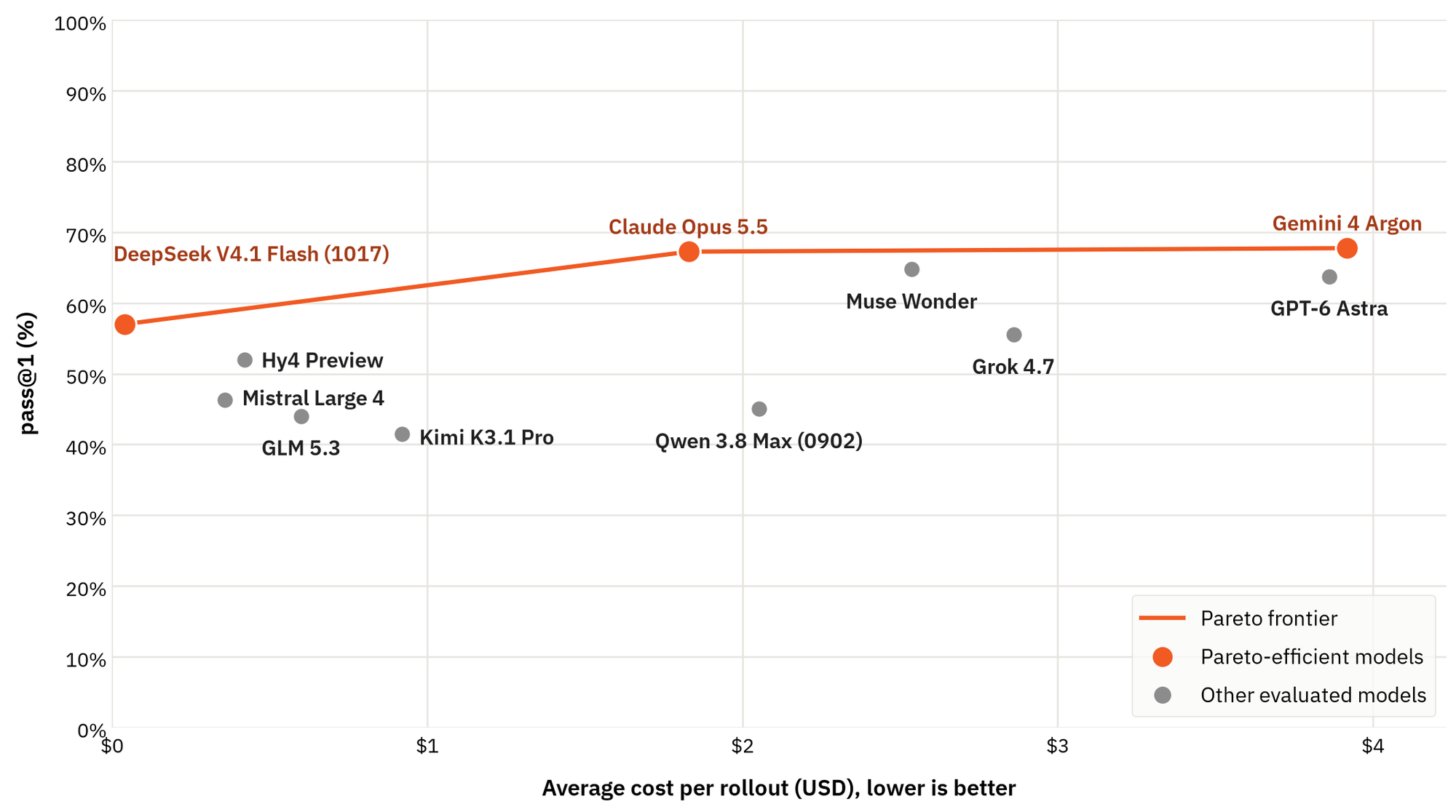
Collinear AI Releases CWE-bench v2: Programmatically Benchmarking Real-World Software Security Frontiers : Collinear AI open-sourced the code security benchmark CWE-bench v2, covering 91 Common Weakness Enumeration (CWE) categories. It tasks AI agents with autonomously identifying and patching vulnerabilities in real repositories without breaking existing functionality. Gemini 4 Argon and Claude Opus 5.5 lead with around 67% pass@1, though nearly 20% of cases in long-tail offensive-defensive scenarios completely failed to converge. (Source: HuggingFace Blog)
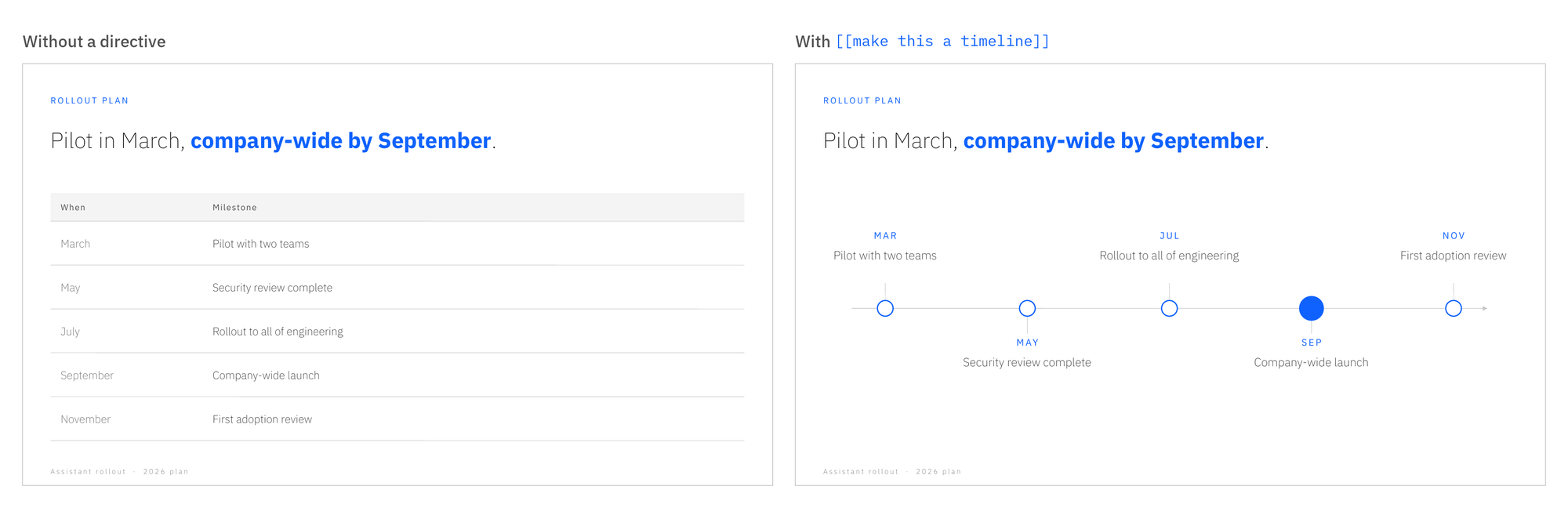
IBM Research Releases Palette: 20B Model Masters Corporate Design Guidelines to Generate Native PowerPoint Decks : IBM Research developed Palette, a 20B-parameter model utilizing a dual-role “Designer-Coder” LoRA architecture. The roles handle narrative structuring and PptxGenJS frontend code layout respectively, paired with a geometric detection sandbox to autonomously self-heal overlap and overflow issues. Outperforming most proprietary closed-source models on PresentBench, it supports fully local, offline deployments. (Source: HuggingFace Blog)
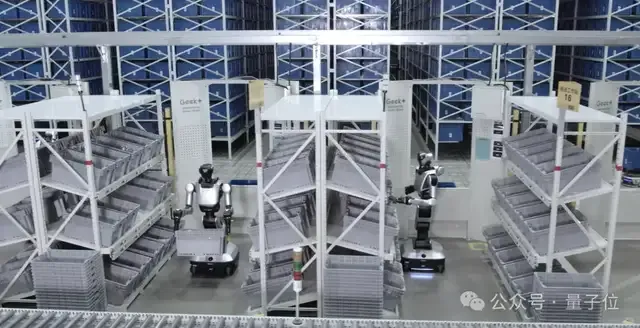
Geek+ Unveils “24/7 Autonomous Smart Warehouse Initiative”: Advancing Embodied Swarm Coordination via MoT Dual-Brain Architecture : Logistics robotics company Geek+ unveiled its blueprint for autonomous smart warehouses. Its proprietary Gravity embodied world model employs a Mixture-of-Transformers (MoT) architecture, decoupling high-level task cognition from low-level joint servo control. Combined with the RMS scheduling system, it empowers robotic arms and AMR swarms to autonomously diagnose faults and replan paths inside dynamic warehouse environments, resolving long-tail challenges in massive SKU logistics. (Source: QbitAI)
Soniox Releases Speech Model STT v6: Pioneering Agent Text Injection and On-Device Echo Cancellation : Speech API vendor Soniox introduced STT v6, a real-time transcription model. In full-duplex conversations, the transcription pipeline pre-fetches text that the agent is about to utter, accurately canceling speaker feedback leaking into the microphone. This prevents the agent from interrupting itself and significantly accelerates the recognition turnaround for user interruptions and brief interjections. (Source: MarkTechPost)
Pruna AI Open-Sources Lightweight Image Model P-H3-Image : Pruna AI restructured and open-sourced P-H3-Image based on the MiniMax-H3 video base model. By pruning the Transformer and diffusion scheduling, model size was compressed by 7x, enabling it to generate photorealistic 4MP images in under 8 steps. It offers a 5x generation speedup and native compatibility with ComfyUI and Diffusers. (Source: ClementDelangue)
🧰 Tools
Baseten Launches Full-Stack Agent Infrastructure: Grid, Sandboxes, and Loops : Baseten introduced a comprehensive product matrix comprising Grid, an intelligent gateway for unified management and cross-model routing; Sandboxes, stateful isolated environments providing millisecond cold starts for coding agents; and Loops, a platform enabling serverless RL/SFT post-training directly targeted at open-source base models from the edge, completing the full agent lifecycle. (Source: baseten)
kimi-k3-in-c: Pure C99 Runs 2.78-Trillion-Parameter Kimi K3 Local Inference on a Single CPU with Zero Dependencies : The open-source project kimi-k3-in-c implements a minimalist C99 inference engine that runs without BLAS libraries, GPUs, or external framework dependencies. Leveraging highly optimized dynamic decompression and memory-mapped streaming, it executes inference for the 2.78-trillion-parameter Kimi K3 model on a single consumer-grade x86/ARM CPU using only 8.24GB of physical RAM, dramatically lowering the barrier to local reverse-engineering and auditing of ultra-large base models. (Source: GitHub Trending)
Comma: Resident Personal Agent Butler Based on Single Master Session and Jev Fast-Decision Model : The personal agent framework Comma introduces an ambient design where a single master session spans the entire workspace. The system uses a primary routing agent to manage emails, Slack messages, and cross-device requests, while the lightweight decision model Jev dynamically maintains a shared fact sheet across sessions. Complex waiting tasks are compiled into formally verified, asynchronous eBPF sandboxes for continuous execution, supporting autonomous optimization of model calling strategies based on task acceptance feedback. (Source: JiQizhixin)
Horizon: Open-Source Profile-Driven Multi-Source Personal AI News Radar System : Developers open-sourced Horizon, an AI news aggregation tool supporting Hacker News, Reddit, X, GitHub, and RSS feeds. Through a pluggable Profile mechanism, the system defines custom scoring prompts, structured extraction dimensions, and deduplication thresholds for varied content formats. It natively integrates with leading desktop agents via the Model Context Protocol (MCP) to power multi-channel notifications. (Source: GitHub Trending)
PR-Agent: Code Review Agent Operates Independently and Fully Transitions to Open-Source Foundation : Originally incubated by Qodo, the AI code review tool PR-Agent has officially transferred to an independent open-source community organization and begun the foundation hosting process. The tool provides lightweight abstractions for commands like /review and /improve, leveraging prompt compression algorithms to accurately parse massive diffs in a single call. Supporting GitHub Actions and diverse self-hosted Git platforms, it removes hard dependencies on proprietary cloud SaaS. (Source: GitHub Trending)

LlamaIndex Launches OpenDocRouter and Ultra-Fast OCR Optimization Stack : LlamaIndex released OpenDocRouter, an out-of-the-box multi-model document parsing and routing tool, and detailed a full engineering stack that boosted OCRia-1 parsing throughput by nearly 10x (reaching 2,800 tok/s) on a single B200 GPU. Incorporating low-bit quantization, speculative decoding (dflash2), and kernel fusion, the stack significantly reduces processing costs for end-to-end document agents. (Source: jerryjliu0)
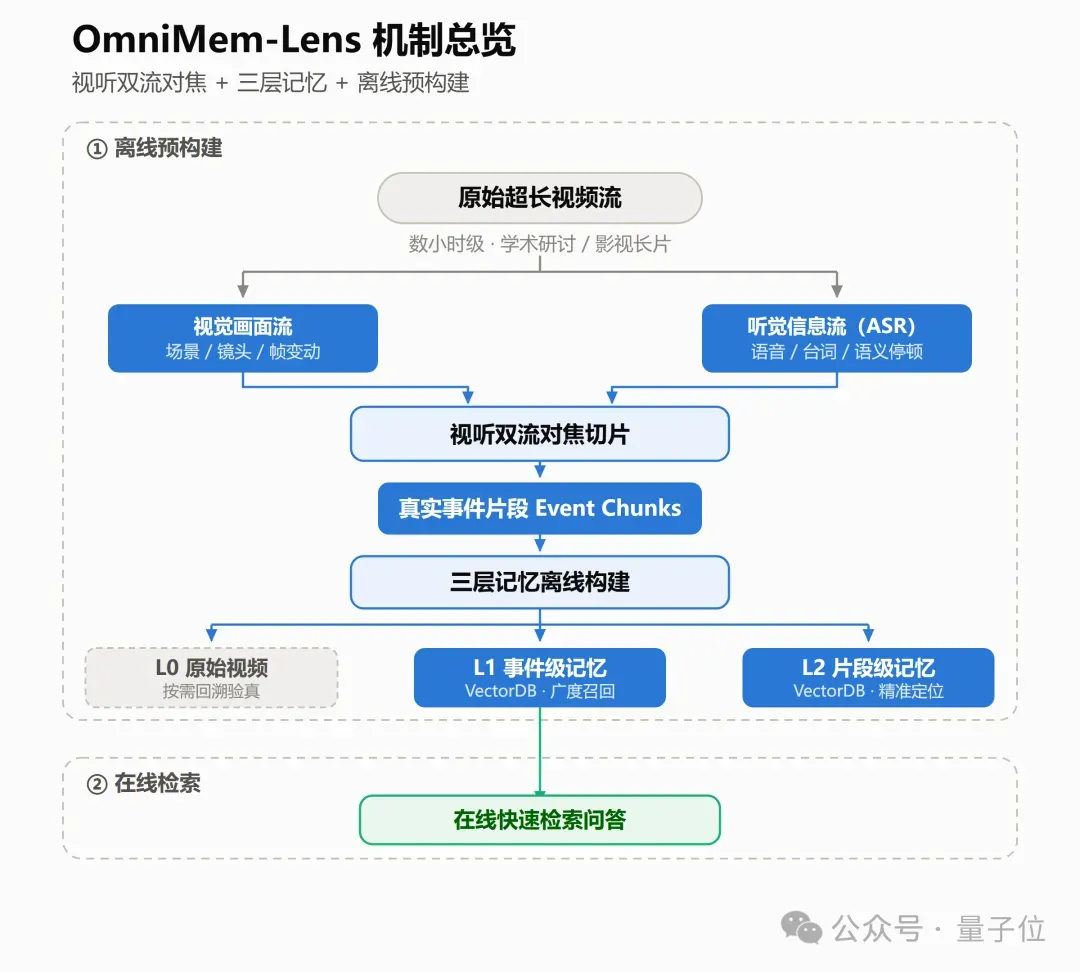
openJiuwen Agent-Memory 0.2.0: Audio-Visual Dual-Stream Memory Lens Solves Blind Chunking of Long Videos : Open-source memory framework openJiuwen released version 0.2.0, introducing OmniMem-Lens. Addressing the loss of causality and fragmented context caused by blind second-by-second slicing in long videos, the tool cross-references visual scene breaks with ASR semantic topic shifts to hierarchically archive footage by actual events. On EgoLife-QA benchmarks, memory recall accuracy rose by 45.7%, while online QA latency dropped by up to 97%. (Source: QbitAI)
Kairos: Open-Source Real-Time Anti-Fraud Risk Platform Combining System 1 Decision Model and MCP : Finic launched Kairos, an open-source real-time risk platform intended to replace traditional solutions like Sift. Addressing the flaw where traditional GBDT models rely heavily on historical labels and are easily bypassed by bad actors, Kairos integrates a low-latency System 1 decision LLM. This allows fraud analysts to define dynamic review rules in natural language, while built-in MCP servers let coding agents automatically maintain and benchmark policy suites. (Source: Hacker News)
Perplexity Computer Launches End-to-End E-Commerce Automation Plugin System : Perplexity rolled out an Agent Plugins ecosystem for its automated computing engine, Computer. The system supports direct orchestration across Shopify admin panels, Klaviyo email marketing, and Meta Ads management, elevating scattered API connections into an end-to-end execution application layer to deliver automated business pipelines. (Source: AravSrinivas)
DeepSeek Harness Launches Baoyu Design Visual Interaction Plugin : To assist long-horizon design workflows, the community developed the Baoyu Design plugin for DeepSeek Harness. Offering unified Kanban management and real-time motion rendering previews, it allows users to dynamically intervene during autonomous agent planning and generates cross-platform slide decks and UI animations, enhancing visual feedback when agents produce complex frontend outputs. (Source: dotey)
📚 Research & Learning
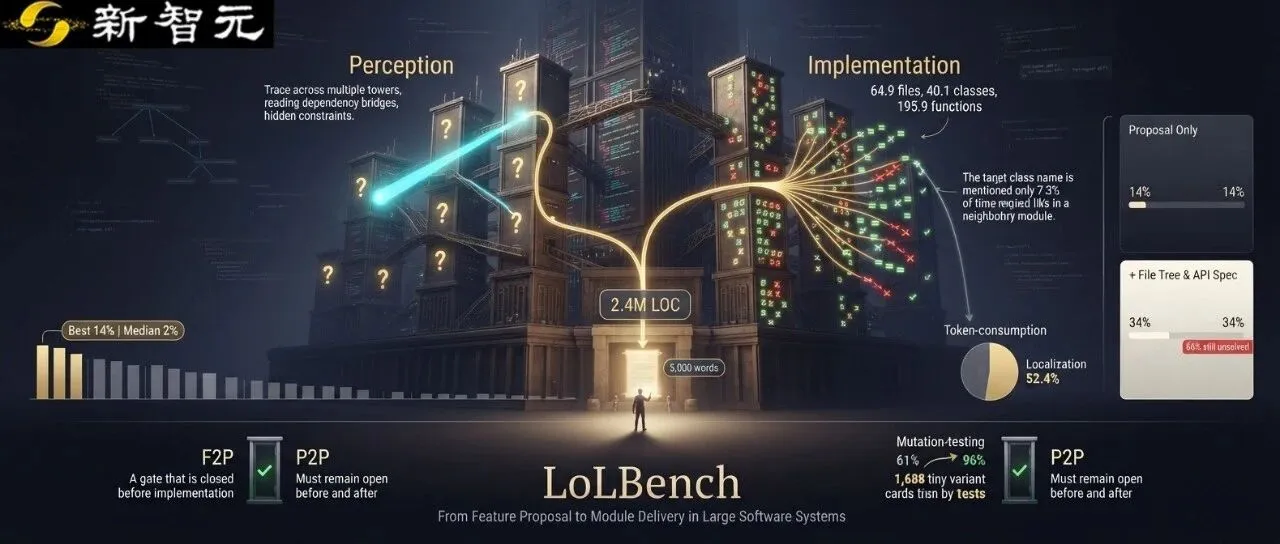
LoLBench: Fudan and Collaborators Propose the First Real-World System Long-Horizon Code Development Benchmark : Fudan University, CUHK, and collaborating institutions released LoLBench, expanding evaluation scope from localized code patches to module-level feature delivery across codebases averaging 2.4 million lines. Testing 28 frontier agent setups against 5,000-word real-world proposals yielded a peak resolution rate of only 14%, with over 50% of compute spent in vain on code dependency resolution—exposing a severe disconnect in current AI’s comprehension of complex software engineering. (Source: WeChat)
DeepLearning.AI and Arize Launch Free Course: “Agent Evaluation and Tuning in Practice” : A new open course led by Laurie Voss, Head of Developer Relations at Arize, is now live. Focusing on the engineering challenge where traditional unit tests fail to catch agent decision hallucinations and tool misuse, the course systematically demonstrates how to extract failure boundaries from execution traces, design robust code evaluators and LLM Judge panels, and build an evaluation-driven tuning pipeline. (Source: )
Hugging Face Proposes Transformers Model Integration Contract: Lightweight Miniature Models Guard CI Merges : Addressing the prohibitive GPU regression testing overhead caused by supporting 750+ models in the Transformers repository, the HF team announced the transformers-mic standard. In this approach, agents distill micro-configuration slices capturing critical architectural traits, shrinking massive models down to tens of megabytes with fixed baseline outputs. This lets CI pipelines catch latent code bugs on inexpensive CPU runners within seconds. (Source: HuggingFace Blog)

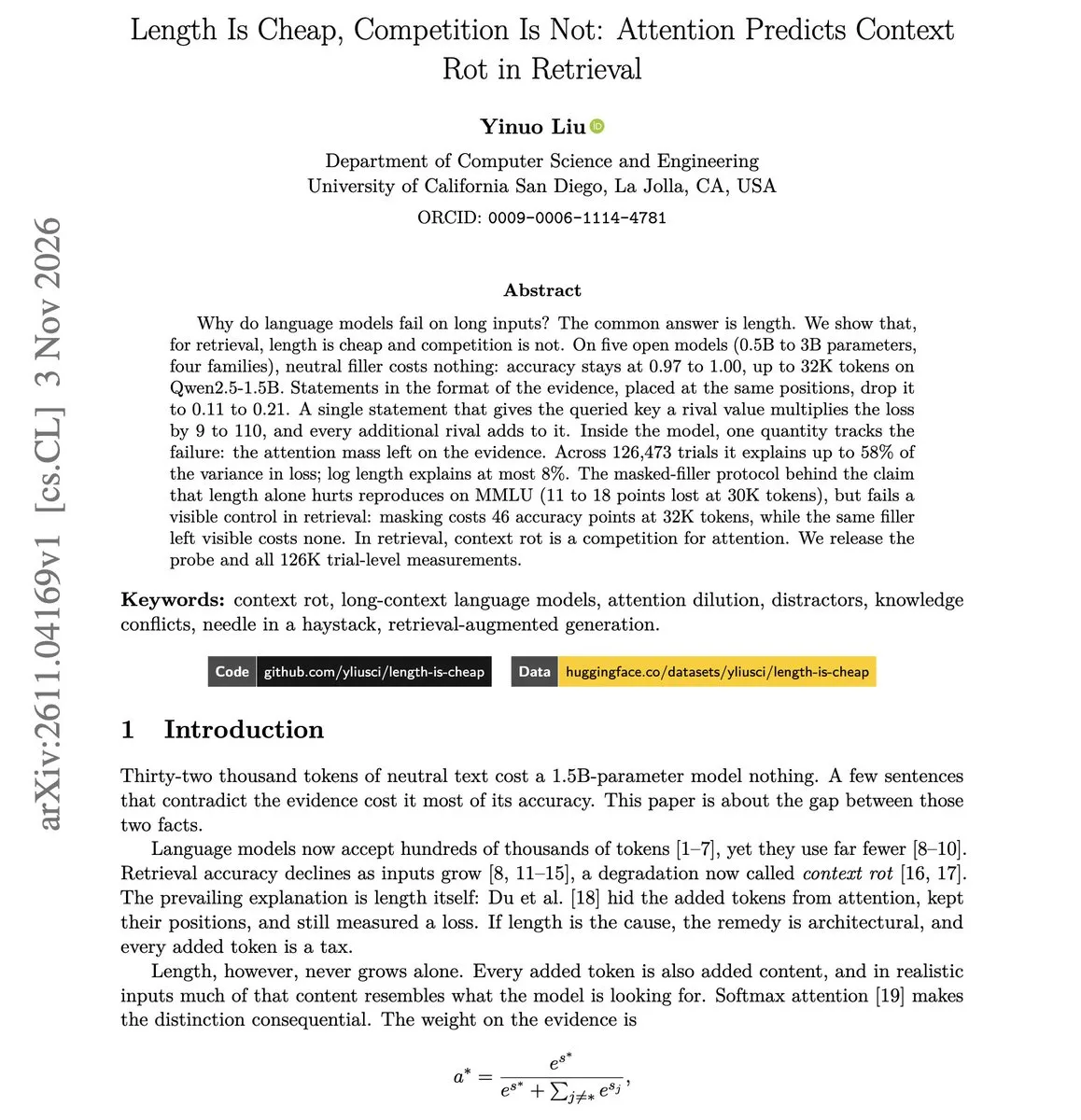
Root Cause of Long-Context Retrieval Failures: Competitive Interference Outweighs Input Length Degradation : Research from UC San Diego reveals that long-context and RAG retrieval failures are primarily driven not by expanded input length, but by the presence of “competitive expressions” in context that are highly similar to the correct answer yet factually or numerically inaccurate. Experiments demonstrate that confusing information directly distracts model attention weights, explaining 58% of recall errors. (Source: dair_ai)
SpecPilot: Autonomous Discovery of Speculative Decoding Optimization Algorithms Using Agents : Aimed at diverse GPU architectures and model deployment environments, researchers introduced SpecPilot, a framework that employs multi-agent collaboration to discover optimal speculative decoding strategies. The system autonomously identified a lossless 12-bit weight representation combined with a two-level tree verification mechanism, boosting single-request decoding speed by up to 10.87x without altering precision. (Source: Reddit r/LocalLLaMA)
NVIDIA Technical Blog Details Three Core Techniques to Accelerate Desktop MoE Inference on DGX Spark : NVIDIA’s engineering team shared optimization practices for single-user decoding efficiency with Ling-3.0-flash (a 124B MoE) on the GB10-based DGX Spark workstation. By combining Humming runtime dynamic compilation kernels, load-time FP8 quantization for the LM Head, and Multi-Token Prediction (MTP) speculative sampling, they increased GSM8K decoding throughput by 42.5% while fully preserving mathematical benchmark accuracy. (Source: MarkTechPost)
“Tutorial on Generative Audio and Music Foundation Models” Systematically Reviews Frontier Technology Landscape and Legal Controversies : A comprehensive review paper breaks down the modern music AI tech stack, covering neural audio codecs, autoregressive token modeling, diffusion and flow-matching acceleration algorithms, and human preference alignment paradigms for real-time accompaniment. It also examines training data copyright attribution and audio watermarking standards in light of landmark judicial infringement cases. (Source: HuggingFace Daily Papers)
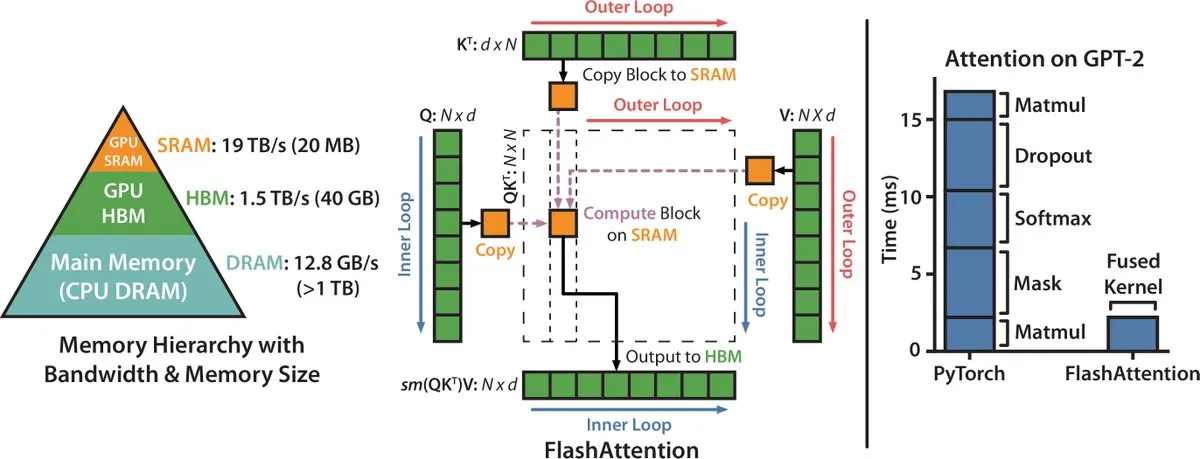
Microarchitecture Engineering Summary: 10 Essential GPU Optimization Papers Powering LLM Acceleration : An industry synthesis outlines 10 foundational kernel engineering papers—spanning FlashAttention-1/2/3, PagedAttention, MARLIN, and FlashInfer—dissecting SRAM tiling, online softmax normalization, and asynchronous compute overlap mechanisms to provide theoretical and practical guidance for building high-throughput agent runtimes. (Source: NandoDF)
💼 Business
AI Multimodal Inference Startup Fal Raises $1.3B, Doubling Valuation to $16B : Fal, a startup providing high-concurrency inference services for open-source audio and video models, announced it has raised $1.65 billion across Series E and F rounds. The latest round was led by Bessemer with participation from NVIDIA, propelling its valuation to $16 billion. Although compute leasing costs have squeezed inference gross margins, the explosion of open-source model applications has quickly pushed its annualized revenue past the $800 million mark. (Source: TechCrunch)
Design Unicorn Canva Announces Global Restructuring, Cutting and Relocating Over 1,200 Roles : Australian design giant Canva, once valued at $40 billion, announced the toughest restructuring in its 13-year history, affecting 1,271 employees (22% of its global team). The company is flattening organizational layers and consolidating teams into central hubs to counter the disruptive shockwave brought by AI-native image generation and layout automation tools. (Source: The Guardian)

Enterprise Linux Giant SUSE Announces 10% Layoffs, Explicitly Citing AI and Automation Transformation : Internal emails from European open-source leader SUSE revealed plans to cut roughly 10% of its global workforce of nearly 2,000 employees. In the letter, the CEO candidly stated that AI and automation tools have deeply integrated into everyday workflows, drastically lowering overhead for existing functions, and that legacy organizational structures can no longer sustain long-term competitiveness in a transforming software industry. (Source: ZDNet)

🌟 Community
GitBook Knocked Offline by Targeted AI Agent Attack, Sounding Alarm on Agent Supply Chain Credentials : Documentation platform GitBook revealed it fell victim to a highly automated, targeted cyberattack orchestrated by AI agents. Attackers breached infrastructure to access API credentials, Git sync keys, and AI assistant interaction histories. GitBook took services offline, revoked all personal access tokens, and mandated credential resets for integrations and MCP services, underscoring the severe threat autonomous agent reconnaissance poses to cloud supply chains. (Source: Hacker News)
Apple App Store Updates Guidelines: Enforcing 18+ Age Rating for AI Emotional Companion Apps : Apple issued a policy update to global developers mandating that any AI app featuring romantic interactions, suggestive themes, or emotional companionship (such as Character.AI and Replika) must update to an 18+ age rating by mid-November. The community noted that Apple is tightening compliance boundaries around anthropomorphic emotional manipulation and artificial intimacy as youth protection laws harden across several jurisdictions. (Source: TechCrunch)
Departure of Claude Code Product Lead Cat Wu Sparks Discussion Over Team Shakeup : Following the departure of several core engineers, Cat Wu, the founding product lead behind Claude Code and Cowork, announced her exit from Anthropic. While the community admired her agile exploration models and “three-month scrap rule,” rapid leadership turnover has fueled ongoing discussions regarding governance and R&D pressures inside proprietary AI unicorns ahead of potential public offerings. (Source: dotey)
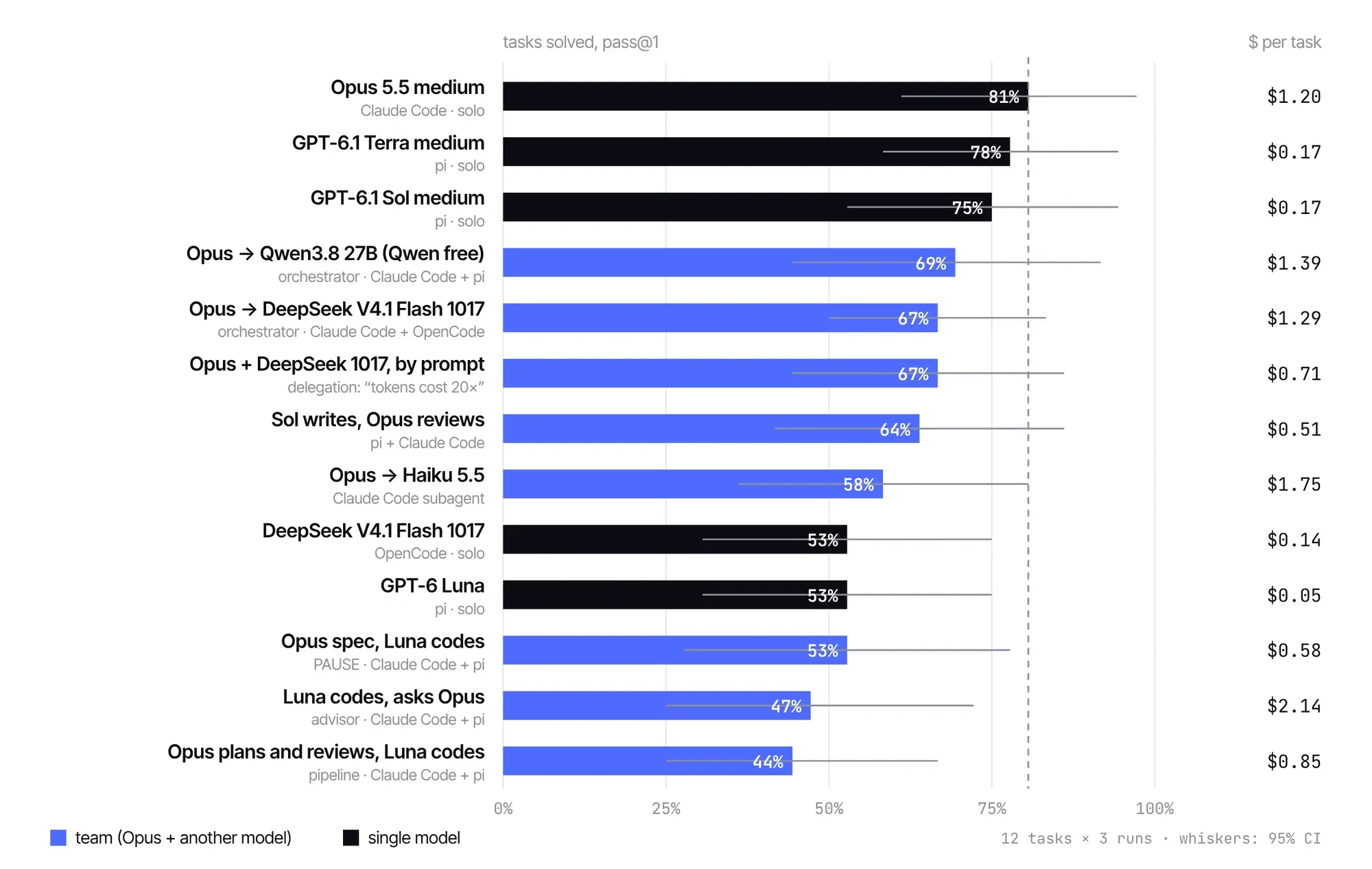
“Expensive Orchestrator + Cheap Sub-Agents” Architecture Faces Cost Waterloo in Practice : Community testing revealed that using expensive frontier models like Opus to decompose tasks while delegating code implementation to lightweight open-source models often backfires in complex software engineering. Due to duplicate context re-injection, multi-turn review conflicts, and cache invalidations, total cost and runtime frequently exceed simply running a single frontier model, casting doubt on the practical efficiency of sub-agent swarms in coding workflows. (Source: Reddit r/ClaudeAI)
Gemini Sparks Privacy Controversy as Personal Paid Accounts Found Training on Chat Data by Default : A viral Hacker News post revealed that even with a paid Google AI premium subscription, personal Gemini users’ chat logs remain enabled by default for LLM training and may be subject to human review and retained for up to three years, unless history is turned off entirely. The revelation shattered the common assumption that paid tiers guarantee privacy, sparking strong protests from developers demanding greater transparency in big-tech terms of service. (Source: Hacker News)
Developer Tests Reveal “Running LLMs Locally Does Not Equal Data Security”: Malicious Instructions Can Exfiltrate Data : Challenging the widespread belief that local, offline LLM deployments serve as an absolute privacy moat, security research demonstrated that running unvetted model weights or prompt-injected open-source bases can still trigger unauthorized data exfiltration payloads if sandbox network isolation is loose. Developers are urging the community to enforce strict network air-gapping on local agent runtimes. (Source: KDnuggets)
“Godfather of AI” Geoffrey Hinton Warns Again: Humanity May Regret Ever Inventing AI : Nobel laureate in physics Geoffrey Hinton warned in an interview ahead of a documentary release that tech executives are brushing aside profound safety hazards in their commercial rush. He cautioned that a “Chernobyl-scale” wake-up call—such as AI triggering widespread power grid collapses or financial clearing interruptions—is highly likely within the next one to two years, reiterating his call for a mandatory, independent FDA-style regulatory gateway for frontier models. (Source: The Guardian)

💡 Miscellaneous
Binance Discloses Post-Mortem Details of $6.3 Billion Hack: Fake Video Interviews and Internal AI Tools Served as Infiltration Springboards : Binance published an investigation tracing last week’s multi-billion dollar breach. Attackers identified operational personnel via malware back in June, approached engineers on professional networks posing as recruiters in September, and tricked an engineer into downloading a Trojan horse during a second-round video interview. By chaining this access with permissions granted to internal AI tools, they escalated privileges laterally to execute fund-draining scripts. To date, $2.85 billion in assets has been intercepted or frozen. (Source: The Guardian)

OpenAI Appoints Former Secretary of the Army Dan Driscoll as Senior Advisor for National Security Modernization : OpenAI formally recruited former U.S. civilian Secretary of the Army Dan Driscoll for a key strategic advisory role. Driscoll previously led budget allocations and the deployment of tactical AI initiatives like ARIA within the military while cultivating strong bipartisan ties. The appointment signals OpenAI’s proactive effort to navigate Washington’s post-midterm power dynamics and accelerate deployment across classified Pentagon networks and allied defense supply chains. (Source: THE DECODER)
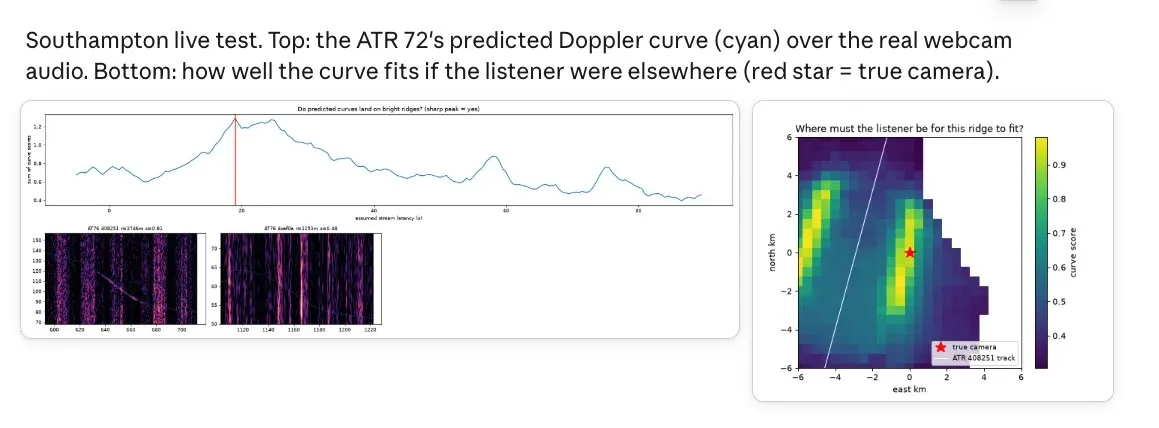
Acoustic Doppler Shift Combined with Flight Tracking Data Enables Passive Video Geolocation : Researchers demonstrated a technique that derives exact physical coordinates of video footage by matching the acoustic Doppler shift of ambient aircraft sounds against public flight trajectory data. Community developers quickly replicated the algorithm with open-source code, prompting renewed debate over privacy risks stemming from inadvertent audio cues in recorded media. (Source: jpt401)